
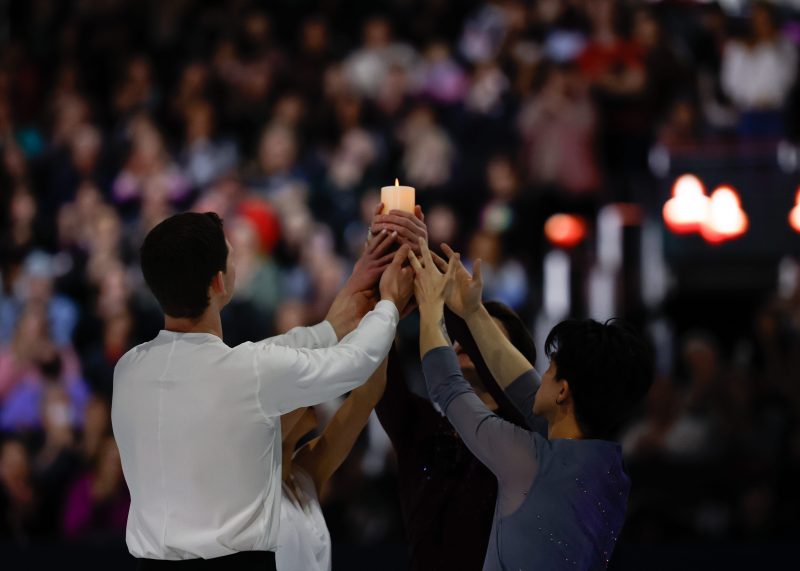
- A mid-air collision over Washington D.C. in January 2025 resulted in the deaths of 67 people.
- The crash killed 28 members of the U.S. figure skating community, including 11 young skaters.
- The skaters were returning from a national development camp in Wichita, Kansas.
- Coaches and family members reflect on the loss of the talented young athletes one year after the tragedy.
As 1998 Olympic men’s figure skating gold medalist Ilia Kulik and two-time Olympic coach Audrey Weisiger stepped outside Fairfax Ice Arena in Northern Virginia on a cold January morning a year ago, there was so much they feared, yet so much they still didn’t know.
They were well aware there had been a midair collision over the Potomac River at Washington Reagan National Airport less than 12 hours earlier. They knew a group of young figure skaters, coaches and families had been on the plane. But they weren’t certain who exactly was on that flight, or perhaps on a different flight coming back from the national development camp for up-and-coming skaters after the 2025 U.S. championships in Wichita, Kansas.
It was 8 a.m. Thursday, January 30, 2025. “Olivia has a lesson now,” said Kulik, who competed for his native Russia but now coaches in the Washington, D.C., suburbs. Olivia Eve Ter, 12, was one of Kulik’s top young skaters.
Weisiger looked at him, steeling herself. “Did you text her mom to see if they were on the flight?”
“I can’t do it,” Kulik said. “I’m shaking.”
So Weisiger took his phone and texted Olivia’s mother as they stood outside in the parking lot in front of the rink.
They waited a couple of minutes, staring at the phone. There was no reply.
“Ilia, I don’t think they’re coming,” Weisiger said.
“No, she’ll be here,” he insisted.
They stood in excruciating silence for several more minutes.
“Ilia, they aren’t coming,” Weisiger finally said, softly, as Kulik, one of his sport’s great champions, collapsed to the pavement, sobbing uncontrollably.
Olivia Eve Ter was one of 11 skaters to perish on American Airlines Flight 5342. Her mother, Olesya Taylor, also was killed. In all, 28 members of the figure skating community and a total of 64 passengers and crew died when a Black Hawk helicopter collided with the plane as it was about to land in Washington at 8:47 p.m. Wednesday, Jan. 29, 2025. Three on the helicopter also were killed.
That same Thursday morning, 10 miles away from Fairfax Ice Arena at his home rink in Reston, Virginia, world and national champion Ilia Malinin arrived to spend what should have been four to six hours practicing on the ice. He left after 30 minutes.
“I knew I had to go to the rink,” Malinin told USA TODAY Sports later that day, “but it got so bad that I had no strength, mentally or physically, to skate. It was very hard for me to be around a skating rink, especially after what happened, knowing that a lot of them were part of my skating club and clubs that I knew. It’s really heartbreaking. It’s like their chances just disappear.”
Malinin knew them as the talented youngsters in the Washington area who took lessons at different rinks and occasionally buzzed near him on the ice as he was practicing his famous quadruple jumps and they were learning their triples.
Weisiger was one of the people teaching them. Figure skating coaching is so different from what we’re used to in major league sports. In baseball, a major league manager doesn’t also coach little leaguers. But in figure skating, that’s exactly what happens. The top coaches also train the younger skaters. So while Weisiger coached Olympians and U.S. champions like Michael Weiss and Timothy Goebel, she also was giving lessons to young children and teenagers.
Four of them were on the plane: 12-year-old Brielle Beyer, 16-year-old Edward Zhou, 16-year-old Cory Haynos and Olivia. A year later, Weisiger proudly talked about each for USA TODAY’s Milan Magic podcast: How they learned a new jump, how they tore across the ice, how proud they were to be selected for the national development camp.
Brielle, she said, “was this little sprite that motored around the rink and she was unstoppable.”
Edward? “There was something so magical about little Eddie. … He was one of those kids that everybody felt joyful around.”
Cory? “Right before they went to (Kansas), Cory achieved his triple axel, which was unbelievable.”
And Olivia? “She was my last lesson with those kids before they went to Kansas. She said, ‘Coach Audrey, this is the biggest moment of my life, I’ve been working for so long to try and get to this camp. I’ll make you proud.’’
Now, when Weisiger visits the kids’ gravesites, disbelief often sets in. “I had never been to so many funerals for children in my life,” she said.
Birthdays still come. Brielle’s father, Andy Beyer, just hosted a celebration at his house to honor his daughter on what would have been her 13th birthday. Brielle’s friends from the neighborhood and from skating observed a moment of silence when they lit the candle on a birthday cake and listened to one of the poems she had written, which he had set to music, “a really special but hard and tearful moment,” he said.
They released balloons into the night sky and walked through Brielle’s bedroom, which was also where Andy was set up remotely to speak on the Milan Magic podcast. He proudly held up Post-It notes she left with her goals written on them.
And he cherishes the red jacket she earned for being invited to the national development camp. “I still have that national development team jacket that they sent me because, you know, unfortunately, she died wearing hers on the airplane.”
Sad reminders of the young lives lost began for Weisiger the day after the plane crash when a delivery came to Fairfax Ice Arena. The pro shop manager beckoned Weisiger to come see what it was, so she did.
It was a box addressed to Edward Zhou. She opened it. Inside was a new pair of skates.