
I think buying a car should be exciting. But the process can quickly turn into a headache. Between comparing prices, negotiating with salespeople, and figuring out financing. What starts as a simple purchase can feel like a full-time job. And when the monthly payments finally come into focus, the excitement can fade pretty quickly.
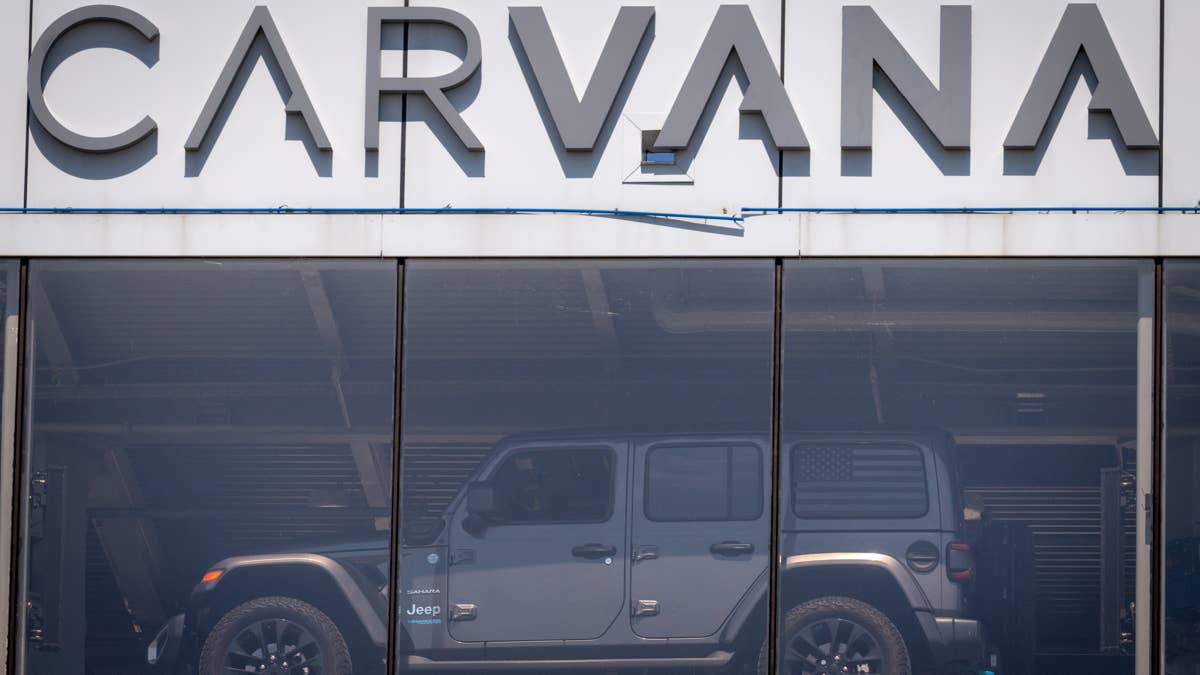
Plenty of shoppers are trading the dealership lot for a screen. Carvana (CVNA) sold 197,325 vehicles in the second quarter, up 38% from a year earlier, on record revenue of $7.38 billion versus $6.91 billion expected, with net income of $513 million.
CEO Ernie Garcia called it the company’s 10th straight quarter of industry-leading growth and profitability in its Q2 earnings statement.
In a letter to shareholders, Ernie also said that “our runway is huge,” noting Carvana holds only 2% market share of used retail and 1.5% of all automotive retail. However, higher interest rates are clouding the profit picture.
Also Read: AI could haggle for your next car, and one stock stands to win
Carvana keeps growing, but rates are squeezing profit per car
Morgan Stanley kept an Overweight rating on Carvana but trimmed its price target to $88 from $90 in a preview note shared with me at TheStreet.
Morgan Stanley argues the debate has moved from unit growth, which investors largely understand, to what higher rates mean for financing profit.
Related: Carvana, CarMax jockey as agentic AI tools look to fix the worst parts of car buying
The stock shows the strain. Carvana shares are down 30.30% year-to-date and 14.67% over the past 12 months, according to Yahoo Finance. Its second-quarter guidance also fell short of some Wall Street expectations, according to a CNBC report.
Carvana reports third-quarter results Oct. 28 after the market closes. Morgan Stanley cut its adjusted EBITDA estimate 2% to $797 million from $816 million. It models EBITDA per car down about $325 from a year ago at $3,759.
Why higher rates hit Carvana’s financing profit
The culprit is a line Wall Street calls Other GPU, or other gross profit per unit. It captures profit per car beyond the sale itself, including the spread Carvana earns when it makes auto loans and later sells to investors. When benchmark rates climb faster than the annual percentage rates (APRs) customers pay, that spread shrinks.
The two-year Treasury yield has risen about 80 basis points since the second quarter, while APRs in Carvana’s latest securitization rose 23 basis points, Morgan Stanley noted. Management has said each basis point of rates not passed on to customers costs roughly $4.50 per car. That implies a gross hit near $365 per car before offsets.
More Automotive:
- GM stock will see major benefit from latest redesign, analyst says
- Tesla rival appears to have a demand problem
- Trump’s latest gift to automakers has major consequences
Morgan Stanley models third-quarter Other GPU of $2,565, down $100 from the prior quarter, and $2,450 in the fourth quarter. Q4 is the bigger debate, but the bar may be more manageable than it appears. That is about $130 and $210 below consensus. It says its math may overstate the damage because public securitizations are only 25% to 30% of loan sales and reflect loans written before the latest rate rise.
When I look at car financing, the monthly payment is what catches my attention first. A small change in interest rates might not sound like much on paper, but spread over several years, it can make an otherwise affordable car feel expensive.
That math lands on real people. Car buyers feel higher interest rates in their monthly payments, while Carvana faces a tougher decision about how much of that added cost to pass on to customers and how quickly. Morgan Stanley also flags consumer credit concerns as a near-term earnings risk.
Morgan Stanley says Carvana may be near a reset
Morgan Stanley calls the quarter a potential “clearing event.” Its investor conversations show Street estimates for fourth-quarter Other GPU need to come down, which has kept some buyers on the sidelines. Once expectations reset, the focus can return to growth. The bank still expects year-over-year growth in EBITDA per car in the fourth quarter.
Its third AlphaWise survey of about 2,000 consumers offers the case for patience. Carvana-only users rose to 43% from 31% in September 2025, while CarMax-only users fell to 37% from 44%.
Some 48% of Carvana customers are very likely to buy again, versus 45% for CarMax (KMX). Carvana leads on trusted brand (56% to 52%), vehicle selection (55% to 40%), and customer service (54% to 49%), though CarMax has narrowed the gap on price.
The $88 target comes from a 15-year discounted cash flow model using a 12% cost of capital, 2.5% terminal growth, and a 13.2% exit EBITDA margin.
Carvana shareholders’ letter shows that Garcia’s own targets are 3 million cars a year and a 13.5% adjusted EBITDA margin by 2030 to 2035. Risks include the auto credit cycle, margin sustainability, capital raises, and tougher competition.
For investors, Morgan Stanley’s message is that the question has shifted. The key is less about whether Carvana can avoid near-term GPU pressure and more about whether management can establish a credible baseline for financing economics, while keeping its growth story intact. A clean reset on Oct. 28 could clear the path for the stock.