Author

admin

Browsing

  • SEC Commissioner Greg Sankey stated that expanding the college football playoff to 16 teams should be a priority.
  • The Big Ten and SEC have not yet agreed on a format for a potential 16-team playoff.
  • The Big Ten has favored a model with more automatic bids, while the SEC prefers a format with more at-large selections.

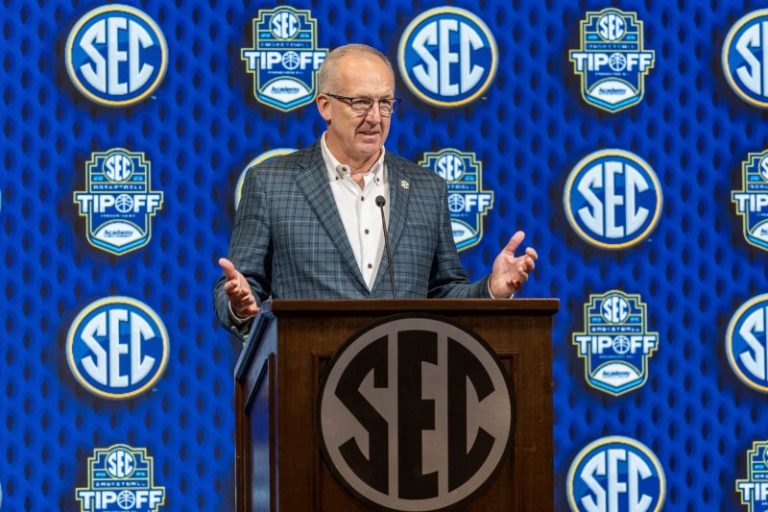
ATHENS, GA – SEC commissioner Greg Sankey desires playoff expansion, but the hour grows late to strike a deal to grow the playoff by next season.

Speaking with reporters before Saturday’s Texas-Georgia game, Sankey raised a call to grow the College Football Playoff by four teams, but the SEC and Big Ten remain unable so far to agree on how those bids should be allocated.

“The move to 16 should be a priority for all of us in conference leadership,” Sankey said.

There’s a Dec. 1 deadline to expand the playoff for next season. If the SEC and Big Ten can’t agree to an expanded format,  “we’re at 12” for next season, Sankey said.

This meshes with what CFP executive director Rich Clark has said previously: If the SEC and Big Ten don’t agree on a 16-team format, then that will prolong the current format for at least another season.

Big Ten commissioner Tony Petitti has pushed for a 16-team format that pre-assigns multiple automatic qualifiers to each of the Power Four conferences. Petitti also likes the idea of play-in games determining which teams receive those automatic bids.

The Big Ten, though, found itself alone on an island this summer favoring a 3+3+2+2+1+3 format, which would allocate three automatic bids apiece to the Big Ten and SEC, two each to the ACC and Big 12, one to the Group of Five, leaving three at-large bids. This format, loaded with auto bids, would achieve Petitti’s goal of reducing the selection committee’s role in determining bids.

The SEC does not share that goal.

For years, Sankey has preferred formats using at-large selection to determine bids. When the playoff expanded from four, Sankey initially wanted to keep all bids assigned by an at-large process, but the SEC compromised and accepted the current 5+7 format that’s in place for the 12-team format, with five automatic bids and seven at-large selections.

The SEC threw support behind a 5+11 playoff format last summer, a plan ACC and Big 12 officials have said they would support. The Big Ten remained a holdout on that plan, and playoff expansion cannot occur without the two main power brokers — the SEC and Big Ten — coming to terms.

Is there any format the SEC would accept other than 5+11?

“Sure, 16+0,” said Sankey, referring to a 16-team playoff in which all 16 bids would be awarded via at-large selection. “But, that’s not reality.”

“The opportunity to have a 16-team format with five conference champions with access and 11 (at-large) is something we could accept,” he added.

The question persists of whether the Big Ten can accept that 5+11 plan.

Blake Toppmeyer is the USA TODAY Network’s senior national college football columnist. Email him at BToppmeyer@gannett.com and follow him on X @btoppmeyer.

This post appeared first on USA TODAY
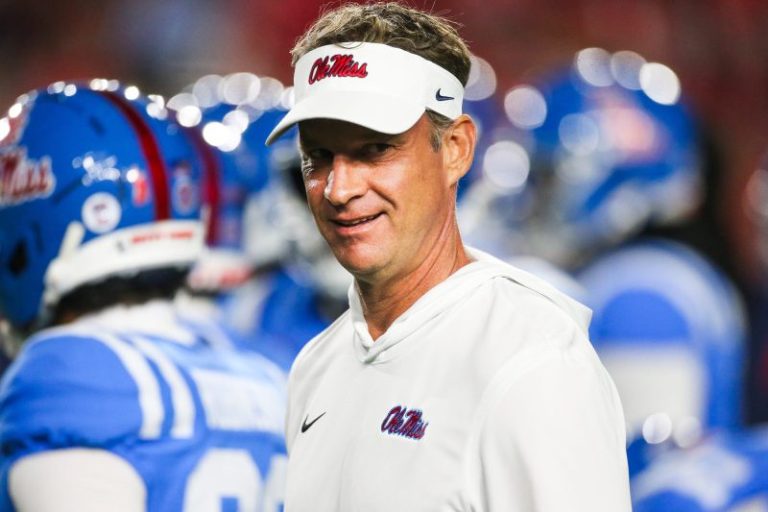
Ole Miss football took home a win in the ‘Lane Kiffin Bowl’ in Week 12 with a 34-24 come-from-behind win vs. Florida.

Just as the Rebels closed off their 10th win of the season, moving one step closer to appearing in the College Football Playoff for the first time in program history, Ole Miss fans at Vaught-Hemingway Stadium made one thing clear to the Rebels brass and Kiffin: They want Lane.

As captured by the ESPN broadcast, ‘We want Lane’ chants broke out in the Ole Miss student section after Kiffin has been linked to the Florida open head coach vacancy, on top of numerous other Power Four conference openings. It appeared not to faze him, as he remained locked in on the final 60 seconds of the game:

Given what he has done in seven seasons at Ole Miss, Kiffin has become a regular on coaching hot boards as positions become available across college football.

On top of his ties to the state of Florida, former Gators coach Steve Spurrier, who told USA TODAY Sports’ Blake Toppmeyer last month that he is a fan of Kiffin and thinks he is a ‘very good coach.’

‘I wanted to be Steve Spurrier,’ Kiffin said during a recent appearance on the ‘Pardon My Take’ podcast. ‘When I watched him and his offenses in the visor and kind of the way he’d throw jabs at other coaches and team and stuff, I was like, Steve Spurrier is the man. That’s what I want to be.’

Kiffin himself has talked at length about his name being tossed around in the coaching carousel, including saying on an appearance on ESPN’s ‘The Pat McAfee Show’ that he will never ‘make a decision based on money’ and that he hasn’t made one based on money in his coaching career.

The win over Florida moved Ole Miss’ record to 54-19 overall under Kiffin.

The USA TODAY app gets you to the heart of the news — fastDownload for award-winning coverage, crosswords, audio storytelling, the eNewspaper and more.

This post appeared first on USA TODAY
Mike Maloney, founder of GoldSilver.com, explains why this time really is different for gold and silver, pointing to factors including growing mainstream adoption.

‘This to me signals the beginning of the third and final phase of the bull market — and that is where you have the greatest amount of gains in the shortest period of time,’ he said.

Securities Disclosure: I, Charlotte McLeod, hold no direct investment interest in any company mentioned in this article.

This post appeared first on investingnews.com

Dana Samuelson, president of American Gold Exchange, discusses this year’s unusual market dynamics for gold and silver, saying there have been three big moves of physical metal.

‘To me, this is literally a run on the bank of gold globally — it’s global, it’s widespread and it’s deep, and I don’t see it changing anytime soon,’ he explained.

Securities Disclosure: I, Charlotte McLeod, hold no direct investment interest in any company mentioned in this article.

This post appeared first on investingnews.com

The gold price was back in action this week, breaking above the US$4,200 per ounce level after spending about two weeks trading at lower price points.

Silver was on the rise again as well, pushing briefly past US$54 per ounce.

Both precious metals saw their biggest gains midway through the week as the US government shutdown came to an end. At 43 days, it was the longest in history, and finished on Wednesday (November 12) as eight Democrats broke ranks to vote in line with Republicans on a funding package.

US economic data has been scarce during the shutdown, and government agencies are now beginning to play catch up as workers return to their posts. While some reports are scheduled to come out next week, others could take weeks or may never be released at all.

‘Based on past shutdowns, we anticipate data originally scheduled for release in the first half of October — primarily data covering September — will be released fairly quickly. However, the timetable will vary depending on the normal data collection process for each indicator’ — Nancy Vanden Houten, Oxford Economics

From a gold perspective, all eyes are on numbers that may impact the US Federal Reserve’s interest rate decision next month. While the Fed has now made two cuts in 2025, Chair Jerome Powell emphasized after the central bank’s last meeting that a December reduction is not guaranteed.

More recent commentary from other Fed officials points to continued dissent, and CME Group’s (NASDAQ:CME) FedWatch tool currently shows an almost even split between a cut or a pause.

That uncertainty weighed on gold and silver prices as the week drew to a close. Gold was at the US$4,080 level as of Friday (November 14) afternoon, while silver was around US$50.60.

Bullet briefing — New Orleans takeaways

For our bullet briefing this week, I want to share a few highlights from the New Orleans Investment Conference, which our team attended from November 2 to 5.

At the time, the gold price was around US$4,000 and the silver price was in the US$48 dollar range, and my main takeaway from the experts I heard from was that the pullback would be temporary.

Given this week’s price activity, it looks like that idea is already being proven right. That said, it’s worth noting that most of the people I heard from weren’t expecting such a quick turnaround — in general, the consensus was that prices could remain at lower levels for weeks or months, with some saying gold could fall as low as US$3,600.

Does that mean a deeper correction is coming? Time will tell…

On that note, another topic that came up at the event frequently was taking profits. Quite a few people discussed how they did some trimming in October, when gold and silver prices were really running, and then put the money to work in other parts of the market.

For example, Rick Rule of Rule Investment Media talked about how he sold 25 percent of his junior gold stocks at that time. Here’s how he explained his decision:

‘We were in a period five weeks ago where there were no asks, there were all bids. And I’ve learned in the market to do what’s easy. If there’s no bids, be a bid. If there’s no asks, be an ask. And the sector was white hot. There were so many junior financings, and when a company’s financing, they’re telling you that your cash is worth more than their stock. Well, they should know what their stock is worth. Since they were selling, I decided I would sell some too.

‘But what was most important to me was personal. I’ve been a heavy investor in the sector since 2020, and I was at a period of time where I could, by selling a quarter of my position, recoup all of my capital and pay the capital gains tax and have the rest for free. I can be very patient with that remaining 75 percent.’

He redeployed the cash he got from selling gold juniors into physical gold, Agnico Eagle Mines (TSX:AEM,NYSE:AEM), Franco-Nevada (TSX:FNV,NYSE:FNV), Wheaton Precious Metals (TSX:WPM,NYSE:WPM) and oil and gas stocks.

Finally, while I’m always keen to understand what’s happening now, I also wanted to use this conference to start talking about what sectors will do well in 2026.

I asked almost all of my interviewees what they think next year’s top-performing asset will be, and I was surprised to get a fairly wide variety of responses.

Precious metals were definitely mentioned, with multiple people saying that while silver has made impressive moves this year, it hasn’t truly had a chance to shine.

But copper was also brought up numerous times, as was uranium. And I got a couple of outlier responses, including emerging markets, which Peter Schiff of Euro Pacific Asset Management discussed, and oil and gas, which Rule said would be his pick for top-performing asset in terms of risk to reward.

Rule also highlighted small-scale community banks in the US.

You can view the full New Orleans Investment Conference playlist here.

Securities Disclosure: I, Charlotte McLeod, hold no direct investment interest in any company mentioned in this article.

This post appeared first on investingnews.com

During the Mining Share panel at the New Orleans Investment Conference, participants underscored that the gold bull market will continue — however, just where we are in that bull run was up for debate.

For conference host and Gold Newsletter editor Brien Lundin, there is still some way to go.

“The gold bull market is still in place. We don’t know how long it’s going to last. That’s the hard part. I think gold’s going to US$6,000 to US$8,000 (per ounce) in the cycle, maybe more. (The) mining share bull market, I would say we’re probably in the fourth inning, fifth inning, maybe. But you know, we could go to extra innings,” he said.

Strategic investor Jeff Phillips also believes the gold bull market is at an early stage.

‘I would say that we are in the third or fourth inning,” he said. “This is early on in the bull market, but I do think there’ll be a rain delay, since we’re talking about baseball terminology. I think this is an epic bull market that we’re in.”

Phillips went on to compare today’s setup to past cycles, noting the strong run gold saw between 2003 and 2007, before the financial crisis briefly derailed momentum. Although he anticipates another correction at some point, he remains confident in the broader bull market and said he is continuing to buy and stay patient.

For Jordan Roy-Byrne, understanding the difference between a secular and cyclical bull market is imperative.

“Secular — that’s the major long-term trend that usually lasts a decade or longer. Cyclically, it can be anywhere from two to five years or so,’ explained the editor and publisher of the Daily Gold.

“I think the cyclical bull has three or four more years left. The risk when that gets long in the tooth is then you have what happened at 1975 to 1976, and also 2008 — that’s when you have your 65 or 60 percent decline in the shares.”

Although Roy-Byrne believes that type of correction is “far off into the future,” he was adamant that something like that will happen before the current secular bull market comes to an end.

Jennifer Shaigec, principal at Sandpiper Trading, said central bank buying shows the bull market is in its infancy.

“I think we’re still actually in fairly early innings,” she said. “The underlying fundamentals for why central banks have been buying gold have not changed. In fact, I can see it accelerating.”

Shaigec went on to acknowledge that gold often experiences a seasonal dip at this time of year, and that some investors may be waiting for a pullback. But she emphasized that the broader fundamentals remain strong.

Drawing a parallel to 2008, when gold fell about 22 percent before rebounding above previous highs within six months, she urged investors to keep a long-term perspective and be mentally prepared for short-term volatility. Shaigec also pointed out that gold has historically been among the first assets to recover after market downturns.

Rounding out the panel, Nick Hodge, publisher at Digest Publishing, told attendees that the gold correction has found short-term support at the US$4000 level, but longer-term support is around US$3,600.

“All the fundamental drivers, ie. the debt, central bank buying, etc., are still in place and haven’t abated,” he said. “Silver hasn’t had its move yet, so that tells me we still have some time to go. And GDX, GDXJ just started outperforming the gold price in August, so it’s still early to the middle days in the precious metal bull market.”

What’s next for the gold price?

From there, panel moderator and well-known investor Rick Rule, proprietor at Rule Investment Media, emphasized that the recent pullback in gold is minor in the context of a much larger, long-running bull market.

Rule agreed with Roy-Byrne’s distinction between cyclical dips and broader secular trends, noting that many investors seem rattled by what is essentially a normal fluctuation.

He pointed out that gold is still up dramatically over the past year, and that past cycles have seen far sharper drops — including a 50 percent decline in 1975 — that ultimately didn’t break the long-term trend.

Noting that precious metals cycles tend to follow a familiar pattern, beginning with strength in gold and moving outward into other segments, Rule asked the panel participants which companies in the gold sector — explorers, developers or potential M&A targets — are now best positioned as the market progresses.

For Hodge, exploration and brownfields development are a strong choice as the precious metals cycle evolves.

He noted that the VanEck Gold Miners ETF (ARCA:GDX) outperformed gold over the summer, prompting some investors to take profits and rotate capital into earlier-stage opportunities — momentum he expects to continue.

Hodge added that market cycles now move faster due to the speed of information, accelerating the shift from producers to companies further down the value chain as miners look to replace reserves.

Additionally, he pointed to a growing influx of risk-tolerant investors who cut their teeth in crypto and are increasingly drawn to gold and mining equities as they learn about fiat currency and counterparty risk. Their appetite for speculation, he said, is likely to push more capital into smaller, higher-risk exploration names over the next year.

Shaigec echoed Hodge’s sentiment.

“I agree there’s a lot of speculative money that has yet to rotate over to precious metals,” she said.

“I’m seeing a lot of oversubscribed private placements. I just think that juniors are still the place to be. There’s some grassroots exploration, which actually hit an all-time low in 2023, and we’ve still had decades of lack of investment in exploration. We have a lot of room yet to run there,’ Shaigec added.

Roy-Byrne advised watching silver, underscoring the value that gold’s sister metal has yet to gain.

“Silver, after this correction, has a chance to make a historic move,” he told the audience. “We’re probably going to see a lot of money jump in next year when that happens.”

Referring to an analogy he once heard, Phillips compared a precious metals bull market to the crack of a whip: producers move first, followed by mid-tier and single-asset developers, with exploration companies snapping into action at the very end. In his view, the market is only just reaching that final stage, and explorers have yet to see real upside.

Phillips also echoed other panelists’ comments that younger crypto investors are becoming more aware of inflation, money printing and the value of hard assets.

That shift, he said, is already showing up in unconventional moves, from stablecoin companies buying gold royalties to major tech firms and even governments directing capital into mining-related assets.

All of that suggests the speculative end of the sector is only beginning to come alive, he said.

Expert stock picks — Gold, silver, copper, nickel and uranium

Toward the end of the discussion, Rule asked each panelist to provide stock picks for the attentive audience.

First was Lundin, who praised the list of more than 100 exhibitors at the 51st New Orleans Investment Conference.

He recommended Delta Resources (TSXV:DLTA,OTCQB:DTARF), highlighting its “large, still undefined, gold resource in the Thunder Bay region.” He also likes Getchell Gold (CSE:GTCH,OTCQB:GGLDF), a company focused on gold in Nevada, and Seabridge Gold (TSX:SEA,NYSE:SA), which he dubbed a “permanent optionality play.”

For Phillips, Empress Royalty’s (TSXV:EMPR,OTCQB:EMPYF) management team, cashflow-positive status and focus on gold and silver puts the company at the top of his list.

Almadex Minerals (TSXV:DEX,OTCQX:AAMMF), where management has a history of finding multimillion-ounce deposits, and prospect generator Headwater Gold (CSE:HWG,OTCQB:HWAUF), were also among his stock selections.

Shaigec veered away from precious metals in recommending SPC Nickel (TSXV:SPC,OTCQX:SPCNF), a company with good geology and a management team that owns 36 percent of the firm’s shares.

She also mentioned Pacifica Silver (CSE:PSIL,OTCQB:PAGFF) citing the company’s recent private placement, which included First Majestic Silver (TSX:AG,NYSE:AG). Her last stock pick and “absolute favorite” is Camino Minerals (TSXV:COR,OTCID:CAMZF), a Peru-focused copper company with good management.

Rounding out the list were Hodge’s selections, starting with Northshore Uranium (TSXV:NSU) due to its US deposit. He also chose Kincora Copper (TSXV:KCC,OTCQB:BZDLF), citing its small market cap, strong investor interest and robust portfolio, and Kingsmen Resources (TSXV:KNG,OTCQX:KNGRF), a company that has seen its share price grow from C$0.25 to C$0.75 in the last year.

Securities Disclosure: I, Georgia Williams, hold no direct investment interest in any company mentioned in this article.

This post appeared first on investingnews.com

On Thursday (November 13), Canadian Prime Minister Mark Carney announced a second round of nation-building projects that will be referred to the Major Projects Office. The office was established earlier in the year to streamline the regulatory and funding processes for projects deemed to be in the national interest.

The first set of projects, announced on September 11, included support for the expansion of Newmont’s (NYSE:NEM,ASX:NEM) Red Chris mine in Northern British Columbia, LNG Canada’s phase 2 expansion of its facility in Kitimat, BC, and Foran Mining’s (TSX:FOM) McIlvenna Bay copper-zinc project in Saskatchewan.

According to the Prime Minister’s Office (PMO), the new set of projects represents more than C$56 billion in new investment and supports the creation of 68,000 new jobs.

Critical mineral projects on the list consist of:

        Outside of critical minerals projects, the announcement included support for the Ksi Lisims liquefied natural gas (LNG) project near Prince Rupert in Northwest BC. The Nisga’a First Nation is leading the project and, when complete, it will become Canada’s second-largest LNG facility after LNG Canada’s Kitimat facility. According to the PMO, the project is expected to generate almost C$30 billion in investment and create thousands of jobs.

        Additionally, support will be made available for the North Coast Transmission line, which will provide low-cost electricity and improved telecommunications to communities along BC’s north coast. Likewise, the Iqaluit Nukkiksautiit hydro energy project will receive support to provide hydroelectric energy to communities in Nunavut and reduce the reliance on diesel imports.

        For more on what’s moving markets this week, check out our top market news round-up.

        Markets and commodities react

        Canadian equity markets were mixed this week.

        The S&P/TSX Composite Index (INDEXTSI:OSPTX) rose 1.89 percent over the week to close Friday (November 14) at 30,326.46.

        Meanwhile, the S&P/TSX Venture Composite Index (INDEXTSI:JX) rebounded to gain 1.33 percent to 879.88. The CSE Composite Index (CSE:CSECOMP) had another bad week, plunging 9.01 percent to close at 150.19.

        The gold price rose significantly this week, climbing from its open of US$4,000 to US$4,243 by Thursday morning. However, it pulled back to end the week up 2.01 percent at US$4,080.64 per ounce by 4:00 p.m. EST Friday.

        The silver price performed even better. After opening at US$48.35, it tested all-time highs at US$54.31 Thursday before ultimately ending the week up 4.57 at US$50.56.

        Meanwhile, in base metals, the copper price gained 1.79 percent to US$5.11 per pound.

        The S&P Goldman Sachs Commodities Index (INDEXSP:SPGSCI) rose 1.28 percent to end Friday at 559.27.

        Top Canadian mining stocks this week

        How did mining stocks perform against this backdrop?

        Take a look at this week’s five best-performing Canadian mining stocks below.

        Stocks data for this article was retrieved at 4:00 p.m. EST on Friday using TradingView’s stock screener. Only companies trading on the TSX, TSXV and CSE with market caps greater than C$10 million are included. Mineral companies within the non-energy minerals, energy minerals, process industry and producer manufacturing sectors were considered.

        1. Adex Mining (TSXV:ADE)

        Weekly gain: 157.14 percent
        Market cap: C$40.63 million
        Share price: C$0.09

        Adex Mining is an exploration company that holds a 100 percent stake in the Mount Pleasant project in Southwest New Brunswick, Canada.

        The property contains two main deposits: the Fire Tower zone, which hosts tungsten and molybdenum mineralization, and the North zone, which hosts tin, zinc and indium.

        The asset consists of 102 mineral claims covering 1,600 hectares, as well as equipment and facilities from historic mining operations conducted by BHP (ASX:BHP,NYSE:BHP,LSE:BHP) between 1983 and 1985.

        According to its most recent investor presentation released on June 11, the property hosts the world’s largest indium reserve and North America’s largest tin deposit. Indicated resources for the North zone demonstrated contained metal values of 47 million kilograms of tin, and 789,000 kilograms of indium from 12.4 million metric tons with average grades of 0.38 percent tin and 64 parts per million indium.

        Additionally, the company engaged Moneta Securities in June to oversee selling the mine following a strategic review.

        Adex has not released news in the past week. However, its Fire Tower zone bears similarities to Northcliff’s Sisson tungsten-molybdenum project in New Brunswick, which the Canadian government referred to the Major Projects Office on Thursday.

        2. Trident Resources (TSXV:ROCK)

        Weekly gain: 118.82 percent
        Market cap: C$42.58 million
        Share price: C$1.86

        Trident Resources, formerly Eros Resources, is a gold and copper exploration company focused on projects in Saskatchewan, Canada.

        A three-way merger in early 2025 between Eros Resources, MAS Gold and Rockridge Resources allowed the companies to consolidate a portfolio of assets in Saskatchewan, including the Contact Lake and Greywacke gold projects in the La Ronge gold belt as well as the Knife Lake copper project.

        Its primary focus has been on its flagship Contact Lake gold project, a 21,440 hectare property located near La Ronge, Saskatchewan. The project hosts four primary deposits: Contact Lake, Preview SW, Preview North and North Lake.

        On Wednesday (November 12), the company released assay results from diamond drilling at Contact Lake, the first exploration conducted on the property in nearly 30 years. Highlights from the initial three holes included one hole with 7.03 grams per metric ton (g/t) gold over 43.25 meters, including an intersection of 30.06 g/t gold over 9.25 meters.

        The company noted that, while it was still in the early stages of exploration at the property, it was encouraged by results that bore similarities to early results of other significant high-grade discoveries in the region.

        3. Northcliff Resources (TSX:NCF)

        Weekly gain: 116.22 percent
        Market cap: C$279.18 million
        Share price: C$0.4

        Northcliff Resources is a development and exploration company advancing its Sisson tungsten-molybdenum project in New Brunswick, Canada.

        The 14,140 hectare property has seen extensive exploration dating back to the early 1980s.

        A 2013 mineral reserve estimate demonstrated total proven and probable quantities of 22.2 million metric tons of tungsten oxide and 154.8 million pounds of molybdenum from 334.36 million metric tons of ore with average grades of 0.07 percent tungsten oxide and 0.02 percent molybdenum.

        The project is currently in the development stage, and on Friday, it announced it was granted a five-year extension to the construction commencement timeline by New Brunswick’s Department of Environment and Climate Change. Construction is now anticipated to begin in December 2025.

        The project was also one of six that were included in the second-tranche of Canadian nation-building projects referred to the Major Projects Office on Thursday. The inclusion on the list will give Northcliff access to a streamlined regulatory process and open funding assistance to facilitate the development of Sisson.

        Commenting on the news, Northcliff Chairman, President and CEO Andrew Ing indicated the company is excited with its inclusion and that its goal is to contribute to building a resilient critical mineral supply chain.

        The release also outlined significant financial funding received since the start of the year, including US$15 million from the US Department of Defense and C$8.21 million from Natural Resources Canada.

        4. Canada Nickel (TSXV:CNC)

        Weekly gain: 61.54 percent
        Market cap: C$334.66 million
        Share price: C$1.68

        Canada Nickel is an exploration and development company advancing its flagship Crawford nickel sulphide project in Ontario, Canada.

        The property consists of 116 crown patents and 150 single- and multi-cell mining claims covering an area of approximately 9,600 hectares near Timmins and has seen exploration dating back to the 1960s.

        A feasibility study released in October 2023 demonstrated the project’s economics, with a post-tax net present value of US$2.48 billion and an internal rate of return of 17.1 percent.

        The included ore reserve estimate reported proven and probable reserves of contained metal values of 3.7 million metric tons of nickel, 9.7 million metric tons of chromium, 215,000 metric tons of copper, 777,000 ounces of palladium, and 519,000 ounces of platinum.

        The metal is contained in 1.72 billion metric tons of ore with average grades of 0.22 percent nickel, 0.57 percent chromium, 0.013 percent copper, 0.014 g/t palladium and 0.01 g/t platinum.

        Shares in Canada Nickel rose sharply this week after Crawford was included in the second round of projects referred to the Canadian government’s Major Project Office.

        In its release following the announcement, Canada Nickel’s CEO said that the company looks forward to working with the government and the MPO to secure financing and permits to begin construction at Crawford by the end of 2026.

        He also stated that the project represents a secure, domestic supply of critical minerals, including nickel and North America’s only source of chromium.

        5. Gold Terra Resources (TSXV:YGT)

        Weekly gain: 57.89 percent
        Market cap: C$51.71 million
        Share price: C$0.15

        Gold Terra is an exploration company advancing the Con Mine gold property in the Northwest Territories, Canada.

        The project was initially acquired as part of a 2021 agreement with Newmont that gave Gold Terra the option to earn a 100 percent interest in the asset for meeting certain exploration milestones and regulatory approvals, along with a C$8 million cash payment to Newmont.

        The agreement was then amended in September 2024, extending the timeline by 2 years to November 21, 2027.

        The property consists of 138 mining leases and 165 claims covering a total area of 79,046 hectares and hosts the historic Con Mine, which produced more than 6.1 million ounces of gold.

        A mineral resource estimate included in an October 2022 technical report demonstrated a total inferred resource of 1.21 million ounces of gold from 24.3 million metric tons with an average grade of 1.54 g/t gold.

        Shares in Gold Terra gained this week after the company announced a C$6.3 million non-brokered private placement that included a new strategic investment from Franco-Nevada (TSX:FNV,NYSE:FNV) Co-Founder David Harquail and existing shareholder Eric Sprott.

        The company said it will use proceeds for general corporate purposes and to fund a drilling program scheduled for January 2026 at the southern end of the Campbell Shear target at the Con Mine property. The program aims to expand the property’s indicated and inferred resources.

        FAQs for Canadian mining stocks

        What is the difference between the TSX and TSXV?

        The TSX, or Toronto Stock Exchange, is used by senior companies with larger market caps, and the TSXV, or TSX Venture Exchange, is used by smaller-cap companies. Companies listed on the TSXV can graduate to the senior exchange.

        How many mining companies are listed on the TSX and TSXV?

        As of May 2025, there were 1,565 companies listed on the TSXV, 910 of which were mining companies. Comparatively, the TSX was home to 1,899 companies, with 181 of those being mining companies.

        Together, the TSX and TSXV host around 40 percent of the world’s public mining companies.

        How much does it cost to list on the TSXV?

        There are a variety of different fees that companies must pay to list on the TSXV, and according to the exchange, they can vary based on the transaction’s nature and complexity. The listing fee alone will most likely cost between C$10,000 to C$70,000. Accounting and auditing fees could rack up between C$25,000 and C$100,000, while legal fees are expected to be over C$75,000 and an underwriters’ commission may hit up to 12 percent.

        The exchange lists a handful of other fees and expenses companies can expect, including but not limited to security commission and transfer agency fees, investor relations costs and director and officer liability insurance.

        These are all just for the initial listing, of course. There are ongoing expenses once companies are trading, such as sustaining fees and additional listing fees, plus the costs associated with filing regular reports.

        How do you trade on the TSXV?

        Investors can trade on the TSXV the way they would trade stocks on any exchange. This means they can use a stock broker or an individual investment account to buy and sell shares of TSXV-listed companies during the exchange’s trading hours.

        Article by Dean Belder; FAQs by Lauren Kelly.

        Securities Disclosure: I, Dean Belder, hold no direct investment interest in any company mentioned in this article.

        Securities Disclosure: I, Lauren Kelly, hold no direct investment interest in any company mentioned in this article.

        This post appeared first on investingnews.com

        This article discusses suicide and suicidal ideation. If you or someone you know is struggling or in crisis, help is available. Call or text 988 or chat at 988lifeline.org.

        It’s been a difficult week and a half for the Dallas Cowboys as they deal with Marshawn Kneeland’s death by suicide on Nov. 6. Players are coping and at the same time preparing to face the Las Vegas Raiders on Monday night.

        ‘Just a great dude,’ quarterback Dak Prescott said of Kneeland, per the Cowboys’ official website. ‘Spirit was always high. Any time you crossed him, very contagious attitude. We spent a lot of time throughout the training room passing each other, having small conversations here and there. Very loving, contagious guy. I know it’s been noted his saying was ‘One Love,’ I think you just felt that. You felt that aura, you felt that demeanor, you felt him carry that and that’s everything that he did.’

        Cowboys players have been deeply impacted by suicide

        Prescott has dealt with similar grief before. His brother died by suicide in 2020. The Cowboys quarterback admitted playing football helps him cope.

        “Having dealt with loss, that is the best medicine for me,” Prescott said. “Getting back out there, handing the ball off and sprinting an extra 10 yards and making sure I’m doing it hard. Marshawn went through my mind a few times in practice today, and I just countered that with running harder after a play or trying to do something to better this team and to show that.’

        Cowboys defensive tackle Solomon Thomas’ sister died by suicide in 2018. His family started a nonprofit “The Defensive Line” in her honor to help impact the lives of young people of color struggling with suicide.

        ‘If we all play like Marshawn, we’ll play as a better team. I’m not saying Marshawn was a perfect player, but the way he would go out there and play is the way football is supposed to be played,” Thomas said of Kneeland this week, via the team’s official website. “He would run to the ball, no matter how tired he was. He would play with intensity and tenacity, and he went out there because he loved the game, and he played with love.’

        Cowboys helmet decal, memorial fund for girlfriend, child to honor Marshawn Kneeland

        The Cowboys will wear a special helmet decal for the rest of the season to honor Kneeland. The team also started the “Marshawn Kneeland Memorial Fund” in part to help Kneeland’s girlfriend, Catalina, who is pregnant.

        “We’re going to honor Marshawn and his family a number of different ways,” Cowboys coach Brian Schottenheimer said.

        The Cowboys travel to Las Vegas to take on the Raiders on “Monday Night Football” in Week 11. It’ll mark the team’s first game since Kneeland’s death.

        Cowboys owner Jerry Jones said on 105.3 The Fan in Dallas on Nov. 14 that he hopes Monday’s game will be “therapeutic” for the players.

        This post appeared first on USA TODAY
        The 18-year-old granddaughter of President Donald Trump was awarded one of three sponsor’s invites to compete at The Annika tournament at Pelican Golf Club in Belleair, Florida. She rebounded with a solid round on Friday after a shaky first round, but it was not enough to make it into the weekend.

        Kai Trump missed the cut by 17 strokes after finishing last among 108 participants at 18-over on the tournament.

        Trump may have missed the cut, which was officially set at 1-over on Friday, but the teen amateur gained a lot of experience. ‘It’s been awesome. … I’ve been having a great time. The experience has been amazing,’ she said.

        Trump struggled with nerves in her opening round on Thursday as large crowds of onlookers eagerly watched her debut. Trump finished with a 13-over 83 after carding nine bogeys and two double-bogeys in a birdie-free opening round on Thursday.

        ‘For the first day I was definitely really nervous. I think the nerves just got to me,’ Trump said on Friday. ‘When I went out there today, I felt very calm and peaceful to be honest with you.’

        The calmness positively impacted Trump’s play and she followed up her less-than-stellar first round with a 5-over 75, eight strokes better than her opening round on Thursday. She finished Friday’s second round with four birdies, four bogeys, one double-bogey and a near ace on the par-3 No. 12. 

        Grace Kim and Linn Grant are tied atop the leaderboard at 9-under through two rounds. Nelly Korda is tied for sixth place at 6-under and is within striking distance.

        Trump said she was blown away ‘by how consistent’ the pro players were on the course. ‘I hit it just as far, but their irons, even if they miss it, they’re still on the green. Obviously, that’s something I need to work on, especially short game. They all have amazing short game out here.’

        The high school senior committed to play golf at the University of Miami earlier this week. Trump said her future plans include ‘more tournaments and then eventually go to college.’

        How to watch The Annika: TV, live streaming

        All four rounds of The Annika in 2025 will be broadcast nationally by The Golf Channel, which is available via live stream through Fubo. LPGA Live and NBCSports.com will also provide live streaming coverage of The Annika. The first round begins on Thursday, Nov. 13 and the final round is scheduled for Sunday, Nov. 16 at The Pelican Golf Club in Belleair, Florida.

        All times Eastern

        Third round: Saturday, Nov. 15

        • 1:30-2:30 p.m. on LPGA Live
        • 2:30-4:30 p.m. on Golf Channel, Fubo, LPGA Live

        Final round: Sunday, Nov. 16

        • 1-2 p.m. on LPGA Live
        • 2-4 p.m. on Golf Channel, Fubo, LPGA Live

        The USA TODAY app gets you to the heart of the news — fastDownload for award-winning coverage, crosswords, audio storytelling, the eNewspaper and more.

        This post appeared first on USA TODAY
        Louisville’s College Football Playoff hopes took a significant hit Nov. 8 with a 29-26 home loss to Cal in overtime.

        The Cardinals’ opportunity for a bounce-back win didn’t go much better.

        Watch Clemson vs. Louisville football live with Fubo (free trial)

        After dropping from No. 15 to No. 21 in the US LBM Coaches Poll, coach Jeff Brohm’s team tripped over itself repeatedly against Dabo Swinney and Clemson on Friday, Nov. 14 at L&N Federal Credit Union Stadium, with a series of Louisville miscues giving the Tigers a 20-19 victory.

        The Cardinals missed an extra point and two field goals, the last of which would have given them the go-ahead score with 1:30 remaining. The kick wasn’t even the most disastrous part of the drive. Louisville was gifted the ball at the Clemson 23-yard line with 2:31 remaining after a bad snap on a Tigers punt attempt, but were moved back five yards due to a false start and then another 15 yards two plays later for unsportsmanlike conduct. A 14-yard completion on third-and-29 got them back within field goal range, but Brohm inserted a new kicker, Nick Keller, for a 46-yard attempt, which went wide left.

        The loss dropped the Cardinals to 7-3 while Clemson improved to 5-5, getting it within a game of bowl eligibility.

        Adam Randall carried (literally) Clemson to the victory, with 15 rushing attempts for 105 yards and two touchdowns. His Louisville counterpart, Keyjuan Brown, was similarly effective, with 135 yards on 15 attempts.

        The Cardinals outgained the Tigers 385-305, but were penalized 10 times for 98 yards, with several of those flags coming at critical junctures in the game.

        Friday’s win extended Clemson’s dominance in its series against Louisville. Since the Cardinals joined the ACC in 2014, the Tigers have won nine of the 10 matchups between the programs, with their only loss coming last season.

        USA TODAY brought you live updates, scores and highlights from the game. Here are the highlights.

        Clemson vs Louisville score

        This section will be updated throughout the game.

        Clemson vs Louisville updates

        Clemson vs Louisville highlights

        FINAL: Clemson 20, Louisville 19

        Louisville forces a Clemson punt, but after a holding penalty on the return, the Cardinals take over at their own 9-yard line with just 28 seconds remaining. They’re unable to get past their own 29, with a failed fourth-and-1 conversion sealing the loss.

        Louisville misses another FG

        After taking over at the Clemson 23-yard line, Louisville’s drive goes as disastrously as it could have. The Cardinals are whistled for a false start on their first play and are called for an unsportsmanlike conduct offense two plays later, pushing them back to the Clemson 42. A 14-yard catch from Antonio Meeks put Louisville back into field goal range, but Jeff Brohm switches kickers, going with Nick Keller, whose 46-yard attempt goes far left.

        Tigers take over at their own 28 with 1:30 left. Louisville has two timeouts.

        Botched Clemson snap on punt puts Louisville in FG range

        After Cooper Ranvier’s missed field goal, Louisville improbably ends up about right where it left its last drive off. Clemson goes three-and-out and Tigers punter Jack Smith is unable to corral a low snap that skips off off the turf and the Cardinals drop him at the Clemson 23.

        Louisville will take over there with 2:31 remaining. Clemson still has all three timeouts and the two-minute timeout.

        Louisville misses go-ahead FG

        After opening its drive with a 48-yard reception from Caullin Lacy, Louisville’s offense stalls. Facing a third-and-9 at the Clemson 26, Cardinals quarterback Miller Moss takes a costly sack, forcing Louisville to attempt a 50-yard field goal. After a high snap, Cooper Ranvier is unable to convert, with the ball sailing wide left.

        Adam Randall TD puts Clemson ahead

        For the second time in as many drives, Clemson goes for it on fourth down near the Louisville goal line. It went much better this time around. On a fourth-and-goal from the Cardinals’ 1-yard line, Adam Randall takes the handoff and backs is way into the end zone.

        With the ensuing extra point, the Tigers go up 20-19 with 7:16 remaining.

        Clemson takes over near midfield

        After keeping Clemson out of the end zone, Louisville isn’t able to get very far, not advancing past its own 7-yard line and punting it away to the Tigers, who will take over at their own 44-yard line with 9:24 remaining in the game.

        Things initially looked promising for the Cardinals after Keyjuan Brown ripped off an 18-yard run on the first play of the drive, but it was negated by a questionable holding penalty on Louisville tight end Nate Kurisky.

        Clemson fumbles twice near goal line

        Clemson got one yard shy of the end zone, but fails to get the go-ahead score. On a third-and-goal from the Louisville 1-yard line, the Tigers hand it off to stud defensive tackle Peter Woods, who has the ball popped out of his grasp. Clemson was able to fall on it, but on the following fourth-down play, Cade Klubnik botches the snap and handoff, with the Cardinals getting the ball at their own 2-yard line.

        End of third quarter: Louisville 19, Clemson 13

        We’re on to the fourth quarter, with Clemson trailing by six, but driving, with a third-and-1 from the Louisville 33-yard line.

        Louisville FG pushes lead back to 6

        We’ve got a field goal-for-field goal trade in the Derby City. Louisville answers Clemson’s scoring drive with one of its own, going 54 yards in 10 plays to set up Cooper Ranvier for a 39-yard field goal that splits the uprights.

        Of the Cardinals’ 54 yards, 41 came on the ground.

        Clemson FG cuts Louisville lead to 3

        Clemson comes away from its first drive of the half with points, as well. The Tigers go 45 yards in eight plays, with a 21-yard pass from Cade Klubnik to Antonio Williams serving as the biggest gain. Nolan Hauser knocks a 48-yard field goal right down the middle and it’s 16-13 Louisville with 7:07 remaining in the third quarter.

        Louisville scores on Philly Special

        The Cardinals’ opening drive of the second half goes about as well as it realistically could have. Louisville marches 75 yards in seven plays, capped off in spectacular fashion, with Caullin Lacy, back in the game after a second-quarter injury, taking a handoff from Miller Moss and finding teammate Nate Kurisky wide open in the end zone for a touchdown. The Cardinals opt for the extra point over a 2-point conversion, giving them a 16-10 lead.

        The drive was fueled largely by running back Keyjuan Brown, who had three carries for 57 yards. After the final of those runs, a 25-yard scamper, Brown limped off the field and was spotted walking gingerly on the Louisville sideline.

        Halftime: Clemson 10, Louisville 9

        Louisville declines to use any of its three remaining timeouts and Clemson’s offense runs out the clock inside its own 20-yard line to get us to halftime. Curious choice from Jeff Brohm.

        The Cardinals will receive the second-half kickoff.

        Caullin Lacy injured for Louisville

        Caullin Lacy, Louisville’s No. 2 receiver, is injured on a 3-yard catch after being taken down awkwardly by a Clemson defender. He initially tried walked off, but went back to the turf and was looked at by team medical personnel. After being examined for a few minutes, he’s able to walk slowly off the field.

        Lacy has 482 receiving yards and two touchdowns this season and is one of the best punt returners in the country, averaging 23.4 yards per return and scoring two return touchdowns.

        Louisville’s drive ends with a punt, with Clemson taking over at its own 9-yard line with 1:01 remaining in the half. Tigers have two timeouts remaining.

        Adam Randall TD puts Clemson on top of Louisville

        What a sequence for Clemson. The Tigers take over possession after Avieon Terrell rips the ball away from Louisville running back Duke Watson at the Cardinals’ 25-yard line.

        On its first play of the ensuing drive, Adam Randall takes the handoff to the house, bursting through the middle of the Louisville defense for a 25-yard touchdown run.

        Clemson with a 10-9 lead with 3:13 left in the half.

        Miller Moss rushing TD puts Louisville ahead

        Louisville takes advantage of the excellent starting field position, with Miller Moss connecting with Chris Bell for a 37-yard completion to Chris Bell on the first play of the drive. Two plays later, Moss sneaks it across the goal line from a yard out to give the Cardinals a 9-3 lead after a missed extra point from Cooper Ranvier.

        The Bell completion had been reviewed as a possible touchdown, as he had reached the ball over the pylon, but been ruled out at the 1-yard line. After a review, the call was upheld, though ESPN rules analyst Matt Austin disagreed with the decision, believing it was a fumble out of the end zone, which would have resulted in a touchback and Clemson taking over the ball.

        Louisville, Clemson trade punts

        Both the Cardinals and Tigers fail to generate much on their most recent drives, with both teams punting. Louisville’s on the more enviable end of that field position battle, though, taking over possession at Clemson’s 38-yard line after a 31-yard Tigers punt out of the end zone.

        For a moment, it looked as though the Cardinals would get the ball at the Clemson 2-yard line after what appeared to be a fumble, but the officials (correctly) rule that Cade Klubnik’s pitch to Adam Randall was a forward pass, not a backwards toss.

        T.J. Moore returns for Clemson

        Good news for Clemson, which gets T.J. Moore back into the game after he briefly exited with a right shoulder injury. The not-so-good news? The Tigers are forced to punt, with Louisville taking over at its own 15-yard line.

        D’Angelo Hutchinson injured for Louisville

        After a long completion from Clemson is called back due to a holding penalty, Louisville defensive back D’Angelo Hutchinson remains on the field, where he’s sitting up, but being looked at by team trainers. He walks off the field on his own power.

        End of first quarter: Clemson 3, Louisville 3

        The first quarter comes to a close, with the score tied at three. Clemson has a second-and-9 at its own 36-yard line.

        Louisville ties Clemson with FG

        After forcing the Clemson punt, Louisville erases its deficit, going 55 yards in eight plays to set Cooper Ranvier up for a 51-yard field goal. The freshman knocks it through, tying the game at 3-3 with 39 seconds remaining in the first quarter.

        T.J. Moore injured for Clemson

        After a deep pass from Cade Klubnik to T.J. Moore fell incomplete, Moore remains on the turf and is tended to by Clemson medical personnel. He’s able to walk off the field on his own power, but he exits the game and the Tigers are forced to punt.

        Moore is the team’s second-leading receiver this season, with 536 receiving yards. The Tigers’ No. 1 receiver, Bryant Wesco Jr., is out for the rest of the season with a back injury.

        Louisville punts

        The Cardinals are unable to answer the Tigers, failing to pick up a first down after having to play behind the sticks following a chop block penalty on a pair of Louisville offensive linemen. Coach Jeff Brohm’s team punts it away, with Clemson taking over at its own 25-yard line after a 48-yard boot.

        The Cardinals had gotten a touchdown on their opening drive in each of their previous four games.

        Clemson gets on board with FG

        Clemson’s first drive of the night ends with points, with the Tigers going 65 yards in 12 plays and 6:22. The possession is capped off by a 27-yard field goal from Nolan Hauser.

        Clemson had been facing a fourth-and-1 at its own 47-yard line, but Dabo Swinney opts to go for it, with Cade Klubnik plunging forward for two yards on a quarterback sneak.

        Pregame

        Clemson wins toss, will receive

        Clemson wins the opening coin toss and elects to receive the ball to start the game. We’re almost underway in the Derby City.

        Clemson football uniform vs Louisville

        In a stark contrast to Louisville’s blackout theme, Clemson will be wearing white jerseys and white pants, along with their customary orange helmets with the white tiger paw.

        Louisville football uniform vs Clemson

        As part of the blackout theme on Friday night at L&N Federal Credit Union Stadium, the Cardinals will be wearing black jerseys and black pants, as well as a black helmet featuring the program’s retro stiff-arming cardinal logo.

        Isaac Brown injury update

        Isaac Brown, Louisville’s leading rusher this season, will miss his second consecutive game for the Cardinals, as the sophomore standout is listed as out on the ACC’s availability report.

        Brown suffered a lower leg injury late in Louisville’s 28-16 win at Virginia Tech on Nov. 1, after which Cardinals coach Jeff Brohm said Brown would be ‘out for a while.’ Despite dealing with nagging injuries and some poor run-blocking from his offensive line, Brown has rushed for 782 yards and five touchdowns this season while averaging 8.6 yards per carry.

        Louisville football injury updates

        Here’s a look at who’s in and who’s out for the Cardinals tonight against Clemson, according to the ACC’s availability report:

        Out

        • RB #1 Isaac Brown
        • QB #17 Travis Egan
        • RB #33 Jamarice Wilder
        • LB #43 Trent Carter
        • RB #43 Shammai Gates
        • OL #76 Tyler Folmar

        Questionable

        • DL #17 AJ Green
        • DB #25 Tayon Holloway

        Probable

        • LB #6 Stanquan Clark

        Clemson football injury updates

        Here’s a look at who’s in and who’s out for the Tigers tonight against Louisville, according to the ACC’s availability report:

        Out

        • WR #12 Bryant Wesco Jr.
        • RB #21 Jarvis Green
        • RB #26 Jay Haynes
        • DE #34 Armon Mason
        • LB #37 Logan Anderson
        • LB #43 Billy Wilkes
        • OL #52 Elyjah Thurmon
        • DT #55 Makhi Williams Lee
        • OL #63 Easton Ware
        • DT #90 Stephiylan Green

        Probable

        • S #6 Ricardo Jones
        • DT #19 DeMonte Capehart

        What TV channel is Clemson vs Louisville on today?

        • TV channel: ESPN
        • Streaming: Fubo (free trial)

        Clemson-Louisville will air live on ESPN, with streaming options available on Fubo, which offers a free trial to potential subscribers.

        How to watch college football on ESPN, ABC for YouTube TV users

        Disney-owned channels such as ABC and the ESPN family of networks are no longer available on YouTube TV after it and Disney were unable to agree to new contract terms.

        One way college football fans who subscribe to YouTube TV can stream games on Disney-owned channels is via Fubo, which carries ABC and the ESPN family of networks and offers a free trial to potential subscribers.

        Clemson vs Louisville start time today

        • Time: 7:30 p.m. ET
        • Date: Friday, Nov. 14
        • Location: L&N Federal Credit Union Stadium (Louisville, Kentucky)

        Clemson vs Louisville predictions, picks, odds

        Odds courtesy of BetMGM as of Wednesday, Nov. 12.

        • Spread: Louisville (-3)
        • Over/under: 50.5
        • Moneyline: Louisville -145 | Clemson +120

        Prediction: Louisville 30, Clemson 24

        For much of his Louisville tenure, Jeff Brohm has followed up a deflating loss with an empathic win, just like he did earlier this season when the Cardinals bounced back from an overtime defeat against Virginia to upset then-No. 2 Miami on the road. Expect more of the same against an underachieving Tigers team that’s still loaded with talent.

        This post appeared first on USA TODAY