
Author

admin

Browsing

Discovery of uranium mineralization in ideal geological setting, supported by regional radiometric anomaly, confirms large Rossing-style target

ReeXploration Inc. (TSXV: REE) (FSE: K2I0) (‘ReeXploration’ or the ‘Company’) is pleased to announce the identification of a significant new uranium exploration target at its Eureka Project (‘Eureka’ or the ‘Project’), located in the Erongo mining district, central Namibia. This new uranium target supports the Company’s broader focus on advancing critical-mineral opportunities in stable, mining-friendly jurisdictions.

HIGHLIGHTS:

  • New Large-Scale Uranium Target Identified: Immediately southwest of the Eureka Dome, which hosts the Company’s rare earth element (‘REE’) resource and numerous REE targets.
  • Strong Regional Radiometric Anomaly: Airborne data defines a 6.5 x 3.5 km zone characterized by high uranium and low thorium responses.
  • Evidence of Widespread Uranium Mineralization: Uranium reported in shallow overburden samples from historical exploration, verified by recent scintillometer readings up to 1,500 counts per second (‘cps’).
  • Uranium Discovered in Weathered Leucogranites: Field reconnaissance confirmed elevated uranium in occasionally outcropping leucogranites (‘alaskites’), with portable XRF semiquantitative values up to 853 ppm U.
  • Along Trend of Namibia’s ‘Alaskite Alley’: Lies within the same structural corridor that hosts major uranium deposits — Rössing, Husab, Etango, Omaholo, and Norasa — which collectively contain more than 1 billion pounds of U₃O₈.
  • Geological Setting Matches Rössing-Style Models: Key discovery criteria evident, including 1) proximity to the Welwitschia Lineament, 2) position on the flanks of a major basement dome, and 3) leucogranites intruded into reactive calc-silicate host rocks.

‘This uranium target, which is almost entirely covered by thin overburden, represents a promising exploration opportunity within one of the world’s most prolific uranium belts,’ commented Tolene Kruger, Senior Geologist for ReeXploration. ‘The geology, structural setting, and early results are consistent with the deposit models that led to the discovery of the major leucogranite-hosted uranium deposits within Namibia.’

Christopher Drysdale, Interim CEO for ReeXploration, added ‘The identification of this new target highlights the strong technical work completed by our exploration team and the expanded potential of the Eureka Project. As we continue to advance with our REE resource growth plan within the Eureka Dome, this extensive target immediately outside the Dome adds significant exploration upside and optionality for our shareholders, in one of the world’s most established critical minerals mining jurisdictions. We are looking forward to advancing exploration on our numerous REE targets and this newly identified uranium target, consistent with our strategy to discover significant critical mineral resources that contribute to secure, responsible supply chains.’

Expanded Discovery Potential – Large-Scale Rössing-Style Target

The identification of this target underscores the exceptional potential of the Eureka Project, which now includes a growing pipeline of REE targets alongside this newly recognized uranium opportunity. Review and field validation of government airborne radiometric data revealed extensive uranium anomalies situated off the southwestern margin of the Eureka Dome, which is host to the Company’s REE mineral resources and exploration targets. The government airborne radiometric data shows large-scale uranium anomalies 6.5 x 3.5 kilometres in extent with high uranium and low thorium – characteristic signature for Rössing-style targets (Figure 1).

Figure 1: Company license holding showing REE targets within the Eureka Dome, and high uranium anomalies outlined in red on uranium radiometric (government airborne radiometrics) backdrop. Insert: Thorium radiometric backdrop showing low thorium relative to the uranium anomalies.

To view an enhanced version of this graphic, please visit:
https://images.newsfilecorp.com/files/6102/274096_b3f40910c437995f_001full.jpg

Located Along Trend of Namibia’s Renowned Alaskite Alley

The new uranium target at Eureka is situated along trend of Namibia’s ‘Alaskite Alley’, a structural corridor within Namibia’s Central Zone of the Damara Belt that hosts multiple giant uranium deposits hosted within leucogranites, including Rössing, Husab, Etango, Omaholo and Norasa (Figure 2).

Figure 2: Regional satellite view showing the position of the uranium anomalies southwest of the Eureka Dome, and their proximity to the Welwitschia Lineament and other large uranium deposits in Alaskite Alley.

To view an enhanced version of this graphic, please visit:
https://images.newsfilecorp.com/files/6102/274096_b3f40910c437995f_002full.jpg

Key Geological Criteria Consistent with Major Uranium Deposits

The target exhibits all the key geological criteria consistent with the major uranium deposit models, including (Figure 3):

  • Proximity to the Welwitschia Lineament – a major crustal-scale structure, central to ‘Alaskite Alley’, interpreted to have played a key role in localizing uranium-bearing leucogranite intrusions throughout the district.
  • The Welwitschia Lineament is located immediately east of the new uranium target at Eureka.

  • An Older Basement Dome – that provides the structural architecture for the emplacement of uranium-rich leucogranites around dome margins.
  • The Eureka Dome is mapped as the same formation as the Rössing Dome (Etusis Formation).
  • Reactive Contact Rocks – typically calc-silicate lithologies (metasediments) which act as chemical traps promoting uranium precipitation.
  • Calc-silicates are mapped flanking the Eureka Dome (Arandis Formation).
  • The Presence of Leucogranites – late-stage magmatic intrusions which host uranium mineralization in Rössing-style deposits.
  • Significant leucogranites are interpreted to exist below the thin overburden at Eureka as sheeted dykes intercalated between calc-silicates, as evidenced by occasional weathered leucogranite outcrop.

Figure 3: Comparison between the major uranium deposits in Alaskite Alley and the airborne uranium anomalies southwest of the Eureka Dome.

To view an enhanced version of this graphic, please visit:
https://images.newsfilecorp.com/files/6102/274096_b3f40910c437995f_003full.jpg

Initial Field Reconnaissance Supports Potential for Rössing-Style Deposit

Field spectrometer prospecting conducted by the Company has confirmed the regional scale of the airborne radiometric uranium anomalies. The anomalies relate to widespread uranium mineralization occurring within thin overburden, which is best visible where drainages have incised a regionally occurring gypcrete/calcrete horizon with anomalous values ranging from 300 to 1,500 counts per second (‘cps’) (Figure 4).

Figure 4: Photographs taken during reconnaissance field work and ground spectrometer survey within the anomalous areas.

To view an enhanced version of this graphic, please visit:
https://images.newsfilecorp.com/files/6102/274096_b3f40910c437995f_004full.jpg

The uranium mineralization within the overburden is potentially indicative of extensive uranium mineralization within the underlying leucogranites, supported by (Figure 5):

  1. Discovery of secondary uranium mineralization (carnotite) within weathered/leached leucogranites— pXRF semiquantitative values of up to 853 ppm U.

  2. Abundant ‘smokey’ or irradiated quartz within the leucogranites.

  3. Spectrometer evidence of uranium enrichment of weathered leucogranites where in contact with chemically-reactive calc-silicates.

Figure 5: Mineralized leucogranite found during reconnaissance field work and the ground spectrometer survey.

To view an enhanced version of this graphic, please visit:
https://images.newsfilecorp.com/files/6102/274096_b3f40910c437995f_005full.jpg

Historical Work Focused on Shallow Overburden Mineralization

Although the target is on trend with Namibia’s Alaskite Alley, its position farther north, together with the thin overburden and the presence of calc-silicates belonging to the Arandis rather than the Khan Formation, likely contributed to the lack of focused historical exploration. Despite the highly favorable geological setting, the target appears to remain largely untested.

Historical uranium exploration at Eureka—outside of the main Eureka Dome and then held under EPL 3637—was primarily directed toward near-surface secondary uranium (carnotite) mineralization hosted within calcrete and gypcrete horizons. While historical work confirmed the presence of leucogranites intruding calc-silicate rocks, these potential bedrock sources were evidently not systematically drill-tested at any depth.

The work completed in 2009 consisted mainly of shallow pitting and percussion drilling (<5 m depth) designed to evaluate surface uranium enrichment in the search for calcrete-hosted (paleochannel-type) uranium deposits such as Langer Heinrich, leaving the primary leucogranite targets effectively untested. Across the broader Eureka license area, historical work included 100 prospecting pits (to 1.8 m depth, averaging 1.3 m) and 139 rotary air-blast (RAB) drill holes totaling only 803 m (i.e. average depth of only 5.8 m). Visible carnotite mineralization was reported in several pits, with uranium values up to 192 ppm U₃O₈ over 1.18 m, confirming uranium enrichment within the overburden and weathered bedrock. Preliminary, non-NI 43-101-compliant historical estimates indicated approximately 600,000 lbs U₃O₈ at 70 ppm within the overburden gycretes and calcretes (see Technical Disclosure below in reference to this historical resource estimate).

Despite best efforts, the Company has been unable to locate additional drill data or records. The summary descriptions provided in the available report suggest that systematic testing of deeper bedrock targets was never completed. This provides a significant opportunity to evaluate the potential for Rössing-style, leucogranite-hosted uranium mineralization beneath the thin overburden.

Drill Testing Warranted Below the Weathering Profile

Given the apparent shallow nature of the historical drilling, any testing of the underlying leucogranite units would have been very limited or non-existent, with exploration evidently focused on surface and near-surface mineralization within the overburden. The highly weathered nature of the limited leucogranite outcrop indicates that leaching has occurred near-surface, and as a result, leucogranites found at surface would not be expected to be mineralized other than possible secondary mineralization (carnotite) — as discovered from initial field reconnaissance. Drilling below the weathering profile is required to test for primary leucogranite-hosted mineralization (uraninite), typical of Rössing-style deposits.

Technical Disclosure

The historical exploration results and historical resource estimate summarized herein are considered historical in nature and have not been verified by the Company’s Qualified Person as defined under National Instrument 43-101 – Standards of Disclosure for Mineral Projects (‘NI 43-101’). These results, including the historical resource estimate, are sourced from Wartha, R.R. (2009). 2009 Annual Technical Report – EPL 3637 (Ancash Investment (Pty) Ltd.), prepared for Valencia Uranium (Pty) Ltd., December 18, 2009. The approximate historical resource estimate was calculated using an area of 1.5 million m2 and an average mineralized thickness of 1 to 2 metres within the overburden gycretes and calcretes providing approximately 3.9 million tonnes of mineralization at 70 ppm, totaling in 600,000 lbs of U₃O₈. The historical resource categories used in the estimate do not conform to the current CIM Definition Standards and should not be compared directly to current mineral resource categories. The Company is not aware of any more recent mineral resource estimates for the Property. A Qualified Person has not completed sufficient work to verify the historical estimate or to classify it as a current mineral resource, and the Company is not treating the historical estimate as a current mineral resource. To verify and upgrade the historical estimate, additional work will be required, including data verification, review of historical drilling and sampling QA/QC, updated geological modeling, and completion of a new mineral resource estimate in accordance with NI 43-101 and CIM Definition Standards.

Field analysis of rock samples was carried out using a calibrated SciAps X-555 portable X-Ray Fluorescence (pXRF) analyzer. The instrument is capable of detecting uranium providing a rapid, preliminary, and semi-quantitative indication of uranium concentrations which is considered sufficiently reliable for initial reporting of initial field reconnaissance results. Samples are expected to be verified through uranium assay at an accredited laboratory.

Counts per second (‘cps’) results were collected using an RS-125 handheld gamma-ray spectrometer. The RS-125 measures natural radioactivity from potassium (K), uranium (U), and thorium (Th), providing real-time counts-per-second (cps) readings that assist in identifying zones of elevated radioactivity and guiding geological mapping and sampling programs. The cps measurements are qualitative in nature and should not be interpreted as equivalent to uranium concentrations obtained through laboratory analysis.

Qualified Person

Tolene Kruger, BSc. (Hons), M.Sc., is a consulting geologist and has reviewed and approved the scientific and technical information in this news release. Mrs. Kruger is registered as Professional Natural Scientist (Pr.Sci.Nat.) with the South African Council for Natural Science Professions (SACNASP, Reg. No.: 148182), and a Qualified Person for the purposes of National Instrument 43-101 – Standards of Disclosure for Mineral Projects. Ms. Kruger is not independent of the Company under NI 43-101.

About ReeXploration Inc.

ReeXploration (TSXV: REE) (FSE: K2I0) is a Canadian exploration company positioned to help meet surging global demand for secure, responsible supplies of critical minerals essential to the clean energy transition, advanced technologies and national defense. The company’s flagship Eureka Project in central Namibia hosts rare earth element (REE) mineralization in monazite, rich in NdPr magnet metals, with bench-scale testing confirming production of a clean, Western-standard concentrate. Supported by a Namibia-based technical team and guided by global critical minerals experts, ReeXploration is advancing discovery-led growth for rare earth elements (REEs) and other critical minerals, building a credible, ESG-aligned platform positioned to benefit from the global race to diversify and secure responsible supply chains.

Caution Regarding Forward-Looking Information

This press release may contain forward-looking information. This information is based on current expectations and assumptions (including assumptions relating to general economic and market conditions) that are subject to significant risks and uncertainties that are difficult to predict. Actual results may differ materially from results suggested in any forward-looking information. ReeXploration does not assume any obligation to update forward-looking information in this release, or to update the reasons why actual results could differ from those reflected in the forward-looking information unless and until required by securities laws applicable to ReeXploration. Additional information identifying risks and uncertainties is contained in the filings made by ReeXploration with Canadian securities regulators, which filings are available at www.sedarplus.ca.

Neither the TSX Venture Exchange nor its Regulation Services Provider (as that term is defined in policies of the TSX Venture Exchange) accepts responsibility for the adequacy or accuracy of this release.

Further details are available on the Corporation’s website at www.rareearthexploration.com or contact Christopher Drysdale, Interim CEO of ReeXploration Inc., at +1 902-334-1949, contact@rareearthexploration.com.

To view the source version of this press release, please visit https://www.newsfilecorp.com/release/274096

News Provided by Newsfile via QuoteMedia

This post appeared first on investingnews.com

Osisko Metals Incorporated (the ‘ Company or ‘ Osisko Metals ‘) ( TSX: OM,OTC:OMZNF ; OTCQX: OMZNF ; FRANKFURT: 0B51 ) is pleased to announce new drill results from the Gaspé Copper Project, located in the Gaspé Peninsula of Eastern Québec.

New analytical results are presented below (see Table 1), including 35 mineralized intercepts from ten new drill holes. Infill intercepts are located inside the 2024 MRE model ( see November 14, 2024 news release ), and are focused on upgrading inferred mineral resources to measured or indicated categories, as applicable. Expansion intercepts are located outside the 2024 MRE model and may potentially lead to additional resources that will be classified appropriately within the next MRE update. Some of the reported intercepts have contiguous shallower infill as well as deeper expansion (noted on Table 1 below as ‘Both’). Maps showing hole locations are available at www.osiskometals.com .

Highlights:

  • Drill hole 30-1128
    • 330.6 metres averaging 0.46% Cu (0.49% CuEq – expansion)
  • Drill hole 30-1115
    • 33.0 metres averaging 1.28% Cu (1.36% CuEq – expansion)
  • Drill hole 30-1117
    • 779.0 metres averaging 0.26% Cu (0.34% CuEq – infill and expansion)
  • Drill hole 30-1118
    • 555.9 metres averaging 0.20% Cu (0.26% CuEq – infill)
  • Drill hole 30-1123
    • 313.5 metres averaging 0.23% Cu (0.28% CuEq – infill and expansion)
    • 220.5 metres averaging 0.20% Cu (0.30% CuEq – expansion)
  • Drill hole 30-1125
    • 293.0 metres averaging 0.23% Cu (0.30% CuEq – expansion)
  • Drill hole 30-1126
    • 804.0 metres averaging 0.24% Cu (0.31% CuEq – infill and expansion)
  • Drill hole 30-1130
    • 347.7 metres averaging 0.24% Cu (0.29% CuEq – infill)
  • Drill hole 30-1131
    • 714.0 metres averaging 0.21% Cu (0.27% CuEq – both)

Table 1: Infill and Expansion Drilling Results

DDH No. From (m) To (m) Length (m) Cu % Ag g/t Mo % CuEq* Type**
30-1115 499.5 532.5 33.0 1.28 8.89 0.009 1.36 Expansion
And 661.5 717.6 56.1 0.59 3.52 <0.005 0.61 Expansion
30-1117 21.0 45.0 24.0 0.24 1.79 <0.005 0.25 Infill
And 149.0 161.0 12.0 0.17 1.84 0.016 0.24 Infill
And 212.5 991.5 779.0 0.26 1.68 0.019 0.34 Both
(including) 212.5 679.0 466.5 0.22 1.44 0.018 0.29 Infill
(including) 679.0 991.5 312.5 0.32 2.04 0.019 0.41 Expansion
30-1118 17.1 573.0 555.9 0.20 1.00 0.008 0.26 Infill
And 624.0 775.5 151.5 0.11 0.77 0.027 0.21 Expansion
30-1123 23.0 59.0 36.0 0.28 2.19 <0.005 0.30 Infill
And 72.0 107.0 35.0 0.19 1.93 <0.005 0.20 Infill
And 123.0 137.0 14.0 0.13 2.04 <0.005 0.14 Infill
And 213.0 526.5 313.5 0.23 1.84 0.012 0.28 Both
(including) 213.0 443.0 230.0 0.24 1.94 0.011 0.29 Infill
(including) 443.0 526.5 83.5 0.20 1.57 0.017 0.27 Expansion
And 553.5 774.0 220.5 0.20 1.63 0.024 0.30 Expansion
30-1125 15.3 199.5 184.2 0.20 0.97 <0.005 0.21 Infill
And 255.0 288.0 33.0 0.12 1.10 0.008 0.14 Infill
And 304.5 335.0 30.5 0.14 0.65 0.009 0.18 Infill
And 356.6 531.7 175.1 0.15 0.98 0.019 <0.005 Infill
And 643.0 936.0 293.0 0.23 1.26 0.019 0.30 Expansion
30-1126 72.0 204.0 132.0 0.13 1.05 0.005 0.15 Infill
And 229.5 1033.5 804.0 0.24 1.48 0.016 0.31 Both
(including) 229.5 634.1 404.6 0.24 1.81 0.017 0.32 Infill
(including) 634.1 1033.5 399.4 0.24 1.15 0.015 0.30 Expansion
30-1127 5.0 24.0 19.0 0.16 2.31 <0.005 0.18 Infill
And 107.0 124.0 17.0 0.30 3.53 0.005 0.33 Infill
And 255.0 284.2 29.2 0.28 2.66 0.012 0.34 Infill
And 328.5 370.5 42.0 0.21 1.84 0.008 0.25 Infill
And 476.5 493.5 17.0 0.19 1.46 <0.005 0.21 Infill
And 546.0 591.0 45.0 0.56 3.46 0.046 0.75 Infill
And 807.9 833.0 25.1 0.53 2.79 <0.005 0.56 Expansion
And 864.0 891.0 27.0 0.40 2.46 <0.005 0.42 Expansion
30-1128 8.0 32.0 24.0 0.18 2.48 <0.005 0.19 Expansion
And 44.0 58.0 14.0 0.21 2.01 <0.005 0.22 Expansion
And 78.0 193.5 115.5 0.44 3.67 0.008 0.49 Expansion
And 225.0 555.6 330.6 0.46 4.33 <0.005 0.49 Expansion
(including) 392.0 406.5 14.5 2.51 24.9 <0.005 2.66 Expansion
30-1130 5.0 18.0 13.0 0.19 2.09 <0.005 0.21 Infill
And 168.0 515.7 347.7 0.24 2.14 0.010 0.29 Infill
And 610.5 888.0 277.5 0.26 1.51 0.023 0.35 Infill
30-1131 27.0 741.0 714.0 0.21 1.11 0.015 0.27 Both

* See explanatory notes below on copper equivalent values and Quality Assurance/Quality Controls.
** ‘Both’ indicates drill holes that have contiguous shallower infill as well as deeper expansion intercepts.

Discussion

Drill hole 30-1115, located on the eastern margin of the 2024 MRE model, did not intersect significant mineralization to a depth of 499 metres, but cut relatively high grades of 33.0 metres averaging 1.28 % Cu, 8.89 g/t Ag within the C Zone skarn horizon (expansion), as well as 56.1 metres averaging 0.59 % Cu and 3.52 g/t Ag, above the E Zone skarn horizon. The hole ended in an E zone stope where massive sulfides and high-grade skarns were previously mined.

Drill hole 30-1117, located on the western flank of Copper Mountain, cut three mineralized intervals including 779.0 metres averaging 0.26 % Cu, 1.68 g/t Ag and 0.019% Mo (which includes 312.5 metres of depth expansion), extending mineralization in this area to a vertical depth of 991 metres.

Drill hole 30-1118, located near the southern lip of the Copper Mountain open pit, cut two mineralized intervals including 555.9 metres averaging 0.20 % Cu, 1.00 g/t Ag and 0.008% Mo (infill) as well as a deeper intersection of 151.5 metres averaging 0.11 % Cu, 0.77 g/t Ag and 0.027% Mo (expansion), extending mineralization in this area to a vertical depth of 776 metres.

Drill hole 30-1123, located on the southern flank of Copper Mountain, cut three mineralized intersections, 14 to 36 metres thick and distributed in ‘layer cake’ fashion from surface to a vertical depth of 137 metres, followed by 313.5 metres averaging 0.23 % Cu, 1.84 g/t Ag and 0.012% Mo (infill and expansion) and then by 220.5 metres averaging 0.20 % Cu, 1.63 g/t Ag and 0.024% Mo (expansion), extending mineralization in this area to a vertical depth of 774 metres.

Drill hole 30-1125, located approximately 200 metres south of 30-1118, near Copper Brook, cut five mineralized intersections, 30 to 293 metres thick and distributed in ‘layer cake’ fashion from surface to a vertical depth of 936 metres, including 184.2 metres averaging 0.20 % C and 0.97 g/t Ag (infill) as well as 293.0 metres averaging 0.23 % Cu, 1.26 g/t Ag and 0.019% Mo (expansion).

Drill hole 30-1126, located on the western flank of Copper Mountain, cut two mineralized intervals including 804.0 metres averaging 0.24 % Cu, 1.48 g/t Ag and 0.016% Mo (which includes 399.4 metres of depth expansion), extending mineralization in this area to a vertical depth of 1033 metres.

Drill hole 30-1127, located near the eastern margin of the 2024 MRE model, cut eight intersections of mineralization, 17 to 45 metres thick and distributed in ‘layer cake’ fashion from surface to a vertical depth of 891 metres, confirming the near limit of the 2024 MRE model at this location.

Drill hole 30-1128, located 100 metres south of the southern margin of the 2024 MRE model, cut four mineralized intersections, all expansion outside the current resource model, including 115.5 metres averaging 0.44 % Cu and 3.67 g/t Ag within (and above) the B Zone skarn horizon, as well as 330.6 metres averaging 0.46 % Cu and 4.33 g/t Ag from the top of the C Zone skarn to well below (120 metres) the E zone horizon. This latter intersection included a high-grade interval of 14.5 metres averaging 2.51 % Cu and 24.9 g/t Ag, located in a mineralized vein/massive sulfide zone about 20 metres above the E Zone horizon. This is a new mineralized zone not previously identified at Gaspé Copper and its extent is presently unknown.

Drill hole 30-1130, located on top of Copper Mountain near the center of the 2024 MRE model, cut two significant mineralized intervals including 347.7 metres averaging 0.24 % Cu, 2.14 g/t Ag and 0.010% Mo, followed by 277.5 metres averaging 0.26% Cu, 1.51 g/t Ag and 0.023% Mo, extending mineralization in this area to a vertical depth of 874 metres.

Drill hole 30-1131, located near the southern lip of the Copper Mountain open pit adjacent to 30-1118, was drilled at a 78-degree dip towards the north and it intersected 741 metres of continuous mineralization from surface, averaging 0.21 % Cu, 1.11 g/t Ag and 0.015% Mo (infill). This hole confirmed mineralization in this area to a vertical depth of 725 metres, ending in the porphyry intrusion core of the Copper Mountain deposit.

Mineralization at Gaspé Copper is of porphyry copper/skarn type and occurs as disseminations and stockworks of chalcopyrite with pyrite or pyrrhotite and minor bornite and molybdenite. One prograde and at least five retrograde vein/stockwork mineralizing events have been recognized at Copper Mountain, which overprint earlier, bedding replacement skarn and porcellanite-hosted mineralization throughout the Gaspé Copper system. Porcellanite is a historical mining term used to describe bleached, pale green to white potassic-altered hornfels. Subvertical stockwork mineralization dominates at Copper Mountain whereas prograde bedding-parallel mineralization, that is mostly stratigraphically controlled, dominates in the area of lower Copper Mountain, Needle Mountain, Needle East, and Copper Brook. High molybdenum grades (up to 0.5% Mo) were locally obtained in both the C Zone and E Zone skarns away from Copper Mountain.

The 2022 to 2024 Osisko Metals drill programs were focused on defining open-pit resources within the Copper Mountain stockwork mineralization ( see May 6, 2024 MRE press release ). Extending the resource model south of Copper Mountain into the poorly-drilled prograde skarn/porcellanite portion of the system subsequently led to a significantly increased resource, mostly in the Inferred category ( see November 14, 2024 MRE press release ).

The current drill program is designed to convert the November 2024 MRE to Measured and Indicated categories, as well as test the expansion of the system deeper into the stratigraphy and laterally to the south and southwest towards Needle East and Needle Mountain respectively. The November 2024 MRE was limited at depth to the base of the L1 skarn horizon (C Zone), and all mineralized intersections below this horizon represent potential depth extensions to the deposit, to be included in the next scheduled MRE update in Q1 2026.

Most holes are being drilled sub-vertically into the altered calcareous stratigraphy which dips 20 to 25 degrees to the north. The L1 (C Zone) the L2 (E Zone) skarn/marble horizons were intersected in most holes, as well as intervening porcellanites that host the bulk of the disseminated copper mineralization.

Table 2: Drill hole locations

DDH No. Azimuth (°) Dip (°) Length (m) UTM E UTM N Elevation
30-1115 0.0 -90.0 723.6 316600.0 5426109.0 612.4
30-1117 0.0 -90.0 1014.0 315811.0 5426424.0 695.7
30-1118 0.0 -90.0 780.0 315612.0 5426495.0 580.2
30-1123 0.0 -90.0 894.0 316136.0 5425972.8 621.3
30-1125 0.0 -90.0 972.0 315608.0 5426313.0 580.0
30-1126 0.0 -90.0 1080.9 315800.0 5426321.0 651.9
30-1127 0.0 -90.0 1029.0 316500.0 5426171.0 647.8
30-1128 90.0 -88.0 675.0 316277.0 5425557.0 566.5
30-1130 345.0 -80.0 888.0 316194.0 5426387.0 746.0
30-1131 355.0 -78.0 741.0 315612.0 5426495.0 583.0


Explanatory note regarding copper-equivalent grades

Copper Equivalent grades are expressed for purposes of simplicity and are calculated taking into account: 1) metal grades; 2) estimated long-term prices of metals: US$4.25/lb copper, $20.00/lb molybdenum, and US$24/oz silver; 3) estimated recoveries of 92%, 70%, and 70% for Cu, Mo, and Ag respectively; and 4) net smelter return value of metals as percentage of the price, estimated at 86.5%, 90.7%, and 75.0% for Cu, Mo, and Ag respectively.

Qualified Person

The scientific and technical content of this news release has been reviewed and approved by Mr. Bernard-Olivier Martel, P. Geo. (OGQ 492), an independent ‘qualified person’ as defined by National Instrument 43-101 – Standards of Disclosure for Mineral Projects (‘NI 43-101’).

Quality Assurance / Quality Control

Mineralized intervals reported herein are calculated using an average 0.12% CuEq lower cut-off over contiguous 20-metre intersections (shorter intervals as the case may be at the upper and lower limits of reported intervals). Intervals of 10 metres or less are not reported unless indicating significantly higher grades .   True widths are estimated at 90 – 92% of the reported core length intervals.

Osisko Metals adheres to a strict QA/QC program for core handling, sampling, sample transportation and analyses, including insertion of blanks and standards in the sample stream. Drill core is drilled in HQ or NQ diameter and securely transported to its core processing facility on site, where it is logged, cut and sampled. Samples selected for assay are sealed and shipped to ALS Canada Ltd.’s preparation facility in Sudbury. Sample preparation details (code PREP-31DH) are available on the ALS Canada website. Pulps are analyzed at the ALS Canada Ltd. facility in North Vancouver, BC. All samples are analyzed by four acid digestion followed by both ICP-AES and ICP-MS for Cu, Mo and Ag.

About Osisko Metals

Osisko Metals Incorporated is a Canadian exploration and development company creating value in the critical metals sector, with a focus on copper and zinc. The Company acquired a 100% interest in the past-producing Gaspé Copper mine from Glencore Canada Corporation in July 2023. The Gaspé Copper mine is located near Murdochville in Québec s Gaspé Peninsula. The Company is currently focused on resource expansion of the Gaspé Copper system, with current Indicated Mineral Resources of 824 Mt averaging 0.34% CuEq and Inferred Mineral Resources of 670 Mt averaging 0.38% CuEq (in compliance with NI 43-101). For more information, see Osisko Metals’ November 14, 2024 news release entitled ‘Osisko Metals Announces Significant Increase in Mineral Resource at Gaspé Copper’. Gaspé Copper hosts the largest undeveloped copper resource in eastern North America, strategically located near existing infrastructure in the mining-friendly province of Québec.

In addition to the Gaspé Copper project, the Company is working with Appian Capital Advisory LLP through the Pine Point Mining Limited joint venture to advance one of Canada s largest past-producing zinc mining camps, the Pine Point project, located in the Northwest Territories. The current mineral resource estimate for the Pine Point project consists of Indicated Mineral Resources of 49.5 Mt averaging 5.52% ZnEq and Inferred Mineral Resources of 8.3 Mt averaging 5.64% ZnEq (in compliance with NI 43-101). For more information, see Osisko Metals June 25, 2024 news release entitled ‘Osisko Metals releases Pine Point mineral resource estimate: 49.5 million tonnes of indicated resources at 5.52% ZnEq’. The Pine Point project is located on the south shore of Great Slave Lake, NWT, close to infrastructure, with paved road access, an electrical substation and 100 kilometres of viable haul roads.

For further information on this news release, visit www.osiskometals.com or contact:

Don Njegovan, President
Email: info@osiskometals.com
Phone: (416) 500-4129

Cautionary Statement on Forward-Looking Information

This news release contains ‘forward-looking information’ within the meaning of applicable Canadian securities legislation based on expectations, estimates and projections as at the date of this news release. Any statement that involves predictions, expectations, interpretations, beliefs, plans, projections, objectives, assumptions, future events or performance (often, but not always, using phrases such as ‘expects’, or ‘does not expect’, ‘is expected’, ‘interpreted’, ‘management’s view’, ‘anticipates’ or ‘does not anticipate’, ‘plans’, ‘budget’, ‘scheduled’, ‘forecasts’, ‘estimates’, ‘potential’, ‘feasibility’, ‘believes’ or ‘intends’ or variations of such words and phrases or stating that certain actions, events or results ‘may’ or ‘could’, ‘would’, ‘might’ or ‘will’ be taken, occur or be achieved) are not statements of historical fact and may be forward-looking information and are intended to identify forward-looking information. This news release contains forward-looking information pertaining to, among other things: the tax treatment of the FT Units; the timing of incurring the Qualifying Expenditures and the renunciation of the Qualifying Expenditures; the ability to advance Gaspé Copper to a construction decision (if at all); the ability to increase the Company’s trading liquidity and enhance its capital markets presence; the potential re-rating of the Company; the ability for the Company to unlock the full potential of its assets and achieve success; the ability for the Company to create value for its shareholders; the advancement of the Pine Point project; the anticipated resource expansion of the Gaspé Copper system and Gaspé Copper hosting the largest undeveloped copper resource in eastern North America.

Forward-looking information is not a guarantee of future performance and is based upon a number of estimates and assumptions of management, in light of management’s experience and perception of trends, current conditions and expected developments, as well as other factors that management believes to be relevant and reasonable in the circumstances, including, without limitation, assumptions about: the ability of exploration results, including drilling, to accurately predict mineralization; errors in geological modelling; insufficient data; equity and debt capital markets; future spot prices of copper and zinc; the timing and results of exploration and drilling programs; the accuracy of mineral resource estimates; production costs; political and regulatory stability; the receipt of governmental and third party approvals; licenses and permits being received on favourable terms; sustained labour stability; stability in financial and capital markets; availability of mining equipment and positive relations with local communities and groups. Forward-looking information involves risks, uncertainties and other factors that could cause actual events, results, performance, prospects and opportunities to differ materially from those expressed or implied by such forward-looking information. Factors that could cause actual results to differ materially from such forward-looking information are set out in the Company’s public disclosure record on SEDAR+ (www.sedarplus.ca) under Osisko Metals’ issuer profile. Although the Company believes that the assumptions and factors used in preparing the forward-looking information in this news release are reasonable, undue reliance should not be placed on such information, which only applies as of the date of this news release, and no assurance can be given that such events will occur in the disclosed time frames or at all. The Company disclaims any intention or obligation to update or revise any forward- looking information, whether as a result of new information, future events or otherwise, other than as required by law.

Neither the TSX Exchange nor its Regulation Services Provider (as that term is defined in the policies of the TSX Exchange) accept responsibility for the adequacy or accuracy of this news release. No stock exchange, securities commission, or other regulatory authority has approved or disapproved the information contained herein.

Photos accompanying this announcement are available at:
https://www.globenewswire.com/NewsRoom/AttachmentNg/1363bf79-5e03-4101-a728-51e24d82c5b7
https://www.globenewswire.com/NewsRoom/AttachmentNg/3081ce36-9665-4fc1-95ee-eeef072ff25b

News Provided by GlobeNewswire via QuoteMedia

This post appeared first on investingnews.com

  • Brand bias continues to hurt Vanderbilt, and help Notre Dame, in each two-loss team’s quest for College Football Playoff.
  • Vanderbilt has lofty strength of schedule metrics, but recent results hamper Commodores, too.
  • Would 10-2 be enough to qualify Vanderbilt? TBD.

Because, brand bias continues to hurt Vanderbilt in its quest to qualify for the College Football Playoff if it reaches a 10-2 record.

How else to explain why Vanderbilt is ranked No. 14 in the latest CFP rankings, five spots behind No. 9 Notre Dame? The Irish have helmet magic. Vanderbilt has women’s bowling magic.

Notre Dame has a storied brand. Vanderbilt has a doormat’s history.

Vanderbilt suffers in CFP rankings, despite solid metrics

That shouldn’t matter, but it does, because when you put the resumes of these teams side-by-side, Vanderbilt’s outshines Notre Dame’s. The Commodores enjoy the advantage in strength of schedule and strength of record metrics.

Notre Dame’s two losses, one of which occurred at home, came against teams now ranked in the top 15. Vanderbilt’s two losses, both of which occurred on the road, came against teams now ranked in the top 10.

Both of Notre Dame’s losses were close. One of Vanderbilt’s losses was close, albeit after a fourth-quarter rally.

Vanderbilt is the only team with two losses or fewer and a top-25 strength of schedule that’s ranked outside the top 11.

Spare me the eye-test business about Notre Dame’s dominance after opening the season 0-2. The Irish’s schedule eased up significantly after those first two games. Yeah, Notre Dame smashed Arkansas, NC State and Navy. It also struggled to put away meek Boston College.

Remember when Vanderbilt played an ACC team? It shattered Virginia Tech.

CFP selection committee chairman Mack Rhoades commended Vanderbilt’s wins against South Carolina, LSU and Missouri — “really, really good wins” — but he referenced Vanderbilt needing overtime to survive struggling Auburn last weekend. And, he noted Notre Dame’s seven-game win streak.

That’s the other factor at play here, in addition to brand bias: Recency bias.

Recency bias and brand hurt Vanderbilt, boost Notre Dame

Vanderbilt had the bad timing of suffering one of its two losses three days before the initial rankings. Then, it needed a white-knuckle triumph against Auburn before these second rankings.

Vanderbilt’s total body of work is still sturdy. Its recent work is shaky.

Notre Dame had the good fortune to schedule its two tough games during swimming pool season, before fattening up on the Big Ten’s worst team, the SEC’s worst team and the ACC’s worst team. Ah, to be an independent.

Don’t even get me started on Notre Dame being ranked six spots ahead of two-loss Miami, even though Miami beat the Irish.

“The committee, we really like Notre Dame as a complete team,” Rhoades said.

Vanderbilt also ranks behind No. 13 Utah, another two-loss team that has inferior strength of schedule metrics compared to Vanderbilt. The Utes, though, have been at their best the past two games.

Eye test, brand and recency trumps strength of schedule.

I’m also left to wonder what the selection committee’s old-timer retired coaches think of Diego Pavia’s ostentatiousness.

Vanderbilt football a joke no more

I used to mock Vanderbilt mercilessly. The Commodores earned every ounce of that mockery. Five years ago, before Vanderbilt embarked on a winless season, I suggested the SEC boot Vanderbilt. NIL and transfer free agency changed things for everyone. Or, at least, Pavia changed things for Vanderbilt.

In fairness to the committee’s evaluations, Vanderbilt’s defense looks vulnerable. A previously lifeless Auburn offense ignited against the Commodores.

Vanderbilt goes as Pavia goes. He goes hard. So hard, that 10-2 is on the table. Even if the Commodores reach that mark, they don’t control their destiny. Utah, Notre Dame and Oklahoma suffering a third loss would aid Vanderbilt’s quest. Vanderbilt is the SEC’s only two-loss team that might still sweat it on Selection Sunday.

And would you trust the committee to evaluate the Pavia-inspired Vanderbilt and forget the program’s past? Forgetting everything you’ve seen your entire life is tough to do, inside or outside of a committee boardroom.

Just flip on “College GameDay” and listen to Nick Saban discuss Vanderbilt. He’s been a skeptic going on two years. He can’t seem to shake the image of the old Vanderbilt that used to stink up the SEC’s joint in his coaching days.

“It’s just hard for me to recognize the fact they have elevated their program the way they have after so many years in the SEC when they were an easy out,” Saban said on air last month, hours before Vanderbilt beat LSU. “They are not an easy out anymore, but it’s hard for me to digest that.”

The committee’s struggling to digest that, too. If only Vanderbilt could get some of Notre Dame’s shiny gold helmets.

Blake Toppmeyer is the USA TODAY Network’s senior national college football columnist. Email him at BToppmeyer@gannett.com and follow him on X @btoppmeyer.

This post appeared first on USA TODAY

There was uncertainty with the first College Football Playoff rankings of the season. The second release Tuesday, Nov. 11, had fewer unknowns with Ohio State expectedly retaining the No. 1 spot.

The defending champion Buckeyes are three games away from completing an unbeaten regular season and clinching a spot in the Big Ten title game. Right behind them is conference rival Indiana. The Hoosiers, who also are unbeaten, kept hold of the second spot after a thrilling defeat of Penn State in the final minute.

Texas A&M, the only other unbeaten in the Bowl Subdivision, remains in third after an impressive road defeat of Missouri. The Aggies are followed by SEC rivals Alabama and Georgia, giving us the same top five as last week.

There was, however, change in the second half of the top 10.

Texas Tech moved up two spots to No. 6, leapfrogging Mississippi after knocking off previously unbeaten Brigham Young to establish itself as the prohibitive Big 12 favorite and knock the Cougars down five spots to No. 12. Oregon improves to No. 8 after its close defeat of Iowa on the road. Notre Dame and Texas gain one spot to complete the top 10.

The race among the Group of Five conference teams has South Florida from the American at No. 24. The Bulls are the lone representative from the group in the top 25. The highest-ranked champion from those conferences is guaranteed a spot in the field.

The ranking is the second of six releases by the committee. The next three will come weekly on Tuesdays until the final release on Sunday, Dec. 7, when the 12 teams in the field and the playoff bracket is unveiled.

CFP rankings Top 25

  1. Ohio State (9-0)
  2. Indiana (10-0)
  3. Texas A&M (9-0)
  4. Alabama (8-1)
  5. Georgia (8-1)
  6. Texas Tech (9-1)
  7. Mississippi (9-1)
  8. Oregon (8-1)
  9. Notre Dame (7-2)
  10. Texas (7-2)
  11. Oklahoma (7-2)
  12. Brigham Young (8-1)
  13. Utah (7-2)
  14. Vanderbilt (8-2)
  15. Miami (7-2)
  16. Georgia Tech (8-1)
  17. Southern California (7-2)
  18. Michigan (7-2)
  19. Virginia (8-2)
  20. Louisville (7-2)
  21. Iowa (6-3)
  22. Pittsburgh (7-2)
  23. Tennessee (6-3)
  24. South Florida (7-2)
  25. Cincinnati (7-2)

How the College Football Playoff would look based on rankings

First round

No. 12 South Florida at No. 5 Georgia

No. 11 Miami at No. 6 Texas Tech

No. 10 Texas at No. 7 Mississippi

No. 9 Notre Dame at No. 8 Oregon

Quarterfinals

No. 4 Alabama vs. Georgia-South Florida winner

No. 3 Texas A&M vs. Texas Tech-Miami winner

No. 2 Indiana vs. Mississippi-Texas winner

No. 1 Ohio State vs. Oregon-Notre Dame winner

What is the College Football Playoff schedule?

The schedule for first-round games taking place on campus sites will see No. 5 hosting No. 12, No. 6 facing No. 11, No. 7 meeting No. 10 and No. 8 squaring off with No. 9.

Winners of those games will advance to the quarterfinals with the Cotton Bowl hosting its matchup on Dec. 31. The other three games of the round will be played Jan. 1 with the Orange Bowl starting the day followed by the Rose Bowl and Sugar Bowl. The Fiesta Bowl and Peach Bowl will host the semifinals on Jan. 8 and Jan. 9, respectively.

The championship game will be played on Jan. 19 in Miami Gardens, Florida, at Hard Rock Stadium.

This post appeared first on USA TODAY

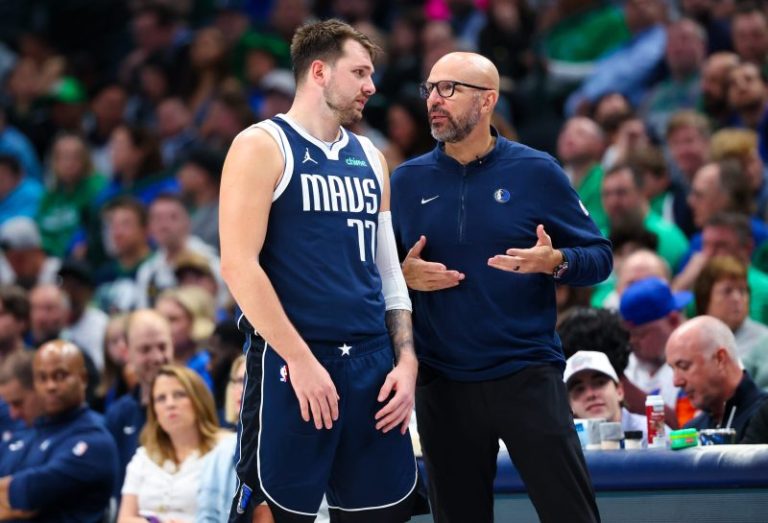
Arguably no team has undergone as much tumultuous change in nine months as the Dallas Mavericks.

In February, they made that seismic trade to ship Luka Dončić away to the Los Angeles Lakers. Now, the Mavericks are also in search of a new general manager after they fired Nico Harrison on Tuesday, Nov. 11.

In essence, by firing Harrison, the architect of that Dončić deal, the Mavs are conceding that the trade was a massive mistake. But there are still plenty of long-term ramifications to sort through, and the full effects of the last nine months won’t be clear for years to come.

Here are the winners and losers from the Mavericks’ decision to fire Harrison:

WINNERS

Luka Dončić

Although he may not say so publicly, and although he has more pressing matters to worry about, Dončić is a clear winner in all of this. Even though Dončić has appeared in just 40 games for the Lakers, and even though he hasn’t even won a single playoff series, Harrison’s firing vindicates Dončić, in a way.

Dončić is averaging an absurd 37.1 points per game this season, which leads the NBA. He has slimmed down and has landed with one of the iconic franchises, in one of the premier markets in the country, and the Lakers inked Dončić to a three-year max extension in August.

The Mavericks youth movement

Dallas, and whoever becomes the eventual general manager, has some decisions to make. Anthony Davis is 32 but often injured. Including this season, he has two more seasons left on his $175.3 million contract, with a $62.7player option for 2027-28, according to Spotrac.com. Kyrie Irving, 33, is in a similar position, though for decidedly less money.

Klay Thompson, 35, has two years left at around $17 million per year. Daniel Gafford, 27, Caleb Martin, 30, and any other pricey veterans should all be on alert as potential trade chips. With Harrison gone, the Mavericks may opt to fully reset, freeing up cap space and amassing draft picks.

Rookie Cooper Flagg, the No. 1 overall pick in the 2025 NBA Draft, is the future face of the franchise. The Mavericks should build around him.

Jason Kidd

To a certain extent, this remains to be seen because Kidd faces a very difficult task ahead. He’s the head coach of a Mavericks team that may offload its veterans in a rebuild, so his standing could change quickly. But Harrison’s firing showed Kidd has some goodwill remaining after he led Dallas to the 2024 NBA Finals.

In a way, Harrison becomes the clear fall guy for the controversial Dončić trade, and Kidd absolves himself; his argument becomes that he simply coached the roster that was handed to him. Yet, the Mavericks are 3-8 and facing injuries. Kidd may be a candidate to move into a front office role, potentially even replacing Harrison. The path forward won’t be easy, but Kidd at least is poised to be part of the plan, as opposed to one of its victims.

Michael Finley and Matt Riccardi

Both were assistant general managers under Harrison, and now both are set to be co-interims in Harrison’s place. This allows them to distance themselves from Harrison and the Dončić mess, even though Harrison promoted them and they were undoubtedly part of the process.

It also sets them up to be considered for the job on a permanent basis.

LOSERS

Nico Harrison

It’s hard to see Harrison recovering from this. He remains relatively inexperienced, as far as NBA front office positions go; Harrison had spent 19 seasons with Nike, eventually becoming the vice president of the shoe goliath’s North American operations. Given the shock of the Dončić trade, reason stands that NBA teams will be leery of bringing on Harrison in any high-level capacity. Given the way it was negotiated, that’s even more magnified.

Harrison reportedly did not field multiple calls for Dončić’s services, opting instead to quietly negotiate with his long-time friend Rob Pelinka, the Lakers general manager. By doing that, Harrison operated from a position of little leverage and hurt the Mavericks. Because if it became widely known that Dončić was available, teams would’ve lined up with far more attractive offers.

The reality, though, is that prior to the Dončić trade, Harrison was a mostly decent general manager. He orchestrated the trade that brought Kyrie Irving at a relative bargain. He was aggressive before the February 2024 trade deadline and acquired center Daniel Gafford and perimeter specialist P.J. Washington, both of whom played key roles in pushing the Mavericks to the Finals later that season. Derek Lively was a solid draft choice in 2023.

The Mavericks

This was a team that, just a little more than two years ago, made the 2024 NBA Finals. And though the Celtics breezed through in five games, the Mavericks still had a solid, young core and appeared to be just a piece or two away from winning their second NBA championship and first since 2011.

Now, a complete rebuild is almost certain, and team ownership must be careful and calculated in the way they fill the general manager vacancy. Another misstep could set the Mavericks back to complete irrelevance – all of which brings us to the biggest losers in all of this.

Dallas fans

This is a Mavericks fanbase that is passionate and knows the game well. They’re loyal to their stars and alumni; just look at the warm reception Dirk Nowitzki gets any time he’s near the team.

They had a generational talent in Dončić. They bought his jerseys and cheered him on, and he was only 25 when the trade happened. They were on the cusp of a championship.

Now, with the Cowboys mostly cooked, their best bet for a title appears to be the NHL’s Stars.

But, at the very least, the Dallas Wings have WNBA 2025 Rookie of the Year Paige Bueckers to support.

This post appeared first on USA TODAY

The NBA All-Star Game has drawn ample criticism in recent years. But this season it’ll be impossible to complain about the same old format.

The NBA is introducing an entirely new one: U.S. vs. The World.

Two teams of U.S. players and a team of international players will compete in a round-robin tournament in four 12-minute games, all to be held on the final day of All-Star Weekend — Sunday, Feb. 15 — the NBA announced Tuesday, Nov. 11.

Whether the format will solve the listless play and almost non-existent defense that has come to define the NBA All-Star Game that will be played this season for the 75th time remains to be seen. But the league will unveil something entirely different when the 2026 All-Star Game is held at the Intuit Dome, the home arena of the Los Angeles Clippers in Inglewood, California.

How will round-robin tournament work?

This won’t be as straightforward as the old days.

All round-robin games will be played on Sunday, Feb. 15, and here’s how the tournament works:

Team A will play Team B in Game 1. 

The winning team from Game 1 will play Team C in Game 2.

The losing team from Game 1 will play Team C in Game 3.

So it’s as easy as ABC, 123. Mostly.

After Game 3, the top two teams by record will play each other in the championship game. But, if all three teams have a 1-1 record after Game 3, the point differential in each team’s two round-robin games will serve as the tiebreaker.

How will the All-Star voting work?

There’s less to learn about this process.

As in the past, there will be 24 NBA All-Stars — 12 from the Western Conference and 12 from the Eastern Conference. The five starters will be selected by fans (50% of the vote), current NBA players (25%) and a media panel (25%). The seven reserves will be selected by NBA head coaches. 

Here’s what’s new: The All-Stars will be picked without regard for position.

How players will be assigned to the two U.S. teams has not yet been determined, according to the league.

The two U.S. teams and what will be known as the World Team will have a minimum of eight players. If the All-Star voting produces fewer than 16 U.S. players or fewer than eight international players to meet the minimum requirement of eight players per team, NBA commissioner Adam Silver will pick additional All-Stars.

This post appeared first on USA TODAY

  • LSU should be a gold standard job for coaching candidates, but university can’t get out of its own way.
  • Brian Kelly lawsuit against LSU becomes a fresh stain.
  • With LSU in turmoil, Florida and Penn State might start looking pretty good.

LSU is considered a crown jewel job within the college football ecosystem. Coaches who ply their craft elsewhere look at LSU with envy. Ed Orgeron won a national championship there. Les Miles won one and nearly two. Enough said.

The job’s so good, it would take a band of idiots to screw up a coaching search so badly as to make LSU unattractive.

Well, strike up the band!

In the latest twist of buffoons on the bayou, LSU is refusing to confirm it will pay fired coach Brian Kelly the $54 million buyout he’s owed, according to a lawsuit filed by Kelly’s lawyers.

The only way LSU would not owe Kelly his buyout is if it showed he violated his contract terms, allowing LSU to fire him for cause.

LSU has not offered evidence it fired Kelly for any other reason than his job performance. Kelly’s win-loss record is insufficient grounds for a for-cause firing.

Hence, the lawsuit.

“LSU repeatedly confirmed, both publicly and to Coach Kelly, that the termination was due to the team’s performance, not for cause,” the lawsuit states.

Let me put it plainly for LSU: You hired him, you fired him, and now you pay his failure money. That’s how this works.

“LSU is cooked,” attorney Tom Mars wrote on social media, adding “LSU’s stupidity” does not constitute grounds to stiff Kelly on his buyout.

Mars, a well-known lawyer in NCAA circles, is not part of Kelly’s legal team. He gained fame for representing former Mississippi coach Houston Nutt in his lawsuit against Ole Miss.

Mars’ assessment hits the mark. LSU entered into a stupid contract with Kelly. Now, it’s doubling down with more foolishness.

Never mind what you think of Kelly’s job performance. This buyout charade only encumbers the process to replace him. It sends a message coaches can’t trust LSU to honor its contracts. The messier LSU’s situation becomes, the better Florida and Penn State look as destinations.

Brian Kelly lawsuit: LSU trying to stiff coach on buyout

The lawsuit continues that on Nov. 10, “for the very first time,” LSU representatives informed Kelly’s legal team the university believes it has for-cause grounds to fire Kelly.

And, get a load of this, apparently LSU has taken the position that Kelly has “not been formally terminated.”

Excuse me, what?

I could have sworn LSU publicly announced Kelly’s firing Oct. 26. That announcement included language LSU had separated with Kelly, “effective immediately.”

A few days later, Gov. Jeff Landry made a big to-do in a news conference about LSU being on the hook for Kelly’s whopper buyout.

“The spirit of the team needed a change, and so that change was made,” Landry said Oct. 29. “… Right now, we got a $53 million liability.”

That’s straight from the circus ringleader’s mouth.

I hate to be the one to tell LSU, but y’all fired Kelly last month.

We probably shouldn’t be surprised LSU can’t decide whether it has or hasn’t fired Kelly, more than two weeks after it fired Kelly.

Last week, Landry’s puppet Wade Rousse, LSU’s new president, couldn’t decide whether Verge Ausberry was or wasn’t LSU’s athletic director. Ausberry went from interim AD to having the interim tag removed to “acting AD” to, well, who knows what to call him?

LSU’s athletics website calls Ausberry the athletic director. We’ll go with that, at least until the next time Rousse opens his mouth and word-vomits. Ausberry’s the guy running the coaching search, anyway. Because, LSU fired Kelly.

You might recall LSU suspended Ausberry four years ago for his role in improperly handling complaints of sexual and physical abuse against LSU athletes. A reporter for the Louisiana Illuminator wrote last week Rousse told her he didn’t know much about Ausberry’s involvement in that scandal.

That’s how a puppet vets a hire.

LSU football coaching candidates will need some answers

To what degree will coaching candidates care about this ongoing eyesore? That depends on the coach.

Some will overlook the circus as an unfortunate sideshow that can be overcome. LSU’s three coaches before Kelly each won a national championship. This remains a national brand located within fertile recruiting terrain.

Show an egotistical coach the LSU job, and they’ll think, “I can win a national championship there. Les nearly won two …” Hand him his NIL budget, point him to the film room, and let him go to work.

A more skeptical coach who’s currently thriving might demonstrate caution at leaving a good gig in favor of LSU’s imbroglio. Kelly won more than 70% of his games, and he’s having to sue LSU to get his buyout.

Coaches often tout the influence of university alignment to a program’s success. A coach, athletic director and president working in lockstep, free of interference from the governor’s mansion, is the dream.

LSU’s alignment consists of a couple of newbies, a meddling governor and a governor-appointed board of supervisors.

Prospective coaching candidates won’t care about Ausberry’s past suspension, but they might like assurance as to who’s running the show at LSU.

Is it the interim/acting/maybe-permanent athletic director?

Is it the puppet in the president’s suite?

Or, does the coach bypass them all and deal directly with the ringleader in the governor’s mansion?

This saga surrounding Kelly’s buyout puts off odd vibes, too, to potential candidates and especially to their agents. Paying buyouts to fired coaches who didn’t win enough is a cost of doing business. Neither Florida nor Penn State tried to stiff their fired coaches the buyout money owed upon termination.

Landry called for more fiscal responsibility within the next coach’s contract. That’s a charming thought, but this is a coaches’ market. Penny-pinching makes for a difficult sales pitch.

The LSU job should sell itself, but a brigade of buffoons keeps rising to the challenge of screwing this up.

Blake Toppmeyer is the USA TODAY Network’s senior national college football columnist. Email him at BToppmeyer@gannett.com and follow him on X @btoppmeyer.

This post appeared first on USA TODAY

InMed Pharmaceuticals (NASDAQ: INM) pairs innovative therapeutic development in Alzheimer’s, ophthalmology, and dermatology with recurring revenue from its BayMedica manufacturing division — giving investors rare small-cap biotech exposure to high-impact science with reduced financing risk.

INM-901 takes a multi-pathway approach to Alzheimer’s, targeting several core drivers of the disease rather than just amyloid beta. In preclinical studies, it protected neurons, reduced inflammation, cleared toxic proteins, and improved cognition, aligning with the industry’s shift toward multi-target therapies.

InMed’s BayMedica subsidiary manufactures rare cannabinoids via chemical synthesis, rather than plant extraction, ensuring purity, consistency and scalability. The business generates approximately $5 million in annual revenue and ~40 percent gross margins, selling to the global health and wellness ingredient markets. This dual business model gives InMed a cash flow-supported R&D engine, enhancing sustainability and valuation resilience.

Investor Insight

InMed is a pharma innovator advancing proprietary small-molecule therapies in Alzheimer’s and ophthalmology, supported by a revenue-producing manufacturing arm. With cash exceeding its market cap and multiple near-term catalysts, it represents a compelling, undervalued biotech opportunity.

This InMed Pharmaceuticals profile is part of a paid investor education campaign.*

Click here to connect with InMed Pharmaceuticals (NASDAQ:INM) to receive an Investor Presentation

This post appeared first on investingnews.com

Mark Skousen of Forecasts & Strategies shares his outlook for gold, silver and the US economy.

‘We’ve entered an era of what I call permanent inflation,’ he explained.

‘After World War II, inflation became permanent — higher and higher prices every year. The inflation rate may ebb and accelerate, but it’s always positive year after year.’

Securities Disclosure: I, Charlotte McLeod, hold no direct investment interest in any company mentioned in this article.

This post appeared first on investingnews.com

Questcorp Mining Inc. (CSE: QQQ,OTC:QQCMF) (OTCQB: QQCMF) (FSE: D910) (the ‘Company’ or ‘Questcorp’) is pleased to announce that Sorbie Bornholm LP (‘Sorbie’), a UK Investment Fund, has undertaken an initial investment in Questcorp Mining Inc. (CSE: QQQ,OTC:QQCMF) (OTCQB: QQCMF) (FSE: D910) (‘Questcorp’ or the ‘Company’). The gross amount of the investment is CAD$2,000,000. The funds will go toward advancing Questcorp’s ongoing exploration and development programs at its flagship La Union Gold and Silver Project in Sonora, Mexico, and its North Island Copper Property on Vancouver Island, British Columbia, and for general working capital purposes.

Reflecting on the new partnership, President & CEO, Saf Dhillon, commented:

‘We are incredibly pleased to have secured this strategic investment from Sorbie Bornholm, a respected international institutional investor. This financing provides us with the flexibility to accelerate exploration across our key assets in Mexico and British Columbia. We view Sorbie’s participation as a strong vote of confidence in Questcorp’s team, vision, and long-term potential to deliver value through discovery and development.’

Whitney Kofford, Managing Director of Sorbie Bornholm LP, added:

‘We are delighted to welcome Questcorp Mining Inc. as a new partner and portfolio company. Our decision to invest reflects our enormous confidence in Questcorp’s leadership. And in turn, by entering into a Sharing Agreement, Questcorp’s leadership signals strong conviction in their ability to execute and grow value for all stakeholders. Sorbie’s Sharing Agreement is designed to align interests towards growth and provide companies with consistent capital that rewards operational success and share price appreciation. We trust Questcorp will use the capital support to systematically unlock long-term value for all shareholders, and we look forward to sharing in their great upside potential.’

About Sorbie Bornholm

Sorbie Bornholm LP is a global investment firm that provides funding for ongoing business objectives to listed micro, small and mid-cap growth companies. We focus on public equity investments in companies that are looking to expand and on management teams with a clear growth strategy. Our extensive experience allows us to invest in most industries in order to provide supportive, longer-term capital that rewards company growth.

Since 2000, Sorbie Bornholm LP founder Greg Kofford has perfected the ‘Sorbie-Strategy’, utilizing a sharing agreement that supports management and rewards growth. This unique approach has now been used in over 50 investments – with many of those resulting in the companies receiving more cash than the original offering proceeds – without having to issue any additional shares.

Sorbie Bornholm’s core values drive who we are and how we invest. We are committed to developing long-term relationships with select listed public companies and their brokers & advisers. We focus on providing supportive, longer-term capital that rewards growth. We invest to make a difference, to become a valued partner and to be a shareholder of choice. It’s important to us that we succeed together.

To see if the Sorbie-Strategy is right for your company, please contact Sorbie Bornholm:

Whitney Kofford, Managing Director
+1-801-554-5889
whitney@sorbiebornholm.com https://sorbiebornholm.co.uk/

About Questcorp Mining Inc.

Questcorp Mining Inc. is engaged in the business of the acquisition and exploration of mineral properties in North America, with the objective of locating and developing economic precious and base metals properties of merit. The Company holds an option to acquire an undivided 100% interest in and to mineral claims totaling 1,168.09 hectares comprising the North Island Copper Property, on Vancouver Island, British Columbia, subject to a royalty obligation. The Company also holds an option to acquire an undivided 100% interest in and to mineral claims totaling 2,520.2 hectares comprising the La Union Project located in Sonora, Mexico, subject to a royalty obligation.

Contact Information

Questcorp Mining Corp.

Saf Dhillon, President & CEO

Email: saf@questcorpmining.ca
Telephone: (604) 484-3031

This news release includes certain ‘forward-looking statements’ under applicable Canadian securities legislation. Forward-looking statements include, but are not limited to, statements with respect to the intended use of proceeds from the Offering. Forward-looking statements are necessarily based upon a number of estimates and assumptions that, while considered reasonable, are subject to known and unknown risks, uncertainties, and other factors which may cause the actual results and future events to differ materially from those expressed or implied by such forward-looking statements. Such factors include, but are not limited to: the ability of Riverside to secure geophysical contractors to undertake orientation surveys and follow up detailed survey to confirm and enhance the drill targets as contemplated or at all, general business, economic, competitive, political and social uncertainties, uncertain capital markets; and delay or failure to receive board or regulatory approvals. There can be no assurance that the geophysical surveys will be completed as contemplated or at all and that such statements will prove to be accurate, as actual results and future events could differ materially from those anticipated in such statements. Accordingly, readers should not place undue reliance on forward-looking statements. The Company disclaims any intention or obligation to update or revise any forward-looking statements, whether as a result of new information, future events or otherwise, except as required by law.

To view the source version of this press release, please visit https://www.newsfilecorp.com/release/273793

News Provided by Newsfile via QuoteMedia

This post appeared first on investingnews.com