Author

admin

Browsing

NASCAR fans couldn’t have asked for a better regular-season finale.

Ryan Blaney made it to victory lane in the NASCAR Cup Series’ race at Daytona International Speedway last Saturday night. The Team Penske driver earned his second victory of 2025 in historic fashion to close out the regular season.

Blaney’s win meant both Alex Bowman and Tyler Reddick made it into the Cup Series playoffs on points. Had Custer, Suarez or Haley taken the checkered flag, Bowman would’ve missed out.

With the playoff field set, 16 drivers are in contention for the 2025 Cup Series title. It all begins this weekend in Darlington, South Carolina.

Playoff contender William Byron led most of the race at Darlington earlier this year. But Denny Hamlin powered through following a late-race caution to get the win in the Goodyear 400, his second of four wins this season.

The first playoff race is a chance for the postseason contenders to establish themselves ahead of a run to the title. Here’s everything you need to know to get ready for the Cook Out Southern 500 at Darlington Raceway on Sunday, Aug. 31:

What time does the NASCAR Cup race at Darlington start?

The Cook Out Southern 500 is scheduled to start at 6 p.m. ET on Sunday, Aug. 31 at Darlington Raceway in Darlington, South Carolina.

What TV channel is the NASCAR Cup race at Darlington on?

The Cook Out Southern 500 will be broadcast on USA Network, the channel for most of the Cup Series playoffs. Pre-race coverage will start at 5:30 p.m. ET.

Will there be a live stream of the NASCAR Cup race at Darlington?

Yes, the Cook Out Southern 500 will be streamed on Peacock, HBO Max, Sling TV and Fubo, which is offering a free trial to new subscribers.

Stream the NASCAR race at Darlington on Fubo

How many laps is the NASCAR Cup race at Darlingon?

The Cook Out Southern 500 is 367 laps around the 1.366-mile track for a total of 501.32 miles. The race will have three segments (laps per stage) — Stage 1: 70 laps; Stage 2: 160 laps; Stage 3: 170 laps.

Which drivers made the NASCAR Cup Series playoffs?

Here’s how the field stacks up on points with their number of wins in parentheses:

  1. Kyle Larson (3)….. 2032
  2. William Byron (2) ….. 2032
  3. Denny Hamlin (4) ….. 2029
  4. Ryan Blaney (2) ….. 2026
  5. Christopher Bell (3) ….. 2023
  6. Shane van Gisbergen (4) ….. 2022
  7. Chase Elliott (1) ….. 2013
  8. Chase Briscoe (1) ….. 2010
  9. Bubba Wallace (1) ….. 2008
  10. Austin Cindric (1) ….. 2008
  11. Ross Chastain (1) ….. 2007
  12. Joey Logano (1) ….. 2007
  13. Josh Berry (1) ….. 2006
  14. Tyler Reddick (0) ….. 2006
  15. Austin Dillon (1) ….. 2005
  16. Alex Bowman (0) ….. 2002

Who won the NASCAR Cup race at Darlington last year?

Kyle Busch pushed him hard at the finish, but Chase Briscoe held on for his first win of the season in the Cook Out Southern 500 on Sept. 1, 2024. This event was the regular-season finale in 2024 and was a thrilling race over 500 miles. Kyle Larson led 263 laps but finished fourth and, in doing so, lost the regular season title to Tyler Reddick by one point. This was Briscoe’s second career win and most recent until taking the checkered flag at Pocono on June 22, 2025. Busch, Christopher Bell, Larson and Ross Chastain rounded out the top five.

What is the lineup for the Cook Out Southern 500 at Darlington?

Here is the lineup for the NASCAR Cup Series playoff race at Darlington Raceway (car number in parentheses; P=playoff driver):

  1. (11) Denny Hamlin (P), Toyota
  2. (19) Chase Briscoe (P), Toyota
  3. (21) Josh Berry (P), Ford
  4. (45) Tyler Reddick (P), Toyota
  5. (5) Kyle Larson (P), Chevrolet
  6. (1) Ross Chastain (P), Chevrolet
  7. (20) Christopher Bell (P), Toyota
  8. (23) Bubba Wallace (P), Toyota
  9. (3) Austin Dillon (P), Chevrolet
  10. (2) Austin Cindric (P), Ford
  11. (24) William Byron (P), Chevrolet
  12. (12) Ryan Blaney (P), Ford
  13. (7) Justin Haley, Chevrolet
  14. (22) Joey Logano (P), Ford
  15. (17) Chris Buescher, Ford
  16. (54) Ty Gibbs, Toyota
  17. (99) Daniel Suarez, Chevrolet
  18. (41) Cole Custer, Ford
  19. (43) Erik Jones, Toyota
  20. (88) Shane Van Gisbergen (P), Chevrolet
  21. (9) Chase Elliott (P), Chevrolet
  22. (16) AJ Allmendinger, Chevrolet
  23. (8) Kyle Busch, Chevrolet
  24. (38) Zane Smith, Ford
  25. (71) Michael McDowell, Chevrolet
  26. (77) Carson Hocevar, Chevrolet
  27. (60) Ryan Preece, Ford
  28. (34) Todd Gilliland, Ford
  29. (48) Alex Bowman (P), Chevrolet
  30. (42) John Hunter Nemechek, Toyota
  31. (10) Ty Dillon, Chevrolet
  32. (6) Brad Keselowski, Ford
  33. (35) Riley Herbst, Toyota
  34. (4) Noah Gragson, Ford
  35. (47) Ricky Stenhouse Jr., Chevrolet
  36. (51) Cody Ware, Ford
  37. (44) Derek Kraus, Chevrolet
  38. (66) Timmy Hill, Ford

The USA TODAY app gets you to the heart of the news — fastDownload for award-winning coverage, crosswords, audio storytelling, the eNewspaper and more.

This post appeared first on USA TODAY

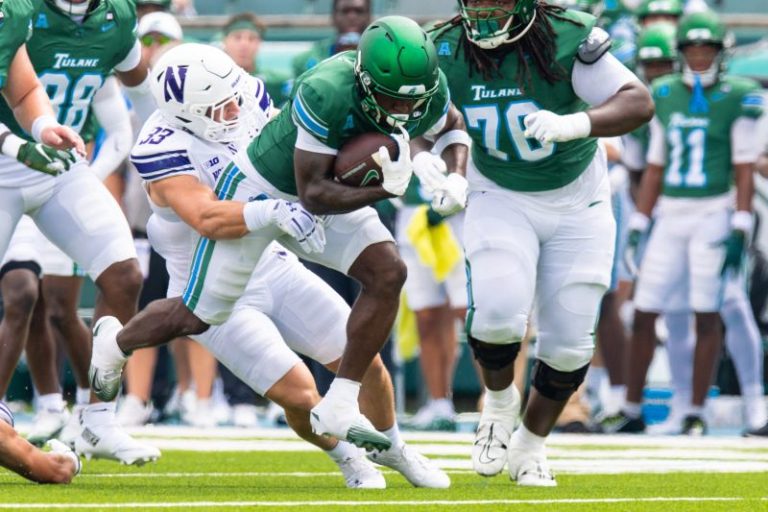
The Green Wave beat the Wildcats 23-3 in New Orleans’ Yulman Stadium in Week 1 to open the 2025 season.

Sumrall expressed his discontent with Northwestern’s decision after the game:

‘I’m not trying to take a shot, but we requested to wear white jerseys because that’s what that team wore,’ Sumrall told reporters in a postgame news conference. ‘It got denied, that’s their prerogative. But when you disrespect the city of New Orleans, that’s what’s going to happen to you. You’re going to run into a team like this that had a chip on their shoulder. … We might’ve used that for a little motivation to represent the city.

‘Don’t disrespect the City of New Orleans, ever.’

Tulane, the home team on Aug. 30, typically would’ve worn its colored uniforms, as road teams normally wear white. ESPN reported, however, that Tulane’s request was made on Aug. 17, after Northwestern had already set up jerseys and decals for the team in preparation for the travel.

Tulane, viewed as one of the top non-Power Four contenders for the College Football Playoff in 2025, looked the part in Week 1 behind a revamped offense led by BYU transfer Jake Retzlaff. He completed 18 of 31 passes for 152 yards and a touchdown against the Wildcats, also rushing for 113 yards and a score.

Tulane intercepted Northwestern quarterback Preston Stone four times, also forcing and recovering a fumble.

This post appeared first on USA TODAY

The insult of losing as a two-touchdown favorite to a Florida State team that went 2-10 last season came with a particularly notable injury for Alabama.

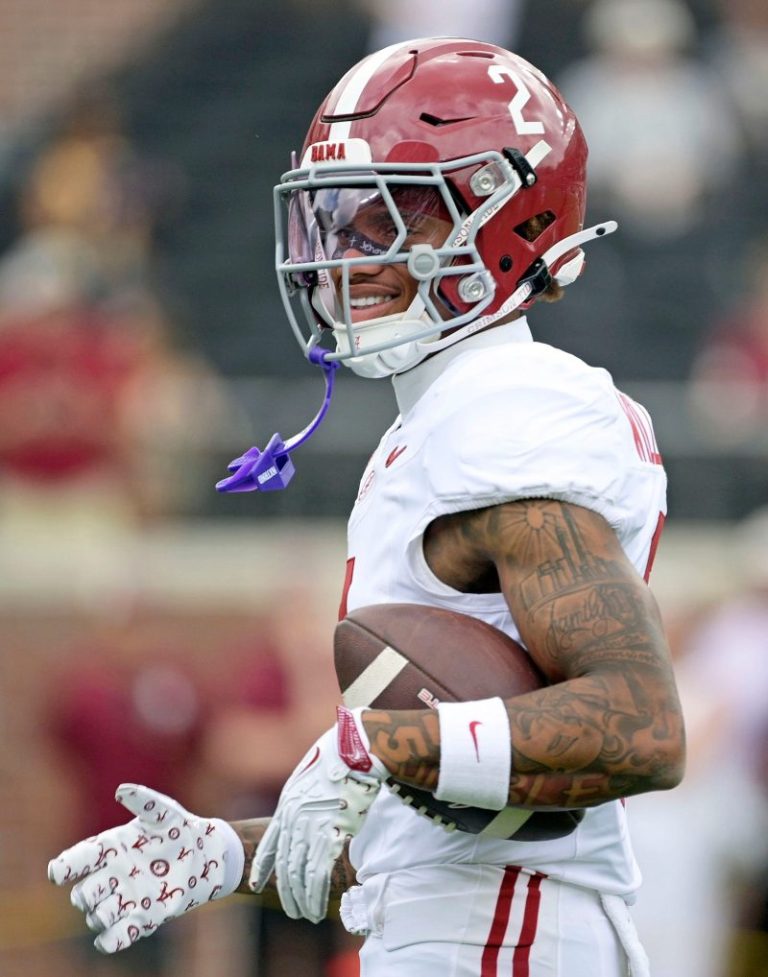
In the fourth quarter of the No. 8 Crimson Tide’s season-opening 31-17 loss against the Seminoles on Saturday, Aug. 30 at Doak Campbell Stadium in Tallahassee, Florida, Alabama wide receiver Ryan Williams exited the game after absorbing a big hit while trying to catch a pass over the middle.

To that point in the game, Williams had five catches for 30 yards.

Williams exploded onto the college football scene last season as a 17-year-old phenom who had 865 receiving yards and eight touchdown catches while earning first-team All-SEC recognition as a freshman.

Here’s the latest on Williams’ injury:

Ryan Williams injury update

With about six minutes remaining and his team trailing by 14 points, Alabama quarterback Ty Simpson attempted to connect with Williams across the middle on a second-and-10, but Williams was unable to hold on to the ball.

After the drop, Williams was hit by a pair of Florida State defensive backs, including Earl Little Jr., who was initially penalized for targeting. Williams remained on the turf after the play and was tended to by Alabama trainers before being able to walk off the field with team medical personnel on either side of him.

Upon review, the targeting penalty was overturned. Shortly after leaving the field, Williams was taken back to the Crimson Tide locker room. He did not return to the game.

In his post-game news conference, Alabama coach Kalen DeBoer confirmed that Williams had suffered a concussion on the play.

The Crimson Tide return to action on Sept. 6 with a home game against Louisiana Monroe.

This post appeared first on USA TODAY

Here’s a quick recap of the crypto landscape for Friday (August 29) as of 12 noon (UTC).

Get the latest insights on Bitcoin, Ethereum and altcoins, along with a round-up of key cryptocurrency market news.

Bitcoin and Ethereum price update

Bitcoin (BTC) was priced at US$108,747, a 3.3 percent decrease in 24 hours. Its lowest valuation of the day was US$108,198 and its highest price on Friday was US$112,652.

Bitcoin price performance, August 29, 2025.

Chart via TradingView

Bitcoin’s slip below the US$110,000 threshold stoked fears of a broader crypto market correction on Friday as liquidations doubled, the Federal Reserve’s preferred inflation gauge showed persistent price pressures, and Bitcoin flashed a potential risk pattern. Analysts warned the token could be edging toward bear market territory.

Adding to volatility, a long-dormant Bitcoin whale that resurfaced this month—after buying US$2.5 billion in Ethereum—shifted another US$1.1 billion on Friday.

Ether (ETH) was priced at US$4,335.28, down by 3.2 percent over the past 24 hours. Its highest was US$4,511.09 and its lowest was US$4,279.96.

Altcoin price update

  • Solana (SOL) was priced at US$204.82, down by 2.4 percent. Its lowest valuation on Friday was US$203.74, and its highest valuation was US$217.66.
  • XRP was trading for US$2.94, down by 4.4 percent in the past 24 hours, and at its lowest valuation of the day. Its highest valuation on Wednesday was US$2.98.
  • SUI (Sui) was trading for US$3.30, down by 4.3 percent in the past 24 hours. Its lowest valuation of the day was US$3.29, and its highest level of the day was US$3.50.
  • Cardano (ADA) was priced at US$0.8201, down by 3.8 percent. Its lowest valuation for Friday was US$0.817, and its highest valuation was US$0.8618.

Today’s crypto news to know

Stablecoins cross US$283 billion threshold record

The stablecoin market reached a new milestone on Friday as total supply climbing to $282.8 billion, according to data from DefiLlama.

That marks a 128 percent increase since January, driven by stronger demand for dollar-pegged tokens and fresh regulatory clarity in the US.

The surge also follows passage of the Genius Act, which sets out federal guidelines for stablecoin issuers and has been billed as a growth catalyst within the sector.

Analysts say stablecoins now serve as a “distribution channel” for US dollars, powering cross-border payments and on-chain settlement systems.

Eric Trump hails US–China leadership in Bitcoin

Speaking at the BTC Asia conference in Hong Kong, Eric Trump praised China’s influence on the digital asset industry and said the US and Beijing were “leading the way” in shaping Bitcoin’s future.

He credited the Middle East as another fast-moving hub for crypto adoption, while stressing Bitcoin’s ability to unite people across borders and cultures.

The younger Trump also added that his father’s administration had accelerated digital asset policy faster in seven months than the prior decade managed. He described America as “winning the digital revolution” with support from Wall Street institutions, sovereign wealth funds, and retirement investors.

Asked whether Bitcoin would be on the agenda in an upcoming US–China trade meeting, he suggested broader topics would dominate but said he “would certainly love to talk about bitcoin.”

Trump-Linked miner American Bitcoin targets September Nasdaq listing

American Bitcoin, a mining company backed by Eric Trump and Donald Trump Jr., is preparing to list on Nasdaq in September following its merger with Gryphon Digital Mining, Reuters reported.

The firm is majority-owned by Hut 8, which controls 80 percent of the business, while the Trump brothers are expected to collectively hold about 19 percent. The company has already raised $220 million to expand its operations and accumulate Bitcoin, adding 215 BTC to its balance sheet as of June.

With Bitcoin trading near US$112,000 this week, that stash is valued at roughly US$24 million.

CEO Asher Genoot said American Bitcoin aims to become one of the largest US mining firms, with backing from high-profile investors including Gemini founders Tyler and Cameron Winklevoss.

Hut 8’s own stock has rallied 29 percent this year. If listed today, American Bitcoin would rank among the top 30 public companies holding Bitcoin in the US.

Securities Disclosure: I, Giann Liguid, hold no direct investment interest in any company mentioned in this article.

Securities Disclosure: I, Meagen Seatter, hold no direct investment interest in any company mentioned in this article.

This post appeared first on investingnews.com

Shares of Cameco (TSX:CCO,NYSE:CCJ) were on the rise after the uranium major announced it is reducing its annual production guidance due to expansion delays at the McArthur mine in Saskatchewan, Canada.

Instead of the projected 18 million pounds of U3O8 the company was aiming for from its McArthur River joint venture with Orano, the revised output tally reduces 2025’s production total to between 14 million and 15 million pounds.

In January, Cameco warned that delays at McArthur River — including slower-than-expected ground freezing, development setbacks and labor constraints — could affect its 2025 production outlook.

“We have determined that we are unable to fully mitigate the expected impact of the delayed development and slower than anticipated ground freezing in the first half of 2025,” Cameco’s statement notes.

Strong output from the Cigar Lake mine may help offset the McArthur River delays, the company said, adding that its diversified assets and risk management strategy position it to meet commitments and maintain long-term value.

In total, a strong performance at Cigar Lake could provide an additional 1 million pounds.

The uranium miner offered assurances that it will fulfill all delivery obligations with its customers.

“With favourable market prices for uranium today, we continue to have the option to buy in the spot market if it is advantageous for us to do so,” the company said, noting that it can source material through other means as well.

News of the shortfall sent shares of Cameco higher, with the company rising from C$105.91 on Thursday (August 28) to C$114 during after-trading hours. Values had pulled back to the C$105 range by midday on Friday (August 29).

Broader uranium market challenges

Cameco’s production cut is the second output reduction the sector has seen in as many weeks.

On August 22, Kazatomprom, Kazakhstan’s state-owned uranium producer, reported plans to lower output in 2026, saying that despite firm long-term prices, market conditions don’t support a return to full capacity.

In a corporate update, the company said its production will be about 10 percent lower compared to earlier targets, dropping from 32,777 metric tons of U3O8 to 29,697 metric tons. The reduction, equal to roughly 8 million pounds, or 5 percent of global supply, will largely stem from changes at its Budenovskoye joint venture.

After spiking to triple-digit levels unseen in more than a decade in early 2024, the spot price has been under pressure, falling as low as US$63.36 in March of this year. However, prices have steadily grown since then, reaching a second quarter high of US$79.01 on June 30 and currently holding at the US$75 mark. Kazatomprom notes that while the spot price remains volatile, the long-term uranium price has held steady at around US$80.

The company plans to exercise its option to operate within a 20 percent deviation of its 2026 subsoil use production levels, with formal guidance to come later. The sector major also also reported stable sulfuric acid supply for 2026, easing concerns after last year’s shortages forced a sharp output downgrade. However, its new acid plant won’t be ready until at least 2026, and higher mineral extraction taxes are expected to weigh on costs.

The updates came alongside half-year results showing that net profit was down 54 percent to 263.2 billion tenge (US$489.5 million), while revenue was off 6 percent at 660.2 billion tenge, largely on weaker sales volumes.

Despite lower near-term output, Kazatomprom said it remains committed to exploration in order to replenish its reserves and maintain its dominance as the world’s top uranium supplier.

Beyond market headwinds, the company highlighted Kazakhstan’s nuclear ambitions, with proposals for three domestic reactors that would require about 1.04 million pounds of uranium each year.

Uranium supply shortage unavoidable?

With tightening margins between uranium demand and global mine supply, these latest announcements are likely to impact market sentiment and could push prices higher.

Taking to X, formerly known as Twitter, Uranium Insider’s Justin Huhn posted an ominous message:

According to the World Nuclear Association, mine supply currently accounts for 90 percent of uranium demand, with the other 10 percent being fulfilled through secondary supply sources.

However, secondary supply is declining and mine supply has not grown to account for the discrepancy. This is likely to be further compounded by the addition of 70 new nuclear reactors that are currently in the construction phase.

Coupled with heightening energy demands from the artificial intelligence sector, analysts at FocusEconomics are projecting a higher spot price environment moving forward.

“The Consensus among our panelists is for uranium prices to remain well above the levels that prevailed in the 2010s for the rest of this decade, with prices forecast to hover between US$65 and US$80 per pound,” the firm wrote in an email. “That said, panelists don’t see a return to the highs of 2024, a period when the spot price likely got ahead of underlying market fundamentals due to investor exuberance.”

Securities Disclosure: I, Georgia Williams, hold no direct investment interest in any company mentioned in this article.

This post appeared first on investingnews.com

About Earthwise Minerals

Earthwise Minerals Corp. (CSE: WISE; FSE: 966) is a Canadian junior exploration company focused on advancing the Iron Range Gold Project in southeastern British Columbia near Creston, B.C. The Company holds an option to earn up to an 80% interest in the fully permitted project, which is road-accessible and situated within a prolific mineralized corridor. The property covers a 10 km x 32 km area along the Iron Range Fault System and hosts multiple high-grade gold showings and large-scale geophysical and geochemical anomalies.

For more information, visit www.earthwiseminerals.com.

EARTHWISE MINERALS CORP.,

ON BEHALF OF THE BOARD

‘Mark Luchinski’

Contact Information:

Mark Luchinski
Chief Executive Officer, Director
Telephone: (604) 506-6201
Email: luch@luchccorp.com

Forward Looking Statements

This news release includes statements that constitute ‘forward-looking information’ as defined under Canadian securities laws (‘forward-looking statements’) including, without limitation, statements respecting the Offering and the intended use of proceeds therefrom. Statements regarding future plans and objectives of the Company are forward looking statements that involve various degrees of risk. Forward-looking statements reflect management’s current views with respect to possible future events and conditions and, by their nature, are subject to known and unknown risks and uncertainties, both general and specific to the Company. Although the Company believes the expectations expressed in its forward-looking statements are reasonable, forward-looking statements are not guarantees of future performance, and actual outcomes may differ materially from those in forward-looking statements. Additional information regarding the various risks and uncertainties facing the Company are described in greater detail in the ‘Risk Factors’ section of the Company’s annual management’s discussion and analysis and other continuous disclosure documents filed with the Canadian securities regulatory authorities which are available at www.sedarplus.ca. The Company undertakes no obligation to update forward-looking information except as required by applicable law. The reader is cautioned not to place undue reliance on forward-looking statements.

For more information, please contact Mark Luchinski, Chief Executive Officer and Director, at luch@luchccorp.com or (604) 506-6201.

Source

This post appeared first on investingnews.com

Statistics Canada released its second-quarter gross domestic product (GDP) figures on Friday (August 29). The data showed that the Canadian economy shrank 0.4 percent in the second quarter and declined 1.6 percent on an annualized basis. The decrease comes following first-quarter gains of 0.5 percent and a 2 percent annualized increase.

Much of the decrease was attributed to a 7.5 percent drop in exports compared to Q1. Canadian exports had risen 1.4 percent in the first three months of the year as US companies increased imports to get ahead of incoming tariffs.Excluding the lower costs at the pumps, CPI remained steady at 2.5 percent, the same increase as May and June.

On an industry level, new monthly data for June shows that the resource sector grew by 0.1 percent after two months of declines, primarily driven by a 2.6 percent gain in the oil and gas subsector, with oil sands extraction rising 6.4 percent over May. However, gains were offset by a 9.7 percent monthly decline in support activities for the resource sector, its largest drop in five years, led by reduced rigging and drilling activities.

South of the border, the US Bureau of Economic Analysis released its second estimate for Q2 real GDP on Thursday (August 28). The data shows that US GDP grew by 3.3 percent during the quarter, 0.3 percent higher than its advance estimate.

According to the agency, the figure reflects a decrease in imports and an increase in consumer spending. The GDP’s upward momentum was tempered by a 13.8 percent decrease in private domestic investment, marking the most significant decline since 2020, during the pandemic.

The growth follows a 0.5 percent decrease in the first quarter of 2025, which saw a significant rise in imports.

This week also saw US President Donald Trump attempt to remove US Federal Reserve Board of Governors member Lisa Cook. Trump justified the decision based on Federal Housing Finance Agency Director Bill Pulte’s claim that Cook claimed primary residence in two mortgage applications submitted weeks apart in 2021. She was confirmed to the Fed Board of Governors in May 2022.

Cook is fighting the move in court, with her lawyer stating that Trump’s unsubstantiated allegation of an event prior to Cook’s confirmation does not meet the ’cause’ required by the Federal Reserve Act to remove a governor. By the end of the day on Friday, the judge hearing the case did not reach a decision on whether to issue a temporary restraining order that would allow Cook to remain in her role during the case.

Pulte has previously made similar allegations against other prominent Democrats, including California Senator Adam Schiff, a vocal critic of Trump, and New York Attorney General Letitia James, who oversaw a civil suit against Trump that resulted in a US$500 million award.

Trump has been eager to reshape the Federal Reserve Board and has hinted that he would like to replace Chairman Jerome Powell before his term ends in 2026. Trump believes the Fed has not been acting quickly enough to lower interest rates and stimulate the economy.

Markets and commodities react

Canadian equity markets were largely unfazed by Canada’s weak GDP data. In fact, the S&P/TSX Composite Index (INDEXTSI:OSPTX) set a new record on Friday, closing the week up 1.73 percent to 28,564.45. The S&P/TSX Venture Composite Index (INDEXTSI:JX) did even better, climbing 5.36 percent to finish Friday at 829.57. The CSE Composite Index (CSE:CSECOMP) fell 0.45 percent on Friday following the StatsCan release, but gained 4.17 percent overall during the week to 166.9.

US equity markets also posted gains this week, but fell from record highs on Friday following a selloff of tech stocks. The S&P 500 (INDEXSP:INX) was up 1.19 percent to 6,460.25, while the Nasdaq 100 (INDEXNASDAQ:NDX) rose 0.99 percent to 23,415.42. Meanwhile, the Dow Jones Industrial Average (INDEXDJX:.DJI) gained 1.32 percent on the week to 45,631.73.

The gold price gained 3.19 percent this week on expectations of a September rate cut by the Federal Reserve, reaching US$3,448.15 per ounce by 4:00 p.m. EDT on Friday. Silver ended the week with a larger gain of 4.2 percent, nearly crossing the US$40 per ounce mark in morning trading before settling at US$39.74 per ounce.

Copper also saw some upward movement, gaining 1.1 percent to US$4.59 per pound. The S&P GSCI (INDEXSP:SPGSCI) commodities index posted an increase of 1.3 percent by close on Friday, finishing at 549.70.

Top Canadian mining stocks this week

How did mining stocks perform against this backdrop?

Take a look at this week’s five best-performing Canadian mining stocks below.

Stocks data for this article was retrieved at 4:00 p.m. EDT on Friday using TradingView’s stock screener. Only companies trading on the TSX, TSXV and CSE with market caps greater than C$10 million are included. Mineral companies within the non-energy minerals, energy minerals, process industry and producer manufacturing sectors were considered.

1. Trifecta Gold (TSXV:TG)

Weekly gain: 117.24 percent
Market cap: C$23.77 million
Share price: C$0.63

Trifecta Gold is a gold exploration company focused on a portfolio of 11 properties in the Tombstone gold belt in the Yukon, Canada.

Its most advanced is its flagship Mt. Hinton gold-silver project, located near Hecla Mining’s (NYSE:HL) Keno Hill silver mine. The company’s project page indicates that vein float samples collected in January 2023 show grades of up to 273 grams per metric ton (g/t) gold.

The company has also been advancing exploration work at its Rye property, which hosts a gold-bismuth soil anomaly, as well as several gold-rich veins.

Shares in Trifecta rose this week alongside news on Thursday that the company had commenced its inaugural drill program at Rye, completing 970 meters across three holes. The announcement reported that the first hole intersected a high density of sheeted quartz veins.

The company said preliminary rock samples collected from the site earlier in 2025 returned multiple assays with greater than 5 g/t gold, including one highlight with 21.1 g/t gold and 8,550 parts per million (ppm) bismuth.

2. Consolidated Lithium Metals (TSXV:CLM)

Weekly gain: 100 percent
Market cap: C$13.98 million
Share price: C$0.04

Consolidated Lithium is an exploration and development company working to advance a portfolio of hard rock lithium projects in Quebéc, Canada.

Its most advanced asset is the Vallée lithium project, a 75/25 joint venture between Consolidated and Sayona Mining (ASX:SAY,OTCQB:SYAXF). The project is located in the Abitibi Greenstone Belt adjacent to and along strike of Sayona’s and Piedmont Lithium (NASDAQ:PLL) North American Lithium mining operation. According to the company’s project page, the Vallée property hosts multiple lithium-bearing pegmatites over a 1 kilometer strike length.

Consolidated announced on Wednesday (August 27) that it signed a letter of intent with the Government of Quebéc-owned Soquem to earn an 80 percent interest in the Kwyjibo rare earth project, located in the Côte-Nord region of the province.

Under the terms of the letter, Consolidated can earn up to an 80 percent interest in the project through two phases, in return for a combination of cash payments, shares in Consolidated and project investments.

A 2017 preliminary economic assessment for Kwyjibo reports project economics including an after-tax net present value of C$373.9 million and an internal rate of return of 17.8 percent, with a payback period of 3.6 years.

3. Electric Metals (TSXV:EML)

Weekly gain: 68.75 percent
Market cap: C$44.34 million
Share price: C$0.27

Electric Metals is a mineral development company focused on advancing its flagship North Star manganese project in Minnesota, US. According to the company, the asset is North America’s highest-grade manganese resource. It plans to produce high-purity manganese sulphate monohydrate for lithium-ion batteries.

The most recent news from Electric Metals was released on Tuesday, when it announced a preliminary economic assessment for the project. The assessment demonstrated a base-case after-tax net present value of US$1.39 billion, with an internal rate of return of 43.5 percent and a payback period of 23 months. and suggested an average annual after-tax cash flow of US$249.6 million.

The report also included an updated mineral resource estimate with an indicated resource of 7.6 million metric tons of ore grading 19.07 percent manganese, 22.33 percent iron and 30.94 percent silicon, and an inferred resource of 3.73 million metric tons of ore grading 17.04 percent manganese, 19.04 percent iron and 30.03 percent silicon.

4. Sage Potash (TSXV:SAGE)

Weekly gain: 58.33 percent
Market cap: C$31.93 million
Share price: C$0.38

Sage Potash is a potash exploration company currently working to advance its portfolio of mineral holdings in Utah’s Paradox Basin in the US.

Historic oil and gas exploration in the basin dating back a century discovered the potential for the potash beds, but they were too deep for mining methods at the time. Sage has since confirmed their presence through its own exploration.

In a revised technical report from February 2023, the company reported an inferred mineral resource estimate of up to 159.3 million metric tons of in-place sylvinite from the upper potash bed and up to 120.2 million metric tons of sylvinite from the lower potash bed.

On August 14, Sage announced that Stockwell Day had joined the company board. Day served several ministerial roles for the Canadian government under Prime Minister Stephen Harper, including as President of the Treasury Board and Minister of International Trade.

This was followed by news on Wednesday that Day had been granted 600,000 stock options at an exercise price of C$0.30 per share and would remain valid for a period of five years.

Sage’s share price spiked earlier this week after the US Government added potash in its draft of an updated list of critical minerals.

5. Kincora Copper (TSXV:KCC)

Weekly gain: 58.33 percent
Market cap: C$24.8 million
Share price: C$0.095

Kincora Copper is an exploration company operating under a project generator model and partnering with other companies to advance its portfolio, including copper-gold projects in the Macquarie Arc of New South Wales, Australia.

Among them is the Northern Junee-Narromine Belt (NJNB) land package, which is covered by a May 2024 earn-in agreement that could see AngloGold Ashanti (NYSE:AU,JSE:ANG) earn up to an 80 percent interest in the Nyngan and Nevertire licenses through AU$50 million in exploration expenditures or AU$25 million for exploration and the completion of a pre-feasibility study.

Kincora secured a second agreement with AngloGold Ashanti in April for the Nyngan South, Nevertire South and Mulla licenses with similar terms, bringing the total exploration funding to AU$100 million.

On Monday (August 25), Kincora announced results from the first drilling program at the Nyngan project, noting that assays support the potential for porphyry copper and epithermal gold, and that it saw ‘encouraging results at particularly shallow depths’ from drill targets identified by a ground gravity survey earlier this year.

Additionally, Kincora said that drilling is ongoing at the Nevertire South and Nevertire projects, with the initial program planned for seven holes and 2,150 meters.

FAQs for Canadian mining stocks

What is the difference between the TSX and TSXV?

The TSX, or Toronto Stock Exchange, is used by senior companies with larger market caps, and the TSXV, or TSX Venture Exchange, is used by smaller-cap companies. Companies listed on the TSXV can graduate to the senior exchange.

How many mining companies are listed on the TSX and TSXV?

As of May 2025, there were 1,565 companies listed on the TSXV, 910 of which were mining companies. Comparatively, the TSX was home to 1,899 companies, with 181 of those being mining companies.

Together, the TSX and TSXV host around 40 percent of the world’s public mining companies.

How much does it cost to list on the TSXV?

There are a variety of different fees that companies must pay to list on the TSXV, and according to the exchange, they can vary based on the transaction’s nature and complexity. The listing fee alone will most likely cost between C$10,000 to C$70,000. Accounting and auditing fees could rack up between C$25,000 and C$100,000, while legal fees are expected to be over C$75,000 and an underwriters’ commission may hit up to 12 percent.

The exchange lists a handful of other fees and expenses companies can expect, including but not limited to security commission and transfer agency fees, investor relations costs and director and officer liability insurance.

These are all just for the initial listing, of course. There are ongoing expenses once companies are trading, such as sustaining fees and additional listing fees, plus the costs associated with filing regular reports.

How do you trade on the TSXV?

Investors can trade on the TSXV the way they would trade stocks on any exchange. This means they can use a stock broker or an individual investment account to buy and sell shares of TSXV-listed companies during the exchange’s trading hours.

Article by Dean Belder; FAQs by Lauren Kelly.

Securities Disclosure: I, Dean Belder, hold no direct investment interest in any company mentioned in this article.

Securities Disclosure: I, Lauren Kelly, hold no direct investment interest in any company mentioned in this article.

This post appeared first on investingnews.com

The gold price was on the rise this week, breaking through US$3,400 per ounce once again.

It’s been pushed higher by US dollar weakness, as well as Federal Reserve turmoil.

President Donald Trump has been pressuring Fed Chair Jerome Powell to cut interest rates for months, and on Monday (August 25) the situation developed further when Trump posted a letter on his social media platform Truth Social. In it, he said he was removing Lisa Cook from her position on the central bank’s board of governors due to allegations of mortgage fraud.

Cook, who has been voting to hold rates steady, was due to serve until 2038; she has now filed a lawsuit asking for Trump’s order to be declared ‘unlawful and void.’

The move has spurred questions about whether Trump can actually fire her — while the Federal Reserve Act doesn’t allow him to remove Fed officials at will, he can do so ‘for cause.’

For its part, the Fed has said it will abide by any court decision.

The situation is still developing, and gold market watchers are keeping a close eye on how it plays out. The yellow metal tends to fare better when interest rates are low, and some experts believe that a rate cut from the Fed could kick off its next move higher

The Fed’s next meeting is scheduled to run from September 16 to 17. Expectations are high that it will cut rates at that time, even though the latest data shows that its preferred measure of inflation, the personal consumption expenditures (PCE) price index, was up 2.6 percent year-on-year in July.

Core PCE, which excludes food and energy, saw a rise of 2.9 percent.

Bullet briefing — US drafts new critical minerals list, uranium miners make cuts

US drafts new critical minerals list

The US Department of the Interior has released a new draft critical minerals list, and the recommended additions include silver, as well as potash, silicon, copper, rhenium and lead.

Silver’s potential inclusion is turning heads in the mining community as market participants assess the potential impact for the metal. The critical minerals list is designed to guide federal strategy, investment and permitting deals as the US works to lock down supply of key commodities, meaning that silver-focused companies could see benefits such as tax breaks and faster timelines.

In total, the draft list has 54 minerals, with 50 included based on results from an economic effects assessment. Three were selected on the back of a qualitative evaluation, and zirconium is there because of the potential for a single point of failure in the US supply chain.

The list was set up after a 2017 executive order from Trump and is updated every three years.

It’s worth noting that silver and the other recommended additions aren’t officially critical minerals yet — the draft critical minerals list was posted for public comment on Tuesday (August 26), and feedback will be accepted for 30 days. It’s also worth noting that two commodities may be stripped of their critical mineral status — arsenic and tellurium have been recommended for removal.

Critical minerals lists vary from country to country based on individual needs, although in many cases they have similarities. In January 2024, a group of silver industry participants, including many major miners, sent a letter to Canada’s energy and natural resources minister proposing that silver be included in the nation’s critical minerals list; to date, it has not been added.

Uranium miners cut production guidance

Sweden’s government has proposed the removal of the country’s ban on uranium mining as it looks to reduce its reliance on imports of the energy fuel.

Uranium mining has been banned in Sweden since 2018, but the country has six operating reactors and generates around one-third of its power from nuclear energy.

The ban is set to be removed on January 1, 2026, and comes as nations increasingly look to nuclear power to fill their energy needs. It also comes amid supply questions — although demand is rising and prices are out of a years-long slump, miners have been slow to ramp back up post-Fukushima.

Just last week, Kazatomprom said it was lowering its 2026 production target compared to earlier estimates, cutting about 8 million pounds. Although the company sees stability in long-term uranium prices and strong sector fundamentals, it isn’t prepared to return to 100 percent levels.

Cameco (TSX:CCO,NYSE:CCJ) made a similar statement this week, saying its 2025 output will be impacted by delays in transitioning the Saskatchewan-based McArthur River mine to new mining areas. Production will be 4 million to 5 million pounds lower, although there is a chance for Cigar Lake to partially offset that loss.

Securities Disclosure: I, Charlotte McLeod, hold no direct investment interest in any company mentioned in this article.

This post appeared first on investingnews.com

BOULDER, CO – Coach Deion Sanders has been telling everybody for months that his new football team at Colorado this year is better than before, possibly even the “best team we’ve ever assembled,” as he said this week.

Then came their first game on Friday, Aug. 29 at sold-out Folsom Field.

And it turns out he might be a little off, at least for one game.

Georgia Tech beat Colorado 27-20 after Georgia Tech quarterback Hayne King scored the game-winning 45-yard touchdown run with 1:07 to go.

It was Sanders’ first game at Colorado without his two youngest sons playing for him: quarterback Shedeur and safety Shilo. Two-way star Travis Hunter also has moved on to the NFL after winning the Heisman Trophy last season with the Buffaloes.

In their place, Sanders fielded a new-look band of Buffaloes, who didn’t fully capitalize on Georgia Tech’s three turnovers in three possessions to start the game. They netted only an 8-yard touchdown pass from new quarterback Kaidon Salter, a transfer from Liberty.

Salter finished 17-for-28 for 159 yards and had that passing touchdown. He added 43 more yards on the ground on 13 carries and scored another touchdown.

But King for Georgia Tech was more prolific. He was 13-for-20 passing for 143 yards and had an interception, but he rushed 19 times for a career-high 156 yards and scored all three Georgia Tech touchdowns, including the 45-yard game-winner with just over a minute to go.

Georgia Tech gained 463 total yards, including 320 rushing yards, before Colorado’s Hail Mary pass fell flat to end the game in front of the announced crowd of 52,868.

Georgia Tech vs. Colorado highlights

Final: Georgia Tech 27, Colorado 20

Colorado’s Hail Mary falls incomplete. There was some questionable time management there in the final minute.

Haynes King gives Georgia Tech late lead

King bursts through the line and cruises the rest of the way for a 45-yard rushing TD. Georgia Tech leads 27-20 with 1:07 to go.

The QB has rushed 19 times for 156 yards and three touchdowns. He’s added 143 yards passing.

Colorado answers, ties game again

Colorado quarterback Kaidon Salter engineered his best drive of the game, capped by his 7-yard scramble for a touchdown with under nine minutes left in the game. The score helped tie the game at 20-20 after Salter drove the Buffs downfield 75 yards in 15 plays as coach Deion Sanders implored him to “be you” during an in-game interview with ESPN.

Game officials initially called Salter down at the 1-yard line on his third-down run. But replay review showed he had pushed the ball across the goal line before his knee was down.

End of third quarter: Georgia Tech 20, Colorado 13

Georgia Tech quarterback Haynes King busted loose for a 17-yard touchdown run after faking a handoff. He moved his team downfield 75 yards on 11 plays. The touchdown put the Yellow Jackets up 20-13 with 14 seconds left in the third quarter.

The drive chewed up 5:46 of game clock and included five first downs for the Yellow Jackets.

Colorado then ran one play – a completion for 16 yards – as time expired in the third quarter. 

King has 99 yards rushing and two touchdowns on 15 attempts. He also has completed 11 of 17 passes for 115 yards with one interception.

Colorado ties it up again

Colorado has tied the game at 13-13 with six minutes left in the third quarter. Kicker Alejandro Mata drilled a 29-yard field goal after the Buffs drove to the Georgia Tech 5-yard line but got stuffed on three plays before the kick. The scoring drive went 39 yards on eight plays, including a 21-yard pass from Kaidon Salter to receiver DeKalon Taylor on the drive’s first play.

Quiet start to third quarter

Both teams opened the second half with punts, with Georgia Tech still leading 13-10 with 10:15 left in the third quarter. Colorado opened the half with three straight runs by running back Micah Welch, including a 22-yarder to the left on the first play after halftime. But the Buffs stalled at the Georgia Tech 45-yard line.

Welch has eight carries for 65 yards. 

Halftime: Georgia Tech 13, Colorado 10

Georgia Tech responded to Colorado’s field goal with a 43-yard field goal of its own as time expired in the first half. The Yellow Jackets lead at halftime 13-10.

Colorado coach Deion Sanders told ESPN at halftime that quarterback Kaidon Salter has been having communication issues but otherwise has had a “solid game.”

Salter has completed 6 of 10 passes for 48 yards and a touchdown.

Georgia Tech quarterback Haynes King has completed 9 of 13 passes for 97 yards. He added a rushing touchdown in the second quarter.

Both teams have reason to be disappointed. Georgia Tech gave up three turnovers to start the game, but Colorado only came up with one touchdown to show for it.

Georgia Tech has outgained Colorado 279-119 in total yards and 18-5 in first downs.

Colorado gets the ball to open the second half.

Colorado ties it up

Colorado rediscovered a little bit of offense to tie the game at 10-10 with 1:39 to go until halftime. The Buffs went 51 yards in eight plays, including a 39-yard pass from quarterback Kaidon Salter to receiver Omarion Miller on third-and-10. That catch on the left side brought the Buffs to the Georgia Tech 25-yard line, but then they had to settle for a 42-yard field goal from kicker Alejandro Mata. 

Georgia Tech takes the lead

The momentum has swung back to Georgia Tech after Colorado failed to fully capitalize on the Yellow Jackets’ three turnovers to start the game. They now lead 10-7 with 4:33 left in the second quarter after going 80 yards in 10 plays, capped by a 4-yard touchdown run by quarterback Haynes King.

Georgia Tech has outgained Colorado 230-63 in total yards. The Yellow Jackets have 16 first downs, compared to three for the Buffs. 

Colorado offense stuck in neutral

Colorado’s offense has fizzled after scoring a touchdown on its first possession. Since then, it’s been three straight punts, including two three-and-outs. Quarterback Kaidon Salter is 4-for-8 passing for 12 yards, including his 8-yard touchdown pass. Georgia Tech has outgained Colorado 150-63 in total yards with 10:30 left before halftime. 

Georgia Tech settles for field goal

The Yellow Jackets settled for a 32-yard field goal after driving from their 2-yard line all the way to the Colorado 8. But a holding penalty pushed them back from there, and now it’s 7-3 with 13:31 left before halftime. They ran 13 plays for 84 yards before the field goal by Aidan Birr. 

End of first quarter: Colorado 7, Georgia Tech 0

Colorado leads 7-0 after one quarter of play but Georgia Tech is threatening to score at the start of the second quarter. The Yellow Jackets finally settled down on their fourth possession of the game, chipping away at Colorado’s defense with a drive that started at its own 2-yard line.

Georgia Tech has outgained Colorado after one quarter, 144-45 yards. The Yellow Jackets have the ball inside the Colorado 20-yard line.

Georgia Tech turns the ball over again

Now it’s three turnovers in three possessions to start the game for Georgia Tech. This time Yellow Jackets quarterback Haynes King threw to the left on first down in Colorado territory, only to be intercepted by Colorado cornerback DJ McKinney. The interception gave the Buffs possession at their own 34-yard line. 

But the Buffs squandered the opportunity for the second straight time and punted the ball back. 

Georgia Tech fumbles again

Two possessions, two fumbles for Georgia Tech. This time a high snap from center ended up on the ground and was recovered by Colorado defender Keaten Wade, putting the Buffaloes in good field position again at its own 48-yard line early in the first quarter. 

The Buffaloes went three-and-out and had to punt, however.

Colorado turns turnover into touchdown

Colorado has struck first and is up 7-0 after recovering a fumble and scoring after going 36 yards in five plays. Quarterback Kaidon Salter threw an 8-yard touchdown pass to newcomer DeKalon “TrackHawk” Taylor with 12:08 left in the first quarter.

Linebacker Martavius French took the ball away from Georgia Tech on the Yellow Jackets’ second play from scrimmage to set it all up.

When is Colorado vs Georgia Tech?

Kickoff is at 8 p.m. ET Friday, Aug. 29 from sold-out Folsom Field in Boulder.

How to watch Colorado vs Georgia Tech

The game will be televised on ESPN and also is available on Fubo.

Colorado vs Georgia Tech odds

The latest odds can be found below. For a full list of sports betting odds, access USA TODAY Sports Betting Scores Odds Hub.

Rain falling at Colorado before game

With less than an hour before kickoff, rain is falling on the field, but not too heavily. It’ll make for wet conditions on Colorado’s new artificial turf field, even if the rain stops after kickoff, as has been forecasted. The rain also has kept the seats from filling at the stadium so far. It’s mostly empty except for students wearing white shirts as part of a coordinated color scheme for Colorado.

Portable toilet on sideline for Deion Sanders

Deion Sanders wasn’t joking when he talked about having a portable toilet on the sideline. A Colorado official confirmed that the black tented box near the 20-yard line is Sanders’ bathroom if he needs it. It is sponsored by Depend, the adult underwear brand. Sanders has a partnership with Depend after having his cancerous bladder removed in May. He has discussed his incontinence and bladder issues openly since then in his effort to remove the stigma around the issue.

What happened to Colorado’s bison mascot?

Raphie VI, Colorado’s live mascot, has retired after four seasons, as was announced earlier this week. Colorado is training a new bison for the job, but she won’t be ready to run on the field before the game.

“We all saw that coming,” Deion Sanders said on the ‘Colorado Football Coaches Show’ Aug. 27.

He was referring to Ralphie VI’s slow trots and seeming lack of interest in the job. Prior Ralphie mascots charged out of the gate down and around the field before kickoff.

“I’m hating the point that we are missing a Ralphie for this game,” Sanders said on the show.

What is the history between Colorado and Georgia Tech?

They’ve never played. But they shared the national championship for the 1990 season after the Associated Press picked Colorado No. 1 to finish the season and the UPI Coaches’ Poll coronated Georgia Tech. It came down to a single point in the Coaches’ Poll. Then-Nebraska coach Tom Osborne previously declined to talk about it but revealed in a recent interview with USA TODAY Sports that he picked Georgia Tech No. 1 instead of Big Eight Conference rival Colorado. Georgia Tech finished 11-0-1 that year. Colorado finished 11-1-1.

Who is replacing Travis Hunter for Colorado?

It takes a village to fill the shoes of the two-way star. On defense, cornerback DJ McKinney was the “other” cornerback last year and is NFL draft material. He’ll be the guy to take on the other team’s top receiver. On offense, the Buffs have a stacked set of fleet feet to catch passes, including a transfer from Incarnate Word who goes by the moniker of “TrackHawk.” That’s DeKalon Taylor, a running back/receiver who is the fastest player on the team.

Why is Colorado wearing a new jersey patch?

The Buffs will wear their traditional home uniforms from the 1990s: gold helmet, black jersey, gold pants, white socks and black shoes. This is to honor former Colorado coach Bill McCartney, who died in January. McCartney led the Buffs to the national championship in 1990 before retiring abruptly after the 1994 season, when his team finished No. 3 nationally.

“We’re going to give some love to Coach McCartney,” Deion Sanders said earlier this week.

The team also will wear a patch on their jerseys to honor “Coach Mac.”

Who will walk with Deion Sanders before the game?

In his first two seasons at Colorado, Sanders would take part in a ritual with his son Shedeur and sometimes his safety son Shilo. They would walk and talk together down the field as father, coach, sons and players. Now that his sons have left the program, another player on the current team offered to walk the same walk with him before the game, which Sanders found touching. But Sanders didn’t say who it was.

Follow reporter Brent Schrotenboer @Schrotenboer. Email: bschrotenb@usatoday.com

This post appeared first on USA TODAY

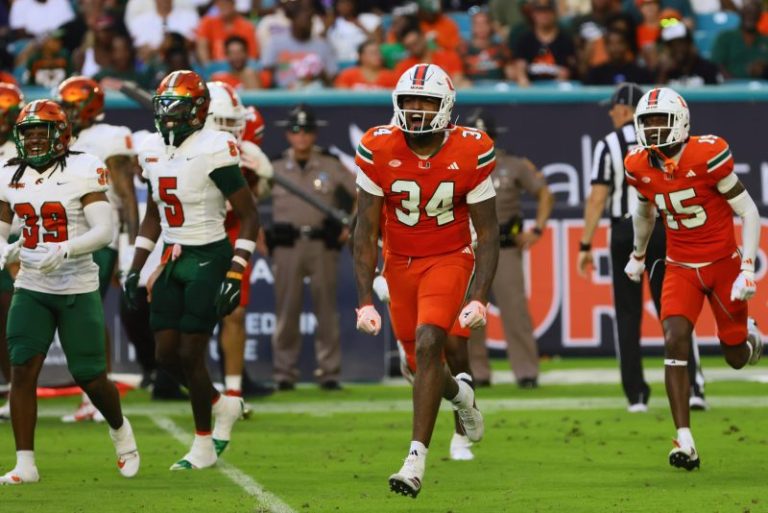
Miami linebacker Adarius Hayes was charged with three counts of vehicular homicide and one count of reckless driving in connection with a two-car crash on May 10 that killed three people.

Hayes was arrested after he turned himself into authorities on Friday, Aug. 29, the Largo Police Department in Florida announced, two days before Miami begins its 2025 season against Notre Dame.

The crash happened in the city of Largo, Hayes’ hometown about 20 miles west of Tampa. Police said initial reports showed Hayes ‘was traveling at a high rate of speed and maneuvering aggressively through traffic’ before his Dodge Durango collided with a Kia Soul at an intersection.

The 78-year-old driver of the Kia and two children, ages 10 and 4, were killed, and a 58-year-old man in the passeger of the Kia was hospitalized with serious injuries. Hayes was taken to a local hospital with non-life-threatening injuries and eventually released.

Police said an investigation into the crash discovered Hayes ‘made a rapid and dangerous maneuver’ of crossing three lanes of traffic five seconds before the crash before he quickly crossed lanes again without signaling. He reached a maximum speed of 78 miles per hour in 40 mph zone when he crashed into the Kia, which police added was lawfully executign a left-hand turn.

‘The investigation concluded that Adarius Hayes’ egregious speed, aggressive and reckless lane changes, and complete disregard for surrounding traffic conditions demonstrated a willful and deliberate disregard for the safety of others, constituting reckless driving. These actions directly led to the tragic deaths of the three victims,’ officials said.

Hayes was booked Pinellas County Jail and was released on $350,000 bond four hours later, according to jail records.

Miami said Hayes is ‘indefinitely suspended from all athletic related activities per athletic department policy’ and declined further comment.

A four-star recruit in the 2024 class, Hayes played in 12 games for the Hurricanes last season, mostly on special teams. He made four tackles and recorded one interception.

This post appeared first on USA TODAY