
Author

admin

Browsing

  • MAVERIC Phase III pivotal trial of orphan drug candidate CardiolRx in recurrent pericarditis is fully funded through to a planned New Drug Application submission with the FDA.

  • New data from the ARCHER trial, highlighting the magnitude of reduction in left ventricular (LV) mass and the read through to heart failure, to be presented at a cardiology conference in November 2025.

  • Next-generation therapy CRD-38 for heart failure funded through to clinical development, with partnership discussions advancing with leading pharmaceutical companies.

Cardiol Therapeutics Inc. (NASDAQ: CRDL) (TSX: CRDL) (‘Cardiol’ or the ‘Company’), a clinical-stage life sciences company advancing late-stage, anti-inflammatory and anti-fibrotic therapies for heart disease, today announced the successful completion of a private placement offering (the ‘Offering’) of units (‘Units’) for net proceeds of US$11 million. The initial closing of US$10 million has been completed, with the remaining US$1 million to close on Monday, October 20, 2025.

‘As recruitment in our pivotal Phase III MAVERIC trial gains momentum, with several prominent centers across the U.S. now enrolling patients, we are pleased to have secured a direct investment of US$11 million to strengthen our balance sheet and accelerate the development of our novel heart failure drug, CRD-38, based on the recently reported findings from our ARCHER trial,’ said David Elsley, President and CEO of Cardiol Therapeutics. ‘Topline results from our ARCHER trial demonstrated a significant reduction in LV mass-marking the first evidence of structural and remodeling improvement in patients with myocarditis. This landmark finding represents our second clinical validation in inflammatory heart disease and establishes a key translational link to data published earlier this year in the Journal of the American College of Cardiology, which demonstrated the beneficial effects of the active pharmaceutical ingredient or API in CardiolRx on cardiac structure, inflammation, and fibrosis in a model of heart failure. The ARCHER findings support pursuing an additional Orphan Drug Designation for CardiolRx in myocarditis and advancing the development of our next-generation CRD-38 formulation, which delivers the same API via subcutaneous administration, to target the broader heart failure market. Notably, blockbuster drugs that reduce LV mass have been shown to lower heart failure-related death and hospitalization, underscoring the clinical potential of Cardiol’s differentiated anti-inflammatory mechanism to address a large unmet need in heart failure, where five-year mortality rates still exceed 50%.’

Under the Offering, the Company sold a total of 11 million Units at a price of US$1.00 per Unit. Each Unit consists of one Class A common share of the Company (a ‘Common Share‘) and one-half of one Common Share purchase warrant. Each whole warrant entitles the holder to acquire one additional Common Share at an exercise price of US$1.35 for a period of 24 months from the date of issuance. The warrants include an acceleration provision, allowing the Company to advance their expiry to the 30th day following the issuance of a news release if the daily volume-weighted average trading price of the Common Shares exceeds US$2.00 for five consecutive trading days. Proceeds from the Offering provide cash resources that are anticipated to support operations into the third quarter of 2027.

The securities have not been registered under the United States Securities Act of 1933, as amended (the ‘U.S. Securities Act‘), or any U.S. state securities laws, and may not be offered or sold to, or for the account or benefit of, persons in the ‘United States’ or ‘U.S. persons’ (as such terms are used in Regulation S under the U.S. Securities Act), absent registration under the U.S. Securities Act and all applicable U.S. state securities laws or in compliance with an exemption therefrom. This news release does not constitute an offer to sell or a solicitation of an offer to buy nor shall there be any sale of any of the securities in any jurisdiction in which such offer, solicitation or sale would be unlawful.

Certain insiders of the Company participated in the Offering. Such participation is considered to be a ‘related-party transaction’ within the meaning of Multilateral Instrument 61-101 – Protection of Minority Security Holders in Special Transactions (‘MI 61-101‘). The Company is relying on the exemptions from the formal valuation and minority shareholder approval requirements of MI 61-101 contained in sections 5.5(a) and 5.7(1)(a) of MI 61-101 in respect of related-party participation in the Offering as the fair market value (as determined under MI 61-101) of the subject matter of, and the fair market value of the consideration for, the transaction, insofar as it involved interested parties, did not exceed 25% of the Company’s market capitalization (as determined under MI 61-101).

About Cardiol Therapeutics

Cardiol Therapeutics Inc. (NASDAQ: CRDL) (TSX: CRDL) is a clinical-stage life sciences company advancing late-stage, anti-inflammatory and anti-fibrotic therapies for heart disease. The Company’s lead small molecule drug candidate, CardiolRx, modulates inflammasome pathway activation, an intracellular process known to play an important role in the development and progression of inflammation and fibrosis associated with pericarditis, myocarditis, and heart failure.

The MAVERIC Program in recurrent pericarditis, an inflammatory disease of the pericardium which is associated with symptoms including debilitating chest pain, shortness of breath, and fatigue, and results in physical limitations, reduced quality of life, emergency department visits, and hospitalizations, comprises the completed Phase II MAvERIC-Pilot study (NCT05494788) and the ongoing pivotal Phase III MAVERIC trial (NCT06708299). The U.S. FDA has granted Orphan Drug Designation to CardiolRx for the treatment of pericarditis, which includes recurrent pericarditis.

The ARCHER Program (NCT05180240) comprises the completed Phase II study in acute myocarditis, an important cause of acute and fulminant heart failure in young adults and a leading cause of sudden cardiac death in people less than 35 years of age.

Cardiol is also developing CRD-38, a novel subcutaneously administered drug formulation intended for use in heart failure-a leading cause of death and hospitalization in the developed world, with associated healthcare costs in the United States exceeding US$30 billion annually.

For more information about Cardiol Therapeutics, please visit cardiolrx.com.

Cautionary statement regarding forward-looking information:

This news release contains ‘forward-looking information’ within the meaning of applicable securities laws. All statements, other than statements of historical fact, that address activities, events, or developments that Cardiol believes, expects, or anticipates will, may, could, or might occur in the future are ‘forward-looking information’. Forward-looking information contained herein may include, but is not limited to statements regarding the Company’s focus on developing anti-inflammatory and anti-fibrotic therapies for the treatment of heart disease, the Company’s intended clinical studies and trial activities and timelines associated with such activities, including the Company’s plan to complete the Phase III study in recurrent pericarditis with CardiolRx, the Company’s plan to advance the development of CRD-38, a novel subcutaneous formulation intended for use in heart failure, the Company’s presentation and publication of the comprehensive ARCHER trial data, the Company’s belief that results from the ARCHER trial provide compelling clinical proof of concept for CardiolRx and strongly support advancing the clinical development of CardiolRx and CRD-38 for the treatment of inflammatory cardiac disorders including cardiomyopathies, heart failure, and myocarditis, and statements regarding the expected length and scope of funding for the Company’s development plans as a result of the Offering. Forward-looking information contained herein reflects the current expectations or beliefs of Cardiol based on information currently available to it and is based on certain assumptions and is also subject to a variety of known and unknown risks and uncertainties and other factors that could cause the actual events or results to differ materially from any future results, performance or achievements expressed or implied by the forward looking information, and are not (and should not be considered to be) guarantees of future performance. These risks and uncertainties and other factors include the risks and uncertainties referred to in the Company’s Annual Information Form filed with the Canadian securities administrators and U.S. Securities and Exchange Commission on March 31, 2025, available on SEDAR+ at sedarplus.ca and EDGAR at sec.gov, as well as the risks and uncertainties associated with product commercialization and clinical studies. These assumptions, risks, uncertainties, and other factors should be considered carefully, and investors should not place undue reliance on the forward-looking information, and such information may not be appropriate for other purposes. Any forward-looking information speaks only as of the date of this press release and, except as may be required by applicable securities laws, Cardiol disclaims any intent or obligation to update or revise such forward-looking information, whether as a result of new information, future events, or results, or otherwise. Investors are cautioned not to rely on these forward-looking statements.

For further information, please contact:
Trevor Burns, Investor Relations +1-289-910-0855
trevor.burns@cardiolrx.com

To view the source version of this press release, please visit https://www.newsfilecorp.com/release/270946

News Provided by Newsfile via QuoteMedia

This post appeared first on investingnews.com

Vince Lanci of Echobay Partners explains what’s driving silver’s record-setting price run.

According to Lanci, who is also a professor at the University of Connecticut and publisher of the GoldFix newsletter on Substack, the London market is facing a liquidity crisis as nations that would typically sell or lend their silver choose to keep the metal at home.

Securities Disclosure: I, Charlotte McLeod, hold no direct investment interest in any company mentioned in this article.

This post appeared first on investingnews.com

This week was marked by strong, event-driven volatility across the tech sector.

Market moves were shaped by artificial intelligence (AI) infrastructure announcements, semiconductor earnings, signals of macroeconomic stress and escalating tensions between the US and China.

Effects of the US government shutdown, coupled with renewed trade tensions between the world’s largest tech markets, weighed on global equities. Quarterly results from regional banks eased earlier concerns about credit risks after Zions Bancorp (NASDAQ:ZION) and Western Alliance (NYSE:WAL) disclosed loan issues related to apparent fraud.

Wall Street ultimately saw weekly gains, despite a midweek selloff that impacted high-value, high-risk sectors.

Hardware and infrastructure were the core positive contributors in the tech sector, reflecting the ongoing AI supercycle investment theme fueled by chip production and data center buildouts.

Semiconductor stocks were the standout performers, boosted by record earnings reports from Taiwan Semiconductor Manufacturing Company (TSMC) (NYSE:TSM) on Tuesday (October 14) and ASML Holding (NASDAQ:ASML) on Wednesday (October 15). Broadcom (NASDAQ:AVGO) and NVIDIA (NASDAQ:NVDA) also rose alongside TSMC, contributing to PHLX Semiconductor Sector’s (INDEXNASDAQ:SOX) 1.2 percent rebound on Thursday (October 16).

Advanced Micro Devices’ (NASDAQ:AMD) deal with Oracle (NYSE:ORCL) to deploy 50,000 GPUs, which was announced the same day as TSMC’s earnings, added a competitive dynamic that sparked selective volatility among chipmakers; at the same time, it underscored strong AI-driven hardware demand across the sector.

In consumer hardware, Apple’s (NASDAQ:AAPL) product launch was notable, but not the primary market mover.

Data centers also had a big impact, highlighted by Microsoft’s (NASDAQ:MSFT) US$14 billion Texas AI data center partnership with Nscale, and Brookfield Asset Management’s (TSX:BAM,NYSE:BAM) US$5 billion investment in Bloom Energy’s (NYSE:BE) fuel cell technology for powering AI-focused data centers. Oracle is forecasting acceleration in its AI data center business, indicating expanding hardware-backed infrastructure demand

Software and cloud-native company movements were more mixed, with gains from Salesforce (NYSE:CRM), but declines from others like Meta Platforms (NASDAQ:META) and Palantir Technologies (NASDAQ:PLTR).

3 tech stocks that moved markets this week

1. Broadcom (NASDAQ:AVGO)

Broadcom shares surged nearly 10 percent on Monday (October 13) after OpenAI announced a multi-year agreement to co-develop custom AI GPUs. The collaboration will focus on deploying 10 gigawatts of custom AI accelerators designed by OpenAI and built by Broadcom, with deployment set to start in H2 2026 and continue through 2029.

Later, multiple reports emerged citing individuals claiming that OpenAI is also partnering with Arm Holdings (NASDAQ:ARM) to produce custom CPUs to work alongside its Broadcom co-designed chip.

Shares of Arm also advanced by over 11 percent.

2. Advanced Micro Devices (NASDAQ:AMD)

Oracle and AMD also announced a major partnership this week, where Oracle will deploy 50,000 AMD-powered MI450 GPUs in its cloud infrastructure starting in the third quarter of 2026, with plans for ongoing expansion.

AMD’s share price rose by over 9 percent on the news, with the deal creating competitive pressure for rival chipmakers like NVIDIA. Meanwhile, Oracle shares declined by almost 7 percent on Friday (October 17) after the firm’s CEO, Clay Magouryk, provided an upbeat projection to analysts, indicating that the deployment of 50,000 AMD-powered MI450 GPUs will significantly accelerate Oracle’s AI business growth.

However, analysts highlighted the potential for a significantly high CAPEX, possibly leading to negative free cashflow totaling more than US$26 billion over the next three fiscal years.

3. Salesforce (NYSE:CRM)

Shares of Salesforce rose by almost 4 percent on Thursday after the company announced a revenue target of US$60 billion by 2030 during its Investor Day at Dreamforce event on Wednesday.

Salesforce plans to achieve this ambitious target through accelerated adoption of AI-powered cloud platforms and ongoing innovation in enterprise software services, as well as expanded use of generative AI across its CRM, analytics, and automation suites.

Broadcom, Salesforce and AMD performance, October 14 to 17, 2025.

Chart via Google Finance.

Tech ETF performance

This week, the iShares Semiconductor ETF (NASDAQ:SOXX) advanced by 1.94 percent, while the Invesco PHLX Semiconductor ETF (NASDAQ:SOXQ) saw a weekly gain of 1.66 percent.

The VanEck Semiconductor ETF (NASDAQ:SMH) increased by 1.59 percent.

These modest gains occurred against a backdrop of heightened volatility, indicating ongoing optimism in the long-term growth of the semiconductor industry.

Other tech market news

            Tech news to watch next week

            Next week brings quarterly earnings from major tech firms Tesla (NASDAQ:TSLA) and IBM (NYSE:IBM) on October 22, followed by Intel (NASDAQ:INTC) and Amazon (NASDAQ:AMZN) on October 23.

            Any new developments in US-China relations, potential technology export restrictions or antitrust actions could significantly affect tech stock performance. Market watchers will also be on the lookout for any indication of an end to the US government shutdown.

            Securities Disclosure: I, Meagen Seatter, hold no direct investment interest in any company mentioned in this article.

            This post appeared first on investingnews.com

            The Government of Ontario started taking applications for resource development projects under its “One Project, One Process” framework on Friday (October 17).

            The new process, which Ontario lawmakers introduced in the spring, promises to streamline and reduce the permitting time for selected projects by at least half, introducing a dedicated office to consolidate applications. Under the current system, the permitting process can add up to 15 years to a project’s development cycle, the government stated.

            In addition to supporting Ontario’s mining industry, the new framework is also a reaction to policy shifts in the United States under the Trump administration, as his tariff policy affects the Ontario and Canadian economies.

            “With President Trump taking direct aim at our economy, it has never been more important to protect Ontario jobs and build the mines that will power our future,” said Stephen Lecce, Minister of Energy and Mines.

            The new policy is similar to the national one introduced by Prime Minister Mark Carney in September. That program, which created the Major Projects Office, is geared to support investment and permitting for projects deemed to be in the national interest. The initiative was part of his election platform earlier in the year in response to Trump’s tariffs on imports of Canadian goods.

            In a speech to the Peterson Institute of International Economics on Thursday (October 16), Bank of Canada Governor Tiff Macklem stated that Canada’s growth outlook remains “soft.”

            He identified several trends that are affecting Canadian and global economies. The first is a slowing of global trade that began in 2010, which then accelerated as Trump increased tariff rates to the highest levels since the 1930s.

            The second is a shift away from the US as the world’s largest trading hub, as supply chains strengthen in China and Europe, creating new hubs there. Macklem also noted that, while the US remains dominant in global finance, investors have expressed uncertainty due to its declining trade position and increasing debt load.

            For Canada, Macklem said the tariffs have affected cross-border trade and stymied investment into Canadian industries, weakening gross domestic product growth.

            Although it’s uncertain if the Bank of Canada will cut its rate when it makes its next policy decision on October 29, Macklem said, “Monetary policy cannot undo the damage of tariffs.” Instead, he suggested that Canada needs to lower barriers to interprovincial trade and focus on projects that increase the export of Canadian goods overseas.

            South of the border, Federal Reserve Chairman Jerome Powell gave a speech on Tuesday (October 14) to the National Association of Business Economics in Philadelphia. In his remarks, he said the outlook for the jobs market and inflation has not changed since September, and signaled the likelihood of another rate cut when the Federal Open Market Committee meets on October 28 and 29.

            In the days following Powell’s remarks, the price of gold surged to a new record high of US$4,379.13 on Thursday, and silver rose to a new record of US$54.40 per ounce. Both have since retreated, but remain elevated.

            For more on what’s moving markets this week, check out our top market news round-up.

            Markets and commodities react

            Canadian equity markets were down this week.

            The S&P/TSX Composite Index (INDEXTSI:OSPTX) lost 0.71 percent over the week to close Friday at 30,108.48.

            The S&P/TSX Venture Composite Index (INDEXTSI:JX) fared worse, ending the week down 3.85 percent at 965.58. The CSE Composite Index (CSE:CSECOMP) also fell this week, shedding 5.33 percent to close out the week at 179.76.

            The gold price set another new record, reaching an intraday high of US$4,379.13 per ounce in early morning trading Friday EST before retreating to US$4,252.69 by Friday’s close. Ultimately, gold was up 5.82 percent over the week.

            The silver price also gained significantly this week, again breaking its own all-time high in early trading Friday when it reached US$54.47 per ounce. However, it had pulled back US$51.76 by 4:00 p.m. EDT Friday, posting a weekly gain of 3.46 percent.

            The copper price was flat on the week, down just 0.2 percent to US$5.03 per pound.

            The S&P Goldman Sachs Commodities Index (INDEXSP:SPGSCI) fell 2.23 percent to end Friday at 539.84.

            Top Canadian mining stocks this week

            How did mining stocks perform against this backdrop?

            Take a look at this week’s five best-performing Canadian mining stocks below.

            Stocks data for this article was retrieved at 4:00 p.m. EDT on Friday using TradingView’s stock screener. Only companies trading on the TSX, TSXV and CSE with market caps greater than C$10 million are included. Mineral companies within the non-energy minerals, energy minerals, process industry and producer manufacturing sectors were considered.

            1. JZR Gold (TSXV:JZR)

            Weekly gain: 112.77 percent
            Market cap: C$28.95 million
            Share price: C$0.50

            JZR Gold is a gold company with exposure to the Vila Nova gold project, located in Amapá, Brazil, through a joint venture royalty agreement with the project’s operator, ECO Mining Oil & Gaz Drilling and Exploration.

            JZR received a 50 percent net profit interest in the Vila Nova project following the completion of payments totaling US$6 million to ECO in January 2023. The funds were used to advance the project and construct an 800 metric ton per day bulk sampling gravimetric mill at the site.

            According to JZR, the funding is considered a loan and will be “repaid to the Company from the proceeds of the sale of any products, prior to the distribution of any profits.”

            The project holds approximately 9 million metric tons of gold tailings grading an average of 2.47 grams per metric ton (g/t) gold from historic operations. The companies plan to reprocess the tailings to generate near-term cash flow that will fund further exploration at the site, anticipating production of 2 kilograms of gold per day.

            Shares gained this week alongside the October 14 news that ECO produced the first gold concentrate from the Vila Nova gold project’s mill. JZR said that ECO has begun to stockpile material at the mill site as it continues testing and optimization, with the goal of improving efficiency and increasing throughput.

            2. Austral Gold (TSXV:AGLD)

            Weekly gain: 90 percent
            Market cap: C$75.37 million
            Share price: C$0.095

            Austral Gold is a gold production company operating two mines in Latin America.

            Its Guanaco – Amancaya mine complex in Chile is its primary operation, hosting a 1,500 metric ton per day milling circuit, a 3,000 metric ton per day crushing circuit and a heap leaching processing plant. In 2024, the complex produced 15,138 ounces of gold and 37,154 ounces of silver.

            Austral’s other operation is the Casposo – Manantiales complex in Argentina, which hosts a 1,100 metric ton per day mill and a dry-stack tailings facility. The mine had been on care and maintenance since 2019, during which time Austral worked on exploration at the site, along with its refurbishment plan to restart operations.

            Shares in Austral rose this week following a pair of announcements on Tuesday.

            The first was a report that Austral has resumed production at Casposo, currently sourcing material from the existing stockpiles. The company said it plans to transition to open-pit mining and is in negotiations with a contractor to finalize an agreement.

            The company produced 230 gold equivalent ounces of doré during the commissioning phase, which began in December 2024, according to the release. It expects Casposo to produce 4,000 to 6,000 gold equivalent ounces during Q4.

            In the other release, Austral provided an updated mineral reserve estimate for Casposo reporting proven and probable gold contained to be 80,000 ounces of gold and 3.28 million ounces of silver with average grades of 1.31 g/t gold and 58.52 g/t silver from 2.15 million metric tons of ore.

            3. Resouro Strategic Metals (TSXV:RSM)

            Weekly gain: 88.64 percent
            Market cap: C$29.14 million
            Share price: C$0.415

            Resouro Strategic Metals is a polymetallic exploration and development company working to advance its mineral properties in Brazil.

            Its Tiros rare earth metals and titanium project is located in Minas Gerais, Brazil, and comprises 28 mineral rights covering an area of 497 square kilometers.

            According to a May 2025 technical report, the site hosts a measured and indicated resource of 1.4 billion metric tons of ore grading 12 percent titanium dioxide and 4,000 parts per million of total rare earth content.

            The company also owns the Novo Mundo gold project located in the Alta Floresta gold province in Central Brazil. It consists of three licenses totaling 167 square kilometers.

            On Tuesday, Resouro provided an update to its ongoing private placement, noting that it had received subscription agreements and expects to close in the next week.

            4. Nio Strategic Metals (TSXV:NIO)

            Weekly gain: 75 percent
            Market cap: C$16.24 million
            Share price: C$0.175

            Nio Strategic Metals is an exploration company working to advance its assets in Québec, Canada.

            Its primary focus has been on its Oka rare earth and critical minerals project. The property hosts a past-producing niobium mine and several nearby mineralized zones.

            According to the project page, Oka’s total measured and indicated resource is 10.63 million metric tons of ore at an average grade of 0.65 percent niobium oxide.

            While the company did not release any news this week, shares in Nio Strategic Metals rose significantly.

            5. Boron One (TSXV:BONE)

            Weekly gain: 71 percent
            Market cap: C$14.92 million
            Share price: C$0.06

            Boron One is an exploration company focused on advancing its Piskanja project located near Belgrade, Serbia.

            The asset hosts two primary densely mineralized zones with gently undulating borate beds. The company was initially granted its exploration license in 2010, with the exclusive right to apply for a mining license.

            In a preliminary economic assessment for the project released in June 2022, Boron One, then named Erin Ventures, reported an economic case with an after-tax, net present value of US$524.9 million with an internal rate of return of 78.7 percent and a payback period of 12 months.

            It also provided a mineral resource statement that demonstrated a measured and indicated resource of 2.36 million metric tons of boric oxide from 6.87 million metric tons of ore with an average grade of 34.36 percent boric oxide.

            The most recent news from the project came on September 26 when the company provided an update on its application for a mining license, noting the Ministry of Mining has requested amendments to the company’s application before it can be approved.

            Boron One said it is preparing the revised version “as quickly as possible.”

            FAQs for Canadian mining stocks

            What is the difference between the TSX and TSXV?

            The TSX, or Toronto Stock Exchange, is used by senior companies with larger market caps, and the TSXV, or TSX Venture Exchange, is used by smaller-cap companies. Companies listed on the TSXV can graduate to the senior exchange.

            How many mining companies are listed on the TSX and TSXV?

            As of May 2025, there were 1,565 companies listed on the TSXV, 910 of which were mining companies. Comparatively, the TSX was home to 1,899 companies, with 181 of those being mining companies.

            Together, the TSX and TSXV host around 40 percent of the world’s public mining companies.

            How much does it cost to list on the TSXV?

            There are a variety of different fees that companies must pay to list on the TSXV, and according to the exchange, they can vary based on the transaction’s nature and complexity. The listing fee alone will most likely cost between C$10,000 to C$70,000. Accounting and auditing fees could rack up between C$25,000 and C$100,000, while legal fees are expected to be over C$75,000 and an underwriters’ commission may hit up to 12 percent.

            The exchange lists a handful of other fees and expenses companies can expect, including but not limited to security commission and transfer agency fees, investor relations costs and director and officer liability insurance.

            These are all just for the initial listing, of course. There are ongoing expenses once companies are trading, such as sustaining fees and additional listing fees, plus the costs associated with filing regular reports.

            How do you trade on the TSXV?

            Investors can trade on the TSXV the way they would trade stocks on any exchange. This means they can use a stock broker or an individual investment account to buy and sell shares of TSXV-listed companies during the exchange’s trading hours.

            Article by Dean Belder; FAQs by Lauren Kelly.

            Securities Disclosure: I, Dean Belder, hold no direct investment interest in any company mentioned in this article.

            Securities Disclosure: I, Lauren Kelly, hold no direct investment interest in any company mentioned in this article.

            This post appeared first on investingnews.com

            /NOT FOR DISSEMINATION IN THE UNITED STATES OR THROUGH U.S. NEWSWIRE SERVICES/

            finlay minerals ltd. (TSXV: FYL,OTC:FYMNF) (OTCQB: FYMNF) (‘Finlay’ or the ‘Company’) is pleased to announce that it has closed its non-brokered private placement (the ‘Private Placement’), previously announced on October 6, 2025, consisting of the issuance of: (i) 10,633,999 flow-through units of the Company (each, a ‘FT Unit’) at a price of $0.15 per FT Unit, and (ii) 883,000 non-flow-through units of the Company (each, a ‘NFT Unit’) at a price of $0.13 per NFT Unit, for aggregate gross proceeds to the Company of $1,709,890.

            Each FT Unit is comprised of one common share of the Company issued on a flow-through basis under the Income Tax Act (Canada) (a ‘FT Share‘) and one-half of one non-flow-through common share purchase warrant (each whole warrant, a ‘Warrant‘). Each Warrant is exercisable by the holder thereof to acquire one non-flow-through common share of the Company (a ‘NFT Share‘) at an exercise price of $0.25 per NFT Share until October 17, 2027.

            Each NFT Unit is comprised of one NFT Share and one Warrant with identical terms to the Warrants underlying the FT Units.

            The Company intends to use the gross proceeds of the Private Placement for exploration of the Company’s SAY, JJB and Silver Hope properties, and for general working capital purposes, as more particularly described in the offering document for the Private Placement. The Company will use the gross proceeds from the issuance of FT Shares to incur ‘Canadian exploration expenses’ and qualify as ‘flow-through critical mineral mining expenditures’, as such terms are defined in the Income Tax Act (Canada).

            The Private Placement was conducted pursuant to the listed issuer financing exemption under Part 5A of National Instrument 45-106 – Prospectus Exemptions and in reliance on the Coordinated Blanket Order 45-935 – Exemptions from Certain Conditions of the Listed Issuer Financing Exemption. The securities issued to purchasers in the Private Placement are not subject to a hold period under applicable Canadian securities laws. The Private Placement is subject to final approval of the TSX Venture Exchange.

            The Company paid aggregate cash finder’s fees of $96,550.78 and issued 648,358 non-transferable finder warrants (each a ‘Finder Warrant‘) to arm’s length finders of the Company, as compensation for identifying purchasers in the Private Placement. Each Finder Warrant entitles the holder thereof to purchase one NFT Share at an exercise price of $0.25 per NFT Share until October 17, 2027. The Finder Warrants and the NFT Shares issued on exercise thereof are subject to a hold period expiring on February 18, 2026 in accordance with applicable securities laws.

            This press release shall not constitute an offer to sell or the solicitation of an offer to buy nor shall there be any sale of the securities in the United States or in any other jurisdiction in which such offer, solicitation or sale would be unlawful. The securities have not been registered under the United States Securities Act of 1933, as amended, and may not be offered or sold in the United States absent registration or an applicable exemption from the registration requirements thereunder.

            About finlay minerals ltd.

            Finlay is a TSXV company focused on exploration for base and precious metal deposits through the advancement of its ATTY, PIL, JJB, SAY and Silver Hope Properties; these properties host copper-gold porphyry and gold-silver epithermal targets within different porphyry districts of northern and central BC. All of the properties are located in areas of recent copper-gold porphyry discoveries.

            Finlay trades under the symbol ‘FYL’ on the TSXV and under the symbol ‘FYMNF’ on the OTCQB. For further information and details, please visit the Company’s website at www.finlayminerals.com 

            On behalf of the Board of Directors,

            Robert F. Brown,
            Executive Chairman of the Board

            Neither the TSXV nor its Regulation Services Provider (as that term is defined in the policies of the TSXV) accepts responsibility for the adequacy or accuracy of this release.

            Forward-Looking Information: This news release includes certain ‘forward-looking information’ and ‘forward-looking statements’ (collectively, ‘forward-looking statements’) within the meaning of applicable Canadian securities legislation. All statements in this news release that address events or developments that we expect to occur in the future are forward-looking statements. Forward-looking statements are statements that are not historical facts and are generally, although not always, identified by words such as ‘expect’, ‘plan’, ‘anticipate’, ‘project’, ‘target’, ‘potential’, ‘schedule’, ‘forecast’, ‘budget’, ‘estimate’, ‘intend’ or ‘believe’ and similar expressions or their negative connotations, or that events or conditions ‘will’, ‘would’, ‘may’, ‘could’, ‘should’ or ‘might’ occur. All such forward-looking statements are based on the opinions and estimates of management as of the date such statements are made. Forward-looking statements in this news release include statements regarding, among others, the final approval for the Private Placement from the TSXV and the planned use of proceeds for the Private Placement. Although Finlay believes the expectations expressed in such forward-looking statements are based on reasonable assumptions, such statements are not guarantees of future performance and actual results or developments may differ materially from those forward-looking statements. Factors that could cause actual results to differ materially from those in forward-looking statements include the ability to obtain regulatory approval for the Private Placement, the state of equity markets in Canada and other jurisdictions, market prices, exploration successes, and continued availability of capital and financing and general economic, market or business conditions. These forward-looking statements are based on a number of assumptions including, among other things, assumptions regarding general business and economic conditions, the timing and receipt of regulatory and governmental approvals, the ability of Finlay and other parties to satisfy stock exchange and other regulatory requirements in a timely manner, the availability of financing for Finlay’s proposed transactions and programs on reasonable terms, and the ability of third-party service providers to deliver services in a timely manner. Investors are cautioned that any such statements are not guarantees of future performance and actual results or developments may differ materially from those projected in the forward-looking statements, and accordingly undue reliance should not be put on such statements due to the inherent uncertainty therein. Finlay does not assume any obligation to update or revise its forward-looking statements, whether as a result of new information, future or otherwise, except as required by applicable law. 

            SOURCE finlay minerals ltd.

            View original content to download multimedia: http://www.newswire.ca/en/releases/archive/October2025/17/c8773.html

            News Provided by Canada Newswire via QuoteMedia

            This post appeared first on investingnews.com

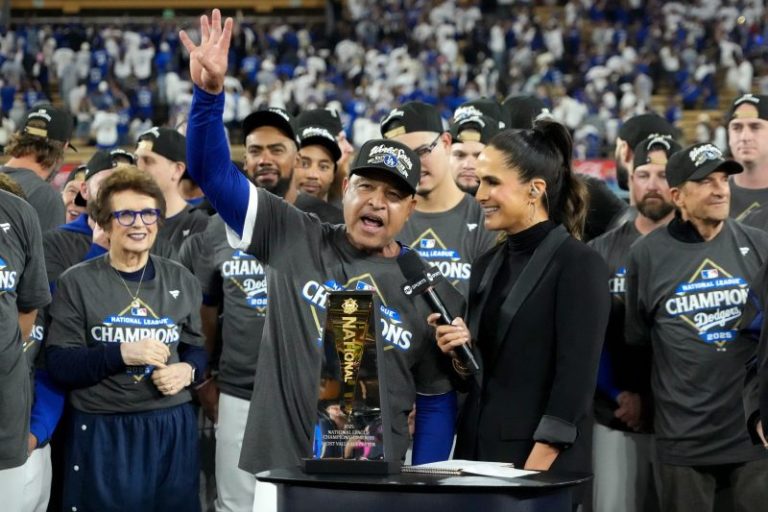
            LOS ANGELES — Manager Dave Roberts sent a clear message Friday night as he stood on the podium after the Los Angeles Dodgers won the National League Championship Series.

            Roberts used the opportunity to address the ongoing conversation about the Dodgers’ high payroll and the advantage it is said to provide compared to other teams in the league.

            “Before the season started, they said the Dodgers are ruining baseball,” Roberts said. “Let’s get four more wins and really ruin baseball.”

            The Dodgers beat the Milwaukee Brewers 5-1 in Game 4 of the NLCS to advance to the World Series for the second consecutive year.

            The manager’s message was met with a roar from the crowd that stayed after the final out for the trophy presentation.

            The Dodgers had the second-highest payroll this season at $321 million, trailing only the New York Mets ($323 million).

            The USA TODAY app gets you to the heart of the news — fastDownload for award-winning coverage, crosswords, audio storytelling, the eNewspaper and more.

            This post appeared first on USA TODAY

            Twenty years ago, one of the most iconic — and controversial — plays in college football took place in one of the sport’s greatest rivalries.

            As Southern California and Notre Dame prepare for what could be their final meeting for some time, the 2025 edition also marks the 20th anniversary of the infamous ‘Bush Push.’ In that game, No. 1 USC went into South Bend, Ind., and defeated No. 9 Notre Dame, 34-31, scoring a touchdown with three seconds left to take the lead.

            But it’s far from an ordinary touchdown, and one that has been debated by both fan bases since on whether it should have happened — or been allowed?

            USC vs Notre Dame 2005 importance

            The 2005 meeting of the Trojans and Fighting Irish had great significance before the game kicked off. Undefeated and No. 1 USC was the defending national champion and Notre Dame had hype building under first-year coach Charlie Weis. In front of a sold-out Notre Dame Stadium, the Fighting Irish wore green uniforms, something they hadn’t done since 2002.

            The game, lead-up to the Bush Push

            It was a close game from start to finish, with the teams trading leads and it a one-score game the entire way. Notre Dame took a 31-28 lead thanks to quarterback Brady Quinn with just over two minutes left in the game.

            The Trojans faced a 4th-and-9 at their own 26-yard line, and quarterback Matt Leinart placed the ball perfectly in the hands of receiver Dwayne Jarrett, who ran for a 61-yard gain into the red zone to keep USC alive.

            After picking up a first down and the clock running inside 20 seconds, Leinart scrambled to his left to try and score a touchdown. However, just as he was approaching the goal line, the ball popped out of his hands.

            Then came chaos. The clock continued to roll down to zero, and Notre Dame players and fans assumed the game was over and ran onto the field to celebrate.

            After discussion, the referees confirmed the ball went out of bounds and the clock should have stopped. The field was cleared and seven seconds were put on the clock, with USC getting the ball at the 1-yard line.

            ‘Bush Push’ play break down

            Having likely one play left, then-USC coach Pete Carroll instructed Leinart to spike the ball to set up a field goal to send the game to overtime.

            Instead, Leinart made the decision to try and sneak the ball in for a touchdown and the win. He snapped the ball and tried to get in when the infamous part of the play occurred.

            Leinart was initially stuffed, but running back Reggie Bush pushed his quarterback forward and he fell into the end zone for a touchdown to make it 34-31 en route to the victory.

            Watch: ‘Bush Push’ video

            Was ‘Bush Push’ legal?

            While there’s no doubt Leinart scored, what’s made the play controversial is whether it should have counted.

            At the time, Section 3, Article 2b of the NCAA rule book stated a runner ‘shall not grasp a teammate; and no other player of his team shall grasp, push, lift or charge into him to assist him in forward progress.’

            Bush pushed Leinart, so a flag should have been thrown.

            What’s important about the rule is while it existed, it was hardly ever enforced, so it would’ve been highly unlikely it wold have ever been called.

            Effect of ‘Bush Push’

            The play and result of the game had a dramatic effect on both teams. USC’s win streak pushed to 28 games, and had a perfect regular season en route to a spot in the national championship game. Bush also ended up winning the Heisman Trophy at the end of the year.

            The Trojans would lose in the title game to Texas.

            For Notre Dame, the loss dropped it to 4-2 and severely hurt the hype surrounding the team. The Fighting Irish ended the season 9-3 with a loss to Ohio State in the Fiesta Bowl. It also started what would be a tough skid for Weis, who went 0-5 in all his meetings with the Trojans.

            Matt Leinart, Brady Quinn meet on field again

            As you can imagine, the emotions are still there for the two quarterbacks 20 years later.

            Leinart and Quinn met inside Notre Dame Stadium earlier in the week as the 2004 Heisman Trophy winner recreated the play. However, Quinn threw a flag and said ‘they should’ve thrown it’ and ‘we should’ve won that.’

            Leinart said it was ‘the only time I’ve ever cried in a football game.’

            As the 20th anniversary approaches of the ‘Bush Push,’ the feelings are clearly still raw on both sides.

            This post appeared first on USA TODAY

            Parent the child you have, not the one you wish you had.

            Kirsten Jones thinks the line is so important, she repeats it within the text of her book.

            “Just because she doesn’t have the same passion for the game that you or her siblings might have doesn’t make her ‘damaged goods,” Jones writes in “Raising Empowered Athletes.” “It simply makes her like all the rest of us: struggling to find our places in the world.”

            Jones is a former elite Division I athlete. She has been a coach of kids, and she’s a mother of three. 

            “I feel like I learned all the chapters in the book,” Jones, now a motivational speaker and performance coach, tells USA TODAY Sports. “I’ve had the kid who was the star, I’ve had the kid who didn’t play. I’ve flown to tournaments where I sat on the sidelines for five days and she didn’t even touch the floor. And it sucks. And the tears in the car ride home for both of you are hard.”

            Her book is not so much a guide, but a pep talk. Parenting, as we discover, is an evolution. It involves patience, compromise and the right amount of levity and humor. We don’t start off knowing everything, and we never reach perfection.

             But we get better at it if we’re willing to learn along the way.

            “The joke is when you get pregnant, everyone hands you What to Expect When You’re Expecting, and you think, ‘Yes! I have all the answers and this is going to be so easy,’” she says. “And then you get to kick and chase and there’s some yahoos standing next to you on the sidelines going, ‘Well, they’re four. You’re not going to do this rec thing, are you?’”

            Jones has raised three athletes (25, 22 and 19) with her husband, Evan. Here are 10 tips she has learned about how we can raise empowered ones, whether they choose to keep playing or not:

            1. We start off with a dream; you never know where it might take you

            Jones grew up in the 1970s in Missoula, Montana, where she rode horses, skied and played basketball before she discovered her passion.

            “I didn’t actually find volleyball until high school because it became a sanctioned sport my freshman year in 1984,” she says.

            Her persistence got her to two Division I college programs, but her story is more about the pursuit of a dream that didn’t quite get fulfilled.

            “I think we should all have aspirations and just because you don’t play for Duke or Real Madrid or wherever, I believe these are all things that you’re going to take whatever you learn and that you’re going to use it for whatever’s next,” she says. “I saw a mom post the other day about, ‘My 16-year-old just quit. All that money wasted.’ 

            “You’re missing the point. Really? Did you ever sign a contract when she was five, that she was going to have to go the whole way or you weren’t gonna invest in it?”

            When we dream, we find out if we’re intrinsically motivated to pursue. Kirsten signed herself up for a volleyball camp at UC San Diego, and flew there from Missoula herself.

            Two years later, she tried out for the junior national team in Colorado Springs (“with my barely matching knee pads.”) Although she didn’t make the team, she chased down Sue Snyder, then an assistant coach at San Diego State, at the Denver airport.

            “Can I come to San Diego State?” she asked.

            2. Make sure it’s your kids’ dream, and not yours

            Jones’ father, a pulmonologist, was all about education, but also learning and growing at whatever you did.

            There were no expectations for activities Kirsten and her siblings tried. They just needed to be all in on whatever they did.

            “My parents were actually more piano and ballet, which was for me, like nails on a chalkboard,” she says. “(But) we finish what we start. So if you signed up for karate and you don’t like it a month in, OK, great, well, let’s just finish the season and then we can pick something else.

            “My dad always said, ‘If you’re playing for me, you should stop.’”

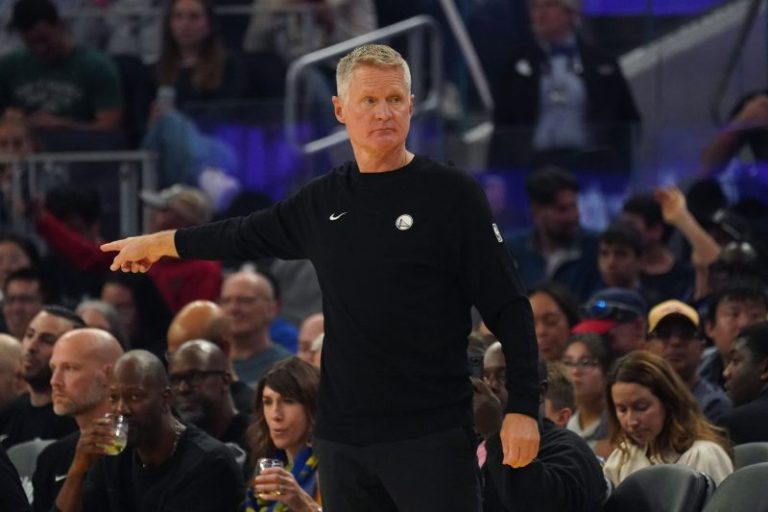
            Parenting, Golden State Warriors coach Steve Kerr told Jones and co-host Susie Walton on their “Raising Athletes” podcast, is a lot like coaching.

            “You’re not doing things for your kids,” Kerr said. “You’re trying to give them perspective and then become the best versions of themselves so that they’re making their own decisions and they’re doing the things that can help them be successful. But they’re the ones who are actually doing it.”

            Jones says we’re like the guardrails.

            3. As parents, we always have to be prepared to pivot

            Kerr was the kid who threw his glove and cried when things didn’t go well.

            “I had the worst tantrums during sports,” he told Jones and Walton. “I was so competitive that I would literally lose my mind.”

            He says his parents never said anything about it until they got home. When a few hours passed, and he would calm down, they might ask: “What are you thinking about when you’re crying?”

            “They were very thoughtful about it,” Kerr said. “Sit and observe, support but you don’t have to constantly be telling them what to do and then you help them find their own way.”

            Two of Kerr’s kids, Nick and Madeline, played Division I athletics, and Nick went on to coach in the NBA G League. But his youngest child, Matthew, wanted to play soccer to get a uniform like the one he saw his sister had.

            When Matthew was about 5, Steve and his wife, Margot, put him in his first game, and watched their son lie down and start picking daisies.

            “You’re not really into this, are you?’ Kerr said to him.

            “No.”

            It was the last sport he ever played.

            “I was fine with that,” his dad said. “He’s a writer now. He was writing stories from an early age and making movies on his home video camera and that’s what he loves and so we encouraged him to do that.”

            4. Check yourself before you check on them

            Jones’ two sons, Caelan and Parker, have played Division 1 basketball. Her daughter, Kylie, had an experience like a lot of our kids: She was on a highly competitive travel team but didn’t get into games as much as many of the other kids.

            “We didn’t even try volleyball until she was 12,” Jones says. “And that was a problem because everybody else had started at seven. And so she was behind. But I figured, I didn’t start until I was 14 and it worked out for me. Was she the best athlete? No. Did she pick it up right away and it all fell into place? Not really. And then COVID hit, and it was rough.”

            But the pandemic provided one respite: No parents were allowed in the gym. We don’t think our kids can hear us, Jones says, especially if we’re not the loudmouth who’s constantly yelling.

            “That’s the only voice they hear,” she says. “And their head’s on a swivel. She was rolling her eyes. I think even having me in the gym was stressful to her because what if I’m not living up? They don’t need the pressure.

            Instead, when practice is over, ask your kid for permission before you offer advice.

            If they say no? “Then you zip it and call a friend, talk to your spouse, go for a walk. Allow it to be their journey.”

            5. Be a friend as well as a parent

            “The dad and me says, ‘You should have done X, Y and Z,’” Jones’ husband, Evan, might ask their kids.

            “The friend in me says, ‘Wow, that was probably a really hard situation.’”

            Evan had played basketball professionally in Europe, where he met Kirsten. He played guitar on the side. Sports, like his music, was intended to be an activity to relieve stress, not provide it.

            As Caelan’s sixth grade assistant coach, he noticed the complex offense and defensive schemes the head coach devised. He politely asked him for a minute before a game.

            “Three things,” Evan told the team. “Talk to each other, space out and be aggressive. Any questions?”

            “That’s all?” asked one kid.

            “That’s all.”

            6. Have a growth mindset: Sports is resilience training for life

            Kirsten started her career working for Nike, where she loved to help professionals push through obstacles in their life.

            In her book, she writes that a growth mindset is an athlete’s willingness — and ability — to be curious about learning new skills.

            “I never made the national team, but look where I landed,” says Jones, who wound up playing volleyball at San Diego State and William & Mary. “It got me to Nike. It got me into two very good schools and a great education.”

            And it got her daughter home.

            7. We can be the sounding board while allowing our kids to be the fixers

            By the time Kylie was a senior in high school, she had made the top club volleyball team, but she was toward the back of the roster. Despite the team flying all over from their Southern California base, including to Hawaii, she was shagging balls for other players at 5:30 a.m. practice.

            “I said, ‘Kylie, I’d much rather you use your time for something you’re interested in where you can start to build the muscle that will help you figure out what you want,’” Jones said. “Unless you really just want to be on the roster.”

            “I don’t want to do this,” her daughter said.

            Here came the pivot, to film school at Loyola Marymount University, where she is now studying.

            Remember Steve Kerr’s son who picked daisies on the soccer field? He went to USC film school and worked in the writers’ room for Ted Lasso.

            8. Find things to do independently from watching your kids play sports

            Kirsten Jones says her mom and dad barely attended her games, not because they didn’t care, but because there were other things going on in their lives.

            U.S. Soccer icon Abby Wambach recently said in her podcast that, as parents, we should never even go to practice. We want our kids’ motivation to come from within, she says, not from us.

            “If you haven’t been at practice,” Wambach said, “then you don’t know what the coaches are saying. You don’t know what they’ve been working on, which is good because it’s your child’s life and their experience.”

            Our children have a right to play without us shouting over the coach.  It’s also healthy for us to have something we love to do that happily prevents us from being there all the time.

            “When do you work out?” Jones asked a woman in Colorado who called her to ask if it’s OK if she didn’t stay and watch practice.

            “I don’t, because I just go to different practices,” was the reply.

            “Go run,” Jones said. “Show your daughter that you’re important too.”

            9. Find things you can do toegher that aren’t sports

            Maybe you’re a coach and have to be there all the time. Or you’re like the parent, a former collegiate athlete, who told Jones: ‘I am embarrassed to admit the number of hours I’ve lost sleep over what team my nine-year-old has got to make.”

            Her advice? Go on a camping trip. “You will spend time alone and be where he is.”

            We all have to be prepared, when we’re camping or otherwise, for them to say: “Well, Dad, I don’t really like soccer, but I know it makes you happy. So I’ll play soccer.”

            You can say, “You don’t have to do that.”

            10. It’s never too late to change – or adjust – how to be sports parents

            When Jones was pitching her book idea, some suggested it should be called, “How to raise a pro athlete.” Her intention was the opposite.

            The book is about how we can survive, and thrive, when our careers end.

            We want our kids to have hurdles, but sometimes we need to just lower the bar. Perfectionist parenting, she says, is too hard.

            Susie Walton, the late Basketball Hall of Famer’s ex-wife who has hosted podcasts with Jones, likes to say: “If you’re perfect, get off at the wrong exit every once in a while and say out loud, ‘Oops, I made a mistake.’”

            Jones says one dad who has played in the NFL told her he was embarrassed because he yells at his young athletes on the car ride home.

            “If you fix that now, they won’t even remember,” she says. “But we’re in the moment with our kid, and well, this is it. No. It’s a moment. It’s not the moment.”

            Like with the equestrian athletes Jones sees, it’s not often about how high the fences are. Our kids just want to jump high enough.

            Steve Borelli, aka Coach Steve, has been an editor and writer with USA TODAY since 1999. He spent 10 years coaching his two sons’ baseball and basketball teams. He and his wife, Colleen, are now sports parents for two high schoolers. His column is posted weekly. For his past columns, click here.

            This post appeared first on USA TODAY

            LOS ANGELES — Shohei Ohtani continues to prove why he’s the best player in baseball.

            Ohtani propelled the Los Angeles Dodgers to a 5-1 win against the Milwaukee Brewers in Game 4 of the National League Championship Series, pitching six innings of brilliant ball while launching three home runs.

            ‘That was probably the greatest postseason performance of all time,’ Dodgers manager Dave Roberts said. ‘There’s been a lot of postseason games. And there’s a reason why he’s the greatest player on the planet.

            ‘What he did on the mound, what he did at the plate, he created a lot of memories for a lot of people. So for us to have a game-clinching — to do it in a game-clinching game at home, wins the NLCS MVP, pretty special. I’m just happy to be able to go along for the ride.’

            Ohtani was the starting pitcher and provided all the run support the Dodgers needed, with solo home runs in the first, fourth and seventh innings. His performance helped complete the sweep of the Brewers as the Dodgers advanced to the World Series for the second consecutive year.

            Ohtani’s pitching performance, which ended when he was lifted in the seventh, concluded another stellar night from the Dodgers’ starting pitchers, following Blake Snell, Yoshinobu Yamamoto and Tyler Glasnow.

            He walked the Brewers’ leadoff hitter, Brice Turang, before striking out Jackson Chourio, Christian Yelich and William Contreras in order. He finished the night with 10 strikeouts, becoming the first player to strike out 10 and hit three homers in a game, per Sarah Langs.

            ‘I really focused on, first and foremost, as a starting pitcher to make sure I’m an effective starting pitcher,’ Ohtani said. ‘On the hitting side, looking at the entire team, we will see that at times the right-handed hitters picked us up. And on the flip side, sometimes the left-handed hitters picked us up. So in a sense we’re just trying to find the right balance.’

            Ohtani provided an early spark at the plate with a solo home run in the bottom of the first inning to give the Dodgers a 1-0 lead. His teammates provided further run support in the first as Mookie Betts and Will Smith scored runs to give the Dodgers a 3-0 lead.

            ‘I think there was a lot of talk that he was scuffling at the plate; he doesn’t swing the bat well when he’s pitching. And all those things I think were fuel to his fire,’ Roberts said. ‘Today, when he took the mound, you can see the focus, the intent. And after that shutdown first inning, just the at-bat right there, you could see that he was smelling a really good night tonight.’

            Jackson Chourio managed to get the Brewers’ first hit in the top of the fourth inning, ending Ohtani’s chance at a no-hitter.

            But Ohtani launched a ball 469 feet toward center field for his second home run in the bottom of the fourth against Brewers pitcher Chad Patrick. He then got his third in the bottom of the seventh.

            Shohei Ohtani stats: Dodgers vs. Brewers results 

            • Batting: 3-for-3, 3 HR, 3 RBI, 1 BB
            • Pitching: 6 innings, 0 ER, 2 hits, 3 walks, 10 strikeouts

            Shohei Ohtani highlights vs. Brewers

            This post appeared first on USA TODAY

            How much does a long-distance call to Trinidad and Tobago cost? I’ll find out come my next phone bill.

            I went on a reporting scavenger hunt this week.

            Admittedly, more than a bit ambitious.

            Also, more than a bit peculiar.

            So is college football, though, right? Especially, college football fandom.

            See, down in Oxford, Mississippi, fans of the No. 5-ranked Rebels are flying Trinidad and Tobago flags by the dozens.

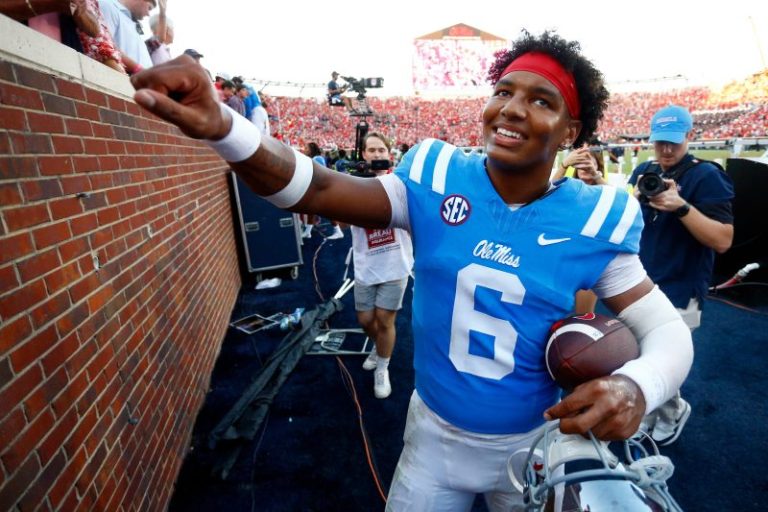
            Why? Well, because of star quarterback Trinidad Chambliss.

            While covering an Mississippi home game against LSU last month, I spotted the southernmost Caribbean island nation’s red, black and white flag displayed throughout the popular Grove tailgate gathering spot. Trinidad and Tobago flags appeared in abundance when Ole Miss hosted Washington State two weeks later. They’re all over town.

            What, exactly, is going on here?

            Well, Ole Miss’ rise has been fueled by Chambliss, a breakout star. A Division II transfer, Chambliss began the season as the team’s backup, but he got thrust into duty after starter Austin Simmons injured his ankle in Week 2. As Chambliss started to dazzle, Trinidad and Tobago flags began showing up as a way for fans to throw support behind this former zero-star recruit turned SEC dynamo.

            Chambliss, to be clear, is not from Trinidad or Tobago. He’s from Michigan. He’s not named after Trinidad and Tobago, either.

            As the Clarion Ledger reported on this week, Chambliss’ parents named him Trinidad because the Christian faith is important to the family. Trinidad is a Spanish word that translates to Trinity in English. Also, his dad liked the name after watching boxer Felix Trinidad on TV.

            And, there you have it. Chambliss’ parents named their son Trinidad, and Ole Miss fans used the flag of a country whose capital is 2,400 miles away from Oxford to support their quarterback. Fads have started for more bizarre reasons than this. Ole Miss fans and even coach Lane Kiffin are including the Trinidad and Tobago flag emoji in social media posts about the team. Dick’s Sporting Goods even sells a red T-shirt featuring the Trinidad and Tobago flag with the words “Ole Miss” underneath for $35.

            “We were down there (for the Washington State game),’ Chambliss’ mom, Cheryl, told the Clarion Ledger, part of the USA TODAY Network. ‘Driving to brunch through the neighborhoods in Oxford and seeing so many houses flying the flag of Trinidad and Tobago, (it’s) quite amazing.”

            Chambliss credits fans’ creativity.

            “I love it — all the flags at the tailgates. It’s really cool,” he said earlier this season. “My family loves it, too.”

            I wanted to know, though, as Ole Miss prepares for a nationally televised clash at No. 7 Georgia, is anyone in Trinidad and Tobago aware of this surging phenomenon, of their country’s flag becoming a Mississippi football rally symbol at games and on display throughout a college town in the southern United States?

            I phoned and sent messages to Trinidad and Tobago’s Ministry of Sport, as well of its Ministry of Tourism and Ministry of Culture. I spoke with a woman at a private tourism group who said I wasn’t the first reporter to call her this week. I emailed a couple of sports editors at newspapers in Trinidad, the larger of the country’s two main islands located off the coast of Venezuela.

            No luck. I failed to connect with anyone in Trinidad or Tobago familiar with Chambliss or the flag fad he inspired. Hardly a surprise. Cricket and soccer are Trinidad and Tobago’s most popular sports. A scan of Trinidad’s newspapers shows no headlines about American college football.

            Late in the week, though, the Trinidad and Tobago embassy in Washington D.C. returned my phone call. Although they weren’t familiar with Chambliss or their country’s flag flying at Ole Miss games before I called, they are now. And, apparently, they’re now planning to watch the Ole Miss-Georgia game, televised on ABC.

            “The Mission is truly impressed by this remarkable phenomenon,” Janae Harris, a senior executive officer at the Trinidad and Tobago embassy in D.C., wrote in an email to me.

            “Please be assured,” she added, “we too will be tuning in to the Trinidad Chambliss game to witness this moment on Saturday.”

            And if this quarterback named Trinidad, who’s captured the heart and creative spirit of Ole Miss, helps author a victory at Georgia, you best believe Trinidad and Tobago flags will be displayed with pride and affection back in Mississippi.

            Sam Hutchens’ reporting for the Clarion Ledger, part of the USA TODAY Network, contributed to this column.

            Blake Toppmeyer is the USA TODAY Network’s senior national college football columnist. Email him at BToppmeyer@gannett.com and follow him on X @btoppmeyer.

            This post appeared first on USA TODAY