
Author

admin

Browsing

Here’s a quick recap of the crypto landscape for Wednesday (October 8) as of 9:00 p.m. UTC.

Get the latest insights on Bitcoin, Ether and altcoins, along with a round-up of key cryptocurrency market news.

Bitcoin and Ether price update

Bitcoin (BTC) was priced at US$123,495, up by 1.5 percent in 24 hours. The cryptocurrency’s lowest valuation of the day was US$121,829, and its highest was US$124,072.

Bitcoin price performance, October 8, 2025.

Chart via TradingView.

Despite retreating to around US$121,000 on Tuesday (October 7), Bitcoin on-chain data and a rising relative strength index still indicate strong momentum and accumulation, with resistance near US$135,000 and support around US$113,300. Analysts believe the crypto market is transitioning from a speculative phase to a “maturity phase,” where institutional strategies and asset allocation will drive price discovery rather than retail hype.

A new report from CF Benchmarks forecasts that Bitcoin could climb another 20 percent to reach US$148,500 by the end of 2025, while the number of crypto exchange-traded funds (ETFs) is expected to double to 80.

The report also projects that stablecoins could hit US$500 billion in circulation.

Various macro factors are shaping this bullish narrative for the sector. Market uncertainty tied to US President Donald Trump’s economic and fiscal policies, his ongoing tension with the Federal Reserve and uncertainty surrounding the ongoing government shutdown have spurred what analysts describe as a “debasement trade.” Investors seeking protection from currency risk are turning to traditional hedges like gold, and increasingly to Bitcoin.

The Fed’s recent interest rate cut has provided additional support for risk assets. CF Benchmarks expects two more reductions by the end of the year, bringing rates closer to the 3.25 percent level.

Despite inflation concerns, analysts argue that Bitcoin remains undervalued, sitting at the lower end of its estimated fair-value range between US$85,000 and US$212,000. According to trader Ted Pillows, if Bitcoin manages to hold the US$120,000 area, it could mark the beginning of a reversal phase and signal renewed bullish momentum.

By Wednesday afternoon, Bitcoin had steadied near US$123,400, recovering some losses, with ETF inflows continuing to boost institutional confidence. The total market cap of cryptocurrencies currently stands at around US$4.3 trillion, per CoinGecko, while the circulating value of stablecoins has already surpassed $300 billion.

Ether (ETH) also slid after last week’s rally, but has since recovered some of its losses. It was up by 0.7 percent over 24 hours to US$4,518.05. Ether’s lowest valuation on Wednesday was US$4,441.20, and its highest was US$4,544.36.

Altcoin price update

  • Solana (SOL) was priced at US$229.20, an increase of 1.6 percent over the last 24 hours and its highest valuation of the day. Its lowest valuation on Wednesday was US$220.04.
  • XRP was trading for US$2.91, up by 3.2 percent over the last 24 hours. Its lowest valuation of the day was US$2.86, and its highest was US$2.92.

Crypto derivatives and market indicators

Total Bitcoin futures open interest was at US$98.85 billion, an increase of roughly 0.84 percent in the last four hours.

Ether open interest stood at US$60.24 billion, down by 0.07 percent in four hours.

Bitcoin liquidations were at US$34.01 million over four hours, primarily forcing long positions to close, which could lead to selling pressure. Ether liquidations totaled US$25.18 million, with the majority being short positions.

Fear and Greed Index snapshot

CMC’s Crypto Fear & Greed Index climbed into high neutral territory after dipping to fear during the last week of September. The index currently stands around 55, inching closer to greed.

CMC Crypto Fear and Greed Index, Bitcoin price and Bitcoin volume.

Chart via CoinMarketCap.

Today’s crypto news to know

JPMorgan says stablecoins could add US$1.4 trillion in dollar demand by 2027

A new JPMorgan Chase (NYSE:JPM) research note estimates that global stablecoin adoption could generate up to US$1.4 trillion in additional demand for US dollars within the next two years, according to Reuters.

The bank’s analysts argue that as foreign investors and corporations increasingly hold dollar-pegged stablecoins, they will effectively strengthen the greenback’s global position. The report projects that the stablecoin market could reach US$2 trillion in a high-end scenario, up from roughly US$260 billion today.

With 99 percent of stablecoins pegged 1:1 to the US dollar, JPMorgan says expansion will translate directly into higher dollar-denominated reserves. The findings counter fears that digital currencies could accelerate “de-dollarization” by offering alternatives to the US financial system.

ICE to invest US$2 billion in Polymarket

Intercontinental Exchange (ICE), the owner of the New York Stock Exchange, is making a major bet on crypto-powered prediction markets. The company announced plans to invest up to US$2 billion in Polymarket, valuing the blockchain-based betting platform at about US$8 billion, a sharp rise from its US$1 billion valuation just two months ago.

Polymarket has gained prominence for its political, sports and entertainment wagers, including high-profile bets on the US presidential race. The deal will allow ICE to distribute Polymarket’s market data globally, signaling a push to integrate event-based contracts into mainstream finance. Founder Shayne Coplan said in a press release that the investment “marks a major step in bringing prediction markets into the financial mainstream.”

The firm is also working to re-enter the US market after acquiring a small derivatives exchange earlier this year.

BNY Mellon to explore tokenized deposits

BNY Mellon, the world’s largest custodian bank, is reportedly exploring tokenized deposits to enable instant, 24/7 fund transfers for clients, aiming to overcome limitations in legacy systems. Carl Slabicki, executive platform owner for Treasury Services, stated that this initiative is part of an effort to upgrade real-time and cross-border payments. The goal is to move a portion of BNY’s US$2.5 trillion daily payment flow onto the blockchain.

Slabicki highlighted that tokenized deposits help banks overcome technology constraints, facilitating the movement of deposits and payments within their own ecosystems and eventually across the broader market.

S&P Global to launch new crypto ecosystem index

The S&P Global, in partnership with Dinari, is creating a new investment index that will bring together both cryptocurrencies and publicly traded blockchain-related companies into a single benchmark called the S&P Digital Markets 50 Index. The index will include 15 cryptocurrencies and 35 public companies in the sector.

No single component will exceed 5 percent. Major companies like Strategy (NASDAQ:MSTR), Coinbase Global (NASDAQ:COIN) and Riot Platforms (NASDAQ:RIOT) are expected to be included.

Dinari plans to issue a tokenized version of the index, known as a “dShare,” which would allow investors to gain direct exposure. The investable version is expected to launch by the end of 2025.

Securities Disclosure: I, Meagen Seatter, hold no direct investment interest in any company mentioned in this article.

Securities Disclosure: I, Giann Liguid, hold no direct investment interest in any company mentioned in this article.

This post appeared first on investingnews.com

Saskatchewan has introduced a new royalty framework for lithium production, marking a major step toward supporting the province’s growing role in Canada’s critical minerals sector.

The amendments to 2017 subsurface mineral royalty regulations formally establish a 3 percent Crown royalty on the value of brine mineral sales, coupled with a two year holiday for new productive capacity.

Provincial officials said the change aligns Saskatchewan’s royalties for lithium with those already applied to potash, salt and sodium sulfate, and keeps the province competitive with leading jurisdictions worldwide.

“Lithium is a critical mineral that is expected to see strong demand and growth in the decades ahead, and Saskatchewan is well-positioned to take advantage of this opportunity,” Energy and Resources Minister Colleen Young said.

“By putting this royalty framework in place now, we are providing certainty for industry, while ensuring the people of Saskatchewan benefit as this sector develops,” Young added.

Industry participants have welcomed the move, calling it a clear signal that the province intends to be a serious player in the global lithium supply chain. Canada-based explorer EMP Metals (CSE:EMPS,OTCQB:EMPPF) described the royalty rate as internationally competitive and a meaningful boost for project economics.

“This is very welcome news. The government of the province of Saskatchewan has once again proven itself to be supportive of lithium production in the province,” EMP Metals CEO Karl Kottmeier said. “This is a highly competitive royalty rate internationally, and a two-year royalty holiday on new production immediately makes a positive impact on financial modelling of what is already a compelling business case for our Project Aurora lithium production project.”

Grounded Lithium (TSXV:GRD) President and CEO Gregg Smith noted that the policy encourages further investment, while recognizing the high upfront costs of developing processing capacity.

“This new regulatory framework provides a reasonable royalty rate while also recognizing the significant risk and initial investment companies make in processing facilities to ultimately achieve commercial production,” he said.

Saskatchewan has emerged as one of Canada’s top destinations for mining investment. The Fraser Institute’s annual mining company survey ranked it the country’s leading jurisdiction, with the province projected to attract over US$7 billion in mining investment this year — more than a quarter of Canada’s total.

The lithium framework also aligns with the province’s broader Critical Minerals Strategy, launched in 2023 to position Saskatchewan as a key contributor to Canada’s resource independence and energy transition.

The plan targets a 15 percent share of national mineral exploration by 2030, the doubling of critical mineral production, and the expansion of existing potash, uranium, and helium output.

Securities Disclosure: I, Giann Liguid, hold no direct investment interest in any company mentioned in this article.
This post appeared first on investingnews.com

Major miner BHP (ASX:BHP,NYSE:BHP,LSE:BHP) welcomed October with the news that it will invest over AU$840 million in its Olympic Dam copper operation in South Australia.

In an October 1 release, the commodities giant said that the funding is for a series of “growth-enabling projects” at the site, focused on strengthening underground mining productivity.

The company outlines several priority projects it intends to pursue at Olympic Dam, namely the construction of an underground access tunnel, a new backfill system, expansion of ore pass capacity and the installation of a new oxygen plant to improve smelter performance and support increased copper-processing capability.

“We expect to grow our copper base from 1.7 million tonnes to around 2.5 million tonnes per annum,” shared BHP COO Edgar Baston. “Achieving that scale requires significant copper growth, and we are fortunate to have a world-class copper province right here in South Australia to do just that.” According to Baston, BHP’s South Australian copper province has been delivering over 300,000 tonnes a year for the past three years.

Copper demand set to rise

In a global trade update shared in May, UN Trade & Development notes that global demand for copper is expected to grow by over 40 percent by 2040. This projected demand increase will drive supply requirements, with the organisation citing the need for around 80 new mines and US$250 billion in investment by 2030 to keep up.

For its part, BHP notes that global copper demand is projected to grow 70 percent by 2050 due to population growth, rising living standards and the energy transition. It adds that this poses a general opportunity for South Australia, underlining that it holds about two-thirds of Australia’s copper resources.

History of Olympic Dam

Olympic Dam was acquired by BHP in 2005 through its acquisition of Western Mining. It has become a cornerstone of BHP’s copper portfolio, with copper accounting for around 70 percent of the asset’s total revenue.

In its 2025 fiscal year, BHP reported a production of over 2 million tonnes of copper for the first time.

Don Farrell, Australian minister for trade and tourism, commented on the company’s investment in Olympic Dam, noting, ‘Australia is at the forefront of the energy transition in which copper is a vital resource and by securing the continued flow of copper from Olympic Dam, BHP is ensuring South Australia’s position as a key global supplier.”

BHP October updates

Also in early October, BHP iron ore cargoes were banned by Chinese iron ore buyer China Mineral Resources Group. The move reportedly stems from pricing disputes and has raised concerns for Australia.

Australia remains China’s top provider of iron ore, and BHP continues to be among the country’s major iron ore exporters, alongside Rio Tinto (ASX:RIO,NYSE:RIO,LSE:RIO) and Fortescue (ASX:FMG,OTCQX:FSUMF).

BHP has not commented on the matter as of writing.

On a positive note, BHP launched the fourth edition of its Xplor Critical Minerals Accelerator Program.

As in previous cohorts, Xplor 2026 participants can receive up to US$500,000 in equity-free funding, mentorship and access to BHP’s global network of suppliers and service providers.

Submissions close on October 15 at 11:59 p.m. AEST.

Securities Disclosure: I, Gabrielle de la Cruz, hold no direct investment interest in any company mentioned in this article.
This post appeared first on investingnews.com

LOS ANGELES — The Philadelphia Phillies tried to tell everyone they wouldn’t panic.

No one believed it.

They kept saying that maybe a change of scenery to Dodger Stadium would relax them.

No one believed it.

They insisted that their powerful trio of All-Star hitters would break out.

No one believed it.

When the Philadelphia Phillies lined up Wednesday night on the Dodger Stadium field for handshakes, blasting the Los Angeles Dodgers 8-2 in front of a stunned sellout crowd of 53,689, they suddenly have a whole lot of believers.

The Phillies still are in trouble, of course, trailing the Dodgers 2-1 in this best-of-five National League Division Series, with Game 4 scheduled for Thursday, Oct. 9 at Dodger Stadium.

Yet, they are alive.

And they also have that dynamic the Dodgers badly wanted to prevent.

Momentum.

“Momentum’s always something that you don’t know if it’s real or not,’ Dodgers third baseman Max Muncy said before the game. “You definitely feel it, though, as a player in certain situations, you feel the momentum change.

‘Obviously we want to finish this tonight, and we don’t want to let anything slip away from us. That’s one of those things, when you talk about momentum, if you don’t finish it tonight, you feel like it’s slipping away. That’s definitely not something you want to have happen.’

Well, it happened.

“We want to put these guys away,’’ Dodgers manager Dave Roberts said before the game, “and don’t let them up for air.’

Well, after what transpired Wednesday, the Phillies suddenly have confidence too.

The Phillies, whose season was on life support after losing the first two games in front of their home crowd at Citizens Bank Park in Philadelphia, believe they can pull this off.

After all, they became the first team in two weeks to beat the defending World Series champions, snapping the Dodgers’ nine-game winning streak.

While Ranger Suarez was brilliant in his five-inning outing coming in relief for Aaron Nola in the third inning, it was the Phillies’ powerful trio who reminded everyone just what they’re capable of doing to the opposition.

Kyle Schwarber, Bryce Harper and Trea Turner, who were in a 2-for-21 skid entering the game, put on a power-hitting clinic for everyone to see.

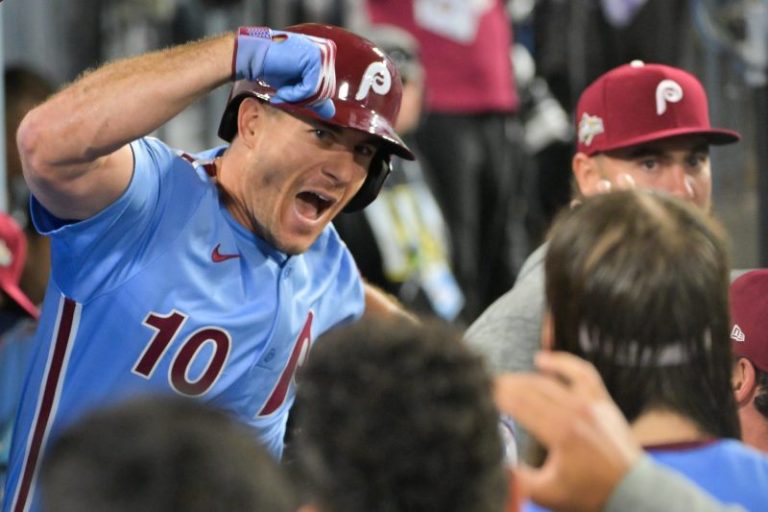
There was Schwarber hitting two home runs, including a 455-foot blast in the fourth inning, with three RBIs.

Turner, who produced three hits and two RBI, broke the game open in the Phillies’ five-run eighth.

There was Harper who had a two-hit game and reached base three times.

Just like that, the Phillies looked like well … the Phillies.

They made sure that Dodgers ace Yoshinobu Yamamoto, who entered the game with a 0.66 ERA in his last six starts, couldn’t make it out of the fifth inning.

It began with Schwarber, who had been hitless in his last 22 at-bats when he stepped up to the plate to lead off the fourth. The slump ended with one majestic swing of the bat.

Schwarber sent Yamamoto’s fastball nearly out of the stadium, landing 455 feet into the right-field pavillion. It was hit so far, and so hard (117-mph), that Dodgers right fielder Teoscar Hernandez didn’t move.

Just like that, the Phillies’ bats awoke.

Harper, who had also been handcuffed this series, followed by slapping a single to left field. Byson Stott singled and when Harper headed to third, center fielder Andy Pages tried to get him. The ball instead sailed past third baseman Max Muncy and bounced into the Dodgers’ dugout, scoring Harper with Stott advancing to third. Brandon Marsh made it 3-1 with a sacrifice fly to left field.

Yamamoto came out for the fifth, but was immediately greeted by with singles by Bryson Stott and Trea Turner knocking him out of the game. It was his shortest outing since June 1.

The Phillies, after a double steal, then had a golden opportunity to blow open the game against left-handed reliever Anthony Banda. Yet, Schwarber struck out. Harper hit a shallow pop-up to right field. And after Bohm was intentionally walked, loading the bases, Brandon Marsh struck out on three pitches. Well, technically two ptiches – with Marsh being charged with an automatic strike on a pich clock violation.

The Phillies threatened again in the seventh inning off three-time Cy Young winner Clayton Kershaw coming into the game relief, with a leadoff single by Turner and a walk by Schwarber. But Harper flied out to right, and then Schwarber was picked off first base when he wandered too far, and the opportunity ended on Brandon Marsh’s line drive to right.

Finally, they broke through in the eighth on J.T. Realmuto’s homer, Turner’s two-run single, and a two-run homer by Schwarber.

Who knows what can happen now, with Dodgers shortstop Mookie Betts vividly remembering the feeling of struggling in the postseason before ending his slump last year.

“I’ve been there…,’ Betts said. “When you get in that rut and it seems like it’s quicksand. No matter what you do you just can’t get out of it. It’s tough. Hell, I didn’t get out of it. So I have no advice or anything. I mean, shoot, I would have if I knew what to do.

“Good luck to those guys and we’ll see if they have the answer.”

For one night, they certainly did.

Follow Nightengale on X: @Bnightengale

Here’s how Wednesday’s game unfolded:

Kyle Schwarber home run blows it open

Coming back out for a second inning, Clayton Kershaw gave up a leadoff home run to J.T. Realmuto. He then walked Max Kepler and Nick Castellanos reached on an error before Bryson Stott bunted them to second and third. With one out, Trea Turner hit a two-RBI single to make it 6-1 Phillies. Then, Kyle Schwarber delivered his second home run of the game, a two-run shot that extended Philadelphia’s lead to 8-1.

Clayton Kershaw comes out of the bullpen

Trailing 3-1 in the seventh, Dave Roberts brought Clayton Kershaw out of the bullpen for his first appearance of the 2025 postseason. Kershaw was met with the Phillies’ best hitters and gave up a leadoff single to Trea Turner before walking Kyle Schwarber. The veteran left-hander got Bryce Harper to fly out and then Schwarber was picked off in a baserunning blunder for the second out.

After intentionally walking Alec Bohm, Kershaw retired Brandon Marsh on a hard-hit line drive to right, getting out of the inning without allowing a run.

Kershaw, retiring at the end of the season, won three Cy Youngs and an MVP award, surely heading for the Baseball Hall of Fame.

Phillies still lead 6-1 in the sixth

Anthony Banda (fifth) and Jack Dreyer (sixth) put up zeroes relieving Yoshinobu Yamamoto, managing to keep the Phillies from adding insurance runs despite Philadelphia loading the bases in the fifth.

Phillies ambush Yoshinobu Yamamoto in the fourth

Kyle Schwarber’s mammoth home run led off the top of the fourth and tied the game. The next batter, Bryce Harper, singled and then scored as a result of Andy Pages’ throwing error on Alec Bohm’s single. The ball went out of play and moved Bohm to third and Brandon Marsh brought him home with a sacrifice fly for the first out of the inning. J.T. Realmuto hit a ground-rule double but Yamamoto got Max Kepler and Nick Castellanos to end the frame with the Phillies up 3-1.

Kyle Schwarber home run ties it up

Leading off the fourth inning, Kyle Schwarber hit a 455-foot homer off Yoshinobu Yamamoto to tie the game.

The Phillies slugger had been stuck in an 0-for-23 slump having led the Natioinaln League with 56 home runs in the regular season.

Tommy Edman home run welcomes Ranger Suarez

Phillies manager Rob Thomson stuck with his plan to limit Aaron Nola’s exposure and pulled the right-hander after two innings to put in southpaw Ranger Suarez.

On Suarez’s first pitch of the night, switch-hitter Tommy Edman hit a solo home run to left field, giving the Dodgers a 1-0 lead in the third.

Meanwhile, Yoshinobu Yamamoto held the Phillies hitless through three innings.

Aaron Nola escapes first-inning jam

Dodgers-Phillies Game 3 underway in Los Angeles

Yoshinobu Yamamoto worked around Bryce Harper’s two-out walk to toss a scoreless first at Dodger Stadium.

In his second year after signing a $325 million contract before throwing an MLB pitch, the Japanese right-hander was the Dodgers’ ace this season with an All-Star nod and a 2.49 ERA.

Phillies lineup today

  1. Trea Turner (R) SS
  2. Kyle Schwarber (L) DH
  3. Bryce Harper (L) 1B
  4. Alec Bohm (R) 3B
  5. Brandon Marsh (L) CF
  6. J.T. Realmuto (R) C
  7. Max Kepler (L) LF
  8. Nick Castellanos (R) RF
  9. Bryson Stott (L) 2B

Dodgers lineup today

  1. Shohei Ohtani (L) DH
  2. Mookie Betts (R) SS
  3. Teoscar Hernández (R) RF
  4. Freddie Freeman (L) 1B
  5. Will Smith (R) C
  6. Enrique Hernández (R) LF
  7. Max Muncy (L) 3B
  8. Andy Pages (R) CF
  9. Tommy Edman (S) 2B

Will Smith returns to Dodgers lineup

The Dodgers’ All-Star catcher is in the starting lineup for the first time this postseason in Game 3, coming off the bench in each of the first two games in the series. Smith had missed nearly a month with a hand fracture.

‘The at-bats have been fantastic especially considering the arms that he’s had to face coming into both those games and the lay-off,’ Dodgers manager Dave Roberts said before Game 3.

‘If I didn’t feel he could finish a game I wouldn’t have started him. I feel good. He’s in a good spot. I think the at-bat quality has been great.’

This post appeared first on USA TODAY

Now that the season is nearly a third of the way through, there are only two ways to improve your rosters — waiver wire and trades.

Evaluating a fantasy trade can be a daunting task. Most managers value their players more than they’re actually worth. That’s where the Week 6 fantasy football trade value charts come in.

The charts can be used as your very own fantasy football trade analyzer in standard, half-PPR (point per reception) and full PPR leagues. Someone sends you an offer? Simply pull out a calculator (on your phone, you don’t need an actual calculator) and plug in the values for each player. Don’t worry, six-points-per-passing-touchdown and superflex leagues are covered as well.

Important note: If you’re offered an uneven trade (i.e., a 2-for-1 or 3-for-1), include the values for the players you’d be moving to the bench or dropping within your calculation. Example: If someone in your league offers you Cam Skattebo, Romeo Doubs, and David Njoku (combined value of 79) for Jonathan Taylor (72), it might look like you’re getting the better end of it. However, if you’re bumping down, say, AJ Barner and Kimani Vidal (combined value of 26) in the process, it’s a net negative deal for you.

The rankings are based on how players should be valued in 12-team leagues. Players are sorted in order of their half-PPR values.

Quarterback trade value chart

(Note: ‘6/TD’ is for leagues that award six points for passing touchdowns and ‘SFLEX’ stands for superflex.)

Running back trade value chart

Wide receiver trade value chart

Tight end trade value chart

Overall Week 6 fantasy football rest-of-season rankings

Note: These values are for 12-team, one-QB leagues with half-PPR scoring.

This post appeared first on USA TODAY

Arturo Gatti Jr. has died at the age of 17 in Mexico, where he lived with his mother on Wednesday, according to the World Boxing Association.

The son of the late Canadian boxer and Hall of Famer Arturo Gatti has recently been confirmed deceased by several close family members, including Gatti Sr.’s former bodyguard. However, the circumstances surrounding his death remain unclear, and details have yet to be released.

Gatti Jr. lost his father at a young age after what was initially considered a mysterious death in a hotel in Brazil in 2009. Later, Brazilian authorities ruled the death a suicide. From an early age, Gatti Jr. aspired to follow in his father’s footsteps, first aiming to compete in the Olympics as an amateur before shifting his focus to a professional boxing career.

‘The WBC sends its heartfelt condolences to the Gatti family, friends, and the entire boxing community mourning this so heartbreaking loss,’ the World Boxing Council wrote.

The USA TODAY app gets you to the heart of the news — fastDownload for award-winning coverage, crosswords, audio storytelling, the eNewspaper and more.

This post appeared first on USA TODAY

  • The College Sports Commission has created a new ‘snitch line’ for reporting rules violations.
  • This reporting system is open to everyone, including coaches, players, and the general public.
  • Reports can be submitted anonymously via text, email, or a web portal.

Seriously, look at these geniuses. You’re not getting anything by these trendsetters.

The College Sports Commission has rolled out a new tool for rules enforcement, and nothing says weren’t you once the NCAA quite like a snitch line. 

I promise you, I’m not making this up.

Not only did the CSC come up with this incredibly flawed idea, they’ve opened the snitch line to everyone. Everyone, you say?

Everyone

Coaches and players, athletic directors and boosters, and, wait for it … the rest of God’s green earth.

What could go wrong? 

Clearly, the good folks at the CSC don’t understand their constituency. So before we go further, let me throw out some examples. 

Trust me when I say, it takes all kinds. 

Like Harvey Updyke, bless his tortured soul, who killed the trees at Toomer’s Corner.

Or former Tennessee coach Jeremy Pruitt, whose wife, Casey, carried cash in a Chick-Fil-A bag and dolled it out to recruits. Before the House case, of course. 

Or the yet to be named “source” — and by source, I mean someone with a string of Bucknuts tied to their rearview mirror — who exposed Michigan’s advanced scouting scheme.

Or the Alabama (notice the trend?) attorney, representing two former Tide assistant coaches, who sued former Tennessee coach Phil Fulmer (notice the trend?) for conspiring with the NCAA to damage the Alabama program — and tried to have him served at SEC media days. 

Or many of the millions of the beautifully unhinged that make this sport breathe on a daily, fanatical basis. 

They’ll flood the snitch line with every hint of every possible instance of their bitter rival cheating to get a leg up on their school. Because, after all, it was on BigRedHuskersFans.com, so it must be true.

My god. MY GOD.

I gotta tell you, maybe Brian Seeley — the new CSC/college football czar hired after the House case settlement completely changed the sport forever — should’ve stayed with Major League Baseball. He has no idea what he’s getting into.

Maybe someone, anyone, at the CSC can introduce Seeley to the entire 16-team SEC. For starters, anyway.

If he thought the Houston Astros’ fun little scheme of stealing signs was a heavy lift from his perch as MLB executive vice president of legal and operations, he better strap in. 

It’s about to get real.

No one cheats like college football. Those coaching and those playing, those born and forced to choose between USC and UCLA, or Alabama and Auburn, or Indiana and Purdue, or Kansas and Kansas State, or any other sick, twisted and wonderfully wild rivalry that brings out the uniquely unknown from all involved.

Everybody cheats, including – and I know this is going to shock Seeley, so hang onto your 162-game schedule, Bri – the universities themselves. 

For the love of pigskin, North Carolina used fake classes for a decade to keep athletes academically eligible (that was once a thing, kids). And when caught, the most amazing thing in the history of legal defense unfolded. 

North Carolina, the bastion of academia and the Harvard of the south, declared the classes weren’t fake because – wait’ll you get a load of this – every student had access to the fake classes. 

And the NCAA bought it. 

So yeah, roll out that snitch line. Good times are on the horizon, baby.

The CSC says they’ll protect your identity. And they promise to get back to you with “continued engagement.” 

You can snitch or send your conspiracy via text, email or submit on the web, and you don’t have to identify yourself. Again, I’m not making that up. 

“The CSC encourages anyone with knowledge of or concerns about potential violations of third-party NIL or revenue sharing rules to use the new system to report them immediately,” some public relations wonk penned in the release. 

These guys have no idea what they’re getting into. 

Matt Hayes is the senior national college football writer for USA TODAY Sports Network. Follow him on X at @MattHayesCFB.

This post appeared first on USA TODAY

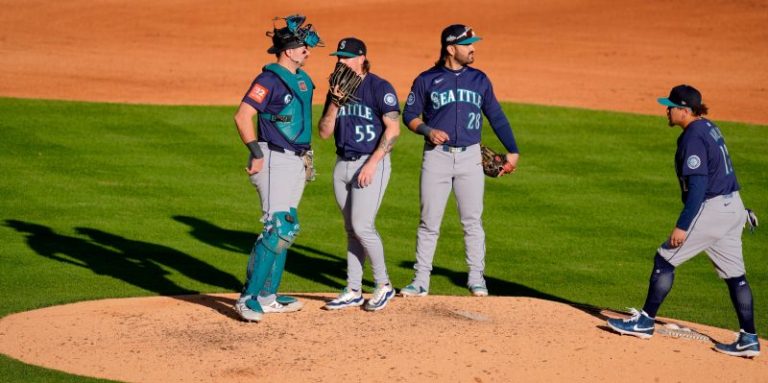
The proverbial “lights-out bullpen” is the desire of every Major League Baseball playoff team. Yet it doesn’t take much for the indicator lights on the dashboard to start blinking.

The Seattle Mariners found this out in Game 4 of their American League Division Series when they bumped up against the two f-words of postseason relief.

Familiarity. And fatigue.

They were up three runs and just 15 outs from dispatching the Detroit Tigers and claiming the first spot in the AL Championship Series when the diminishing returns of relief pitching reared its head.

Detroit struck for seven runs over two innings against Gabe Speier and Eduard Bazardo, who’d been near-perfect in the first three games of the series, to salvage its season and send both teams winging it back to Seattle for a decisive Game 5.

Where presumed Cy Young Award winner Tarik Skubal will await the Mariners.

That’s how quickly these things can turn: From comfortable lead and bullpen security blankets to lightning striking, the Tigers evening the series with a 9-3 victory that squares this ALDS 2-2.

And to think the Mariners nearly rocked these Tigers to sleep.

Comerica Park was a funeral parlor into the bottom of the fifth, with Mariners right-hander Bryce Miller outkicking his 2025 statistics to allow just two hits through four innings. Then things got loud – and unsuspecting fans were about to see nine unanswered runs on the board.

Dillon Dingler’s double scored Spencer Torkelson, who’d singled. It was 3-1. Dan Wilson, in his first full season as manager, prudently hooked Miller for the lefty Speier – only to get outflanked by his counterpart.

Sure, Speier had seen eight Tigers hitters in this series – and retired all eight of them, striking out four. But increased exposure brings adversity for even the more immortal pitchers.

‘There are no secrets,’ says Tigers manager A.J. Hinch, ‘when you get this deep into a series.’

And Speier suddenly looked like a mere mortal.

Hinch threw up righty-swinging Jahmai Jones to pinch-hit in Parker Meadows’ place, and he hooked an RBI double down the left field line. A 3-2 game.

No. 9 hitter Javy Baez reawakened the echoes of 2016 with a solid single to plate Jones. A 3-3 game.

Speier worked around a Baez stolen base, got a groundout, issued an intentional walk to Gleyber Torres and escaped the jam with the score tied.

That should have been it.

But Wilson opted to bring back Speier, despite having to sit down and run back out there, despite the familiarity that Greene might enjoy, having seen Speier twice already this series.

“Just trying to get it to the next guy. Just trying to get on base for the guys behind me,” the ever-humble Greene, 2 for 14 with no extra-base hits in the series before that at-bat, said after the game.

He did much more – clouting a Speier slider 454 feet into the right field seats. Suddenly, the Tigers had a lead for the first time since the 11th inning of Game 1.

Hey, no worries. Wilson simply turned to Eduard Bazardo, who’d pitched in Games 1, 2 and 3, who’d recorded seven outs and gave up just one hit.

Wilson was asked after the game if he was concerned that the Tigers had seen Speier twice and Bazardo three times before Game 4.

‘These guys have thrown the ball so well, and I don’t think that’s a risk,’ says Wilson. ‘These guys have done the job and thrown the ball extremely well, and today they just – they were able to get to us.’

The Tigers rocked Bazardo for four hits, including a Baez home run, fattening the lead and ensuring they’d only need closer Will Vest for one, not two innings.

Game 5?

Well, they’ll all have a day off as they hop from the D to the Pacific Northwest. The arms should ostensibly be rested. Skubal will be breathing fire, still stinging from his Game 2 loss.

The Mariners? They can only hope one more game of familiarity doesn’t set off the fireworks in Detroit’s lineup.

This post appeared first on USA TODAY

Canada One Mining (TSXV:CONE, OTC:COMCF, FSE:AU31) is an emerging explorer focused on the Quesnel porphyry belt, one of Canada’s most prolific critical mineral districts. Its flagship Copper Dome project, adjacent to the 45,000 t/day Copper Mountain mine (702 Mt at 0.24 percent copper, 0.09 grams per ton gold, 0.72 grams per ton silver), offers brownfield porphyry copper potential with strong discovery upside.

The flagship Copper Dome project is a 12,800-hectare, 100-percent-owned land package located just 1.5 km south of Hudbay Minerals’ Copper Mountain mine and 18 km from Princeton, British Columbia. With year-round road access, grid power, water supply, and nearby services, the project requires no camp or helicopter support and sits within a three-hour drive of Vancouver.

Positioned in the lower Quesnel porphyry belt—one of Canada’s most prolific porphyry copper districts—Copper Dome offers compelling exploration potential. Backed by a fully permitted, five-year drill program, the project is poised to deliver near-term results and game-changing catalysts.

Company Highlights

  • Flagship Copper Project in Tier-1 Jurisdiction: 12,800 ha Copper Dome land package, adjacent to Hudbay’s Copper Mountain mine, one of Canada’s most prominent copper operations.
  • Discovery Thesis: Porphyry cluster-style deposit potential; Copper Mountain deposit analogs average ~150 to 200 Mt.
  • Logistics Advantage: Year-round access, no camp/helicopters; 3 to 3.5 hrs from Vancouver; pine-beetle-thinned cover aids access.
  • Technical Uplift: Transitioning to four-acid digestion (industry standard) vs. the historical three-acid will, on average, return materially high metal values especially where minerals are more resistant to dissolution.
  • Near-term Catalysts: Five-year drill permits in place; upcoming geophysics, geochemistry and drill programs across multiple porphyry copper/gold zones.
  • Multiple Assets in Canada: In addition to Copper Dome, Canada One’s other exploration assets include the historical small-scale, past-producing Goldrop property and the Zeus gold project.
  • Valuation Upside: Market cap just below C$3 million provides significant leverage to discovery and exploration success.
  • Capital Strategy: Management will not finance below $0.10; interim self-funding to minimize dilution.
  • Experienced Leadership: Management team is supported by resource veterans such as Dave Anthony, head of the company’s advisory board, past COO of Barrick Africa and current CEO of Assante Gold Corporation (TSX:ASE) with a $1.7 billion market capitalization.

This Canada One Mining profile is part of a paid investor education campaign.*

Click here to connect with Canada One Mining (TSXV:CONE) to receive an Investor Presentation

This post appeared first on investingnews.com