Author

admin

Browsing

The first week of the NFL season is always the most chaotic – both on the field and on the fantasy football waiver wire that follows.

We can’t really be sure if what we just witnessed is a fact or fluke until we have more corroborating evidence. For example, is the Detroit Lions offense a shell of its former self without former offensive coordinator Ben Johnson … or is the Green Bay Packers defense really that good?

Additionally, are the Buffalo Bills and Baltimore Ravens in trouble on defense … or did they both look bad because they were facing the NFL’s two best quarterbacks?

The best we can do after one week’s worth of games is make educated guesses with the information we have available.

Fantasy football players to add for Week 2

Due to the wide variance in types of leagues and individual team needs, especially this early in the season, no roster rates are included this week. So be sure to check if the players are available in your league. (Suggested bid values based on $100 free agent acquisition budget for the season.)

WR Marquise ‘Hollywood’ Brown, Kansas City Chiefs

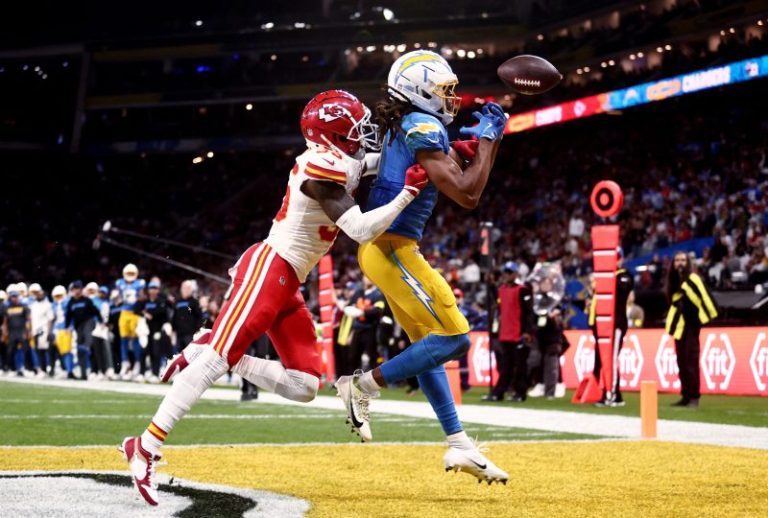
With Xavier Worthy’s shoulder injury likely to sideline him for several weeks (and Rashee Rice suspended), Brown steps up as the top receiving option in Kansas City. He had a league-high 16 targets in Week 1, catching 10 for 99 yards. Travis Kelce’s disappointing showing until a late TD catch only boosts Hollywood’s box office score potential. (Suggested FAAB bid: $15)

RB Quinshon Judkins, Cleveland Browns

The second-round pick avoided being charged in an offseason altercation and just signed a contract before the season started. Still subject to an NFL suspension, he will be available to play as early as this week. Jerome Ford’s lackluster showing as the starter opens the door for Judkins and fellow rookie Dylan Sampson (12-29 rushing, 8-64 receiving) to take a larger share of the touches. Judkins was drafted to be the lead back so the ceiling is high. But so is the risk level. (FAAB bid: $12)

WR Quentin Johnston, Los Angeles Chargers

The Chargers’ Justin Herbert finished as the QB5 in Week 1, showing off a surprising affinity for the air. Johnston was the main beneficiary, catching a pair of touchdown passes among his five receptions for 79 yards. Fellow wideout Keenan Allen also had a good game (7-68, TD) so he could be a fallback option, especially if L.A.’s run game doesn’t improve. (FAAB bid: $9)

WR Kayshon Boutte, New England Patriots

An under-the-radar name here with some decent immediate value. Boutte led all Patriots receivers with eight targets on Sunday, catching six for 103 yards. However, like the Chargers, the Pats weren’t able to run the ball very well. So QB Drake Maye ended up throwing 46 passes. Perhaps the best news is that the Miami Dolphins defense is up next. (FAAB bid: $8)

WR Cedric Tillman, Cleveland Browns

As long as Joe Flacco is the quarterback, the Browns will be a threat in the passing game. Flacco threw the ball 45 times in a one-point loss to the Bengals, with Tillman targeted on eight of those. He caught five for 52 yards and Flacco’s lone TD. There’s still a lot to sort out in the Browns offense, so don’t go overboard just yet. Heck, rookie tight end Harold Fannin Jr. had seven catches for 63 yards. (FAAB bid: $8)

TE Juwan Johnson, New Orleans Saints

What a mess Week 1 was for tight ends – with Brock Bowers, George Kittle and Evan Engram all leaving early with injuries. Johnson, meanwhile, was one tight end who flourished. He led the position with 11 targets, and finished with eight catches for 76 yards. The Saints will likely be playing from behind a lot this season, so Johnson could be one of 2025’s early-season breakouts. (FAAB bid: $7)

QB Aaron Rodgers, Pittsburgh Steelers

Are you a believer yet? The 41-year-old led all quarterbacks in Week 1 with four touchdown passes in his Steelers debut, looking a lot like the four-time MVP that he is. Having a game-breaking target like DK Metcalf certainly helps, but those TD passes (against what was supposed to be a decent New York Jets defense) went to Calvin Austin, Ben Skowronek, Jaylen Warren and Jonnu Smith. Has A-Rod found the Fountain of Ayahuasca? (FAAB bid: $3)

RB Kenneth Gainwell, Pittsburgh Steelers

Several backup running backs saw their stock rise after Week 1. Gainwell is seemingly ahead of rookie Kaleb Johnson on the depth chart (behind starter Jaylen Warren) after getting seven carries and four targets. He didn’t do much with those opportunities (23 total yards) but could be a useful bench option for the time being. (FAAB bid: $3)

RB Bhayshul Tuten, Jacksonville Jaguars

The Jaguars backfield just got less competitive for snaps with Tank Bigsby traded to Philadelphia. Travis Etienne (156 total yards) was marvelous in the opener so that may have played a role, but Tuten could emerge as a worthwhile backup, given Etienne’s injury history. (FAAB bid: $3)

TE Jake Tonges, San Francisco 49ers

For those in realllllly deep leagues, Kittle’s hamstring injury will likely keep him out for at least a month, opening the door for Tonges to take over the role. The Niners receiving corps had already been decimated before Kittle went down, and WR Jauan Jennings also left early Sunday with a shoulder injury. Tonges caught three passes for 15 yards, but one of them was the game-winning touchdown. Look for him to be a larger part of the offense in the interim. (FAAB bid: $1)

This post appeared first on USA TODAY

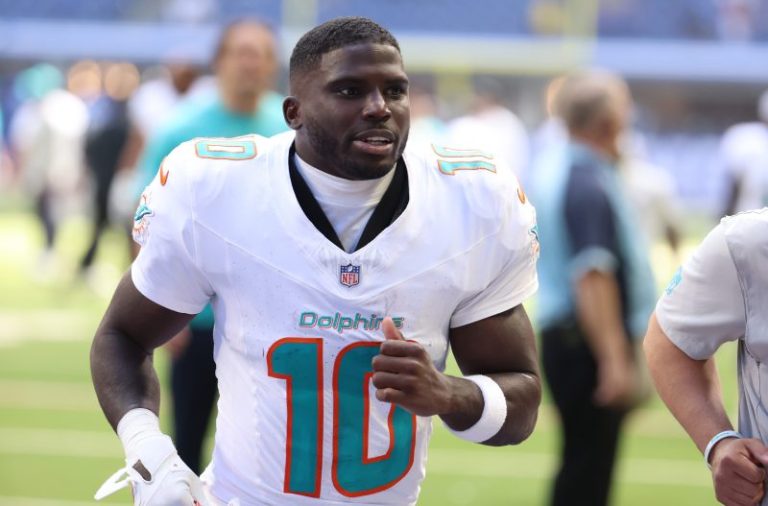
Tyreek Hill’s lawyer on Monday said domestic-violence claims made by the Miami Dolphins wideout’s estranged wife ‘are nothing more than an attempt …. to shake Mr. Hill down.’

Lakeeta Vaccaro Hill said in new court filings, per TMZ, that Hill became violent on eight separate occasions during their marriage. In one alleged incident, Vaccaro claimed Hill spat on her; she also alleged the five-time All-Pro threw a marijuana cigarette at her before leaving for the 2024 Pro Bowl on Feb. 7 of that year.

Hill’s attorney, Julius Collins, released a statement to USA TODAY Sports denying the claims, saying that Vaccaro and her team only amended the initial petition for separation.

‘The new allegations that Ms. Vaccaro and her counsel have decided to allege are all unsubstantiated, untrue and an attempt to generate bad media coverage for Mr. Hill and therefore extort a large settlement offer from Mr. Hill, of which we believe Ms. Vaccaro is not entitled in this 17 month (sic) marriage,’ the statement read.

Hill’s lawyers said he gave Vaccaro $500,000 ‘to do as she wished and needed’ considering they share a child and offered an additional $100,000 to purchase a vehicle. In her latest court filing, Vaccaro is requesting $1,100,857.51.

‘These new allegations are further proof that Ms. Vaccaro and/or her counsel are set on partaking in a smear campaign in hopes that Mr. Hill will settle and give she and her counsel an unreasonable and unwarranted amount of money,’ Hill’s representation wrote. ‘Mr. Hill will not be moved by this and awaits his day in Court to present his evidence.’

Vaccaro filed for divorce on April 8, 2025, one day after the Sunny Isles Beach Police Department responded to an incident at their home. They were married in November 2023 and Vaccaro gave birth to the couple’s child late in 2024.

In an email to USA TODAY Sports, Vaccaro’s lawyer, Evan Marks, wrote that her amended petition is ‘verified – meaning that she has sworn that the allegations contained therein are true and correct.’

‘Evidence will be presented to a jury who will then decide whether Ms. Vaccaro is entitled to be compensated for the damages that she sustained due to the conduct of Mr. Hill as alleged,’ Marks wrote.

A Zoom hearing is scheduled for Monday, Sept. 15, one day after the Dolphins host the New England Patriots in Week 2 of the 2025 NFL season.

The 31-year-old Hill has been involved in a litany of litigation and events that escalated to the response of the authorities in recent years. There was a physical altercation with a South Florida marina employee in June 2023. A separate lawsuit alleges he broke a social media influencer’s leg that same month.

This post appeared first on USA TODAY

The Seattle Storm have punched their ticket to the 2025 WNBA playoffs.

The Storm clinched the eighth and final postseason bid Tuesday after defeating the Golden State Valkyries, 74-73, in the team’s regular-season finale at Seattle’s Climate Pledge Arena. It will be the Storm’s third playoff appearance under fourth-year head coach Noelle Quinn. Erica Wheeler knocked down a go-ahead jumper with 19.2 seconds remaining to win.

The eighth-place Storm and ninth-place Los Angeles Sparks were vying for the final playoff spot entering Tuesday, Sept. 9, with the Storm needing the win to claim the final playoff spot. The Sparks needed a win over the Phoenix Mercury — which the team notched on Tuesday — in addition to a Storm loss. The Storm’s victory officially eliminated the Sparks, marking the fifth consecutive year Los Angeles missed the postseason.

Seattle returns to the playoffs for the second consecutive year, but didn’t make it easy. The Storm emerged as one of the top teams in the league during the first half of the season and were in fourth place in the standings entering the 2025 WNBA All-Star break, where the Storm had three All-Star selections, tied with the Indiana Fever for the most in the league. But the Storm faltered in the second half of the season and slid down the standings after losing nine out of 12 games, including a six-game losing streak that threatened their playoff hopes.

The Storm were able to rebound in the final stretch and won six of their next nine games to make the playoffs, including Tuesday’s victory over the Valkyries, in which Wheeler had a team-high 17 points off the bench. Nneka Ogwumike added 16 points and eight rebounds.

Although the field has been set for the WNBA postseason, playoff seeding is coming down to the final games of the regular season. The sixth-place Valkyries have one game remaining against the league-leading Minnesota Lynx on Thursday.

The Storm will be seeking to win their fifth WNBA championship and first since 2020.

The USA TODAY app gets you to the heart of the news — fastDownload for award-winning coverage, crosswords, audio storytelling, the eNewspaper and more.

This post appeared first on USA TODAY

But his fans were, and Terence Crawford discovered that the loud way.

At Grand Arrivals for the two fighters, Crawford was greeted by loud boos on Tuesday, Sept. 9 at Fontainebleau Las Vegas hotel — early evidence Crawford will be treated like the villain when he and Alvarez fight on Saturday Sept. 13.

As the boos continued, Crawford smiled.

“This ain’t nothing different than when I went to Scotland and fought Ricky Burns,’’ he told boxing analyst Max Kellerman during the livestreamed event.

Crawford was referring to 2014, when he traveled to Scotland to fight Scottish boxer Ricky Burns for the WBO world lightweight title. At the time, Crawford said he would silence the crowd on fight night. He did just that, beating Burns by unanimous decision and winning his first world title.

So for Crawford, who’s from Omaha, Nebraska, Las Vegas suddenly feels a little like Scotland.

Not for Alvarez.

The Mexican star is about 1,500 miles from his birthplace of Guadalajara, and once again his fans are expected to flock, this time to watch him defend his undisputed super middleweight championship. The bout will take place at Allegiant Stadium, home of the NFL’s Las Vegas Raiders, and be livestreamed by Netflix three days before Mexican Independence Day.

“They’re all going to be quiet come Saturday,’’ Crawford told Kellerman, and he later remarked, “I’ve been booed before. Hey, listen, they can’t fight for him, so it don’t matter.’’

Alvarez arrived about an hour later and there was no need to talk about boos.

In Spanish Alvarez told his backers, “I’m super grateful for all the support that you always provided to me.’’

This post appeared first on USA TODAY

Tackling soaring inflation in the US is the job of the country’s central bank, known as the US Federal Reserve, or the Fed.

The US Fed has consistently made headlines in recent years due to its role in managing inflation through the use of interest rate changes.

Between mid-2021 and 2023, the US economy experienced high inflation, peaking at 8.5 percent in July 2022. The Fed has helped bring it largely under control through careful interest rate increases during that time period.

According to US Labor Department data, the inflation rate in July 2025 was 2.7 percent. As this is still above the Fed’s target of 2 percent, the bank has been slow to lower interest rates so far.

It’s important for any investor to understand the ins and outs of the Fed’s role in US monetary policy and interest rates, as its decisions have a strong impact on US and global markets as well as precious metals prices.

In this article

    What is the US Federal Reserve?

    The Federal Reserve, often referred to as the Fed, is the US central bank and monetary authority. It was established by the Federal Reserve Act in 1913, which gave the Fed responsibility for setting monetary policy in response to the 1907 Banker’s Panic.

    “The Panic was caused by a build-up of excessive speculative investment driven by loose monetary policy,” explains Investopedia. “Without a government central bank to fall back on, U.S. financial markets were bailed out from the crisis by personal funds, guarantees, and top financiers and investors, including J.P. Morgan and John D. Rockefeller.”

    Although it is an independent government agency, the Fed is accountable to the public and US Congress. The current Fed Chair is Jerome Powell, an investment banker who served as assistant secretary and undersecretary of the Department of the Treasury under former President George H.W. Bush. Powell took the helm at the Fed in 2018.

    The Fed has a dual mandate: to achieve stable prices and stable employment. The government agency also provides banking services and is the main regulator of the nation’s banks. In times of economic turmoil, the Fed also acts as a lender of last resort.

    It’s important to note that while the Fed manages the national monetary policy and regulates the financial system in the US, its actions also have a powerful influence on the global economy.

    What is the FOMC?

    The Federal Open Market Committee (FOMC) is the Fed’s monetary policy-making body. The 12 members of the FOMC are the seven members of the board of governors of the Federal Reserve System, the president of the Federal Reserve Bank of New York and four of the 11 reserve bank presidents who rotate through the positions for one year terms.

    Why does the US Federal Reserve hike or cut interest rates?

    For more than a century, the Fed has been tasked with keeping a watchful eye on any structural risk to monetary stability in the US financial system, and rising inflation and high unemployment are two of the biggest threats to monetary stability.

    In the face of rising inflation, the Fed raises interest rates in the hopes of reigning in rapidly rising prices by curbing demand. When interest rates are higher, borrowing money becomes more expensive, which ultimately slows consumer spending and curtails corporate growth.

    During times of slow economic growth, the Fed lowers interest rates in order to stimulate the economy. Lower interest rates in effect lower the cost of borrowing and investing for both businesses and individuals.

    The Fed’s goal is to keep inflation around its target rate of 2 percent, and unemployment around 4 to 4.5 percent.

    “The principle of inflation targeting is based on the belief that long-term economic growth is best achieved by maintaining price stability, and price stability is achieved by controlling inflation,” according to Investopedia.

    What are the biggest contributors to US inflation?

    Inflation is calculated through factoring in price changes of a weighted basket of goods and services, as well as housing.

    For example, the COVID-19 pandemic that began in 2020 caused a surge of inflation in the US and globally.

    Prices of goods were driven higher by a mix of factors, including significant supply chain disruptions hurting product availability, and economic stimulus packages increasing spending power and demand.

    Additionally, the lasting switch to work-from-home for many led to increased demand for homes with space for offices, driving up housing prices. As housing is the highest weighted factor when calculating US inflation, this was one of the biggest drivers of inflation in the 2020s.

    Global supply chains have since been hampered by factors like Russia’s ongoing war in Ukraine and growing conflict in the Middle East. There is also the uncertainty generated from the global wave of tariffs sparked by US President Donald Trump’s trade policies, which will raise the cost of goods purchased by American consumers.

    This global supply and demand imbalance has led to rising prices for a wide range of consumer products, from gas to groceries. The result has been a loss in purchasing power for US consumers as their dollar needs to stretch further.

    How much has the US Federal Reserve hiked rates since 2022?

    In an effort to fight inflation, the American central bank consistently increasing rates from its March 2022 meeting with an initial boost of 25 basis points. Its hike of 75 basis points in June 2022 was at the time its largest since 1994, and it was followed by another three hikes of this magnitude in 2022.

    The Fed raised interest rates by 5.25 percentage points between March 2022 and July 2023 before holding at 5.50 percentage points for more than a year. The Fed’s current rate cutting cycle began with a .50 drop in September 2024.

    _FOMC meeting date___

    Rate hike in basis points_

    Target federal funds rate_

    January 25 to 26, 2022

    N/A

    0 to 0.25 percent

    March 15 to 16, 2022

    +25

    0.25 to 0.5 percent

    May 3 to 4, 2022

    +50

    0.75 to 1 percent

    June 14 to 15, 2022

    +75

    1.5 to 1.75 percent

    July 26 to 27, 2022

    +75

    2.25 to 2.5 percent

    September 20 to 21, 2022

    +75

    3.0 to 3.25 percent

    November 1 to 2, 2022

    +75

    3.75 to 4.0 percent

    December 13 to 14, 2022

    +50

    4.25 to 4.5 percent

    January 31 to February 1, 2023

    +25

    4.5 to 4.75 percent

    March 21 to 22, 2023

    +25

    4.75 to 5.0 percent

    May 2 to 3, 2023

    +25

    5.0 to 5.25 percent

    July 25 to 26, 2023

    +25

    5.25 to 5.5 percent

    How many times does the Fed meet each year?

    The FOMC holds eight meetings per year, typically scheduled every seven weeks. According to the Fed’s website, during these meetings the FOMC “reviews economic and financial conditions, determines the appropriate stance of monetary policy, and assesses the risks to its long-run goals of price stability and sustainable economic growth.”

    How many more US Federal Reserve meetings this year?

    As of August 21, three more Fed meetings are scheduled for 2025, and market participants will be closely watching these events.

    It’s too soon to know what exactly the Fed will do at these remaining meetings, but its July statement gives some clues — in it, the central bank said that it ‘seeks to achieve maximum employment and inflation at the rate of 2 percent over the longer run. Uncertainty about the economic outlook remains elevated. The Committee is attentive to the risks to both sides of its dual mandate.’

    At the time, the Federal Reserve decided to hold rates steady at 4.25 to 4.5 percent for the fifth straight meeting as inflation remained elevated and job numbers appeared strong. The decision placed downward pressure on the gold price as a better economic outlook dimmed demand for the safe-haven asset.

    While the current tariff war between the US and many of its major trading partners has some calling for a return to higher inflation, weak unemployment figures and other economic data published since the last meeting has caused others to consider the potential for a recession before the end of the year.

    ‘At present, the latest economic data have been sufficiently mixed as to support either policy alternative,’ according to analysts writing for the Peterson Institute for International Economics. ‘The case for a rate cut is driven by the pronounced slowing in job creation, the failure of inflation to respond much to the initial tariff increases, and the fact that most FOMC participants view the current stance of policy as slightly tighter than neutral.’

    Securities Disclosure: I, Melissa Pistilli, hold no direct investment interest in any company mentioned in this article.

    This post appeared first on investingnews.com

    • Billy Napier’s remarks after Florida’s loss to South Florida read like that of a coach waiting on a buyout check.
    • Napier fought off hot seat last season, but Florida’s upcoming schedule is tailormade for a firing.
    • Redirect hype from Clemson to Oklahoma. Only Sooners deserve it.

    Florida fans chanted for Billy Napier’s firing as they exited The Swamp after a loss to South Florida. By the time they reached the car park, those sober enough to generate coherent thought probably were brainstorming names of dream candidates to replace Napier.

    Can Oklahoma State borrow some of those names?

    Two weeks into the season, the hot seat is scalding, from Gainesville to Stillwater.

    There’s no hot seat in Clemson. Just Dabo Swinney talking up a come-from-behind win against Troy.

    Here are four questions on my mind after college football’s Week 2:

    Does Billy Napier have any fight left in him?

    Napier’s remarks after Florida’s loss read like that of a coach waiting on a buyout check.

    He said the Gators were “not good enough,” that he’s responsible for the shortcomings, and when asked about the team’s undisciplined play, Napier said, “I think it is coaching.”

    He’ll hear no argument here. Basically, Napier laid out a tidy synopsis for why Florida needs to fire up the buyout machine and get a coaching search humming.

    Four seasons into Napier’s tenure, we can fairly say coaching is quite obviously part of the problem. That cannot continue.

    Napier fended off the hot seat with Florida’s strong finish to last season, then surrendered his stash of goodwill at warp speed.

    It’s tempting to describe Florida’s 18-16 loss to the Bulls at The Swamp as stunning, but was it, really? South Florida had just smashed Boise State. The Bulls have positioned themselves as a prime contender for the Group of Five’s College Football Playoff spot.

    Meanwhile, Napier is a .500 coach, and September has been an awful month for Florida throughout his tenure. The Gators lost either the first or second game of the season in all four years under Napier. Three of those losses occurred at The Swamp.

    So, this counts as an upset, but it’s not stunning. With Florida’s next four games coming against ranked opponents, it sure wouldn’t be stunning if Napier absorbs a knockout punch before Columbus Day.

    “We’ll have our opportunity to respond,” Napier said after the loss.

    Consider it his last opportunity.

    Clemson more hype than national championship substance

    Believing in Clemson’s national championship potential required two things: One, you needed to buy that Cade Klubnik ranked among the nation’s elite quarterbacks. Two, you needed to believe Clemson beating SMU in last year’s ACC championship game foretold greatness in 2025.

    Through two games, there’s no greatness coming out of Clemson.

    Let’s reconsider last year’s narrow win against SMU, too. The Mustangs weren’t playoff caliber. The committee erred by selecting them, and Penn State waxed SMU in the first round. This season, SMU already has blown a lead and lost to Baylor, which previously got beaten soundly by Auburn. Last season, SMU lost at home to Brigham Young.

    So, Clemson’s only signature win these past two seasons wasn’t all that much of a statement.

    Also tucked inside Clemson’s last five games, dating back to last season, it lost to South Carolina at home, lost to Texas in the playoff, its offense turtled up in a home loss to LSU, and the Tigers needed a second-half rally to fend off Troy.

    Klubnik probably will feast on ACC defenses, but I’m not seeing an attack that would strike fear in Ohio State or Penn State or Georgia or Texas.

    Clemson remains an ACC contender, but this team shows little national championship substance after a preseason filled with hype. And we might need to rethink that whole ACC thing, depending on how this weekend goes against Georgia Tech.

    “We’ve played two games and given up three touchdowns — sign me up for that,” Swinney said.

    He needs to sign up for some more offense, too.

    Is Oklahoma for real?

    If you’ve got a quarterback, you’ve got a chance. The Sooners have a quarterback.

    Oklahoma looked the part of playoff contender in a 24-13 thumping of Michigan.

    Transfer John Mateer came to Oklahoma with good credentials from Washington State, but he struggled with his completion rate in his two games last season against Power Four opponents.

    How would he fare against a big-boy defense from Michigan?

    Pretty well.

    Mateer’s gassed up on moxie. He’s a shifty runner who’s also willing to get the hard yards. When a reporter mentioned to Mateer that he’s got some nifty moves, the quarterback just smiled and said, “Thank you,” as if the rest of us are just now realizing what anyone who faced him at Washington State already knows.

    Even better than the runs, though, were Mateer’s completions into tough coverage. He evaded pressure, scrambled out of the pocket and fired a rope up the sideline to fellow transfer Isaiah Sategna III for the night’s most brilliant completion. I didn’t see highlights like those coming out of Oklahoma last season.

    Mateer’s a bit of a risk-reward player. He threw several daring passes. Some found their mark. Others found the turf. He was fortunate to be intercepted just once, but, overall, Oklahoma’s pass game looked better than it did at any point last season. The return of Deion Burks to healthy form helps, and the offensive line mostly held up against Michigan.

    Oklahoma’s defense that’s intent on ‘hunting,’ as coach Brent Venables put it, should keep the Sooners in games against tough opponents. The rest is up to Mateer on his offense.

    The schedule is brutal. That could become an asset if the Sooners finish 9-3. A convincing victory against Michigan promises to be a long-term résumé booster.

    Is a playoff bid bound for the American?

    South Florida, owning wins against Boise State and Florida, established itself as the early frontrunner for the Group of Five’s playoff bid, but the American rolls a few-deep with playoff contenders. The Bulls will face Miami this weekend. A win would be huge for their playoff credentials, but the ticket remains in surviving the conference schedule.

    Tulane already skunked Northwestern. The Green Wave have Duke and Mississippi on deck. Don’t discount Memphis or Navy from the American, either.

    Oh, and don’t forget Dan Mullen. If the American devolves into a knockdown, drag-out battle royale, that’s an opportunity for Mullen’s undefeated UNLV Runnin’ Rebels, who cast more illumination of the error of Nico Iamaleava’s transfer to UCLA by beating the Bruins.

    Blake Toppmeyer is the USA TODAY Network’s senior national college football columnist. Email him at BToppmeyer@gannett.com and follow him on X @btoppmeyer.

    This post appeared first on USA TODAY