Author

admin

Browsing

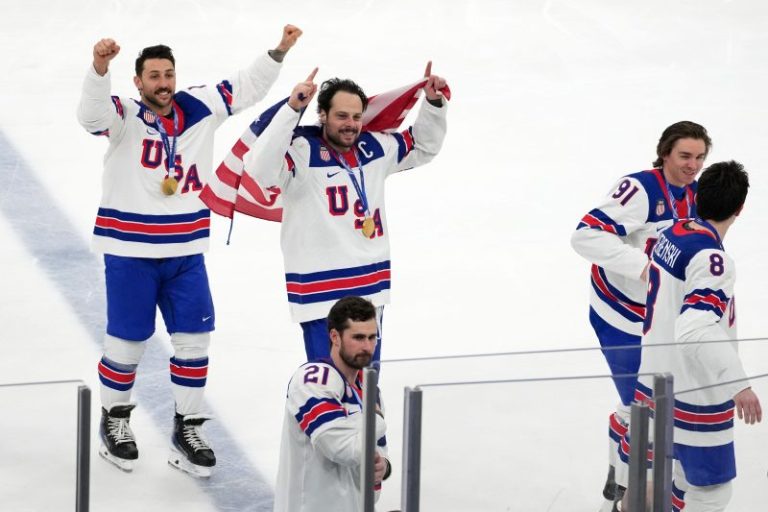
The 2026 Winter Olympics are over, the United States won its first gold medal since 1980 and now Olympians are rejoining their NHL teams for the stretch run.

The league is starting up again on Wednesday, Feb. 25, and NHL games will be played for the first time since Feb. 5. The Detroit Red Wings, Pittsburgh Penguins, New York Islanders, Buffalo Sabres, Boston Bruins, Seattle Kraken, Utah Mammoth and Anaheim Ducks sit in a playoff position after missing the postseason in 2024-25.

The trade deadline is around the corner and the rush to a playoff berth is on before the regular season ends on April 16.

Here’s a look at key questions as the NHL regular season resumes:

Will the trade deadline be busy?

The date is March 6 this year, so teams don’t have a lot of time to work something out.

There was a major trade right before the Olympic freeze when the Rangers moved Artemi Panarin to the Kings. Once the freeze lifted, the Avalanche traded defenseman Samuel Girard to the Penguins for Brett Kulak on Feb. 24.

There’s an opportunity for more trades because there’s a gap between the haves and the have-nots, and top teams have needs. The last-place Canucks, who already moved Quinn Hughes and Kiefer Sherwood, have Evander Kane and Teddy Blueger as pending free agents. The Rangers could move Vincent Trocheck, Flames center Nazem Kadri would be coveted and the Blues could be sellers.

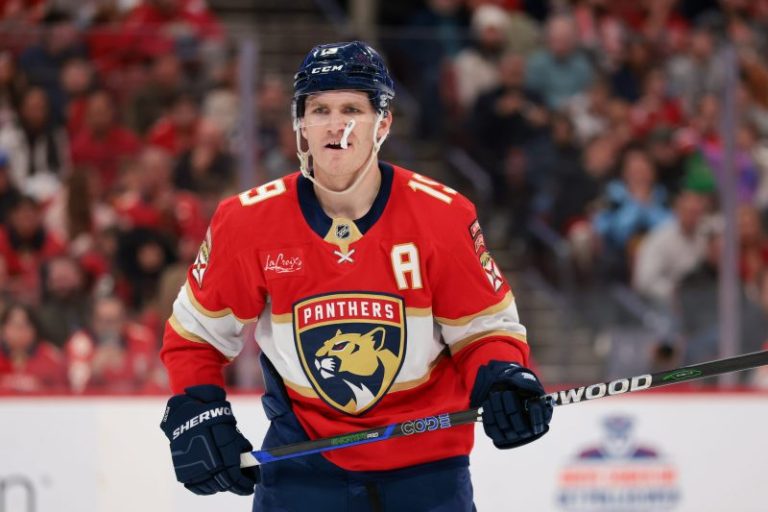
Will the Panthers keep their Stanley Cup hopes alive?

They won the last two Stanley Cup titles, went to the Final the year before that and were Presidents’ Trophy winners in 2021-22. But that string of success suffered a serious blow when captain and Selke Trophy winner Aleksander Barkov needed ACL surgery after being injured on his first day of practice in September.

They’re also missing defensemen Dmitry Kulikov and Seth Jones and sit in last place in the Atlantic Division with 61 points, eight points out of a playoff spot. The good news is Matthew Tkachuk returned before the break and that Jones is skating with a non-contact jersey. Bill Zito is a creative general manager and Paul Maurice a top-notch coach. They have 25 games to make up those points, which is possible if they come out strong after the break. And as they showed the last three years, if they make it into the postseason, they can go far.

Can the Sabres end their playoff drought?

Their 14 years out of the playoffs is an NHL record. It looked like it might reach 15 when they started slowly. But things turned around when they fired general manager Kevyn Adams and promoted Jarmo Kekalainen. They pushed a winning streak to 10 games and now sit in the first wild-card spot in the Eastern Conference. But they lost three out of four heading into the break and will need to remedy that, especially when they will be facing the Lightning and Golden Knights two times each in the next 11 games.

Can the Red Wings end their playoff drought?

They haven’t made the playoffs in nine years and are sitting in third place in the tough Atlantic Division. Other teams have a game or more in hand. But their goaltending is better than in the past because of John Gibson, and they have plenty of cap space to make a move at the deadline.

Can Kings overcome the loss of Kevin Fiala?

Fiala broke his leg while playing for Switzerland at the Olympics, had surgery and will miss the rest of the regular season. The Kings have Panarin now, but his acquisition was designed to boost an offense that had Fiala in the lineup. Fiala leads the Kings with 17 power-play points. Los Angeles is three points out of a playoff spot, so it might need to make another trade.

This post appeared first on USA TODAY

It might be more difficult than ever to identify a true NFL draft sleeper prospect.

There aren’t any true unknowns among the 319 prospects invited to the NFL Scouting Combine in Indianapolis this week. Meanwhile, many players who might have been small-school darlings in years past have gravitated toward higher payouts and brighter spotlights in the NIL era.

Between the proliferation of pre-draft information and changing college enrollment dynamics, that’s left the notion of a sleeper somewhat hard to define in 2026. A player who might seem to satisfy the criteria for one person might seem like an established entity to another.

With all that said, here are eight less-heralded players who could stand out at the combine:

RB Robert Henry Jr., Texas-San Antonio

In a fairly lackluster running back class – at least beyond Notre Dame’s Jeremiyah Love – teams might be best served to pursue players with a distinct calling card rather than trying to find a true lead ball carrier. Henry has a few strengths in his elastic running style and rapid acceleration, which he utilized to average 6.9 yards per carry last season. He should be a Day 3 draw for teams looking to add a bit of juice to their backfield without investing significant resources. Though he still has to exhibit more patience as a runner, the key to aiding his stock while he’s in Indianapolis might be demonstrating more capabilities as a potential third-down weapon, as he logged just 18 carries for 114 yards last season.

WR Ted Hurst, Georgia State

The word might already be out on Hurst, a 1,000-yard receiver for the Panthers who also built a considerable buzz at the Senior Bowl. At 6-foot-3 and 207 pounds with plenty of build-up speed, he’s exactly the kind of deep threat teams seek to diversify their passing attacks and stress defenses. It will still bear watching just how he sizes up against a deep class of receivers, with many of them having faced a higher level of competition. Hurst still has work to do to fully leverage his advantages on downfield contested catches, but it seems likely that his pre-draft ascent will only continue at the combine.

WR Eric McAlister, TCU

The Horned Frogs have had a stellar run of speedy receivers in recent years, and McAlister has kept that lineage alive and well. The 6-3, 193-pound Boise State transfer is entirely at home working vertically and racing past cornerbacks to haul in big gains. Most other components of his game are still a work in progress, which leaves him a good bit behind some of the other speedy threats in this year’s group of pass catchers. Yet after this week, several NFL coaching staffs might be eager to be the ones tasked with helping polish his approach.

WR Malik Benson, Oregon

Noticing a theme here? Game-breaking speed is a major selling point for receivers outside of the first-round mix, and few have a higher ceiling in that area than Benson. The former junior college standout has had a somewhat nomadic and unfulfilled college career that included stops at Alabama and Florida State, but he showed off his potential with the Ducks by averaging 16.7 yards per catch and reeling off a handful of long scores. Like many former track standouts, the 5-11, 185-pound target poses some weighty questions on whether he can become a more complete receiver or whether he’ll need to have touches schemed for him to compensate for shortcomings in his route-running. But he’s a legitimate threat to challenge other speed merchants in Mississippi State’s Brenen Thompson and LSU’s Barion Brown and Chris Hilton Jr. for the combine’s fastest 40-yard dash time.

TE John Michael Gyllenborg, Wyoming

He’s got a name of an ’80s action movie star, as well the athleticism of one. The 6-5, 251-pounder has all the requisite traits to be a serious seam threat at the next level. It’s up to him to make good on them, however, as he never put together the kind of breakout season one would have hoped to see coming of a player who faced a lower level of competition, with just 24 catches for 217 yards and one touchdown as a senior. He’ll need to serve up a reminder of his upside at the combine or risk getting lost in a fairly muddled picture at tight end.

DT Kaleb Proctor, Southeastern Louisiana

In terms of pure disruptiveness from the interior, Proctor gets at it with the best of them. He notched nine sacks last season, an output that doesn’t capture just how problematic he was for opposing offenses. And at the East-West Shrine Bowl, he hardly looked out of place against more highly touted foes. The 6-1, 275-pounder will only be a fit for teams are willing to sacrifice a bit of strength for playmaking ability. In the right scheme, however, he could continue continue to regularly make himself at home in opponents’ backfields, even if only in a part-time role to begin.

DE/OLB Nadame Tucker, Western Michigan

Any pass rusher who ties with Texas Tech’s David Bailey, a potential top-five pick, for the Football Bowl Subdivision lead in sacks (14½) is clearly doing something right. Tucker isn’t a household name, but he combines plenty of burst and knowhow to consistently get in the face of quarterbacks. Measuring in under 6-2 and 246 pounds at the Senior Bowl, he might be reduced to a designated pass rusher in the early going, serving in a Josh Uche-lite role to shield him from being engulfed by bigger blockers in the run game. As a late-round flier, though, he’s an intriguing option for any defensive staff willing to get a little creative with his usage.

OLB Jaishawn Barham, Michigan

After a stellar start to his career at Maryland, Barham still seems to be defined by the notion of some unrealized potential. He’ll work out at the combine with the edge rushers, and it’s easy to see why teams might be drawn toward utilizing the 6-3, 243-pounder in that role. Not only is he explosive and fluid when pursuing the quarterback, he also matches those traits with his forcefulness at the point of attack. Don’t be surprised if he ends up with one of the more impressive testing profiles of the defensive prospects.

This post appeared first on USA TODAY

First, the particulars, because three years later, it still makes no sense. 

A Georgia football player died in January 2023 while a car he was riding in was racing other Georgia football players. More than 20 Georgia players have since been cited or arrested for speeding and/or reckless driving — including two last week.

But before we jump on Georgia coach Kirby Smart about discipline and direction and leading young men, maybe it’s time we go to the source: players. 

Maybe it’s time we take a detailed look at what we’re doing in the NIL world, and how young men flush with cash now feel bulletproof.

Wasn’t that long ago when the cycle of pandering and prostitution of athletes included cutting corners, skipping classes and answers to tests. All before they even reached high school.

From there it was academic fraud — including ACT and SAT college entrance exam fraud — and shady middlemen who brokered financial deals with colleges under the table.   

A car here, a bag of cash there. A house for Mom, and a job for Dad. All part of the game. 

Until much of the seen and unseen of this dirty dalliance no one wanted to admit was revealed with the advent of the NIL era. At least, the machinations of it all. 

Because one thing still stands clear: There were no rules in the shadows then, there are no rules in the sunlight now.   

We’ve gone from pushing players through school despite them not knowing the work — in some cases, not being able to read — to throwing millions of dollars at them before they step on a college campus.

Just to be clear: The enabling sins of the past haven’t ended. They’ve been — if you can believe this utter nonsense — reinforced with foundational money and free player movement that has soiled the entire college experience. 

Higher education is as much about academics as it is proving you can live on your own with individual responsibilities (and vices), and figuring a way to grow and prosper as a human — much less an athlete.

Now throw millions of dollars into that equation. Then add the built-in excuses and reset of free player movement.

No wonder players feel bulletproof. No wonder the greatest concern for NFL scouts now isn’t playing ability, but life skills and maturity.

How else can you explain Georgia players — after Devin Willock’s tragic death while riding in a car racing other teammates at speeds in excess of 100 mph — doing the same thing? Over and over and over. 

How else do you explain Georgia linebacker Chris Cole, one of the SEC’s top young players with a bright professional future, last week racing teammate Darren Ikinnagbon and driving 105 mph in a 65 mph zone on Outer Loop 10 in Athens, Ga.? 

Or about 2-3 miles from where Willock lost his life.

Smart can suspend players (he’s done that), he can kick them off the team (he’s done that, too). He can talk to players about the inherent danger, or have law enforcement explain the odds of significant injury and bodily harm when racing (yep, check). 

But at the end of the day, this is an individual making a poor decision.

An individual who, in many cases, has been given whatever he wants, whenever he wants, because he’s elite at the sport he plays. 

Make no mistake, players deserve their fair share of the billions in media rights universities earn every year. We’re well down that road, and there’s no going back.

The problem: We’ve taken consequences completely out of the equation.

If it doesn’t work at this school, it’ll work at that one. If this coach doesn’t like me, that coach will give me another chance. 

If I underperformed my NIL deal at this school, that school will still give me cash. 

There’s no pause in the process like there once was, no opportunity of reflection or a life reorg while sitting out a transfer season. It’s one deal to the next until you reach the NFL. 

Or you don’t, and then what have we accomplished ― other than temporary wealth? 

If Smart dismisses Cole or Ikinnagbon, there will be a line of schools waiting to take them, give them cash and further exacerbate the problem.

Three years later, it still makes no sense.  

This post appeared first on USA TODAY

UCLA men’s basketball flat-out outplayed USC in Tuesday night’s 81-62 win. The archrivals met for the first of their two Big Ten clashes on Feb. 24 in what was a crucial game for two teams on the bubble in USA TODAY Sports’ latest Bracketology.

The two have been on opposite trajectories as of late, with the Bruins entering Tuesday fresh off Donovan Dent’s overtime buzzer-beater to beat No. 11 Illinois and secure a much-needed quad 1 win. The Trojans, meanwhile, entered the night in the midst of a three-game losing streak capped off by a stunning 71-70 home loss to Oregon in which they led by six points with 59 seconds to go.

Those trends played continued as UCLA’s physical defense and a 30-point gem from Donovan Dent derailed a Trojans team that couldn’t find much offense from anyone not named Chad Baker-Mazara (25 points, eight rebounds, two assists).

‘They’re a very athletic team, obviously Baker-Mazara is a potent offensive player that can turn your lights out. Proud of the guys that got the job done,’ Bruins head coach Mick Cronin said postgame. ‘This late in the year, guys are just trying to win and stay healthy. … Happy with the win, and nobody got injured. So, onward.’

Here are the winners and losers from the first leg of the USC-UCLA rivalry:

WINNERS

UCLA’s tournament hopes

The Bruins entered the day as one of the last four teams in, and they just got one step closer to March with a big quad 2 win – over their biggest rivals, nonetheless. After the Illinois game on Saturday, Feb. 21, players said they’re feeling like they’re at their highest point as a team right now.

Cronin sees it a little differently.

‘I’m glad they feel that way,’ he said. ‘I would say you’re only as good as your next game. When you win, your team’s going to have a better feeling about those things. Sometimes you can play well and lose, though. We could’ve lost that game, I still thought it was one of the best comebacks we had played. … But we got a little goal here for the end of the year. We got two down, three to go.’

Donovan Dent

Dent followed up his heroics from the Illinois game with another stellar performance. He led all scorers with 30 points, two rebounds and seven assists (which also led the game). He shot 62.5% from the floor and was five-for-six from deep.

‘I’m hoping this groove continues,’ he said. ‘This is the best time to get a groove, honestly. I was struggling early this season, so for me to get in a groove right now I feel like would be huge for our team and huge for myself.’

UCLA’s offensive attack

It wasn’t just Dent who shared the love on Tuesday. The team overall moved the ball especially well, finishing the game with 18 assists, seven more than USC. Trent Perry (four assists) and Skyy Clark (three) did their part in finding the open man.

‘When we share the ball we’re a very high level offense. When we share the ball,’ Cronin said. ‘That said, Donnie had a great game. Got Tyler (Bilodeau) some balls late. … Got some different contributions (too).’

LOSERS

USC still outside the bubble

With Tuesday’s loss, the Trojans have now dropped their fourth consecutive Big Ten game and second straight quad 1 game. All 10 of their losses this season have come in conference play. They took another step back, and now their tournament hopes are standing at the edge of a cliff.

‘We’re not in the tournament,’ USC head coach Eric Musselman said. ‘We’re outside looking in. We have to figure out a way to win a game before we even worry about anything of that magnitude. We have three opportunities left, and then we have the Big Ten tournament.

‘We’re a team that has been on the bubble with three games left and we haven’t played good basketball last four games, and obviously the Northwestern loss and the Oregon loss is going to hurt us for sure.’

Growing pains for Alijah Arenas

It wasn’t all bad. Arenas finished with 10 points to be the only Trojan besides Baker-Mazara to score in double figures. A lot wasn’t good either, though. He didn’t make his first field goal of the game until late in the second half as his opportunities to make an impact early in the game were limited by foul trouble. He also had five turnovers.

But these bumps on the road are to be expected for Arenas, who didn’t make his season debut until late January due to a torn right meniscus.

‘It’s a learning curve for him,’ Musselman said. ‘We’re trying to balance his minutes and teaching him on the fly and it’s super difficult because he missed all the summer, and he missed the first half of Big Ten, and he’s a reclassification.

‘He’s an incredible talent who’s got an awesome ceiling, and he’s got an incredible future. … But it’s a process when you don’t – he doesn’t have the whole summer. He doesn’t have non-conference play, and so we’re asking him to do a lot for sure.’

This post appeared first on USA TODAY

Here’s a quick recap of the crypto landscape for Monday (February 23) as of 9:00 p.m. UTC.

Get the latest insights on Bitcoin, Ether and altcoins, along with a round-up of key cryptocurrency market news.

Bitcoin (BTC) was priced at US$64,409.84, down by 4.4 percent over the last 24 hours.

Bitcoin price performance, February 23, 2026.

Chart via TradingView.

XS.com senior market analyst Linh Tran suggested that the medium-term uptrend is limited without major catalysts. She predicts that Bitcoin will fluctuate between US$65,000 support and US$70,000 resistance; however, if current pressures persist, there is a risk of Bitcoin retesting the US$60,000 low, which could trigger a deeper decline.

Software stocks slipped alongside a further decline in crypto prices after Anthropic said its Claude platform can help ‘break the cost barrier to COBOL modernization,’ a high-level, compiled computer programming language that the firm says ‘runs in production every day, powering critical systems in finance, airlines, and government.’

Ether (ETH) was priced at US$1,860.34, down by 4.1 percent over the last 24 hours.

Altcoin price update

  • XRP (XRP) was priced at US$1.36, down by 2 percent over 24 hours.
  • Solana (SOL) was trading at US$78.37, down by 5.6 percent over 24 hours.

Today’s crypto news to know

Yield Basis thrives on market volatility

Some parts of the DeFi ecosystem have benefited from the chaos of Bitcoin’s sudden price drop in January, which liquidated billions of dollars’ worth of positions. A DeFi project called Yield Basis, which helps people trade Bitcoin and Ether through its liquidity pools, says it’s handled US$769 million in trades since the beginning of 2026, with more than half occurring after January 28, when crypto prices began swinging wildly.

According to a recent report, the protocol has collected US$12.15 million in fees since it launched its v2 pools in November 2025, compared to US$5.31 million worth of tokens it paid out as rewards, leaving about US$6.84 million in net profit for the users providing liquidity and holding the project’s tokens.

Open-source AI project distances itself from crypto

An open-source AI agent framework known as OpenClaw has inadvertently become the center of a crypto controversy. The project, built to power autonomous agents capable of browsing the web and executing complex tasks, was briefly rebranded amid a naming dispute before scammers launched a fake Solana-based token using its former branding.

The token’s market capitalization surged to roughly US$16 million within hours before collapsing more than 90 percent after developer Peter Steinberger disavowed any connection.

Steinberger publicly rejected the speculation, writing on X: “To all crypto folks: please stop pinging me, stop harassing me. I will never do a coin. Any project that lists me as coin owner is a SCAM.”

USDT contraction flashes rare stress signal

Tether’s USDT stablecoin is signaling liquidity strain reminiscent of the market turmoil following the FTX collapse.

According to CryptoQuant, the 60 day change in USDT supply has dropped to negative US$3 billion, which marks only the second time such a contraction has occurred. Bloomberg reported that USDT is on pace for its steepest monthly supply decline since December 2022, already shrinking by roughly US$1.5 billion in February alone.

Large-scale redemptions typically suggest institutions or major holders are pulling capital out of the crypto ecosystem rather than simply rotating between tokens. The last comparable contraction came as Bitcoin fell toward US$16,000 during the FTX crisis before stabilizing and beginning a multi-year recovery.

Securities Disclosure: I, Meagen Seatter, hold no direct investment interest in any company mentioned in this article.

Securities Disclosure: I, Giann Liguid, hold no direct investment interest in any company mentioned in this article.

This post appeared first on investingnews.com

Red Mountain Mining Limited (ASX: RMX, US CODE: RMXFF, or “Company”), a Critical Minerals exploration and development company with an established portfolio in Tier-1 Mining Districts in the United States and Australia, is pleased to announce an update on the Company’s portfolio of high-quality Antimony projects in the United States.

Over the past six months, Red Mountain has moved decisively to acquire assets in Tier-1 regions in highly prospective antimony mineral districts in Montana, Utah and Idaho, USA, placing the Company in a strong strategic position as the US Government moves aggressively to secure domestic supply of Antimony which is classified as a Critical Metal by the United States and Australian Governments.

HIGHLIGHTS:

  • Red Mountain continues to deliver repeated successful project and development programs across its high-quality Critical Minerals portfolio, systematically advancing its United States and Australian projects toward development and directly supporting the US Government’s drive to secure domestic supply of critical metals

Thompson Falls Antimony Project, High-grade Antimony next to UAMY Antimony Smelter

  • Thompson Falls Antimony Project is 4.2km from the operations of United States Antimony Corporation (NYSE: UAMY; Market Cap $A1.5 billion), with the country’s only operating Antimony smelter
    • Initial sampling from Red Mountain’s Thompson Falls Project returned high-grade values of up 36.5% Sb and 0.65g/t Au
    • Additional assay results are now expected to be received by the end of February
  • Comprehensive surface mapping and sampling program to fast-track the definition of the Thompsons Falls Antimony Project resource potential, planned to launch next month
  • Red Mountain has recently strengthened its US technical team with dedicated drill-permitting expertise, driving the permitting process forward across all of the Company’s US Projects

Utah Antimony Project, Antimony Mining District

  • Utah Antimony Project adjoins American Tungsten and Antimony Ltd’s (ASX: AT4; Market cap A$200 million) Antimony Canyon Project (ACP), one of the largest and highest-grade Antimony projects in the USA, which has reported assays of up to 33% Sb and has a defined conceptual Exploration Target of 12.8 to 15.6 Mt @ 0.75% to 1.5% Sb, containing between 96,000 to 234,000 tons of Antimony metal
    • Recent visible stibnite mineralisation observed between AT4’s claims and RMX’s project provides evidence the ACP system may extend into the Utah Antimony Project*
    • Mapping analysis previously undertaken by RMX suggests that both the same type of host rocks and extensions of the large epithermal Antimony mineralising system targeted by AT4 at Antimony Canyon are present within the Utah Antimony Project**

Exceptionally Strong Antimony results from Thompson Falls and further assays pending

Red Mountain acquired the Thompson Falls Antimony Project on 5 February1, next to the only operating antimony smelter in the USA, US Antimony Corporation’s (NYSE: UAMY; Market Cap ~AU$1.5 billion) Thompson Falls Smelter and UAMY’s Stibnite Hill Mine in Montana (Figure 1).

First-pass exploration of Red Mountain’s Thompson Falls Antimony Project, by the Company’s US field team, successfully located three historical underground mines and pit within the project area. Initial sampling of material from Eastern Star returned multiple samples with high antimony and gold results, with peak results of 36.5% Sb and 0.65g/t Au1 (Figure 1; Figure 2).

Samples collected from Eastern Star closely resemble the quartz-stibnite veins mined at UAMY’s Stibnite Hill deposit, ~7km east of Red Mountain’s Thompson Falls Project area, although these veins are not recorded as producing gold. Red Mountain’s field team also collected additional rock samples from the project area, with assay results expected this month.

Click here for the full ASX Release

This post appeared first on investingnews.com

The era of “smooth globalization” is over, and mining is entering a more fragmented, politically charged phase defined by strategic nationalism, according to speakers at S&P Global’s latest webinar.

Jason Holden, who opened the “State of the Market: Mining Q4 2025” session with a macro overview, said the industry is operating in a world increasingly shaped by supply chain security and state intervention.

“For decades we operated under a model of frictionless trade,” said Holden, a senior mining analyst at the firm. “That era is over. We’ve entered a world of strategic re-nationalization.”

While the base economic outlook remains resilient, with moderate growth and easing headline inflation, Holden warned that “sticky core inflation remains stubbornly high.”

For mining companies, that has two major implications: higher capital costs and less room for the easy-money valuation surges seen in past cycles. Central banks, led by the US Federal Reserve, are no longer aggressively tightening, but are also not on a clear-cut path to interest rate cuts.

“We’re no longer on a predictable path of easing,” Holden explained to listeners. “The market is now focused on if and when cuts might resume.” At the same time, geopolitical disputes are increasingly spilling into trade policy. The conversation around critical minerals, he noted, has shifted decisively.

“It’s no longer just about economics,’ said Holden. “It’s explicitly framed as national security.”

That shift is driving greater government intervention, subsidies, capital screening and “friend-shoring,” where materials are sourced from politically aligned nations.

Gold’s insurance premium

Nowhere has geopolitical risk been more visible than in gold.

The metal surged to fresh highs in early 2026 after setting 40 new records in 2024 and 53 more in 2025, a pace not seen since 1979. The price briefly pushed beyond US$5,500 per ounce at the start of the year.

“The message from this price action is unmistakable,” Holden said. “In an uncertain world, the market is paying a premium for insurance, and gold is the ultimate safe asset.”

While short-term flashpoints helped fuel the rally, the structural driver has been central bank buying. Since sanctions in 2022 prompted reserve managers to rethink US dollar exposure, official sector purchases have accelerated.

“The sustained buying from central banks is the real engine behind the rally,” Holden said.

S&P’s base case sees gold averaging US$4,247 per ounce in 2026, with upside potential toward US$6,000 by 2027 in a more bullish scenario.

Copper tightness, nickel politics

Luiz Amaral from S&P’s exploration team said copper ended 2025 on strong footing, with London Metal Exchange (LME) prices reaching US$12,500 per metric ton in December.

Supply-side tightness, a weaker US dollar and copper’s growing role in electrification supported prices. The US decision to formally list copper as a critical mineral reinforced its strategic importance.

S&P has lifted its 2026 copper price forecast to US$11,400 per metric ton, projecting a 543,000 metric ton concentrate deficit next year. However, the refined market is expected to move into surplus later in the decade as new smelter capacity ramps up. Longer term, the concentrate picture darkens again.

“Our base case shows a 3 million metric ton shortfall by 2036,” Amaral said.

Nickel’s recent rally, by contrast, has been driven more by policy than fundamentals. The price broke above US$18,000 per metric ton in January after Indonesia reduced its 2026 production quota.

“The market is responding emotionally to policy updates,” Amaral said, noting that despite the rally, the broader market remains in surplus and LME inventories are building.

Lithium rebounds amid persistent surplus

Lithium prices have also staged a sharp rebound, rising 57 percent in China between mid-December and mid-January on renewed demand optimism and supply concerns. Yet S&P expects the market to remain oversupplied for most of the decade, with deficits not emerging until the early 2030s.

New supply from Australia, Latin America and China continues to outpace demand growth, even as electric vehicles account for roughly 75 percent of lithium consumption through 2035.

Diverging margins

At the mine level, gold producers are enjoying some of the strongest margins in years, with prices rising faster than all-in sustaining costs. Silver has outperformed even more dramatically, climbing 154 percent in 2025 versus gold’s 71 percent gain, compressing the gold-silver ratio to below 70.

Battery metals face a tougher backdrop.

“Lithium and nickel continue to face margin pressure as prices lag elevated costs amid oversupply,” said Monica Ramirez from S&P’s mine economics and emissions team.

Across 12 metals analyzed, S&P sees a structurally higher cost environment emerging due to inflation, energy expenses and maturing ore bodies. Precious metals retain the strongest buffers, while copper remains positive but increasingly sensitive at the upper end of the cost curve.

Exploration at a crossroads

Despite record prices in some commodities, exploration spending tells a more cautious story.

Global exploration budgets totaled US$12.4 billion in 2025, down 1 percent year-on-year. Adjusted for inflation, spending has slipped back to levels last seen nearly two decades ago.

“Gold continues to dominate,” Amaral said, accounting for roughly half of global exploration budgets. Lithium, once a standout, saw budgets fall nearly 50 percent amid weaker prices.

More concerning is the structural shift away from grassroots exploration.

In the mid-1990s, two-thirds of spending targeted generative programs. Today, that share has fallen to a record low as companies prioritize near-mine and late-stage work.

“We are underinvesting at the very front end of the supply chain,” Amaral warned. Without renewed grassroots spending, the long-term discovery pipeline could suffer.

M&A: Quality over quantity

Mining M&A remained active into late 2025, though deal value normalized after earlier mega-mergers. Transaction value fell 45 percent quarter-on-quarter to US$16.1 billion, but deal count rose to its highest level in more than five years.

Gold led activity, with buyers focusing on large-scale, long-life assets in low-risk jurisdictions.

“Gold M&A today is no longer about simple volume growth,” Ramirez emphasized to viewers. “It’s about asset quality, jurisdictional safety and durable cashflow.”

As the webinar made clear, mining is navigating a landscape defined by geopolitical risk, tighter capital and structural cost pressures. For companies able to secure high-quality assets and control costs, opportunities remain, but the margin for error is narrowing.

Securities Disclosure: I, Georgia Williams, hold no direct investment interest in any company mentioned in this article.

This post appeared first on investingnews.com
We’ve already seen an upset in NCAA women’s college hockey, and some programs were still finishing the final week of the 2025-26 season.

The opening round of conference playoffs began for some teams, including Union College, which upset nationally ranked Clarkson. 

Rounding out the opening round of ECAC playoffs, Colgate ousted RPI, Brown eliminated Dartmouth, and Harvard edged St. Lawrence in overtime. In Atlantic Hockey America, Lindenwood eliminated Robert Morris to set up a playoff matchup against Mercyhurst, while Syracuse beat RIT in double overtime to advance to face Penn State.

Hockey East, NEWHA and WCHA finished their regular seasons this week and will now enter conference playoff competition.

The playoffs have arrived, Olympians have already started returning, and NCAA women’s hockey is now at the point of win-or-go-home for most teams.

Here’s a look at the top 10 NCAA women’s hockey programs this week:

Women’s college hockey power rankings

1. Wisconsin (WCHA)

A weekend sweep over St. Cloud State locked up the top spot in the WCHA for Wisconsin, guaranteeing it the top playoff seed. Lacey Eden had four goals and four assists in the two games. When the playoffs open, Wisconsin will have its full arsenal returning, including Olympic MVP, co-leading scorer, best defender, and all-star Caroline Harvey, fellow gold medallist and all-star Laila Edwards, and others.

2. Ohio State (WCHA)

Against Bemidji State, the Buckeyes’ offense went to work, scoring 13 goals in a series sweep. After missing much of the season, Kaia Malachino has been a catalyst since her return, scoring five goals this past weekend. Hailey MacLeod had an up-and-down weekend in net, which remains Ohio State’s biggest question mark. She allowed four goals on 36 shots across both games. 

3. Minnesota (WCHA)

Despite the return of Olympians Nelli Laitinen and Tereza Plosova, Minnesota stumbled hard, losing both games to Minnesota-Duluth. Both games were one-goal losses, with the Friday game needing overtime. Perhaps they underestimated the Bulldogs, which have been on a downward spiral for more than a month. Either way, the Gophers are lucky this happened now and not in the playoffs.

4. Quinnipiac (ECAC)

After an opening round bye, Quinnipiac prepares for Brown, which has proven to be a worthy competitor this season. Quinnipiac will lean on netminder Felicia Frank and Kahlen Lamarche, who is the second leading goal-scorer in the nation. Their formidable group also includes Zoe Uens, Makayla Watson, Laurence Frenette and Emerson Jarvis.

5. Northeastern (Hockey East)

The Huskies knocked off UConn, then beat Providence to close out their season. Stryker Zablocki has emerged as not only one of the top rookies in the nation but one of the top players, period. Alongside Lily Shannon, they’re a dynamic one-two punch. Northeastern has dealt with injuries, but overall, this program is building toward something bigger again after years of watching star after star turn pro.

6. Penn State (AHA)

Penn State will face Syracuse in the opening round of the AHA playoffs. They went 4-0 against Syracuse this season, outscoring their opponent 25-5. Those games got closer as the season went on, but the Nittany Lions are the overwhelming favorites, especially with the return of Olympic gold medallist and captain Tessa Janecke and Italianstandout Matilde Fantin. 

7. Yale (ECAC)

Yale did not play this past weekend after recording a shutout win over Princeton and an overtime loss to Quinnipiac the week before. They’ll face Union College in a best-of-three series starting this Friday. Yale is peaking at the right time, having won 14 of its last 15 games and not losing in regulation since Dec. 6. Their leading scorers, Carina DiAntonio and Jordan Ray, could be selected in the PWHL draft.

8. UConn (Hockey East)

After falling in overtime to Northeastern, UConn bounced back with a win over Merrimack to close its season. Connecticut got a massive spark from second-year forward Claire Murdoch, who has had a difficult sophomore season. Murdoch scored a goal and an assist against Northeastern, and she then notched a hat trick against Merrimack. She’s the kind of threat the Huskies have needed.

9. Minnesota-Duluth (WCHA)

Guess who’s back? After back-to-back overtime wins over No. 3 Minnesota, Minnesota-Duluth showed why it was a top-five team for most of the season. Senior Tova Henderson was the hero, scoring the overtime-winner in both games. She’s headed into the PWHL draft this off-season, and it’s clear that Henderson and the Bulldogs want to extend their season by taking another shot at a national title.

10. Princeton (ECAC)

Princeton won’t have an easy first game in the ECAC playoffs, facing Harvard, which knocked off St. Lawrence in overtime to advance. The Crimson have proven worthy competitors and have solid goaltending with Ainsley Tuffy. Princeton’s high-powered offense will get a test, and first-year coach Courtney Kessel will have her chance to put a positive mark on the program.

This post appeared first on USA TODAY

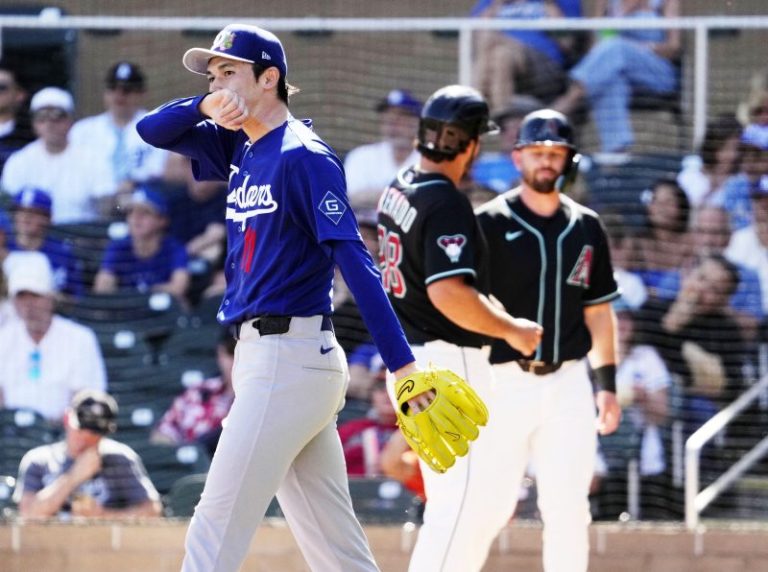
PHOENIX – It may have been a meaningless spring training game, but for Los Angeles Dodgers reliever Alex Vesia, it meant everything.

He slowly walked to the mound Monday, listening to the crowd at Camelback Ranch give him a rousing ovation, took a deep breath, and with his heart pounding, proceeded to do what he does best.

Vesia pitched a 1-2-3 inning against the Seattle Mariners, and he walked off the mound, the cheering grew louder and louder. He patted his chest and looked to the crowd in appreciation. He reached the dugout, and every single one of his teammates stood up to hug him, shake his hand, or pump fists.

“It’s been hard,’’ Vesia said. “I guess it’s hard in a good way because I want to interact with all of the fans and stuff like that, but I have a job to do.

“Even on the backfields, first day, I walk out the doors and cheers and lots of love. So, yeah, it means a lot, not only for myself, but for [wife] Kayla, too.’’

This was the first time Vesia pitched in a game since he and Kayla lost their newborn daughter, Sterling Sol, on Oct. 26, just before the start of the World Series. He left the team, but watched every pitch of every game on TV, and celebrated when they won the World Series against the Toronto Blue Jays.

He stayed home with his wife during the World Series parade, still in mourning, and after months of working out fanatically in the gym, and undergoing counseling with his wife, is back with the Dodgers, with life ever so slowly feeling as normal as could be in the aftermath of heartache and tragedy.

“Being around the guys, it’s really been comforting, you know,’’ Vesia said. “We’ve had multiple conversations and guys are asking me questions and just trying to, you know, feel for me. That’s honestly been a blessing. I do like talking about it with the guys and whatnot. I don’t want them to feel like they can’t. These guys are my brothers, man. I truly do love them all.’’

“It was a little overwhelming,’’ said Vesia, who was immediately praised by Dodgers pitching coach Mark Prior and assistant Connor McGuiness. “I was just trying to take it all in. Definitely, it was nice.’’

Vesia’s teammates certainly showed their love right back by standing in the dugout when he came off the mound, making sure he understood what he means to them, too.

Vesia, 29, a key left-hander in the Dodgers bullpen, says he had been working out nonstop since the tragedy. He spent hours and hours in the gym, perhaps too much he says, but it was his haven to keep his mind temporarily free from reliving the nightmare of losing a child.

Now, being around his teammates, and playing baseball once again, it’s the therapy Vesia savors.

“Obviously, what Alex and Kayla went through,’’ Dodgers manager Dave Roberts said, “you don’t wish that upon anyone. They’re getting to the other side of things. And to see him getting back out here in a baseball game, and to have a clean inning and be received by the fans, I know it meant a lot to him. Obviously, his teammates feel for him and want to support him.’’

And, now, ever so slowly, day by day, life is starting to become routine again being in spring training.

“I think the main thing is getting back to normalcy,’’ Roberts said. “That’s something I know that he wants and to kind of move forward and focus on 2026. We obviously know what went on, and what they’ve been through, but I think the main thing is getting back to doing what he loves to do, and that’s playing baseball.

“He’s in a good place.’’

Says Vesia: “It’s going to be a fun year. I’m really excited. I think we’re going to do some really cool things this year.’’

Follow Nightengale on X @Bnightengale

This post appeared first on USA TODAY