Author

admin

Browsing

Governments and militaries around the world are beefing up their defense budgets as geopolitical and trade tensions mount. Unsurprisingly, aerospace and defense stocks are looking more attractive to investors. 

The aerospace and defense industry comprises covers a large array of products, including aircraft, autonomous vehicles, marine vessels, satellites, electronic systems, software, missiles, drones and tanks.

Global defense spending increased by 9.4 percent in 2024 to US$2.72 trillion, led by the United States, China, Russia, Germany and India.

For its part, Canada spent US$29.3 billion on defense in 2024, making it the 15th highest spender globally. The country has yet to meet NATO member country spending targets of 2 percent of gross domestic product (GDP), coming in at 1.37 percent last year. However, this is expected to change in 2025.

In June, the Canadian government announced plans to invest an additional C$9 billion in the Canadian Armed Forces for the 2025/2026 fiscal year. The funds will go towards a wide array of improvements, including new aircraft, armed vehicles and drones.

“In an increasingly dangerous and divided world, Canada must assert its sovereignty,’ Prime Minister Mark Carney stated. ‘We will rapidly procure new equipment and technology, build our defence industrial capacity, and meet our NATO defence commitment this year. Canada will seize this opportunity with urgency and determination.”

Top 5 Canadian Defense Stocks

Canada’s aerospace and defense industry plays a large role both domestically and through exports. The Canadian Armed Forces prioritizes domestic equipment and services procurement, with 55 percent of expenditures made to Canadian suppliers in 2022.

The Canadian defense sector has historically outperformed the broader manufacturing sector in terms of industrial growth, according to a Government of Canada report.

Exports represent a significant portion of revenues for land and marine military goods and services. GlobalData reports that naval vessels and surface combatants, military fixed-wing aircrafts and military satellites are currently the most attractive segments of the country’s defense market.

1. CAE (TSX:CAE)

Market cap: C$12.33 billion

Established in 1947, CAE manufactures simulation technologies and digitally immersive training services for the aerospace, defense and healthcare industries. The company’s defense and security business unit provides training and mission support solutions for air, land, maritime, space and cybersecurity operations.

The company has regional defense and security training facilities in many countries and regions globally, namely the US, Canada, the United Kingdom, Europe, the Indo-Pacific and the Middle East. CAE’s annual revenue for its 2025 fiscal year ending March 31, 2025, was C$4.71 billion, up 10 percent year-over-year.

2. Bombardier (TSX:BBD.B)

Market cap: C$11.57 billion

A global leader in aviation, Bombardier is headquartered in Québec, Canada, and operates aerostructure, assembly and completion facilities in Canada, the US and Mexico. Although best known for its business jets, the company has also earned the distinction of being a trusted designer and manufacturer of military special-mission aircraft under its Bombardier Defense unit.

Bombardier Defense has a multi-year US$465 million contract to sell its Global 6000 jets to the US Air Force under the Battlefield Airborne Communications Node program, which began in 2021 and extends through 2026. Under the contract, Bombardier is selling modified Global aircrafts to the US Air Force. These aircrafts are specialized communications platforms that help bridge voice and data between forces on the ground and in the air.

Bombardier reported US$8.7 billion in revenue for 2024, up 8 percent year-over-year.

3. MDA Space (TSX:MDA)

Market cap: C$4.25 billion

MDA calls itself “an international space mission partner and a robotics, satellite systems and geointelligence pioneer.” The company is responsible for Canada’s first military satellite, Sapphire, which is designed to monitor Earth’s orbit and surveil outer space for man-made space debris and other satellites. Classified as a Space Situational Awareness small-satellite system, Sapphire was created for Canada’s Department of National Defence. MDA also provides satellite capabilities to the Department of National Defence’s Polar Epsilon satellite ground stations.

MDA reported strong top-line growth in 2024, with revenues of C$1.08 billion, up 34 percent year-over-year. The company expects 2025 full year revenues to be between C$1.5 billion and C$1.65 billion.

4. Magellan Aerospace (TSX:MAL)

Market cap: C$1.06 billion

Magellan Aerospace designs, manufacturers and services aeroengine and aerostructure assemblies and components for the global aerospace market, as well as proprietary products for the military and space submarkets.

In April of this year, the company signed an amendment to an important long-term revenue sharing agreement with GE Aerospace (NYSE:GE). The amendment includes the production of major components for the F414-GE-400K aircraft engine over a seven-year period for the Korean KF-21 fighter aircraft program for South Korea’s national arms procurement agency.

Magellan’s total revenue for 2024 came in at C$942.37 million, up 7.1 percent over the previous year.

5. Kraken Robotics (TSXV:PNG)

Market cap: C$767.92 million

Marine technology company Kraken Robotics provides advanced subsea sonar and laser systems, as well as batteries and robotics systems for unmanned underwater vehicles used in the military and commercially. According to Kraken, it is best known for its high-resolution 3D acoustic imaging solutions and services.

In February of this year, Kraken announced plans to open a new battery production facility in Nova Scotia, stating it aims to meet increasing demand for uncrewed underwater vehicles from the defense sector.

Kraken’s consolidated revenue for 2024 reached C$91.3 million, up 31 percent year-over-year. The company’s guidance for 2025 revenue is C$120 million to C$135 million.

Top Canadian Defense ETFs

Exchange-traded funds (ETFs) are marketable securities that track an index, a commodity, bonds or a basket of assets like an index fund. Investors can diversify their portfolio and lower the risk of investing in individual stocks with defense ETFs.

ETF Portfolio Blueprint has identified two Canadian Defense ETFs worthy of investor attention. All data was current as of June 30, 2025.

1. iShares U.S. Aerospace & Defense Index ETF (TSX:XAD)

Assets under management: C$50.57 million

iShares U.S. Aerospace & Defense ETF launched in September 2023, and has an expense ratio of 0.44 percent. This fund replicates the iShares U.S. Aerospace & Defense ETF (BATS:ITA) and tracks the Dow Jones US Select Aerospace & Defense Index.

These defense stocks are typically stable companies in the sector whose revenues are mainly tied to long-term government contracts. Top holdings include RTX (NYSE:RTX), The Boeing Company (NYSE:BA), Lockheed Martin (NYSE:LMT), General Dynamics (NYSE:GD) and L3Harris Technologies (NYSE:LHX).

2. Global X Defence Tech Index ETF (TSX:SHLD)

Assets under management: C$28.88 million

Launched in April 2025, the Global X Defense Tech Index ETF is the Canadian version of the Global X Defense Tech ETF (NYSEARCA:SHLD). Like its US equivalent, the ETF tracks the proprietary Global X Defense Tech Index, meaning this ETF differs from XAD by offering exposure to a mix of US and global defense stocks. As it is a brand new ETF, an expense ratio has not yet been calculated, but it has a management fee of 0.49 percent.

Its only holding is the US Global X Defense Tech ETF, which includes some of the biggest defense stocks such as Lockheed Martin and General Dynamics, and is also heavily weighted in Palantir Technologies (NASDAQ:PLTR) and L3Harris Technologies.

Securities Disclosure: I, Melissa Pistilli, hold no direct investment interest in any company mentioned in this article.

This post appeared first on investingnews.com

Silver took some luster from gold in Q2 as its price climbed to 14 year highs.

Many of the same contributors that affected the gold price were also in play for silver.

Uncertainty in financial markets, driven by a chaotic US trade and tariff policy, coincided with rising tensions in the Middle East and continued fighting between Russia and Ukraine, prompting investors to seek safe-haven assets.

Unlike gold, however, silver also saw gains as industrial demand strained overall supply.

What happened to the silver price in Q2?

The quarter opened with the price of silver sinking from US$33.77 per ounce on April 2 to US$29.57 on April 4. However, the metal quickly found momentum and climbed back above the US$30 mark on April 9.

Silver continued upward through much of April, peaking at US$33.63 on April 23.

Volatility was the story through the end of April and into May, with silver fluctuating between a low of US$32.05 on May 2 and a high of US$33.46 on May 23.

Silver price, April 1 to July 17, 2025.

Chart via Trading Economics.

At the start of June, the price of silver soared to 14 year highs, opening the month at US$32.99 and rising to US$36.76 by June 9. Ultimately, the metal reached a year-to-date high of US$37.12 on June 17. Although the price has eased slightly from its high, it has remained in the US$36 to US$37 range to the end of the quarter and into July.

Silver supply/demand balance still tight

Various factors impacted silver in the second quarter of the year, but industrial demand was a primary driver in both upward and downward movements. Over the past several years, silver has been increasingly utilized in industrial sectors, particularly in the production of photovoltaics. In fact, according to the Silver Institute’s latest World Silver Survey, released on April 16, demand for the metal reached a record 680.5 million ounces in 2024.

Artificial intelligence, vehicle electrification and grid infrastructure all contributed to demand growth

At the same time, mine supply has failed to keep up, with the institute reporting a 148.9 million ounce production shortfall. This marked the fourth consecutive year of structural deficit in the silver market.

“(We have) flat supply, growing demand — demand that’s nearly 20 percent above supply,’ he said. ‘And our ability to meet those deficits is shrinking because we’re tapping into these aboveground stockpiles that have shrunk by about 800 million ounces in the last four years, which is equivalent to an entire year’s mine supply. So it’s the perfect storm.’

But industrial demand can send the silver price in either direction.

The chaos caused by Trump’s on-again, off-again tariffs has caused some consternation among investors.

While gold and silver have traditionally both been viewed as safe-haven assets, silver’s increasing industrial demand has decoupled it slightly from that aspect. When Trump announced his ‘Liberation Day’ tariffs on April 2, silver was impacted due to fears that a recession could cause demand for the metal to slip.

Although the dip in silver was short-lived, it was one of its steepest falls in recent years.

“If a global recession really starts, silver will most likely nosedive momentarily. In terms of its 2025 performance, silver growth has been largely bolstered by consolidated precious metals group appreciation, additionally beefed up by relative USD weakness.’

Geopolitics and the silver price

Adding to the tailwinds is a growing east-west divide. Due to its usage in industrial components, particularly those related to the military and energy sectors, and its role as a safe haven, silver is being influenced by geopolitics.

June’s price rally came alongside growing speculation that Israel was preparing to attack Iranian nuclear sites. Investors became concerned that war could disrupt international trade and oil movements in the region.

Ultimately, their concerns were proven right, and Israel launched attacks on June 12; the US then bombed key nuclear facilities on June 21. While the escalation is new, the underlying politics have been simmering for years.

Sanctions against Russia have strengthened support among the BRICS nations, which have been working to reduce their reliance on US dollar assets, such as treasuries, and increase trade in their own currencies.

But they may also be working to separate themselves from western commodities markets. In October 2024, Russia floated the idea of creating a precious metals exchange to its BRICS counterparts. If established, it could shake up pricing for commodities like silver, allowing Russia to circumvent sanctions and trade with its bloc partners.

While the exchange is still just an idea, a bifurcated world is not. While the US has targeted most nations with tariffs, it has singled out China. Much of the first half of the year saw the world’s two largest economies escalate import fees with one another, with China even restricting the export of rare earth elements to the US.

Discussions on national security and critical minerals have been at the forefront for the last several years. Still, they have become even more pronounced with the US and China on tense footing.

“Even if that’s going to happen, industrial use value — building infrastructure, building national security, national energy priorities — needs a lot of silver, and there just simply isn’t enough supply out of the ground to meet the demand. That’s long-term demand above the ground. This has been a thing, but right now, because of these geopolitical forces and realignments, silver is going to drop more into that industrial role,” she said.

Silver price forecast for 2025

Overall, the expectation is that without new mine supply and dwindling aboveground stockpiles, silver is likely to remain in deficit for some time. Other factors, like Trump tariffs and geopolitics, aren’t likely to disappear either.

Demand could ease off if a global recession were to materialize, but safe-haven investing could offset declines.

For his part, Krauth thinks the silver price is likely to remain above the US$35 mark, but it could fluctuate and he suggested a rally in the US dollar could push the silver price down. However, he also sees some pressure easing on the recession side of the equation if the US signs tariff deals that would eliminate some uncertainty.

“US$40, let’s say by the end of this year,’ he said, adding, ‘Frankly, I could see something really realistically above that, maybe an additional 10 percent if the scenario plays out right.’

He doesn’t think that’s the end. In the longer term, Krauth sees silver going even higher. He pointed to the current gold-silver ratio, which is around 92:1, compared to an average of 60:1 over the last 50 years.

“So we could go to, who knows, somewhere like maybe 40 or 30 to one in the ratio. That would be tremendous for silver — that could bring silver above US$100. I’m not saying that’s happening tomorrow, but in the next couple of years I would say that’s certainly something that could easily be in the cards,” Krauth said.

Fundamentals and geopolitics aligned for silver in the first half of 2025, and barring a recession, they are likely to provide tailwinds in the second half. Whether the price climbs or continues to find support at US$35 is yet to be seen.

Securities Disclosure: I, Dean Belder, hold no direct investment interest in any company mentioned in this article.

This post appeared first on investingnews.com

Apple (NASDAQ:AAPL) and MP Materials (NYSE:MP) have signed a US$500 million supply agreement to manufacture rare earth magnets in the US from 100 percent recycled materials.

Under the deal, MP will deliver recycled magnets starting in 2027 to support “hundreds of millions” of Apple devices, including iPhones, iPads and MacBooks. Announced on Tuesday (July 15), the deal marks a major step forward in Apple’s plan to build more sustainable domestic supply chains for its core technologies.

“American innovation drives everything we do at Apple, and we’re proud to deepen our investment in the US economy,” Apple CEO Tim Cook said in a press release. “Rare earth materials are essential for making advanced technology, and this partnership will help strengthen the supply of these vital materials here in the United States.”

The two companies spent nearly five years developing recycling technologies capable of meeting Apple’s stringent performance and environmental standards. Now, MP will build a commercial-scale recycling line at its Mountain Pass site to process magnet scrap and recovered components from decommissioned products.

To fulfill Apple’s requirements, MP will also expand its Fort Worth, Texas, facility — dubbed “Independence” — creating dozens of new roles in manufacturing, as well as research and development.

“We are proud to partner with Apple to launch MP’s recycling platform and scale up our magnetics business,” said MP CEO James Litinsky in a separate Tuesday press release. “This collaboration deepens our vertical integration, strengthens supply chain resilience, and reinforces America’s industrial capacity at a pivotal moment.”

MP’s share price soared 20 percent following the news, pushing its market cap to near US$10 billion.

Analysts view the deal as a validation of MP’s strategy to build a fully domestic rare earth magnet supply chain and as a boost to national efforts to reduce reliance on China, which controls roughly 70 percent of global rare earths supply.

MP currently operates the only active US rare earths mine at Mountain Pass. Rare earth magnets produced from its materials power devices ranging from consumer electronics and electric vehicles to wind turbines and defense systems.

MP teams up with defense department

Just days before the Apple deal, MP secured a US$400 million preferred equity investment from the US Department of Defense (DoD), making the Pentagon its largest shareholder.

The funds will support a second magnet manufacturing plant — called the 10X facility — which is slated for commissioning in 2028 and will increase MP’s annual magnet output to 10,000 metric tons.

The government has also committed to purchasing 100 percent of the magnets produced at the new plant for 10 years, guaranteeing a floor price of US$110 per kilogram for neodymium-praseodymium oxide.

If market prices fall below that level, the DoD will pay the difference. Once production begins, the government will also receive 30 percent of any profits above the guaranteed price.

With operations spanning mining, separation, metallization and magnet production, MP is currently the only US firm with end-to-end capabilities for rare earth magnet manufacturing. The company is also expecting a US$150 million Pentagon loan to enhance its heavy rare earths separation capabilities at Mountain Pass.

MP’s Independence facility in Texas, alongside the upcoming 10X plant, anchors its downstream production strategy. The recycled feedstock used for Apple’s magnets will be sourced from post-industrial waste and retired electronics — reducing environmental impact while reinforcing resource resilience.

Apple, for its part, is pressing ahead with its US$500 billion US manufacturing initiative.

Earlier this year, it announced plans for a new artificial intelligence server factory in Texas and signaled continued interest in reshoring key parts of its production ecosystem.

Securities Disclosure: I, Giann Liguid, hold no direct investment interest in any company mentioned in this article.

This post appeared first on investingnews.com

Comedian Shane Gillis roasted quarterback Shedeur Sanders and his father Deion Wednesday with a joke about the controversial decision to retire Shedeur’s No. 2 at Colorado after two seasons in Boulder.

Gillis made the remarks while hosting the ESPYS in Los Angeles on Wednesday, July 16, when he made fun of many sports celebrities and topics.

“Shedeur Sanders had his jersey number retired at Colorado this year, and people are saying it’s because of nepotism, because of his father, and it’s not” Gillis said. “It’s because he went 13-12 over his career, and he almost won the Alamo Bowl. Definitely not nepotism, right?”

The joke drew a muted response from the audience, with Baltimore Ravens quarterback Lamar Jackson shown on ESPN looking down and smiling.

Shedeur Sanders, now with the Cleveland Browns, actually went 13-11 as starting quarterback at Colorado across the 2023 and 2024 seasons while playing for his father Deion, Colorado’s head coach. But he is considered possibly the best quarterback in school history after breaking over 100 school records and reviving a program that went 1-11 in 2022, the season before he arrived.

The decision to retire his jersey number still was controversial, partly because it came less than four months after his last college game in the Alamo Bowl against BYU, which he lost, 36-14.

The decision also seemed to overlook other all-time Colorado greats, especially former Colorado quarterback Darian Hagan, who led Colorado to the national championship in 1990 and had a 28-5-2 record as QB. By contrast, Hagan’s jersey number never was retired by Colorado.

The university said the decision to retire a player’s jersey number is at the discretion of the athletic department administration and current head coach.

In April, the university announced the decision to retire the jersey numbers of Sanders and his teammate Travis Hunter, the Heisman Trophy winner. Before them, only four jersey numbers had been retired in CU’s 135-year football history and none since 2017.

Follow reporter Brent Schrotenboer @Schrotenboer. Email: bschrotenb@usatoday.com

This post appeared first on USA TODAY

Alfonso Mondelo was 13 years old when he arrived in the United States from Spain in 1971.

‘Soccer was almost nonexistent,’ he tells USA TODAY Sports. ‘You had to go chase it.’

Your desire to see the sport might take you to New York’s Felt Forum, the then-named auditorium at Madison Square Garden where Mondelo watched the 1974 World Cup on a closed-circuit television, or to movie theaters.

Even by 1990, Major League Soccer’s longtime technical director says, when the U.S. men qualified for the tournament in Italy, you went to a bar with a satellite dish to watch them.

‘If there was a baseball game, you had to fight with the baseball people to keep the soccer game on,’ Mondelo says. ‘So this has gone to where this is the country that consumes probably the most soccer in the world. Right now, you can turn on a TV on Saturday morning at 7 o’clock, begin to watch European games and continuously watch live soccer until probably 12:30, 1 o’clock in the morning, when MLS finishes.

‘It’s a sport that you can play forever. Every day, there are more American-born fans, and I would say under the age of 40 in this country, most players have played it at one level or the other.’

Mondelo, 66, spent time on the pitch in Spain’s second division while he was in the U.S. Air Force and later became a coach. He got his start as a coach in MLS with the New York/New Jersey MetroStars in the late 1990s. He moved to his position in the league’s front office in 2004, when teams had no youth programming.

Today, there are 40,000 kids participating in its MLS GO recreational program and almost 18,000 enrolled in its elite MLS NEXT platform (raising to 40,000-plus with a new competition tier), which runs from the U13 to U19 levels.

As of June 15, according to MLS, 93% of the players on U.S. youth national teams are coming from MLS NEXT. This year alone, the league also has invested more than $125 million in player development, according to Mondelo.

‘It’s the greatest sport in the world,’ says Mondelo, whom we interviewed upon the 30th anniversary of MLS. ‘Once you start playing it, you get hooked on it. If you speak soccer, you can engage conversations in any country in the world. I think the Americans are catching onto it. …

‘Now there is a direct pathway, so a young player who begins to play the game and has a passion for it can see a direct pathway from youth all the way to a professional team. Now, in a lot of the markets, they have a professional team that they can go see and they can aspire to be part of.’

The league realizes, of course, the overall percentages of becoming a professional player are very small. It’s constantly seeking ways to get more kids access to the game, hoping to create fans at the grassroots levels who will attend MLS matches.

Where might your son or daughter fit into MLS’ youth ecosystem? Here are the opportunities it provides:

MLS GO: Finding a lifelong love of the game

When we place our kid in a sport at a young age, a goal is they enjoy it and want to come back for another season.

‘We’re not trying to create world-class players from the time of 5 or 6 years old,’ says Kyle Albrecht, the general manager of MLS GO and MLS NEXT.

MLS GO is designed to teach fundamentals to boys and girls from 4 to 14 – sometimes playing in games together – in a community setting. It’s in 47 states and Washington D.C., and, if you’re in an MLS market, tickets to a pro game might be included with your entry fee.

Albrecht says the median age of an MLS GO player is 7 or 8 but it’s open to beginners throughout its age groups.

‘It also gives that opportunity at the higher end of the spectrum,’ Albrecht says. “Let’s say that individual player is not ready to go into the youth travel environment (with) more competitive aspects that we know have a tendency to drive kids and families out of the game.’

MLS GO, Albrecht says, was born in 2023 out of data that registered soccer participation wasn’t really growing over the past 20-plus years.

‘There was a real intentionality about the push to travel too early, (the) cost growing so high at young ages. How do we build a program to combat that negativity with the game becoming too intense for that recreational audience?’ Albrecht says.

MLS NEXT: Seeking your highest potential

Kids with more ambitious sports aspirations can try out for clubs within MLS NEXT starting at the U13 level. There are 29 MLS academies and 238 elite academies within the 267 clubs (including the second tier of competition) that make up MLS NEXT.

MLS NEXT academy teams compete in high-level events such as Generation Adidas Cup. The GA Cup began almost two decades ago as a gauge to evaluate how MLS academy teams were developing across the country and then started to bring in international competition.

‘When we first started there, it was hard to compete,’ Mondelo says. ‘The foreign teams were beating us; we got a draw, we felt that that was a positive result. And over the last 10, 15, years, we’re seeing that the MLS teams in some age groups are dominating the competition, so we are getting to be close to a world-level par in player development.

‘Also, the interest of international clubs on the players that are being developed domestically has risen tremendously. So they’ve seen the American player as a viable option to bring into top-level clubs worldwide.’

MLS NEXT came about in 2020, taking over when the U.S. Soccer Development Academy ended operations. There are 130 NEXT players who have matriculated to MLS. They include Diego Luna (Real Salt Lake), Benjamin Cremaschi (Inter Miami CF), Alex Freeman (Orlando City SC), Obed Vargas (Seattle Sounders FC) and Cavan Sullivan (Philadelphia Union).

MLS NEXT top-tier players agree to forgo participating simultaneously in both MLS NEXT and high school soccer, according to an MLS spokesperson, though clubs can submit a high school waiver and play. Players in the other tier will be allowed to play it.

‘Our objective from a player development strategy is to develop the next generation of talent that will affect the pro game, and the pro game includes Major League Soccer, it includes national teams,’ Luis Robles, MLS NEXT’s technical director, told USA TODAY Sports in January, when laying out the parameters of the second tier. ‘But within that object is another sub tier of, ‘How does that play itself out?’ We saw an opportunity to deepen the player pool, to give more families that experience. … So it is the aspirational athlete, but it’s also just the athlete that wants to continue to play soccer with their friends. So it is a combination of everyone.’

The 29 lead academies offer scholarships, housing and schooling, but players at the non-MLS academies, which MLS refers to as elite academies, are given looks and opportunities to move up within the organization. These chances include trials at MLS academies, talent ID camps or sometimes guest appearances for the clubs at competitions like the GA Cup.

There are coaching and travel costs associated with elite academies, though Albrecht says MLS NEXT clubs try and look at providing financial aid where it might be needed.

‘We try and get every player in MLS NEXT to reach their highest potential,’ Albrecht says. ‘That may mean it’s Division 1 or Division III college. We’re hosting our MLS NEXT Fest event in December and that’s going to be the biggest college recruiting event in youth soccer.’

MLS NEXT Pro: Completing the path

MLS determined as it began to build its youth programs that it lacked qualified coaching compared to other parts of the world. It started working with the French Federation to develop courses.

In addition, all 30 MLS clubs have state-of-the-art training facilities where their MLS NEXT academy teams train. (San Diego FC academy is just getting off the ground and not competing in MLS NEXT yet.)

‘Without a doubt, I think in the next few years, we’re going to see a world-class player emerge here that will be comparable to what’s coming out of any other country in the world,’ Mondelo says.

MLS NEXT players who advance along the path toward MLS might also get the chance to participate in MLS NEXT Pro, a men’s league in the USA and Canada. MLS NEXT Pro might also include international players, older collegiate graduates and others who may not have played in MLS NEXT.

Since the launch in 2022, MLS teams have signed more than 160 players from this polishing stage.

More opportunities for girls

MLS NEXT is a boys competition but member clubs can invite girls to play on their teams. USWNT players Alyssa and Gisele Thompson, for example, played on an U19 MLS NEXT team.

MLS NEXT announced in December it had formed an alliance with the Girls Academy. According to MLS, the Girls Academy has 114 clubs and more than 16,000 players (including 48 clubs that have a boys team in MLS NEXT) from the U13 to U19 age groups.

‘We’re in very regular contact with the leadership team at Girls Academy, just in terms of what are those touch points that we can add value – whether it be through events, through different coaching education initiatives, things we can do to really align that development,’ Albrecht says.

The GA Cup, which Mondelo spearheaded for MLS, had a girls division for the first time in 2025. Girls Academy Red beat Girls Academy Blue in the U16 final. Their division also included FC Bayern (Germany) and Manchester City FC (England).

Initial plans, Albrecht says, have looked at expanding the girls division to allow for additional Girls Academy teams as well as international teams.

‘I would not be surprised if we start seeing some of our (professional) clubs begin to develop the youth academies on the women’s side,’ Mondelo says of MLS.

The future: ‘Best is yet to come’

According to MLS, MLS NEXT players have represented 32 different youth national teams around the globe in 2025. Players from 56 MLS NEXT clubs (277 players in all) have been called up to youth national teams this year.

Albrecht predicts a half-million-plus players participating in MLS GO in the years following the 2026 World Cup next summer.

Five decades ago, Mondelo says, it was strictly immigrants who would go out and watch soccer. During the most recent men’s World Cup (held in Qatar in 2022), he noticed in New York City the bars were not only full, but people were outside on the street looking inside to try to see the game.

‘Americans want to be winners and want to have a team that wins,’ Mondelo says. ‘So as our national team goes, I think we’re very nationalistic. That will also continue in this constant growth of the sport. …

‘I think a lot of credit has to be given to the ownership groups in MLS, the investment that has been made in these facilities, not only for the first team, for the pro team, but for these academies, has really brought us to the next level.

‘The reward will be when we start seeing these American players becoming the mainstay of MLS clubs. So ideally, the mid-level players and above will be domestically grown players, and then the influx of the internationals will be truly the superstars that will elevate this league. Major steps have been taken in 30 years, but the best is yet to come.’

Steve Borelli, aka Coach Steve, has been an editor and writer with USA TODAY since 1999. He spent 10 years coaching his two sons’ baseball and basketball teams. He and his wife, Colleen, are now sports parents for two high schoolers. His column is posted weekly. For his past columns, click here.

This post appeared first on USA TODAY

MLS has seen its fair share of stars over what is now a 30-season lifespan. Whether those players were global icons, cult figures, or unknowns who used the league to make their name in the soccer world, the league has seen some outstanding talents grace its fields.

Some of the biggest names are obvious: Lionel Messi is a player with no equal, while even the most casual soccer fan in the U.S. knows names like David Beckham and Landon Donovan.

However, MLS history extends beyond the ‘retirement league” cliches, and to see the league as nothing more than a home for aging big names and U.S. men’s national team hopefuls would be a huge mistake. From the get-go, MLS has been home to some extravagantly skillful players, as well as some incredible underdog stories, comebacks and top-level international talent that real soccer heads know all about.

With that thought in mind, here are USA TODAY’s picks for the 30 best players in MLS history:

Jeff Agoos

Only Landon Donovan has surpassed Agoos’ five MLS Cup rings. The longtime USMNT defender, who today is the president and general manager of the NWSL’s Portland Thorns, was a crucial piece for the most dominant team in MLS history (the D.C. United sides of the 1990s) and then arguably even more important on a San Jose Earthquakes club that won MLS Cups in 2001 and 2003.

Miguel Almirón

Almirón has only played three seasons in MLS, but his impact is undeniable. The Paraguayan put together two marvelous MLS Best XI campaigns with Atlanta United in 2017-18, helping a brand-new team redefine what it is to hit the ground running in this league. Almirón then joined Newcastle United in a reported $26 million transfer, which remains a league record. Moreover, the move validated MLS as a place for elite younger players to blossom before moving on to the world’s elite leagues.

The Five Stripes brought “Miggy” back this season in part hoping to recapture the club’s early success.

DaMarcus Beasley

As a fleet-footed winger, Beasley burst onto the scene with an excellent Chicago Fire side that won three trophies in his five seasons there.

The Indiana native – who is the only USMNT player to appear in four World Cups – then broke new ground with a transfer to Dutch power PSV, eventually playing in the Premier League and Bundesliga before returning to MLS in 2014 to join the Houston Dynamo. Remaking himself as a left back, Beasley became a leader in Houston, helping the Dynamo to the 2018 U.S. Open Cup.

Kyle Beckerman

The dreadlocked Crofton, Maryland, native owns the MLS record for minutes played by a field player (41,164), a remarkable achievement for a player whose career started before teams in this league really knew what to do with talented youngsters. His other MLS record (most yellow cards, with 152) speaks to a win-at-all-costs grit that made him a club legend for Real Salt Lake.

Beckerman played in six MLS All-Star Games and is one of 15 players with 400-plus league appearances.

David Beckham

Beckham’s place in MLS history is fascinating. The global superstar was an important piece of the puzzle for an LA Galaxy side that won MLS Cups in 2011 and 2012, putting up 20 goals and 42 assists in 124 appearances in all competitions. However, he was not the most important player on that team and missed time due to a torn Achilles tendon suffered on a winter loan to AC Milan that, at the time, went down like a lead balloon.

As a cultural force, though, Beckham’s impact was absolutely essential for MLS’ growth. His arrival served as rocket fuel for a league that was seemingly stuck in place, opening wallets domestically and doors abroad that were previously closed.

Sergio Busquets

Busquets’ career speaks for itself: nine championships and three UEFA Champions League wins with a Barcelona side whose stylistic qualities fundamentally changed the sport, and a pivotal role on the Spain team that won the 2010 World Cup to boot.

The 36-year-old may play an unglamorous position, but his presence in MLS remains mind-blowing for any long-standing league observer. Since coming to Inter Miami in 2023, Busquets has been nearly ever-present, functioning as a leader and the driving force of the possession-based style that allows Messi and company to make all the headlines.

Dwayne De Rosario

“De Ro” is a thoroughly MLS success story. De Rosario won eight major trophies and was named to the MLS Best XI six times in his 14 seasons in the league. With the San Jose Earthquakes, he scored a brilliant Golden Goal to secure the 2001 MLS Cup and later scored a physics-defying free kick that remains arguably the best goal in MLS history. In 2011 he won the MLS MVP award despite being traded twice after that season had begun (playing for Toronto FC, the New York Red Bulls, and D.C. United).

Between his wandering career, his trademark goal celebration, and a staggering highlight reel, the Ontario native is unquestionably an MLS legend.

Clint Dempsey

Dempsey started his career in MLS with the New England Revolution in 2004, eventually earning a move to the Premier League after three seasons. However, the second chapter of Dempsey’s MLS career with the Seattle Sounders is what earned him his place on this list. A blockbuster $8 million return to the league after European success with Fulham and Tottenham Hotspur broke new ground for MLS, with an in-demand USMNT star coming to the league at a time when that simply didn’t happen.

Dempsey’s swaggering, brash personality and creativity are ingredients MLS clubs have often had to find abroad, making him a uniquely important figure in league history.

Landon Donovan

Donovan’s MLS career was so impressive, and so important to what was a fledgling league when the California native arrived on the scene, that the league MVP award is officially titled the Landon Donovan Most Valuable Player Award.

No one has won more MLS Cups (six), made more Best XI lists (seven), or had more assists (136) than Donovan, who also sits third on the league’s all-time goal scoring list with 145. Between his time with the Earthquakes and Galaxy, Donovan lifted nine major trophies.

Marco Etcheverry

Etcheverry was the cornerstone of what remains the most successful run by a single club in MLS history. D.C. United won eight trophies from 1996 to 1999, including three MLS Cup victories and the first continental trophy in league history (the 1998 Concacaf Champions Cup).

Moreover, the Bolivian playmaker was exactly what MLS wanted to be: his skills would have fit in anywhere in the world, and his competitive fire (his nickname, “El Diablo,” was no joke) drove D.C. to heights it couldn’t have achieved otherwise. Etcheverry’s 101 assists in league play came in just 191 appearances, making him one of the most prolific chance generators MLS has ever seen.

Sebastian Giovinco

Giovinco wasn’t in MLS for all that long, but his four years with Toronto FC were unprecedented.

The pint-sized Italian won the league MVP award in 2015, leading MLS in both goals (22) and assists (15). TFC would go on to be the only team in MLS history to win a treble in 2017, claiming the MLS Cup, the Supporters’ Shield, and the Canadian Championship. In just four MLS seasons, Giovinco scored a league-record 13 direct free kick goals.

Thierry Henry

Henry’s numbers (52 goals, 40 assists in 135 appearances) speak to his class as a player, but where the Arsenal and Barcelona icon truly stood out came by changing perceptions about MLS.

Many global stars came to the league at the same point in their careers as Henry, who arrived in the league at age 33. However, none with his profile had brought the intensity and commitment to winning that the France legend did, and it’s fair to say he sparked a sea change at a Red Bulls franchise that had never won anything before his arrival.

Zlatan Ibrahimović

Whether you buy into the Zlatan persona or not, the towering Swedish striker made an impact in MLS that stands alone. Ibrahimović joined an LA Galaxy side in 2018, scoring 52 goals in 56 games for what was otherwise one of the worst teams in the league at the time.

Ibrahimović’s combination of skill, creativity and pure power remain unmatched in league history, and his subsequent success at AC Milan showed that MLS wasn’t as far from the world’s top leagues as some would say.

Robbie Keane

As much as the LA Galaxy’s best era as a team are defined by Beckham and Donovan, Keane was arguably that group’s most vital player. The Ireland striker was relentless for a Galaxy team that won the MLS Cup three times in four seasons, scoring 83 times in 125 total appearances.

His forward partnership with Donovan has arguably never been matched in the league, and Keane’s intense competitive nature was just as important in pushing the biggest club in MLS to capitalize on Beckham’s presence with on-field success.

Kei Kamara

A refugee who escaped the Sierra Leone civil war, Kamara has had a remarkably unlikely path to MLS stardom. The striker has played for a record 12 MLS teams, and he sits second on the league’s all-time goal scoring chart with 146.

Despite rarely staying with any team for more than two years, Kamara has aerial ability and an outsized personality that have won fans over across MLS. At age 40, Kamara is in the midst of his 18th MLS season, and he’s not merely hanging around. The target man is an often-used substitute for a serious contender in FC Cincinnati, and last season he had a similar role with another big-time franchise in LAFC.

Chad Marshall

Marshall’s 35,843 minutes played place him fifth all-time, and third among field players. A remarkable 16-year run in MLS saw the California native establish himself as a defensive cornerstone for the Columbus Crew and Seattle Sounders, leading both teams to tremendous success. In Ohio, Marshall helped the Crew to an MLS Cup win in 2008 and three Supporters’ Shields.

The center back then joined the Sounders, lifting three trophies (including the 2016 MLS Cup), and was a model of consistency throughout his career. Despite long being on the outside looking in with the USMNT, Marshall is the only player to win MLS Defender of the Year three times.

Josef Martínez

Martínez may currently play for San Jose, but he is synonymous with the incredible early success Atlanta United experienced when the club entered MLS in 2017. Martínez bagged 111 goals and 17 assists in 158 appearances for Atlanta, terrorizing defenses with a wide range of finishes. There have been few players to feel as inevitable as Martínez did from 2017 to 2020, before a torn ACL slowed his output and hastened his exit with the Five Stripes.

While his performances at Inter Miami, CF Montréal and with the Earthquakes may not quite have matched the good old days, the Venezuelan is sixth in MLS history with 123 goals. His strike rate of 0.62 goals per appearance is the best among any of the 13 players to cross the 100-goal barrier.

Tony Meola

Meola was a vital figure in MLS’ first few years, lending the notoriety he gained as the USMNT’s starting No. 1 (which also resulted in an NFL tryout with the New York Jets, among other things) to a league that needed all the help it could get.

The New Jersey native remains the only MLS goalkeeper to win an MVP award, doing so in 2000 as he helped a defense-first Kansas City Wizards (now Sporting Kansas City) to an MLS Cup victory. Meola’s 16 shutouts that season remain an MLS record, and we’d be remiss if we ignored what remains the best season a goalkeeper has had in league history.

Lionel Messi

If you’re regarded in plenty of quarters as the best player in soccer history, and you play in MLS, you definitely belong on this list.

Messi’s output for Inter Miami (49 goals, 24 assists in 59 games) is jaw-dropping, even knowing how good he has been at the very top of the sport, and only Beckham has come close to matching the Argentine’s cultural impact as an MLS player. He is, simply put, one of one.

Could MLS have more clearly capitalized on his presence? Certainly, but the GOAT being in the league has still been revolutionary.

Jaime Moreno

Moreno (133 goals, 102 assists) remains an icon with D.C. United, having been two different versions of himself in two stints with the club. In the ’90s, Moreno was the best forward in MLS, a classic speed-first No. 9 who was indispensable for a team that won three of the first four MLS Cup titles.

After a back injury that nearly ended his career in a 2002 trade, he returned to the District in 2004 slower but craftier, helping United win another championship in 2004. The Bolivian was a part of 12 of United’s 13 major trophy wins, landing on the Best XI five times. He and Donovan are the only two players to sit in the league’s all-time top 10 in goals and assists.

Pat Onstad

Now the president of soccer at the Houston Dynamo, Onstad won two MLS Goalkeeper of the Year honors in 2003 and 2005 (earning a spot in the Best XI on both occasions as well). Quiet and unspectacular, Onstad made positioning, sound fundamentals and organizational ability his top priorities.

The result? He was a key piece in the San Jose team that claimed the 2003 MLS Cup and 2005 Supporters’ Shield, then carried on when the team relocated, becoming the Houston Dynamo. That same group, now in Texas, continued an outstanding run, going back-to-back with MLS Cup wins in 2006 and 2007. In a nine-year MLS career, the Canadian posted a 1.14 goals-against average, one of the 10 best marks in MLS history.

Eddie Pope

In an era where center backs were big, mean, and slow, Pope was like a visitor from the future. The North Carolina native’s 12 MLS seasons were characterized with an unshakable calm with and without the ball, as well as the kind of mobility and comfort with the ball that became hallmarks in soccer over a decade after he had hung up his boots.

Pope won eight trophies in his years with D.C. United (scoring a legendary game-winner in the first-ever MLS Cup final), and landed on the MLS Best XI four times (twice with D.C. and twice with the MetroStars). He remains arguably the best center back the USMNT has ever had, another highly unlikely achievement for a player whose pro career was entirely spent in MLS.

Preki

Predrag Radosavljević had the kind of career that can scarcely be believed: Stints in Serbia, Sweden, and in the Premier League with Everton were broken up by years spent plying his trade in the various indoor soccer leagues that served as the best option in the U.S. before MLS kicked off in 1996.

In 10 MLS seasons (nine of which came with the Kansas City Wizards), Preki was named MLS MVP in 1997 and 2003, making him the only player in league history to win that award twice. With his trademark cutback move and powerful shot, Preki won two Golden Boot awards, while his 112 career assists rank him fifth in league history.

Steve Ralston

MLS’s first-ever Rookie of the Year, Ralston was a six-time All-Star Game participant and landed on the league’s Best XI three times (1999, 2000, 2002). The Missouri native’s 135 career assists are one shy of Donovan’s all-time record, while his 33,143 career minutes played rank 10th all-time.

Ralston thrived alongside Carlos Valderrama with the Tampa Bay Mutiny, then became a key cog for the best era in New England Revolution history once the Florida-based side folded in 2001. His consistent play over such a long span eventually won him a role with the USMNT, where he scored the goal that clinched the team’s qualification for the 2006 World Cup.

Nick Rimando

No player has spent more time on the field in MLS games than Rimando, whose 46,336 minutes played are easily the league record. He also holds league records for shutouts (154) and saves (1,701).

While Rimando is held in high esteem at D.C. United, his legend was truly built with Real Salt Lake, where he made 389 appearances over 13 seasons. There, the California native’s prowess at saving penalty kicks became mythical, and he would claim the MLS Cup MVP award in helping RSL claim its lone championship victory in 2009. While the league’s Goalkeeper of the Year award (controversially) never went his way, his place in MLS history is secure.

Carlos Valderrama

A legend in Colombian soccer, Valderrama was much more than his iconic hairstyle. One of the great playmakers on the planet in the ’90s, “El Pibe” piled up 114 assists in 175 MLS matches (the fourth-highest total all-time), including a 26-assist masterclass in 2000 that remains the league’s single-season mark.

During time with the Tampa Bay Mutiny, Miami Fusion, and Colorado Rapids, Valderrama played the game with a casual ease that MLS has only really seen in one other player: Messi. Valderrama’s vision and ability to weigh a pass perfectly meant that he could play with casual ease and still be the most dangerous player on the field.

Diego Valeri

Humble, dedicated, and possessing lavish skill, Valeri is the kind of player every MLS fan hopes their team will sign. Portland Timbers fans fell in love with the Argentine straight away, as Valeri led MLS in assists and clinched the first of three appearances on the league’s Best XI after joining the club in 2013.

During his nine seasons with Portland, Valeri would become just the third MLS player ever to surpass 80 goals and 80 assists, and he helped the Timbers win the MLS Cup in 2015 by scoring just 27 seconds from kickoff, the fastest goal in the league final’s history.

Carlos Vela

Vela was LAFC’s first designated player, and it could hardly have found a better candidate for the job. The Mexican forward came to MLS in 2018 and was instantly dangerous in a 14 goal/10 assist campaign.

That was just the appetizer. Vela’s 2019 remains the single-season bar all other players aspire to: a 34-goal, 10-assist masterpiece that set a new MLS record for goal scoring in one year and helped LAFC to the 2019 Supporters’ Shield. That’s the kind of productivity that only Messi has really matched, and it helped set a standard for LA’s second club that has thus far seen the team in the discussion for trophies during every single season it has existed.

Chris Wondolowski

There is no better MLS underdog story than “Wondo,” who was the 89th player selected across MLS’ two different college drafts in 2005. Wondolowski earned a contract with the Earthquakes but saw little action, largely stuck out of position as a right winger.

By the time his 17th season in the league had ended, the California native had scored 171 goals, which still stands as the league’s all-time record. It’s a staggering feat, especially when you consider that he didn’t become a starter (or score more than five goals in one season) until 2010. What followed was unmatched consistency: 10 straight seasons with at least 10 goals, including five instances in which he broke the 15-goal barrier.

Bradley Wright-Phillips

Wright-Phillips didn’t look like he would be much of an MLS signing.

With a more famous sibling (his brother Shaun played for Manchester City) and a solid career in the English second and third tiers, “BWP” seemed like a shot in the dark when the New York Red Bulls signed him in the summer of 2013.

After a tepid debut half-season, the move turned out to be a stroke of genius for both parties.

Wright-Phillips scored 27 goals in 2014, equaling what was the league record at the time and landing the first of two Golden Boot awards during his nine seasons in MLS.

The English striker scored at least 17 goals in five straight seasons and sits seventh on MLS’ all-time goal scoring list with 117 goals in 234 games.

USA TODAY Sports’ 48-page special edition commemorates 30 years of Major League Soccer, from its best players to key milestones and championship dynasties to what exciting steps are next with the World Cup ahead. Order your copy today.

This post appeared first on USA TODAY

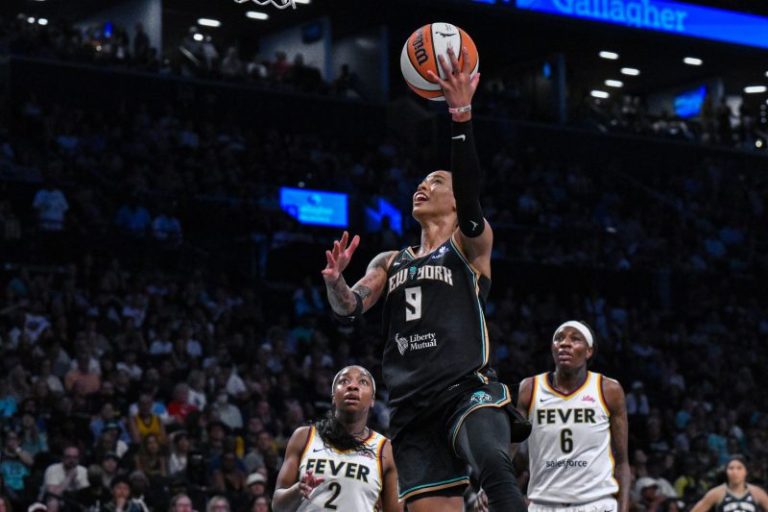
NEW YORK — About two hours before Wednesday night’s game between the Indiana Fever and the New York Liberty, the scene outside of Barclays Center could have easily been mistaken for the crowds in Iowa City or Indianapolis that have been clamoring to see a glimpse of Caitlin Clark.

Thousands of fans sporting Iowa Hawkeyes and Fever jerseys were aplenty and awaiting entry to see this pivotal matchup of Eastern Conference rivals, and those who showed up to see Clark were sorely disappointed as she missed the game after aggravating her right groin in Tuesday’s 85-77 win against the Connecticut Sun in Boston.

Fever head coach Stephanie White again had to shuffle her lineup against the defending WNBA champions, noting that Clark is day-to-day with her injury and her All-Star weekend availability in Indianapolis, including being a team captain for the All-Star Game and Friday’s 3-point contest, is uncertain. It’s Clark’s fourth different muscle injury this year, after never missing a game during her collegiate career and her Rookie of the Year campaign last season.  

‘I think that we’ve approached it that way from a slow pace from the beginning,’ Fever coach Stephanie White said. ‘The big picture is the most important: for her health and wellness, long-term, and for our team.’

The impact of Clark’s absence on the floor cannot be mistaken. During her absence, the Fever have been an inside team, feeding the ball to All-Star center Aliyah Boston, who leads the WNBA in field goal percentage, and Kelsey Mitchell, who has picked up the scoring slack as well.

But before a sellout crowd of 17,371 in Brooklyn, the Fever were down as many as 17 in the first half, and were routed 98-77, suffering their worst loss of the season, thanks to poor shooting and the inability to stop New York in a transition or any other phase of the game.

Breanna Stewart led five New York players in double figures with 24 points, 11 rebounds, and seven assists. Sabrina Ionesua had 15 points and nine assists, and Natasha Cloud added 14 points for the efficient Liberty, who shot 58%, with 30 assists on 37 made baskets, while knocking down 14 of their 27 3-point attempts.

The Fever, who are now 4-6 without Clark in the lineup, were led by Mitchell, who scored 16 points, snapping a string of three straight games of her scoring 20 points or more, and Sophie Cunningham, who had 12.

Second half expectations

Both teams recognize that achieving their postseason goals depends on their health. While Clark will have to manage her groin injury for the time being, New York is set to welcome back center Jonquel Jones — who has missed a month because of a right ankle injury — when these same two teams meet in the first game after the All-Star break on Tuesday, July 22.

“It would mean everything,” Brondello said of the 2024 WNBA Finals MVP and five-time All-Star. “Every team goes through adversity with injuries, and we’re no different this year. I thought we managed it as well as we could, but I think we realized how important she is for how we play at both ends of the floor.”

The Liberty have been fortunate, still leading the conference at 15-6, despite posting a 5-5 record without Jones.

Clark’s injury puts more of a spotlight on Indiana, who head into the All-Star Break at 12-11. White said one of the things she is doing is trying to keep her All-WNBA superstar in good spirits, while looking at the big picture of championship goals set at the beginning of the season.

“The most important thing for us is to keep her upbeat, continue to support her and let her know we got her back and let her know we’re going to go battle for her,” White said about Clark before Wednesday’s game.

“I consider it good news. For me, anything we’re talking about still day-to-day is always good news for me,” White said about the injury. ‘Being injured and continuing to have setbacks is frustrating. Mentally, emotionally. Often times, being injured is isolating. The primary conversations we’ve had is checking in.’

This post appeared first on USA TODAY

All 32 NFL teams are preparing to open their training camps in preparation for the 2025 season. This means fantasy football drafts are on the horizon.

The team at USA TODAY Sports is conducting a virtual tour of each division in preparation for the upcoming draft season. This will highlight the most critical issues or questions that impact fantasy football for every team.

While mock drafts are a helpful tool this time of year, sometimes gathering information on position battles and depth charts can be just as useful.

Whether it’s a new arrival or departure that opens the door for an important position battle or a potential breakout, we have the fantasy insights to help shape your draft strategy.

It’s never too early to start preparing for the fantasy football season. In this edition, we take a closer look at the AFC North.

Baltimore Ravens (12-5)

Will Todd Monken and the offense begin to lean on Isaiah Likely over Mark Andrews?

Tight end Mark Andrews has been a fantasy stalwart for seven seasons, but fantasy owners will remember his slow start and gut-wrenching finish in 2024.

He has been a consensus top-5 tight end for the last six seasons but finds himself ranked ninth overall at the position. This could be due to the emergence of Isaiah Likely, who posted career-highs across the board in 2024. Andrews, who will be 30 this season, saw his yards per route run drop for the third consecutive year.

Likely is just 25 years old and averaged 6.1 yards after the catch (tied for sixth among TEs) compared to Andrews’ 3.7, which was tied for 41st. Likely amassed 111 yards on nine catches and a touchdown in Week 1 against the Chiefs last year, displaying his abilities, but Todd Monken’s offense still featured Andrews as the season progressed.

While speaking to the media at OTAs, head coach John Harbaugh said he’s setting a goal for Likely to be an All-Pro by the end of the 2025 season.

‘I want to see [Likely] be an All-Pro. That would be my goal for him, and he’s capable of it.’

A strong connection was established with two-time MVP Lamar Jackson, as he posted a 131.2 passer rating when targeting Likely in 2024. There is legitimate TE1 upside if Andrews were to be phased out or even traded.

Top players (Fantasy Pros ADP)

  • Derrick Henry (RB7, overall: 21)
  • Lamar Jackson (QB2, overall: 25)
  • Zay Flowers (WR25, overall: 50)
  • Mark Andrews (TE9, overall: 90)
  • Rashod Bateman (WR57, overall: 62)
  • Isaiah Likely (TE22)

Pittsburgh Steelers (10-7)

Will DK Metcalf deliver a top-10 finish among WRs?

In 2024, Garrett Wilson finished as WR10 in PPR (points per reception) formats, and Davante Adams was on pace for a top-10 finish at the position, posting 854 yards and seven TDs in just 11 games alongside Aaron Rodgers in New York.

Pittsburgh acquired DK Metcalf in a trade from Seattle earlier in the offseason and is poised to receive the lion’s share of targets in the new-look Steelers offense.

Metcalf leads the NFL with 96 end-zone targets since entering the league and brings rare physical traits to the field.

He’s finished between 967 and 1,114 yards in the past four seasons. His best season was in 2020, when he finished as the 10th overall wide receiver in fantasy points per game. He hasn’t demanded an elite target share, but perhaps Rodgers can unlock some of the promise he displayed during the 2020 season.

Adams and Rodgers had one of the best connections in NFL history. In 2020, Adams led the league with 18 touchdowns and 98.1 receiving yards per game in arguably the best season of the pairing. It’s unlikely Metcalf can replicate those numbers in the Steelers’ run-first environment, but he’s capable of finishing inside the top 10 at the position.

They’ll have a full training camp to get on the same page. As things currently stand, there’s little target competition in the receiver room. George Pickens was traded to the Dallas Cowboys. Calvin Austin, Robert Woods and Roman Wilson will compete for snaps and targets but the Steelers lack a true No. 2 option. They may add another veteran to the room as the offseason progresses but Metcalf is primed for the highest target share of his career.

Top players (Fantasy Pros ADP)

  • DK Metcalf (WR24, overall: 47)
  • Kaleb Johnson (RB28, overall: 81)
  • Jaylen Warren (RB30, overall: 87)
  • Jonnu Smith (TE15)
  • Pat Freiermuth (TE20)
  • Aaron Rodgers (QB28)

Cincinnati Bengals (9-8)

Is Chase Brown a breakout candidate?

Everyone is aware of Bengals’ receivers Ja’Marr Chase and Tee Higgins, but Chase Brown is a sneaky option in the offense who burst onto the scene in the second half of 2024. He’s currently being drafted as the ninth overall running back and could be a massive steal in drafts.

Cincinnati’s offense is set up to score points at a high clip again (27.8 points per game in 2024) with Joe Burrow leading the way. All of those points can’t come through the air.

Brown took on a massive role, playing an elite 85% of snaps from Week 9 on and averaged 20.6 fantasy points per game (RB4 in PPR in that span). In his last eight games, Brown averaged 116.25 scrimmage yards, projecting to 1,976 over 17 games, which would have ranked third in the NFL last year.

The Bengals have veterans Zack Moss and Samaje Perine, but it’s more likely they fill a change-of-pace back role. Cincinnati drafted sixth-rounder Tahj Brooks, signaling they are expecting Brown to carry the load in 2025.

Brown has the pedigree to be an elite back. He led all RBs in the vertical jump, broad jump and bench press at the 2023 NFL Combine. He’s at a prime age (25) at the RB position and even displayed elite receiving abilities (54 receptions on 65 targets) in 2024.

Top players (Fantasy Pros ADP)

  • Ja’Marr Chase (WR1, overall: 1)
  • Tee Higgins (WR14, overall: 24)
  • Chase Brown (RB9, overall: 29)
  • Joe Burrow (QB5, overall: 48)
  • Mike Gesicki (TE21)

Cleveland Browns (3-14)

Does it matter who’s playing QB for Jerry Jeudy?

The Browns’ offense has question marks all over it. There’s a massive quarterback competition heading into training camp between Joe Flacco, Kenny Pickett, Dillon Gabriel and Shedeur Sanders. Cleveland’s second-round pick, running back Quinshon Judkins was arrested on July 12. The receiver room consists of Jerry Jeudy, Cedric Tillman and much-maligned Diontae Johnson.

The lack of depth at receiver is concerning, but this means the door is wide open again for Jeudy to build off of his 2024 success (WR12 in PPR). The uncertainty at QB is leading Jeudy to fall in drafts.

Jeudy posted 1,229 receiving yards last year and after Cleveland traded Amari Cooper in Week 7, he had 981 of those yards on 109 targets in 11 games. The Browns are expected to play from behind often, which will lead to more passing opportunities, as the game script suggests when trailing. Volume is king and Jeudy is set up for another massive target share in 2025 (145 targets – seventh among WRs in 2024).

Top players (Fantasy Pros ADP)

  • Jerry Jeudy (WR33, overall: 67)
  • Quinshon Judkins (RB29, overall: 83)
  • David Njoku (TE8, overall: 86)
  • Cedric Tillman (WR56)
This post appeared first on USA TODAY

Relatively healthy earnings reports from the big banks and a June inflation report that came in line with analyst expectations didn’t give the stock market much of a lift, as the S&P 500 ($SPX) and Dow Jones Industrial Average ($INDU) both ended the day lower. The only major index to shine was the Nasdaq Composite ($COMPQ), which closed at a record high.

Technology stocks were the stars of the show. It wasn’t a blowout rally, but the sector still managed to finish in the green. Why? There were a couple of key developments that gave tech a nice boost.

First, semiconductors got some breathing room. Restrictions on chip sales to China were relaxed, and that gave big names like NVIDIA Corp. (NVDA) and Advanced Micro Devices (AMD) a reason to rally. 

Second, there’s a push from the government to invest in AI and energy initiatives in Pennsylvania. One of the biggest winners was Super Micro Computer, Inc. (SMCI), which jumped 6.9% — the biggest percentage gain in the S&P 500. You can see from the StockCharts MarketCarpet for the S&P 500 stocks that, besides the top-weighted stocks in the index, it was mostly a sea of red.

FIGURE 1. MARKETCARPET FOR TUESDAY, JULY 15. Technology was the clear leader, with the largest cap-weighted stocks leading the sector higher.Image source: StockCharts.com. For educational purposes.

Semiconductors Show Strength

If you’ve been watching semiconductors, you may have noticed that the SPDR S&P Semiconductor ETF (XSD) has been on a roll. Since April, the ETF has stayed above its 20-day exponential moving average (EMA). The relative performance of XSD against the SPDR S&P 500 ETF (SPY) has been improving, and its relative strength index (RSI) is at around 62, an indication that momentum is at healthy levels (see chart below). It’s important to note that since May, the RSI has remained above 50, which is supportive of XSD’s upside movement.

Note: StockCharts members can access this chart from the Market Summary page or the Market Summary ChartPack (under US Industries > Bellwether Industries).

FIGURE 2. DAILY CHART OF XSD. Since April, XSD has been trending higher and is now trading above its 21-day EMA.Chart source: StockCharts.com. For educational purposes.

How to Track Semiconductor Stocks

If the environment for semiconductors remains strong, there could be more upside for stocks in that space. A simple way to keep tabs on the stocks using StockCharts tools is to create a ChartList of semiconductor stocks you’re interested in owning.

  • Begin by heading to the US Sectors panel in the Market Summary page or the Sector Summary page on your Dashboard.
  • Click Sector Drill-Down > Technology Sector Fund > Semiconductors.
  • You’ll see the list of semiconductor stocks that make up the industry group.

From there, I prefer to sort the data by the Universe (U) column, starting with the large caps and then the StockCharts Technical Rank (SCTR) score to find large-cap technically strong stocks. You can then view the charts on the list. If you see a chart that appears to have a favorable risk-to-reward ratio, you can save it to your Semiconductor ChartList.

FIGURE 3. SEMICONDUCTOR STOCKS TO REVIEW. The sector drill-down will uncover stocks in leading sectors or industry groups. Scroll down the list to identify charts that meet your investment or trading criteria. Image source: StockCharts.com. For educational purposes.

As you review the charts in your ChartList, you can identify potential support and resistance levels and set alerts to notify you when prices reach your key levels. It’s a great way to stay proactive.

The Bottom Line

This type of top-down analysis helps you stay one step ahead of the market. Start with the broad market, then narrow down to sectors, then industry groups, and then individual stocks. By taking a proactive approach to managing your investments, you’re always preparing for the stock market’s next move.


Disclaimer: This blog is for educational purposes only and should not be construed as financial advice. The ideas and strategies should never be used without first assessing your own personal and financial situation, or without consulting a financial professional.

Geopolitical tensions are rising in several regions of the world, and governments are expected to increase their defense spending in the years ahead. This has investors looking to aerospace and defense stocks.

The entrenched Russia-Ukraine war, widespread conflict in the Middle East, military posturing in the ongoing US-China trade conflict and the spread of cybersecurity attacks on critical infrastructure — all of these developments and more are driving demand in the global defense market.

In 2024, the five countries spending the most on their militaries were the United States, China, Russia, Germany and India, according to data from the Stockholm International Peace Research Institute.

For the most part, the aerospace and defense industry provides equipment, technologies and services to national governments through contracts. The players in this space are typically defense contractors that design and manufacture aircraft, satellites, electronic systems, software, missiles, drones, autonomous vehicles, tanks and marine vessels.

Global aerospace and defense revenue reached record highs in 2024, according to PwC in its latest annual sector report, totaling US$922 billion across the top 100 companies. However, the firm reports that increased demand is outpacing supply and capacity from defense companies.

5 Biggest US Defense Stocks

Today, the US accounts for the largest share of global defense spending, representing about 37 percent of worldwide military outlays. In fact, military spending represents about 12 percent of the US federal budget for fiscal year 2025. Worsening geopolitical tensions are expected to increase the US government’s spending on defense technology.

1. RTX (NYSE:RTX)

Market cap: US$189.46 billion

One of the most well-known American defense companies, RTX operates in the defense, aviation, space, electronics and cybersecurity sectors. The company captured more than US$80.7 billion in revenue for 2024, up 17.15 percent from the previous year.

The company’s defense solutions arm Raytheon was awarded a US$250 million contract in June 2025 from Japan’s Mitsubishi Electric (TSE:6503) for licensed production of ESSM Block 2 short to medium-range guided missiles.

‘Under the Direct Commercial Sale contract, Raytheon will provide missile kits, parts, and components as well as technical support for missile production at (Mitsubishi Electric) in Japan,’ the press release stated.

2. The Boeing Company (NYSE:BA)

Market cap: US$151.52 billion

Another heavyweight in the aerospace and defense industry, Boeing designs and manufactures airplanes, rotorcraft, rockets, satellites, telecommunications equipment and missiles.

Revenue for the company declined by 14.5 percent in 2024 over the previous year to come in at US$66.5 billion. The majority of that loss was driven by its airplane segment; its defense segment revenue dropped 4 percent over the same period. The company’s aviation sector has faced heavy scrutiny in recent years after several disastrous incidents linked to the Boeing 737.

As for its defense business, in March 2025, Boeing reported that production of its air defense systems, Patriot Advanced Capability-3 seekers, reached an all-time high in 2024. According to the release, the company produces the seekers as a subcontractor for Lockheed Martin and has sold them to 17 countries, including the US and Ukraine.

3. Honeywell International (NASDAQ:HON)

Market cap: US$144.57 billion

Engineering and technology company Honeywell International develops and manufactures technological solutions for a variety of sectors. The company’s four business divisions are aerospace technologies, building automation, energy and sustainability solutions, and industrial automation. Honeywell’s sales came in at US$38.5 billion in 2024, up 5 percent from the previous year.

Honeywell has numerous defense contracts with government agencies around the world, including right at home with the US Department of Defense (DoD) and US Armed Forces. In May 2025, the company’s JetWave X satellite communication system was selected for use in the advanced US Army aircraft ARES.

4. Lockheed Martin (NYSE:LMT)

Market cap: US$107.57 billion

Lockheed Martin’s business is concentrated on aerospace products and advanced defense technology systems. The F-16 Fighting Falcon fighter jet is among its most notable products, but Lockheed is also well known for its space launchers, ballistic missiles and satellites. The company’s 2024 net sales increased by 5.15 percent from the previous year to just over US$71 billion.

Unsurprisingly, about half of Lockheed Martin’s annual sales are made to the US DoD. However, governments around the world have purchasing contracts with the company to supply their militaries with defense products such as F-16 and F-35 fighter jets. In April 2025, the Royal Norwegian Air Force received the last two F-35 fighter jets of the 52 ordered in its most recent supply contract.

5. General Dynamics (NYSE:GD)

Market cap: US$76.57 billion

Although best known for its Gulfstream business jets, General Dynamics designs and manufactures wheeled and tracked combat vehicles, submarines, weapons and communications systems, as well as munitions. The company garnered more than US$47.72 billion in revenue for 2024, up 12.88 percent from the previous year.

General Dynamics is a major defense contractor for the US military as well as allied nations abroad. In April 2025, the company was awarded US$12 billion in contract modifications for the construction of two Virginia-class submarines for the US Navy, bringing the potential value of the contract to US$17.2 billion. This type of sub is designed for anti-submarine and surface ship warfare and special operations support.

5 Biggest US Defense ETFs

Investors looking to mitigate the risk of investing in individual stocks can diversify their portfolio with defense ETFs. While ETFs aren’t without risk, they are often considered a more stable investment compared to stocks as they allocate funds across a variety of stocks that are rebalanced by an asset manager to meet the return goals of the fund.

The biggest US Defense ETFs by assets under management are listed below according to data from ETF Database.

1. iShares U.S. Aerospace & Defense ETF (BATS:ITA)

Assets under management: US$7.83 billion

The iShares U.S. Aerospace & Defense ETF launched in May 2006. This fund invests in large, generally stable companies in the aerospace and defense sector, particularly those with the majority of their revenues based on long-term government contracts.

The ETF has 40 holdings and an expense ratio of 0.4 percent. IShares U.S. Aerospace & Defense ETF’s top holdings include RTX, Boeing, Lockheed Martin and General Dynamics as well as another important name in the industry, L3Harris Technologies (NYSE:LHX).

2. Invesco Aerospace & Defense ETF (NYSEARCA:PPA)

Assets under management: US$5.41 billion

Invesco Aerospace & Defense ETF launched in October 2005. Like ITA, it also tracks large, stable aerospace and defense stocks with steady revenue streams from long-term government contracts.

While it has more holdings than ITA at 57, it also has a higher expense ratio at 0.58 percent. Unlike ITA, Honeywell is listed among Invesco Aerospace & Defense ETF’s top holdings in addition to the other biggest US defense stocks.

3. SPDR S&P Aerospace & Defense ETF (NYSEARCA:XAR)

Assets under management: US$3.76 billion

SPDR S&P Aerospace & Defense ETF, which launched in September 2011, offers exposure to large cap stocks in this sector. It has the lowest expense ratio on this list at 0.35 percent.

Of the 40 holdings XAR tracks, the most heavily weighted US defense stocks include RTX, Boeing, Lockheed Martin and General Dynamics as well as Rocket Lab (NASDAQ:RKLB) and AeroVironment (NASDAQ:AVAV).

4. Global X Defense Tech ETF (NYSEARCA:SHLD)

Assets under management: US$2.69 billion

Launched in September 2023, Global X Defense Tech ETF is the newest defense ETF on the market. While it does offer a geographic diversity of exposure to the overall defense sector, its holdings are just over 50 percent based in the United States. This ETF has an expense ratio of 0.50 percent.

SHLD has 43 holdings, including the biggest US defense stocks such as Lockheed Martin and General Dynamics, but is also heavily weighted in Palantir Technologies (NASDAQ:PLTR) and L3Harris Technologies.

5. Direxion Daily Aerospace & Defense Bull 3X Shares (NYSEARCA:DFEN)

Assets under management: US$249.19 million

Direxion Daily Aerospace & Defense Bull 3X Shares launched in May 2017 with the goal of tripling the daily return of an index of major defense industry stocks.

DFEN has the highest expense ratio on this list at 0.95 percent. Some of the most heavily weighted stocks of its 39 holdings are Boeing, Lockheed Martin and RTX.

Securities Disclosure: I, Melissa Pistilli, hold no direct investment interest in any company mentioned in this article.

This post appeared first on investingnews.com