Author

admin

Browsing

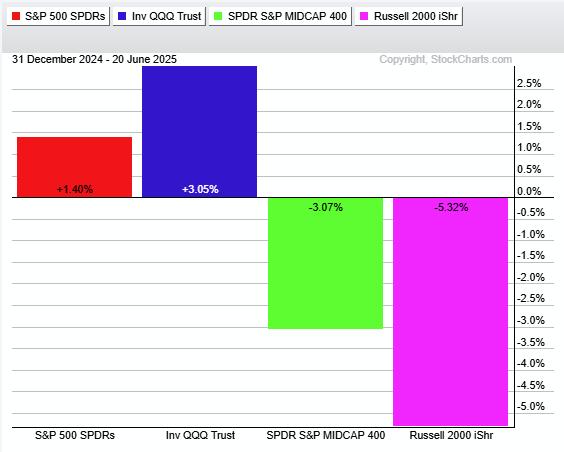
Last Friday, the S&P 500 finished the week just below 5700. The question going into this week was, “Will the S&P 500 get propelled above the 200-day?” And as I review the evidence after Friday’s close, I’m noting that the SPX is almost exactly where it was one week ago!

That’s right–after all the headlines, tariff tantrums, and earnings reports, the S&P 500 ended the week 0.4% below where it started. This “lack of conviction” week led me to post the following poll on X, asking followers to decide which they felt would happen first: a retest of the February 2025 high or a retest of the April 2025 low.

I was actually quite surprised that there wasn’t more optimism after April’s incredible rally phase, but you can see that 55% of respondents thought the February high around 6150 would be hit first. So unlike the AAII survey’s recent readings, there appear to be more bulls than bears out there.

Based on this week’s extended choppiness, I thought it might be good to revisit an approach called “probabilistic analysis” to consider four potential paths for the S&P 500 between now and late June 2025. Basically, I’ll share four different scenarios, describe the market conditions that would likely be involved, and also share my estimated probability for each scenario.

By the way, we last ran this analytical process on the S&P 500 back in January, and you need to see which scenario actually played out!

And remember, the point of this exercise is threefold:

  1. Consider all four potential future paths for the index, think about what would cause each scenario to unfold in terms of the macro drivers, and review what signals/patterns/indicators would confirm the scenario.
  2. Decide which scenario you feel is most likely, and why you think that’s the case. Don’t forget to drop me a comment and let me know your vote!
  3. Think about how each of the four scenarios would impact your current portfolio. How would you manage risk in each case? How and when would you take action to adapt to this new reality?

Let’s start with the most optimistic scenario, with the S&P 500 index continuing the recent uptrend phase to retest all-time highs by June.

Option 1: The Super Bullish Scenario

Our most bullish scenario would mean that the aggressive rally phase off the April low would essentially continue in its current form. After perhaps the briefest of pullbacks at the 200-day moving average, we continue to the upside. This scenario would most likely mean the Magnificent 7 stocks would have to really find their mojo, with names like GOOGL, AAPL, and AMZN finally breaking through their 200-day moving averages.

Dave’s Vote: 10%

Option 2: The Mildly Bullish Scenario

What if the S&P 500 stalls around the 200-day, with a pullback that inspires even more indecision among investors? Perhaps we are still in “wait and see” mode as some tariff negotiations prove fruitful, but empty shipping containers remind consumers of the prospects of chronic inflation.  By mid-June, we’re no closer to a real clear sense of direction than we are today.

Dave’s vote: 30%

Option 3: The Mildly Bearish Scenario

Because of the time frame I’ve selected, there won’t be another Fed meeting until after this period is over. So, what if inflation data starts to imply real price issues, consumer sentiment really starts to falter, and the Fed is unable to take any meaningful action to address mounting concerns? If we fail to push above the 200-day moving average soon, then 5500 would be a likely area of support on the way down.  This scenario brings us right back down to that level.

Dave’s vote: 40%

Option 4: The Very Bearish Scenario

You always need a bear case, and this one would entail a new distribution phase that takes the major benchmarks down to retest the April low. I’d say a reasonable downside objective would be 5100, and we’ll spend the month of June debating whether we’re forming a huge double bottom pattern or see another bounce higher. Defensive sectors shine as investors rotate big time to risk-off positions.

Dave’s vote: 20%

What probabilities would you assign to each of these four scenarios?  Check out the video below, and then drop a comment with which scenario you select and why!

RR#6,

Dave

P.S. Ready to upgrade your investment process? Check out my free behavioral investing course!


David Keller, CMT

President and Chief Strategist

Sierra Alpha Research LLC


Disclaimer: This blog is for educational purposes only and should not be construed as financial advice. The ideas and strategies should never be used without first assessing your own personal and financial situation, or without consulting a financial professional.

The author does not have a position in mentioned securities at the time of publication. Any opinions expressed herein are solely those of the author and do not in any way represent the views or opinions of any other person or entity.

In this insightful session, Grayson introduces the Traffic Light indicator, a unique tool available exclusively on the Advanced Charting Platform (ACP). Amidst the current volatility of the S&P 500, Grayson demonstrates how this indicator can help investors clarify trend directions and make more confident decisions.

This video originally premiered on May 9, 2025. Click on the above image to watch on our dedicated Grayson Roze page on StockCharts TV.

You can view previously recorded videos from Grayson at this link.

Here’s a quick recap of the crypto landscape for Friday (May 9) as of 9:00 p.m. UTC.

Get the latest insights on Bitcoin, Ethereum and altcoins, along with a round-up of key cryptocurrency market news.

Bitcoin and Ethereum price update

Bitcoin (BTC) was priced at US$103,027 as markets opened, up 1.3 percent in 24 hours. After breaking through the US$100,000 threshold Thursday (May 8) the digital asset has found support. The day’s range has seen a low of US$102,871 and a high of US$103,672.

Bitcoin performance, May 9, 2025.

Chart via TradingView.

Bitcoin’s recent price surge is driven by the US government’s decision to legalize strategic Bitcoin reserves—boosting investor confidence and signaling institutional backing—alongside growing global adoption supported by favorable regulations and broader acceptance across sectors.

Ethereum (ETH) started the trading day at US$2,220 and quickly rallied. The cryptocurrency reached an intraday low of US$1,792.06 and saw a daily high of US$2,415.

Altcoin price update

  • Solana (SOL) opened at US$169.63 up 4.57 percent over 24 hours. SOL experienced a low of US$151.51 and a high of US$171.39.
  • XRP was trading at US$2.33, reflecting a 5 percent increase over 24 hours. The cryptocurrency reached a daily high of US$2.36 midday.
  • Sui (SUI) was priced at US$3.80, showing an increaseof 0.50 percent over the past 24 hours. It achieved a daily low of US$3.36 and a high of US$3.92.
  • Cardano (ADA) is trading at US$0.7866, up 7 percent over the past 24 hours. Its lowest price of the day was US$0.71, and it reached a high of US$0.79.

Today’s crypto news to know

Bitcoin surges past $100,000 amid trade optimism and institutional inflows

Bitcoin (BTC) has reclaimed the US$100,000 mark for the first time since February, driven by optimism surrounding a new US-UK trade deal and significant institutional investments. On May 8, US Bitcoin ETFs saw net inflows totaling US$117.4 million, with BlackRock’s IBIT and Fidelity’s FBTC leading the gains.

Additionally, the Federal Reserve’s decision to hold interest rates steady has bolstered investor confidence in crypto markets.

Coinbase acquires Deribit in landmark US$2.9 billion crypto derivatives deal

Coinbase has announced its acquisition of Deribit, a leading crypto derivatives exchange, for $2.9 billion—the largest deal in the crypto industry to date. This strategic move positions Coinbase to expand its offerings in the crypto options market, catering to the growing demand for advanced trading products.

The acquisition includes US$700 million in cash and 11 million shares of Coinbase Class A common stock. Deribit, which processed US$1.2 trillion in trading volume last year, controls approximately 85 percent of the global crypto options market.

This deal is expected to enhance Coinbase’s presence in the international derivatives market and diversify its revenue streams.

Analysts view the acquisition as a significant step for Coinbase to compete with other major exchanges like Binance and Kraken in the derivatives space. The transaction is subject to regulatory approvals and is anticipated to close later this year. Until then, Deribit will continue its operations as usual.

Celsius founder sentenced to 12 years for crypto fraud

Alex Mashinsky, founder and former CEO of Celsius Network, has been sentenced to 12 years in federal prison for defrauding customers and manipulating the price of the company’s CEL token.

Between 2018 and 2022, Mashinsky misled investors about the safety of their funds, using customer deposits to inflate CEL’s value and personally profiting over US$48 million. Celsius, which once managed over US$25 billion in assets, collapsed in 2022 amid a broader crypto market downturn, leaving thousands of users unable to access their funds.

Securities Disclosure: I, Giann Liguid, hold no direct investment interest in any company mentioned in this article.

Securities Disclosure: I, Meagen Seatter, hold no direct investment interest in any company mentioned in this article.

This post appeared first on investingnews.com

Exchange-traded funds (ETFs) are one of the fastest-growing investment vehicles, and as uranium’s role in the energy transition grows, investors are becoming increasingly interested in uranium ETFs and related products.

After years of dormancy, the uranium spot price zoomed past the US$100 per pound level in early 2024 on supply risks and a strong outlook for long-term demand. Although it’s since pulled back, bulls believe it still has room to run.

Supporting factors include the lack of new uranium mines, Russia’s dominance in conversion and enrichment, rising demand for low-carbon energy sources and the continued development and deployment of small modular reactors.

There is also increasing demand for uranium from China and India as both of these countries grapple with air pollution in the face of growing electricity demand. China is working to expand its nuclear power capacity, and although it ranks among the top 10 uranium-producing countries, it relies heavily on uranium imports.

Compounded, these factors are creating a mounting supply deficit.

“This year, uranium mines will only supply 75 percent of demand, so 25 percent of demand is uncovered,” Amir Adnani, CEO and president of Uranium Energy (NYSEAMERICAN:UEC), said at a January 2025 event.

Although the fundamentals are promising, the U3O8 spot price has faced pressure in 2025, with prices below US$80 since the start of the year. As supply tightens, incentivizing new projects to come online is becoming imperative.

“Next year, uranium demand is going up because there are 65 reactors under construction, and we haven’t even started talking about small and advanced modular reactors,” Adnani said. “Small and advanced modular reactors are an additional source of demand that, maybe not next year, but within the next three to four years, can become a reality.”

As mentioned, that backdrop is helping uranium ETFs and related investment products gain steam. Today there are five uranium ETFs available, as well as four investment vehicles backed by physical uranium — and perhaps more to come.

Read on to learn about the uranium ETFs and related vehicles on offer. All data was current as of May 5, 2025.

Uranium ETFs tracking uranium stocks

1. Global X Uranium ETF (ARCA:URA)

Total asset value: US$2.7 billion

The Global X Uranium ETF tracks a basket of uranium miners, as well as nuclear component producers.

The fund has an expense ratio of 0.69 percent and a yearly return of negative 17.23 percent, a decline that coincides with the recent pullback in the uranium price.

Uranium companies account for a significant portion of its portfolio, and nearly half of those companies are Canadian. The ETF’s top two uranium company holdings are major uranium producer Cameco (TSX:CCO,NYSE:CCJ) at a weight of 22.31 percent and NexGen Energy (TSX:NXE) at 5.64 percent. Interestingly, one of its top three holdings is the Sprott Physical Uranium Trust (TSX:U.U) at a weight of 8.52 percent.

2. Sprott Uranium Miners ETF (ARCA:URNM)

Total asset value: US$1.32 billion

The Sprott Uranium Miners ETF includes both uranium producers and explorers for broader exposure. The fund has an expense ratio of 0.75 percent and a yearly return of negative 34.69 percent.

Uranium stocks with market caps under US$2 billion account for 48.7 percent of the ETF’s holdings. Its top three holdings are Cameco at 15.28 percent, the Sprott Physical Uranium Trust at 13.21 percent and Kazatomprom (LSE:59OT,OTC Pink:NATKY) at 12.99 percent.

3. VanEck Vectors Uranium + Nuclear Energy ETF (ARCA:NLR)

Total asset value: US$1.02 billion

The VanEck Vectors Uranium + Nuclear Energy ETF launched in 2007 and tracks a market-cap-weighted index of stocks in the uranium and nuclear energy industries. Its expense ratio is 0.61 percent and its yearly return is negative 0.12 percent.

This uranium ETF’s top three holdings are Constellation Energy Group (NASDAQ:CEG) at a weight of 8.49 percent, Public Service Enterprise Group (NYSE:PEG) at 7.38 percent and Endesa (OTC Pink:ELEZF,SSE:ELE) at 6.95 percent.

4. Sprott Junior Uranium Miners ETF (NASDAQ:URNJ)

Total asset value: US$232.29 million

The Sprott Junior Uranium Miners ETF launched in February 2023, making it one of the newest additions to the uranium ETF universe. The ETF has an expense ratio of 0.8 percent and a yearly return of negative 15.51 percent.

It tracks the NASDAQ Sprott Junior Uranium Miners Index (INDEXNASDAQ:NSURNJ), which follows small-cap uranium companies. The fund’s 33 holdings are all uranium mining, development or exploration companies. Its top three holdings are Paladin Energy (ASX:PDN,OTCQX:PALAF) at 12.46 percent, Uranium Energy (NYSEAMERICAN:UEC) at 10.32 percent and NexGen Energy at 10.25 percent.

5. Horizons Global Uranium Index ETF (TSX:HURA)

Total asset value: US$55.08 million

The Horizons Global Uranium Index ETF was Canada’s first pure-play uranium ETF and provides exposure to uranium industry growth. It has an expense ratio of 1.06 percent and a yearly return of negative 25.2 percent.

Created in 2019, the fund’s top holdings are Cameco with a weight of 20.68 percent, Kazatomprom at a weight of 17.12 percent and the Sprott Physical Uranium Trust at 15.25 percent.

Physical uranium investment vehicles

1. Sprott Physical Uranium Trust (TSX:U.U)

Total asset value: US$4.09 billion

Of all the uranium-focused funds, this one has created the most buzz. Launched in July 2021, the Sprott Physical Uranium Trust quickly made its mark on the sector, stoking investor interest and prices for the commodity.

The fund holds 66.22 million pounds of U3O8, has an expense ratio of 0.64 percent and has a yearly return of negative 34.57 percent.

2. Yellow Cake (LSE:YCA,OTCQB:YLLXF)

Total asset value: US$983.66 million

Founded in 2018, Yellow Cake is a uranium company that provides investment exposure to the uranium spot price through its physical holdings of uranium and uranium-related commercial activities.

Yellow Cake’s current holdings total 21.68 million pounds of U3O8. Its access to material volumes of uranium at prevailing market prices comes via its long-term partnership with Kazatomprom. Through this partnership, it has the option to purchase up to US$100 million of uranium annually through 2027.

3. Zuri-Invest Uranium AMC

Total asset value: US$1.65 billion

Launched in April 2023, Zuri-Invest’s product is directly linked to physical uranium, and is the first actively managed certificate (AMC) in the sector. According to Zuri-Invest, “an AMC is a security that can be managed on a discretionary basis enabling the active management of a chosen investment strategy.”

Qualified non-US institutional and professional investors can take part in this physical uranium AMC (Swiss ISIN code CH1214916533) through their bank. The custodian of the product is Cameco, which holds the physical uranium in a secure storage facility in Canada.

4. xU3O8

Total asset value: US$5.93 million

One of the newest ways to gain exposure to physical uranium is through the token xU3O8.

Using the power of the Tezos blockchain and real-world asset tokenization, the xU3O8 token from uranium.io gives investors the ability to directly own and trade physical uranium. Launched in 2024, xU3O8’s 38,464.62 kilograms of U3O8 are stored at a secure Cameco facility, with Archax acting as trustee.

Securities Disclosure: I, Georgia Williams, hold no direct investment interest in any company mentioned in this article.

This post appeared first on investingnews.com

  • Reviews 2025 exploration strategy across Freegold Mountain and Andalusite Peak
  • Advances acquisition strategy targeting high-grade silver assets
  • Engages Independent Trading Group to improve trading liquidity

triumph gold Corp. (TSXV: TIG) (OTC Pink: TIGCF) (FSE: 8N61) is pleased to provide an operational update as it enters 2025 with a refined exploration focus, strategic growth objectives, and a commitment to responsible development. The Company also announced it has engaged a market maker and granted incentive stock options.

Leadership and Direction

triumph gold continues under the leadership of John Anderson, Chairman and Interim Chief Executive Officer. With over 25 years of experience in the capital markets and resource sectors, Anderson has guided the Company since its early days as Northern Freegold.

‘We’ve taken meaningful steps to streamline operations and position the Company for disciplined growth,’ said Anderson. ‘With strong core assets, a focused strategy, and improving market conditions for gold and copper, Triumph prepares to enter the second quarter of 2025 ready to pursue opportunities that create long-term value’.

Key Assets and Positioning

Freegold Mountain Project

Located in Yukon, the flagship Freegold Mountain Project hosts over 2 million gold equivalent ounces across three mineralized zones, as defined in a 2020 NI 43-101 resource estimate. These deposits provide exposure to high-grade gold, copper, molybdenum, and tungsten at a time of increasing demand for critical minerals.

Andalusite Peak Property

Triumph’s Andalusite Peak copper-gold project is located in British Columbia’s Golden Horseshoe region, in proximity to major porphyry systems such as Saddle North and Red Chris. The Company plans to advance exploration in 2025 through geochemical surveys and mapping.

Favourable Jurisdictions
All assets are situated in well-established, mining-friendly regions of Yukon and British Columbia, offering stable permitting frameworks and access to infrastructure.

2025 Growth Strategy

triumph gold’s 2025 strategy centers on project advancement, portfolio expansion, and disciplined exploration:

  • Strategic Acquisitions
    The Company is evaluating potential acquisitions of high-quality silver projects to complement and diversify its current asset base.

  • Advancing Andalusite Peak
    Located in British Columbia’s Golden Horseshoe near Newmont’s Saddle North and Red Chris projects, the Andalusite Peak property will focus on geochemical surveys and detailed geological mapping in 2025.

  • Expanding Freegold Mountain Exploration
    Triumph will review historical datasets and define new exploration targets outside current resource zones to support potential discoveries.

Commitment to Responsible Development

triumph gold is committed to responsible exploration and development. The Company maintains active engagement with First Nations and local communities, recognizes the traditional territories on which its projects are located, and prioritizes environmental stewardship and cultural respect in all exploration activities.

Triumph Engages Independent Trading Group (ITG) as Market Maker

triumph gold announces that subject to regulatory approval, it has engaged the services of Independent Trading Group (‘ITG’) to provide market-making services in accordance with TSX Venture Exchange TSXV, CSE, and Cboe Canada policies. ITG will trade shares of the Company on the CSE/ Cboe Canada/ TSXV and all other trading venues to maintain a reasonable market and improve the liquidity of the Company’s common shares.

Under the agreement, ITG will receive compensation of CAD$6,500 per month, payable monthly in advance. The agreement is for an initial term of one month and will renew for additional one-month terms unless terminated. The agreement may be terminated by either party with 30 days’ notice. No performance factors are contained in the agreement, and ITG will not receive shares or options as compensation. ITG and the Company are unrelated and unaffiliated entities. At the time of the agreement, neither ITG nor its principals have an interest, directly or indirectly, in the securities of the Company.

triumph gold Issues Stock Options

The Company has granted 4,750,000 incentive stock options to directors, officers, employees, and consultants. The options are exercisable at $0.27 per share for a period of five years, with immediate vesting.

The options were granted pursuant to triumph gold’s rolling stock option plan, which has been approved by shareholders and the TSX Venture Exchange. This issuance is intended to retain and motivate key contributors and align long-term interests with those of shareholders.

Looking Ahead

triumph gold is entering 2025 with momentum, a clear strategy, and a commitment to shareholder value. The Company thanks its shareholders for their continued support and looks forward to sharing further updates in the months ahead. For more information or investor inquiries, please email John Anderson, Chairman & Interim CEO, at janderson@triumphgoldcorp.com.

About triumph gold Corp.

triumph gold is a Canadian-based, growth-oriented exploration and development company with a district-scale land package in the mining-friendly Yukon. Led by an experienced management and technical team, The Company is focused on actively advancing its flagship Freegold Mountain Project using multidiscipline exploration and evaluation techniques.

The road-accessible Freegold Mountain Project, located in the Dawson Range Au-Cu Belt, is host to three NI 43-101 Mineral Deposits (Nucleus, Revenue, and Tinta Hill). The Project is 200 square kilometres and covers an extensive section of the Big Creek Fault Zone, a structure directly related to epithermal gold and silver mineralization and gold-rich porphyry copper mineralization.

The Company owns 100% of the Big Creek and Tad/Toro gold-silver-copper properties situated along the strike of the Freegold Mountain Project within the Dawson Range.

The Company also owns 100% of the Andalusite Peak copper-gold property, 36 km southeast of Dease Lake within the Stikine Range in British Columbia.

triumph gold acknowledges the traditional territories of the Little Salmon Carmacks First Nation and Selkirk First Nation, on which the Company’s Yukon mineral exploration projects are located. triumph gold has a longstanding, ongoing engagement with these First Nations through communication, environmental stewardship, and local employment.

For more information, please visit triumphgoldcorp.com.

For further information about triumph gold, please contact:

John Anderson, Executive Chairman
triumph gold Corp.
(604) 218-7400
janderson@triumphgoldcorp.com

Neither the TSX Venture Exchange nor its Regulation Services Provider (as that term is defined in policies of the TSX Venture Exchange) accepts responsibility for the adequacy or accuracy of this release.

This news release contains forward-looking information, which involves known and unknown risks, uncertainties and other factors that may cause actual events to differ materially from current expectations. Important factors – including the availability of funds, the results of financing efforts, the completion of due diligence and the results of exploration activities – that could cause actual results to differ materially from the Company’s expectations are disclosed in the Company’s documents filed from time to time on SEDAR (see www.sedarplus.com). Readers are cautioned not to place undue reliance on these forward-looking statements, which speak only as of the date of this press release. The company disclaims any intention or obligation, except to the extent required by law, to update or revise any forward-looking statements, whether as a result of new information, future events or otherwise

To view the source version of this press release, please visit https://www.newsfilecorp.com/release/251572

News Provided by Newsfile via QuoteMedia

This post appeared first on investingnews.com

There’s more than one way to invest in copper. In addition to buying shares of copper stocks, investors can gain exposure through copper exchange-traded funds (ETFs) or copper exchange-traded notes (ETNs).

For the uninitiated, ETFs are securities that trade like stocks on an exchange, but track an index, commodity, bonds or a basket of assets like an index fund. In the case of base metal copper, there are various options — an ETF can track specific groups of copper-focused companies, as well as copper futures contracts or even physical copper.

ETNs also track an underlying asset and trade like stocks on an exchange, but they differ from ETFs in some ways. Specifically, ETNs are more like bonds — they are unsecured debt notes issued by an institution, and can be held to maturity or bought and sold at will. The main disadvantage to be aware of is that investors risk total default if an ETN’s underwriter goes bankrupt.

The copper outlook is strong as demand rises and concerns about supply increase as the energy transition gains traction. This has caused many investors to wonder how to take advantage of the potential in the copper market.

1. Global X Copper Miners ETF (ARCA:COPX)

Assets under management: US$2.09 billion

The Global X Copper Miners ETF tracks the Solactive Global Copper Miners Index, which covers copper exploration companies, developers and producers. The fund has an expense ratio of 0.65 percent.

The fund currently has 39 holdings, with the top three companies being First Quantum Minerals (TSX:FM,OTC Pink:FQVLF), Freeport-McMoRan (NYSE:FCX) and Lundin Mining (TSX:LUN,OTC Pink:LUNMF).

2. United States Copper Index Fund (ARCA:CPER)

Assets under management: US$162.94 million

The United States Copper Index Fund aims to give investors exposure to a portfolio of copper futures without using a commodity futures account. It has an expense ratio of 1.04 percent.

The fund tracks the performance of the SummerHaven Copper Index Total Return (INDEXNYSEGIS:SCITR), which is calculated based on certain copper futures contracts selected on a monthly basis.

3. Sprott Physical Copper Trust (TSX:COP.U,OTCQX:SPHCF)

Assets under management: US$96.59 million

A relatively new ETF, the Sprott Physical Copper Trust was established in July 2024 and is one of the first funds to be based around physical copper. The fund has an expense ratio of 2.03 percent.

As of the start of May 2025, the fund held 10,157 metric tons of copper worth US$96.59 million.

4. iShares Copper and Metals Mining ETF (NASDAQ:ICOP)

Assets under management: US$50.63 million

The iShares Copper and Metals Mining ETF tracks the STOXX Global Copper and Metals Mining Index, which is composed of public companies primarily engaged in copper and metal mining. It has an expense ratio of 0.47 percent.

The fund represents a global portfolio of 41 copper companies. Its top three holdings are Grupo Mexico (OTC Pink:GMBXF,BMV:GMEXICOB), BHP (NYSE:BHP,ASX:BHP,LSE:BHP) and Freeport McMoRan.

5. Sprott Copper Miners ETF (NASDAQ:COPP)

Assets under management: US$23.65 million

Sprott Asset Management bills its Sprott Copper Miners ETF as ‘the only pure-play ETF focused on large-, mid- and small-cap copper mining companies that are providing a critical mineral necessary for the clean energy transition.’

It came to market in March 2024, and has an expense ratio of 0.65 percent.

The fund is made up of a portfolio of 49 companies and has a market cap of US$279 billion; it is rebalanced twice a year in June and December. The fund’s top three holdings are Freeport-McMoRan, Teck Resources (TSX:TECK.A,TECK.B,NYSE:TECK) and Ivanhoe Mines (TSX:IVN,OTCQX:IVPAF).

6. Sprott Junior Copper Miners ETF (NASDAQ:COPJ)

Assets under management: US$12.6 million

Launched in February 2023, the Sprott Junior Copper Miners is a pure-play ETF that, as its name suggests, is focused on small-cap copper miners. It has an expense ratio of 0.76 percent.

The fund consists of 40 companies, and its top three holdings are Northern Dynasty Minerals (TSX:NDM,NYSEAMERICAN:NAK), Solaris Resources (TSX:SLS,NYSEAMERICAN:SLSR) and Atalaya Mining (LSE:ATYM).

Like Sprott’s other copper fund on this list, COPJ is rebalanced twice a year in June and December.

7. iPath Series B Bloomberg Copper Subindex Total Return ETN (OTC Pink:JJCTF)

Assets under management: US$6.9 million

The iPath Series B Bloomberg Copper Subindex Total Return ETN provides exposure to the Bloomberg Copper Subindex Total Return. According to Barclays (LSE:BARC), the note ‘reflects the returns that are potentially available through an unleveraged investment in the futures contracts on copper.’ It is tied to the high-grade copper futures contract available on the Comex and carries an expense ratio of 0.75 percent.

Unlike an ETF, an ETN does not own the underlying asset. Instead, an ETN functions in the same way as an uninsured bond. Investopedia states that investors take their profits when they sell the note or it reaches maturity.

Securities Disclosure: I, Dean Belder, hold shares of Northern Dynasty Minerals.

This post appeared first on investingnews.com

Legendary investor Warren Buffett is stepping down as CEO of Berkshire Hathaway (NYSE:BRK.A,NYSE:BRK.B) after six decades at the helm — but he’s still not yet ready to retire.

In a media release on Monday (May 5), Berkshire said that its board of directors unanimously has voted to appoint Greg Abel, vice chairman, non-insurance operations, as president and CEO come January 2026.

Buffett will remain the chairman of the board of directors.

Buffett has held the position of CEO at Berkshire since 1970, with Abel confirmed as his successor in 2021.

What is Buffett’s strategy?

Buffett took control of Berkshire in 1965, back when the company was a struggling textile manufacturer.

In a 2010 letter to shareholders, he recounted his experience in those early days:

‘Berkshire was then only intextiles, where it had in the previous decade lost significant money. The dumbest thing I could have done was topursue ‘opportunities’ to improve and expand the existing textile operation – so for years that’s exactly what Idid. And then, in a final burst of brilliance, I went out and bought another textile company. Aaaaaaargh!Eventually I came to my senses, heading first into insurance and then into other industries.’

Many people have tried to explain Buffett’s success in recent years. One recent Financial Times article titled “How Buffet Did It” notes that his strategy is “more than great stock picks and insurance premiums.”

An older paper called ‘Buffett’s Alpha’ suggests that his exposure to low-risk, cheap and high-quality stocks is key.

“(He) has boosted his returns by using leverage, and that he has stuck to a good strategy for a very long time period, surviving rough periods where others might have been forced into a fire sale or a career shift,” states the paper, which was written by Andrea Frazzini, David Kabiller and Lasse Heje Pedersen.

‘We estimate that Buffett applies a leverage of about 1.7-to-1, boosting both his risk and excess return in that proportion. Thus, his many accomplishments include having the conviction, wherewithal, and skill to operate with leverage and significant risk over a number of decades,’ the authors also note.

Who is Buffett’s successor?

Abel has been with Berkshire since 2000, when Berkshire bought MidAmerican, an energy company he had been running. He joined the board as vice chairman, non-insurance operations, in 2018.

MidAmerican was renamed Berkshire Hathaway Energy (BHE), with Abel serving as its chief executive officer from 2008 to 2018. He remains the company’s chair as of writing. At both MidAmerican and Berkshire, Abel was mentored by David Sokol, who seemed a likely successor to Warren Buffett until he resigned from Berkshire in 2011.

Abel was named vice chairman in 2018 along with Ajit Jain. In a 2014 letter to shareholders, Buffett’s longtime right-hand man, Charlie Munger, who passed away in 2023, wrote about the two as potential successors.

‘Ajit Jain and Greg Abel are proven performers who would probably be under-described as ‘world-class.’ ‘World-leading’ would be the description I would choose,’ said Munger.

‘In some important ways, each is a better business executive than Buffett.’

Buffett has also spoken highly of Abel, saying in 2023, ‘Greg understands capital allocation as well as I do. That’s lucky for us. He will make those decisions, I think, very much in the same framework as I would make them. We have laid out that framework now for 30 years.’

Berkshire’s path forward under Abel

Buffett’s words indicate that he sees Berkshire and Abel following the framework he has laid out.

Of course, there may be some evolution. Morningstar analyst Gregg Warren notes that the ‘groundwork for a successful transition’ at Berkshire has been in place for decades.

He also notes that Buffett and Munger were skilled at acquiring businesses that were a good cultural fit.

“We expect this to continue, believing that Berkshire’s culture of management autonomy and entrepreneurship has become institutionalized,’ Warren explains in a recent article.

‘ However, the new managers will probably work with a slightly different opportunity set, and we believe they will evolve Berkshire from what has historically been a reinvestment machine into one that is more focused on returning capital to shareholders, which is what we would expect of a company of this size with limited investment opportunities.”

Warren also comments that Berkshire currently doesn’t pay a dividend. This principle is because of Buffett’s belief that retained earnings should yield greater value than cash payouts.

Warren said this may change after Abel takes over, underlining that issuing a dividend could help Berkshire retain shareholders who may consider selling once Buffett is no longer at the helm.

Berkshire’s recent activities include diversification of its portfolio via strategic acquisitions and investments.

In January 2025, Forest River Bus & Van, a Berkshire subsidiary, announced its acquisition of L.A. West Coaches to enhance its product portfolio in the luxury transportation market.

“This partnership represents a shared commitment to excellence and innovation,” said Douglas Wright, group general nanager of Forest River Bus & Van. “L.A. West Coaches’ proven expertise and dedication to quality align with our values, and we look forward to collaborating to expand our product range.”

BHE is also currently exploring the production of lithium carbonate and other minerals from its geothermal power plants in California’s Imperial Valley, aligning with the company’s interest in renewable energy and sustainability.

BHE Renewables publicized a joint venture with Occidental Petroleum (NYSE:OXY) in June 2024, saying that this will be useful for the demonstration and deployment of TerraLithium’s direct lithium extraction.

Occidental is the owner of TerraLithium, a company that provides a technology platform for extracting lithium from geothermal and other brines to produce ultra-pure battery-grade lithium hydroxide and lithium carbonate.

Once the demonstration is successful, BHE Renewables plans to build, own and operate commercial lithium production facilities in California’s Imperial Valley. The joint venture also plans to license the technology and develop commercial lithium production facilities outside the Imperial Valley.

Securities Disclosure: I, Gabrielle de la Cruz, hold no direct investment interest in any company mentioned in this article.

This post appeared first on investingnews.com

The 2025 NBA playoffs continued Friday with Game 3 between the Cleveland Cavaliers and Indiana Pacers. 

Donovan Mitchell’s 43-point performance guided the Cavaliers to a 126-104 rout over the Pacers and their first victory in the series. Indiana still holds a 2-1 lead with the road team winning each game in the series.

While Mitchell had a busy night, it was a fairly quiet night for Pacers star Tyrese Haliburton, who was limited to just four points.

Jarrett Allen (19 points and 12 rebounds) and Evan Mobley (18 points and 13 rebounds) produced double-doubles in the victory. Max Strus added 20 points.

The Pacers staged a remarkable comeback in Game 2, winning 120-119 when Haliburton made a last-second 3-pointer to sink the top-seeded Cavaliers. Bennedict Mathurin scored a team-high 23 points for Indiana.

Cavaliers vs. Pacers highlights

Final: Cavaliers 126, Pacers 104

End of third quarter: Cavaliers 97, Pacers 79

The Pacers outscored the Cavs 34-31 in the quarter after Indiana showed signs of life with an 11-2 run during a two-minute stretch in the third quarter. The Cavs were able to gain some momentum after Myles Turner left the game briefly.

Turner went back to the locker room with close to six minutes left in the quarter after a potential foot injury. Turner returned just minutes later after having his ankle retaped.

The Cavs have led by as many as 24 points through the first three quarters of play. The Pacers have not led at any point during the game.

End of second quarter: Cavaliers 66, Pacers 45

The Cavaliers outscored the Pacers 34-13 in the second quarter to take a comfortable lead into the locker room. Donovan Mitchell produced 17 points and five rebounds in the first half while Jarrett Allen and Max Strus finished with 13 points each.

Tyrese Haliburton went scoreless in the second quarter for the Pacers after scoring just two points in the first quarter.

The Pacers shot just 3-for-11 against the Cavaliers’ zone defense in the first half. All three shots came in the second quarter, according to ESPN.

End of first quarter: Cavaliers 32, Pacers 32

It was a roller coaster first quarter in Indianapolis.

The Cavaliers sprinted out to an 11-0 lead and pushed it to 19-5, but Indiana slowly crawled back throughout the frame and tied it up with under 5 seconds to play on a Ben Sheppard 3-pointer.

Myles Turner has a game-high 12 points for Indiana, and Bennedict Mathurin added eight off the bench. Evan Mobley and Max Strus led Cleveland with eight points apiece in the first.

What time is Cavaliers vs. Pacers Game 3?

Game 3 between the Cleveland Cavaliers and Indiana Pacers will tip at 7:30 p.m. ET on Friday at Gainbridge Fieldhouse in Indianapolis on Friday, May 9.

How to watch Cavaliers vs. Pacers Game 3: TV, stream

  • Time: 7:30 p.m. ET
  • Location: Gainbridge Fieldhouse (Indianapolis)
  • TV: ESPN
  • Stream: Fubo

Watch Cavaliers-Pacers Game 3 with Fubo

Cavaliers vs. Pacers NBA playoff schedule, results

(Pacers lead series, 2-0)

  • Game 1: Pacers 121, Cavaliers 112
  • Game 2: Pacers 120, Cavaliers 119
  • Game 3: Cavaliers at Pacers | Friday, 7:30 p.m. | ESPN, Fubo
  • Game 4: Cavaliers at Pacers | Sunday, May 11 | 8 p.m. | TNT, truTV, Max, Sling TV
  • Game 5: Pacers at Cavaliers | Tuesday, May 13 | TBD | TNT, truTV, Max, Sling TV*
  • Game 6: Cavaliers at Pacers | Thursday, May 15 | TBD | ESPN, Fubo*
  • Game 7: Pacers at Cavaliers | Sunday, May 18 | TBD | TBD*
This post appeared first on USA TODAY

PHOENIX — Clay Holmes was initially stunned, then numb and eventually, well, rather intrigued.

Here he was, a two-time All-Star closer with 307 career appearances in the bullpen, never pitching more than 70 innings in any of his eight seasons, and suddenly he’s being asked to make a dramatic career change.

He had one, then two, then three teams calling him this winter to inquire whether if he was interested in giving up his role as a reliever, and be converted into a starter.

Meanwhile, three other teams called and made him offers to remain as a closer or late-inning reliever.

Holmes, a free agent for the first time, not only had to decide where he wanted to play – but what he wanted to do.

He could continue closing and accept one of the offers guaranteeing him more than $40 million.

Or he could gamble, earn a bit less money as a starting pitcher and take on a role he hadn’t played since his rookie season in 2018.

Holmes, 32, bet on himself.

He signed a three-year, $38 million contract with the New York Mets, believing he could potentially go where no pitcher has gone since Hall of Famer John Smoltz.

Holmes, who grew up in Georgia as a huge fan of the Atlanta legend, could become the only active player to be an All-Star as both a reliever and starting pitcher.

Holmes, who starts Friday in a first-place matchup against the Chicago Cubs at Citi Field in New York, is putting himself in the All-Star conversation with a 4-1 record and 2.95 ERA. He not only has been one of baseball’s biggest surprises, but also invaluable to the Mets this season, who have been without veteran starters Frankie Montas and Sean Manaea.

“I definitely went into the offseason not expecting to be a starter,’ Holmes told USA TODAY Sports. “I mean, it wasn’t like the World Series ended and I went out seeking to be a starter. It was nothing I thought about.

“Then a couple of weeks later, my agent came to me and said there’s a couple of teams that are throwing out the idea, and were gauging my interest. I started thinking about it, and said, ‘Hey, why not? Let’s see what’s out there.’ ‘

‘Sense of desire from the Mets’

The Mets weren’t the first team to express interest in Holmes as a starter, said B.B. Abbott, Holmes’ agent, but they were the most convincing. They showed how their analytical studies proved it will work. Holmes was also familiar with manager Carlos Mendoza and assistant pitching coach Desi Druschel, his former Yankee coaches. And he loves playing in New York.

“They did a good job laying it all out for him,’ Abbott said. “They saw his pitches. They had the analytic guys talk to him. Ultimately, it down to the familiarity of the staff, the way they were going to utilize him, the comfort of New York, and being on a winning team.’

The Yankees, who helped develop Holmes into one of the game’s top closers, never once did brought up the idea of Holmes becoming a starter. They were lightly engaged in talks with him in the offseason about a possible return, but strictly as a reliever.

“I mean, there were jokes about it last year,’ Holmes said, “but that was it. I started throwing a change-up in bullpen sessions, and before you knew it, I was throwing five [different] pitches down there. There would be jokes about it, like ‘man, you should be starting with all of these pitches,’ but it was nothing more than a joke.

“But when the idea came up in the offseason, it really got my the wheel turning, like, I know I can do this. I can expand my arsenal.’

Abbott knew that Holmes was taking the idea seriously and by the time it was ready to make a decision, Holmes was informed he could make more money remaining as a closer, but the challenge burned inside him.

“Clay has always been very analytical, very intelligent, and he grasps the analytic side of pitching,’ Abbott said. “He always talked about stuff he was working on. So, it didn’t surprise me, honestly. What surprised me was how many teams were along for the ride. Some teams weren’t even interested in signing him but were asking questions, ‘Hey, did you ever think about starting?’

“Well, he had some curiosities in the back of his mind, but it sure wasn’t anything we discussed. He’s just a guy who loves to be intellectually and physically challenged.’

The Mets ultimately proposed that challenge, and Holmes was ready to embrace it, intrigued by Mets president David Stearns and the coaching staff’s plans for him.

“I felt like there was a real sense of desire from the Mets,’ Holmes said. “Stearns asked me a lot of questions, and there was a real belief that I could not only be just a starter, but a really good starting pitcher. I think that goes a long way, and obviously just a desire to win and what they’re trying to build here with the Mets.

“They really just drew me in, and it felt right.’

‘He had the weapons’

Still, despite all of the analytics and belief by the Mets that it could be possible, Holmes’ conversion was a surprise move for a team vying to win its first World Series title since 1986.

“I remember when we first signed him,’ Mets reliever Ryne Stanek said, “and I was like, ‘Oh, that’s cool. That’s a good deal. He’s going to really help our bullpen.’ But then when I heard he was going into the rotation, I sure didn’t see that coming.

“And when I saw him in spring training, I thought, ‘You know, if there’s someone that can do it, it’s him. He’s just such a good pitcher, and he’s been in those tight ballgames in big environments. If things get a little hairy, he can go out and do it.’

Said Mets All-Star right fielder Juan Soto, who played for the Yankees last season: “I never thought about him being a starter. Never. I mean, I knew he worked hard every day, but to go from throwing one inning to being a starter, that’s tough. What he’s doing now is so impressive.’

Seven starts into the season and Holmes now has everyone in New York believing in him, hoping it can last all season. He has pitched 36 ⅔ innings, already just 27 ⅓ innings shy of last year’s entire total.

“Physically, he’s a big boy (6-foot-5, 245 pounds), so if someone can manage that workload and make that transition, it would be him,’ Mendoza said. “My biggest question making that transition was what his third and fourth pitches would be, because in my years with the Yankees, it was sinker/slider. He was very tough on righties, so I knew as a starter, teams were going to load up with the lefties.

“Well, what we’ve seen is that with teams loading up lefties against him, the changeup is not just a pitch, it’s a weapon.’

Said Druschel: “All of his pitches are above average, but that changeup has been devastating.’

Holmes, who had not thrown a single changeup in a game since 2019 with the Pirates, has already thrown 98 this season, accounting for 16% of his pitches. Hitters have been virtually helpless, batting just .182 with only one extra-base hit and a 38% swing-and-miss rate. He now has had a six-pitch mix with his sinker (35%), changeup (16%), sweeper (16%), slider (13%), cutter (11.9%) and four-seam fastball (8.9%).

“There was really not a need for the changeup before,’ Druschel said, “but with the transition, we needed more depth in his repertoire to go multiple times through the order. Then, he’s in tune and adept with the analytics and understanding the numbers. You know, ‘I need this for this purpose with lefties or righties or whatnot. I need to fill these gaps,’ and that’s basically what he’s done.

“I was pretty sure that he had the weapons, and I was really confident that he would be able to do this because he’s so smart. He knew he had to train differently to be a starter than a reliever.’’

Holmes spent the winter in Georgia working on his conditioning, improving his cardiovascular activity, and began throwing earlier than in the past. Holmes has never thrown this much by early May since 2018, but he insists he feels fresh.

The $38 million question now is whether he can sustain this workload for an entire season.

It was just a year ago when Jordan Hicks was converted from a reliever to a starter with the San Francisco Giants. Everything went smooth for the first 11 starts when he was 4-1 with a 2.33 ERA, but he was out of the starting rotation two months later. He never won another game, finishing with a 6.10 ERA the final four months, yielding a .321 batting average and .920 OPS.

The Mets are carefully monitoring Holmes. They have used a six-man rotation, and with a scheduled day off each week during May, will be able to give all of their starters an extra day between starts. Holmes, who has not gone longer than six innings or thrown more than 92 pitches in his seven starts, has pitched just once since April 26.

‘You train the body to accept the demands that you’re asking of it, which he has, I see no reason why you can’t push that innings limit up to any normal starter,’ Druschel said.

Besides, if he needs a role model, he has to look no further than former teammate Michael King of the San Diego Padres. They were in the Yankee bullpen together when King was traded to the Padres in the Soto trade. King became a full-time starter with the Padres, increased his workload from 104 ⅔ innings in 2023 to 185 ⅔ across the regular season and postseason last season, and felt as strong in October as April.

“I mean you can look at some of the older guys,’ Holmes said. “They would go from being a reliever to a starter, and go from 65 innings to 200 innings, four years in a row, and have no problems. So, we’ll see. If we need to recalibrate, we can.’

For now, well, the biggest adjustment may be his souvenir baseball collection. He saved the baseball from each of his 74 career saves with the Yankees, but now that he’s a starter, well, the cupboard remains bare.

“Well, maybe when I get that first complete game,’ he said, laughing. “Right now, I’m more focused on making the adjustment in my routine.’

‘Journey’ going perfect so far

When Holmes was with the Yankees, he showed up at the ballpark knowing he could be appearing in any game. Now that he’s a starter, he’s five days’ notice.

“As a reliever, there’s a there’s just a certain energy the way you kind of go about things,’ Holmes said. “It’s like your whole day is just building to a moment. You become accustomed to that. It’s a thing you really enjoy, kind of a thrilling experience.

“As a starter, it’s just very different, you spend the week preparing for that moment. Even though I’m not impacting the game every day, which I miss, just the starter routine and be able to make a huge impact on that one game is something I enjoy more than I thought. Instead of having that quick adrenaline rush, you have a slow buildup.

“So far, this journey has been great, and this thing honestly has worked out perfectly so far.’

Certainly, Holmes’ transition has drawn the attention of pitchers around baseball.

“For him to do this is pretty impressive,’ said Arizona Diamondbacks veteran Shelby Miller, who spent the first seven years of his career as a starter and the past four as a reliever. “You see a lot of starters go into the bullpen later in their careers, but pretty rare to go as a reliever to a starter. It’s really special to see him do this.’

If Holmes continues his success, he could be helping open the door for teams to experiment with their own relievers, knowing that a pitcher who can make 30 starts a year is more valuable than someone pitching 60 to 70 innings out of the pen. Look at Seth Lugo. He was a reliever for most of his time with the Mets, signed with the Padres and became a full-time starter and last year finished second in the AL Cy Young race by going 16-9 with a 3.00 for the Kansas City Royals.

“There’s a lot of relievers in the big leagues who were starters at some point,’ Holmes said, “so there might be some desire there. I think as the game grows, and the ability to have the different pitch designs, you might see more guys doing it now. Teams are looking for value, and if they see guys in the pen that they might be able to move into the starting rotation, they’re going to be open to doing that.

“We’ll see where it all goes.

“But I can definitely see a trend happening, and it feels good to be a part of it.’

Follow Nightengale on X: @Bnightengale

The USA TODAY app gets you to the heart of the news — fastDownload for award-winning coverage, crosswords, audio storytelling, the eNewspaper and more.

This post appeared first on USA TODAY