ST. LOUIS — The Michigan Panthers defeated the DC Defenders badly in their lone matchup of the 2025 UFL regular season.
The Defenders returned the favor in a 58-34 UFL championship game drubbing of the Panthers.
Jordan Ta’amu’s MVP performance fueled the Defenders. DC’s quarterback set a UFL record with 390 passing yards and had five total touchdowns during the contest. That included a 73-yard strike to receiver Ty Scott, in which Ta’amu demonstrated pinpoint accuracy and hit his receiver in stride.
Michigan’s offense had issues dealing with Blake Williams’ attacking defense but nearly broke through late. They were able to execute the UFL’s onside kick alternative, a fourth-and-12 attempt from their 28-yard line, twice and cut DC’s lead to 18 in the later stages of the fourth quarter.
However, Kiondre Thomas broke up a pass intended for Cole Hikutini to break Michigan’s streak. That allowed Defenders receiver Chris Rowland to score on a 19-yard scamper and put the game out of reach.
The victory put a bow on Shannon Harris’ first season as Defenders coach, a job he took on six days before the season opener after Reggie Barlow’s departure to take an opening at Tennessee State.
DC Defenders win 2025 UFL championship
The Defenders were able to stop the Panthers on a fourth-and-3 with 1:38 left in regulation. Michigan has just one timeout remaining, so DC will be able to run out the clock and win the 2025 UFL championship.
DC Defenders vs. Michigan Panthers UFL championship game highlights
Chris Rowland notches 19-yard TD run to re-extend Defenders lead to three scores
The Defenders were able to chew some clock with running plays and Rowland found the end zone after an 19-yard scamper. They couldn’t get the 1-point conversion, but DC’s lead is 24 with 3:33 left in regulation. Defenders 58, Panthers 34
Defenders stop Panthers fourth-and-12 attempt
After twice allowing Michigan to notch fourth-down conversions, DC finally gets a stop. Kiondre Thomas undercut Bryce Perkins’ pass to Cole Hikutini, who briefly appeared to be open before Thomas flashed in front of him. DC will now have a chance to run some clock and rest its defense while nursing an 18-point lead.
B.T. Potter makes 49-yard field goal to make it two-score game
Michigan wasn’t able to get into the end zone after their second conversion, so they attempted a 49-yard field goal. Potter’s kick was true and cut DC’s lead to 18, which is a two-score game in the UFL thanks to the league’s 3-point conversion. Defenders 52, Panthers 34
Michigan converts second consecutive fourth-and-12 to keep ball
Once again, the Panthers have managed to execute their onside kick alternative to perfection. Bryce Perkins scrambled away from pressure and found Malik Turner for 15-yard gain. This will be Michigan’s third consecutive possession, and they have held the ball for 5:29 of consecutive game time – and counting.
Malik Turner gets third TD as Panthers cut lead to 21
The Panthers made the Defenders pay for allowing them to convert the fourth-and-7. Bryce Perkins found Turner, who made a nice catch amid tight coverage for his third score of the game. Michigan couldn’t punch in a 2-point conversion, but they have cut DC’s lead to 21 with 9:57 left in regulation. Defenders 52, Panthers 31
Panthers convert fourth-and-7 to keep ball
In the UFL, teams are allowed to attempt a fourth-and-12 conversion from their 28-yard line instead of an onside kick. Michigan’s attempt became a fourth-and-7 attempt after DC jumped offside, and Bryce Perkins found Devin Ross for a 22-yard gain.
That will allow Michigan to keep the ball and try to further cut into DC’s 27-point lead.
Panthers score: Malik Turner notches second TD
The Panthers are on the board for the first time in the second half. Bryce Perkins found Turner open over the middle of the field and he managed to make his way into the end zone for a 26-yard score. The Panthers’ 2-point attempt was slightly behind the receiver, so Michigan’s deficit remains 27. Defenders 52, Panthers 25
Defenders set single-game scoring record after Briley Moore scores
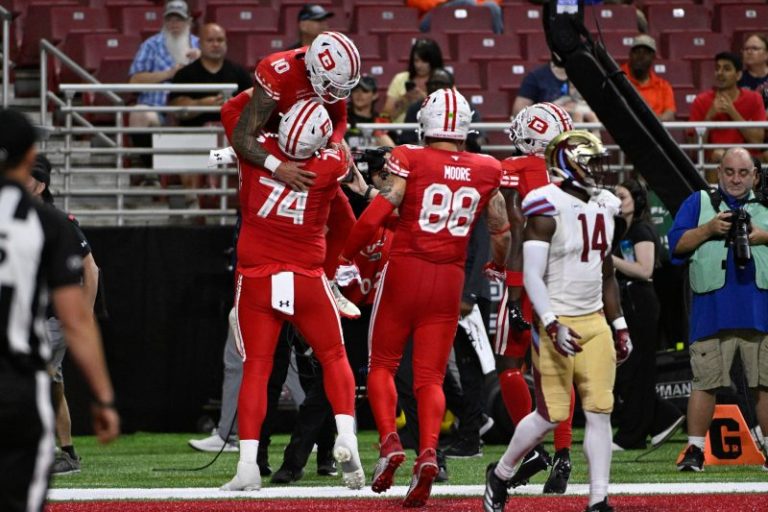
Jordan Ta’amu once again had a wide-open receiver, as Moore broke away from his defender to notch a 1-yard touchdown. The score pushed the Defenders over 50 points, making them the first team in UFL history to reach that plateau.
Moore was whistled for an unsportsmanlike conduct penalty after the play, which moved the try back to the 17-yard line. A holding penalty on Michigan then moved the try to the 12-yard line. The Defenders couldn’t convert but now lead by 33 with 14:56 left in the fourth quarter. Defenders 52, Panthers 19
End of third quarter: Defenders in control with 46-19 lead
The Defenders are closing in on a championship as they continue to pull away from the Panthers in the second half. DC outscored Michigan 9-0 in the third quarter and will be on the goal line again to open the fourth quarter.
Jordan Ta’amu has set a single-game UFL passing record while another DC score would give Shannon Harris’ team the record for the most points scored in a UFL game.
Jordan Ta’amu sets UFL single-game passing yards record
Ta’amu hit Seth Williams for a 45-yard gain with just about three minutes remaining in the third quarter. That gave him 388 passing yards for the game, good for the most in a single game in the UFL’s two-season history.
Score update: Deon Jackson scampers for second TD
DC continues to pour it on. Jackson found a seam behind the left side of the offensive line and ran untouched into the end zone for a 19-yard score. The Defenders went for a 1-point conversion, but Abram Smith couldn’t get it. DC’s lead has now ballooned to 27, and they are threatening the record for most points scored in a UFL game. Defenders 46, Panthers 19
Bryce Perkins intercepted by Kiondre Thomas
Michigan’s first drive of the second half was not as successful as DC’s. Perkins was desperately trying to keep a play alive after scrambling left out of the pocket and then back to his right. He ultimately threw the ball downfield but sailed it directly to Thomas. The defensive back returned it to Michigan’s 31-yard line, once again putting DC in scoring range.
Defenders score: Matt McCrane makes 38-yard field goal to open second half
The Defenders continue to score every time they touch the ball. They couldn’t turn the opening possession of the second half into a touchdown, but McCrane came on to put a 38-yard field goal through the uprights to give DC a three-score lead. Defenders 40, Panthers 19
Jordan Ta’amu halftime stats
Ta’amu is on his way to a potential MVP performance at halftime. Below is a look at his statline from the first half:
- Comp./Att.: 16 of 20 (80%)
- Passing yards: 320
- Passing TDs: 3
- Interceptions: 0
- Passer rating: 158.3
- Carries: 4
- Rushing yards: 10
- Rushing TDs: 1
Who are The Black Moods?
The UFL booked The Black Moods to perform their halftime show in 2025. They are a rock band comprised of guitarist Josh Kennedy – who is originally from Wheaton, Missouri – bassist Brendan McBride and drummer Chico Diaz.
Kennedy also performed an instrumental version of the National Anthem at the UFL championship game.
Halftime score: Defenders hold 37-19 lead over Panthers
The 2024 UFL championship game was all about the Birmingham Stallions’ defense. This year, DC and Michigan are trading offensive haymakers, as they notched a combined 56 points in the first half.
Jordan Ta’amu has been the game’s star so far. The Defenders quarterback has completed 16 of 20 passes for 320 yards and three touchdowns, demonstrating pinpoint downfield accuracy throughout the game.
The Panthers offense has also been solid, with UFL MVP Bryce Perkins completing 8 of 13 passes for 160 yards and two touchdowns, but Blake Williams’ defense managed to pressure him at times in the second quarter. Those stops helped DC notch 25 unanswered points, and 31 total in the second quarter, to bring an 18-point lead into the half.
Jordan Ta’amu hits Ty Scott for 73-yard TD
The Defenders and Panthers continue to trade 70-plus-yard scores. This time, Ta’amu found Scott behind the defense and hit the 6-1 receiver in stride for the score. The Defenders couldn’t make the 2-point conversion, so DC’s lead will remain 18, which is a two-score game in the UFL. Defenders 37, Panthers 19
Bryce Perkins finds Malik Turner for 71-yard touchdown
The Panthers finally ended the Defenders’ run of 25 consecutive points. Perkins scrambled away from pressure and managed to find Turner open after his defender broke off him in an effort to contain the mobile quarterback. Turner then ran through DC’s defense and powered through a tackle near the goal-line to score.
DC used its super challenge to attempt to negate the score, but the play was upheld. Michigan could not convert the 3-point conversion, ensuring DC’s lead would remain two scores. Defenders 31, Panthers 19
Deon Jackson punches in 5-yard Defenders TD run
The Defenders continue to pour it on offensively. Jackson ran for a 5-yard touchdown before Fred Kaiss broke out the ‘Philly Special’ on the ensuing 2-point conversion. Wide receiver Jaydon Mickens’ pass to quarterback Jordan Ta’amu was on the mark, and DC has now scored 25 unanswered points.
Defenders force Panthers to punt for second consecutive possession
The Defenders forced Bryce Perkins into three consecutive incompletions after the Panthers started the drive with a first-and-15 following a too many men in the huddle penalty. As a result, Michigan was forced to punt, and DC will take over at its 45-yard line.
Jordan Ta’amu powers through Michigan defense for fourth-and-1 TD
The Defenders got to the 1-yard line on a third-down run but couldn’t pound it in. Ta’amu kept the ball off play-action and had to power his way through a couple of Michigan defenders to get the ball over the goal line.
Ta’amu then found Briley Moore for the 2-point conversion to give DC a double-digit lead with 7:13 remaining in the first half. Defenders 23, Panthers 13
Michigan fumbles kickoff return, DC gets goal-to-go opportunity
On the kickoff following the Defenders’ touchdown, DC’s special teams made a big play, stripping the ball out of the hands of Panthers returner Xavier Malone. Willie Drew Jr. was able to jump on it and set DC up with a goal-to-go opportunity from the 7-yard line.
Defenders take first lead on 19-yard Cornell Powell TD reception
The Defenders once again moved down the field with relatively little resistance from the Panthers. This time, Jordan Ta’amu found Powell open in the end zone. He managed to make the catch and get both of his feet down before going out of bounds.
DC wasn’t able to complete their 2-point conversion pass, but they still have their first lead of the game with 9:24 left in the second quarter. Defenders 15, Panthers 13
Defenders sack leads to first punt of the game
The Panthers went three-and-out following DC’s field goal. Bryce Perkins attempted to scramble away from pressure on a third-and-4 but was brought down for a 3-yard loss by Malik Fisher.
The Defenders will get the ball back and can take their first lead of the game with a score.
Score update: DC settles for field goal after goal-to-go stall-out
The Defenders couldn’t turn Jaydon Mickens’ explosive play into a touchdown. They opted to kick a field goal on fourth-and-goal from the 4-yard line and veteran Matt McCrane knocked it through with ease to cut Michigan’s lead to four. Panthers 13, Defenders 9
End of first quarter: Panthers lead 13-6 but Defenders are driving
The UFL championship game is off to a roaring start, as the Defenders and Panthers combined for a whopping 310 yards and 19 points in the first quarter. Michigan has the early lead but DC will open the second quarter with a second-and-goal play.
Jordan Ta’amu has been the game’s early star, as DC’s quarterback has completed 7 of 9 passes for 149 yards and a touchdown. Bryce Perkins has performed well for Michigan, racking up 84 yards and a touchdown while completing 6 of 7 passes. Nate McCrary (3 carries, 40 yards) has Michigan’s other score.
Defenders’ Jaydon Mickens makes 66-yard reception
Just one play after Cornell Powell’s 70-yard touchdown was wiped out, the Defenders had another massive passing play. This time, Jordan Ta’amu found Mickens open down the middle of the field for a big gain. DC now has a goal-to-go opportunity.
Defenders 70-yard TD called back by penalty
It appeared Jordan Ta’amu and the Defenders had answered immediately again after Cornell Powell had a 70-yard catch-and-run score. However, a member of the offense was illegally downfield, wiping out the score and moving DC back 5 yards.
Panthers score: Bryce Perkins finds Siaosi Mariner for 38-yard TD
Michigan got DC’s defense to bite on a play-action pass after methodically marching down the field. Perkins found Mariner wide open downfield as a result.
Once again, the Panthers went for one. This time, they passed, and Perkins was able to find Mariner to put Michigan up 7. Panthers 13, Defenders 6
Jordan Ta’amu feathers 26-yard TD pass to Jaydon Mickens
The Defenders punched back against the Panthers and scored on their first drive of the game. On a third-and-10, Ta’amu faded back to pass and lofted a pass to Mickens, streaking down the middle of the field and toward the end zone. The 31-year-old receiver had a step on his defender and caught the pass with ease.
DC tried to go for 2 after the score, but Ta’amu couldn’t find anyone open on a bootleg. The teams are tied with 5:12 remaining in the first quarter. Defenders 6, Panthers 6
Panthers open scoring with 35-yard Nate McCrary TD run
The Panthers get on the board first. McCrary, the team’s backup running back, found a lane on the left side of the defense and scampered untouched into the end zone.
Michigan wasn’t able to punch in the ensuing 1-point conversion attempt, but the Panthers have a lead early in the first quarter. Panthers 6, Defenders 0
DC Defenders win coin toss
The Defenders elected to defer, so the Panthers will begin the game with the ball. The game is officially set to kick off at 8:15 p.m. ET.
Who is home team for UFL championship game?
The Panthers are serving as the home team for the UFL championship game, which is being played at a neutral site in St. Louis. Michigan is wearing white because of its designation while DC is wearing red.
Michigan Panthers inactives
The following Michigan players will not be active for the 2025 UFL championship game:
- CB Keni-H Lovely
- RB Matthew Colburn
- LB Andrew Parker
- DE Kenny Willekes
- OT Keith Russell
- OT Brian Dooley
- TE Jalen Wydermyer
DC Defenders inactives
The following DC players will not be active for the 2025 UFL championship game:
- S Tayler Hawkins
- WR Javon Antonio
- DE Davin Bellamy
- CB Kelvin Joseph
- RB Darius Hagans
- LB Brian Abraham
- TE Ben Bresnahan
Who is the Michigan Panthers QB?
Bryce Perkins is the starting quarterback for the Panthers. The 28-year-old went undrafted out of Virginia in 2020 but landed with the Los Angeles Rams. He spent three years in Sean McVay’s organization and was a part of the Super Bowl 56-winning squad.
Perkins played sparingly during his first UFL season in 2024 but was named the UFL’s Offensive Player of the Year in 2025. He completed 69% of his passes for 1,342 yards, nine touchdowns and two interceptions in seven games while adding 269 yards and five scores on the ground.
Who is the DC Defenders QB?
Jordan Ta’amu is the starting quarterback for the Defenders. The 27-year-old has been a spring-league staple, playing five consecutive seasons dating back to the 2020 XFL campaign.
Ta’amu was one of the league’s most prolific passers in 2025, completing 54.4% of his passes for 2,153 yards, a league-best 17 touchdowns and four interceptions. He also ran for 178 yards and two scores across nine games.
Who is the Michigan Panthers coach?
Mike Nolan is in his third season as Michigan’s coach. The 66-year-old who coached the San Francisco 49ers from 2005-08 came out of retirement to lead the Panthers and has posted a 17-13 record across three seasons.
Nolan led the Panthers to their first championship game appearance since the 2022 USFL reboot and earned his first-ever win over the three-time reigning champion Birmingham Stallions in the conference championship game.
Who is the DC Defenders coach?
Shannon Harris is coaching the Defenders in 2025. He was named the team’s interim coach six days before the season after Reggie Barlow took the coaching job at Tennessee State.
Harris led the Defenders to a 6-4 record and an upset win over the St. Louis Battlehawks in the XFL conference championship game.
UFL championship game start time
- Time: 8 p.m. ET (5 p.m. PT)
The Michigan Panthers vs. DC Defenders UFL championship game will kick off at 8 p.m. ET on Saturday, June 14 at The Dome at America’s Center in St. Louis.
UFL championship game TV channel
ABC will broadcast the UFL championship game in 2025. Joe Tessitore (play-by-play) and Jordan Rodgers (analyst) will be on the call while Sam Acho and Tom Luginbill report from the sidelines.
Erin Dolan will also be a part of ABC’s broadcast as a betting analyst.
UFL championship game live stream
Football fans hoping to catch the UFL championship game will be able to watch it on Fubo, which comes with a free trial, or on ESPN’s proprietary streaming service, ESPN+.
Where is the UFL championship game 2025?
- Venue: The Dome at America’s Center
- Location: St. Louis, Missouri
For the second consecutive season, St. Louis will host the UFL championship game. The contest will be played at The Dome at America’s Center, the home of the UFL’s St. Louis Battlehawks.
The Dome has been open since 1995 and has a seating capacity of 67,277.
UFL championship game odds
The Panthers are favored to beat the Defenders in the 2025 UFL championship game, according to BetMGM. Here is a look at the spread, moneyline and point total for the contest:
- Spread: Panthers (-3.5)
- Moneyline: Panthers (-185) | Defenders (+150)
- Over/under: 50.5
What is the UFL?
The UFL is a spring football league that was created in 2024. The league formed after the USFL and XFL merged from two, separate eight-team leagues that competed head-to-head in the 2023 season into one eight-team league.
Like its predecessors, the UFL operates with a 10-week regular season and a two-week postseason. The season begins on March 28 and will complete play with its championship game on June 14.
What does UFL stand for?
UFL stands for ‘United Football League.’ It was a familiar name chosen by the USFL and XFL after their merger, as another spring league with the United Football League moniker operated from 2009-12.
This iteration of the UFL has no relation to that league or the spring football league that ran from 1961-64.
Who owns the UFL?
The UFL is a joint venture between Fox Sports, RedBird Capital Partners, Dany Garcia and Dwayne ‘The Rock’ Johnson. Fox Sports, which originally invested in the USFL, owns 50% of the league; the other 50% is shared by the other three partners, according to Fox Sports’ website.
Garcia and Johnson were previously co-owners of the XFL; Garcia served as the chair of the league.
UFL teams 2025
The UFL fielded eight teams during the 2025 season. They are separated into two divisions, the USFL and XFL divisions, and are as follows:
USFL division
- Birmingham Stallions
- Houston Roughnecks
- Memphis Showboats
- Michigan Panthers
XFL division
- Arlington Renegades
- DC Defenders
- San Antonio Brahmas
- St. Louis Battlehawks
These teams are the same eight that participated in the first UFL season. There were no relocations nor was there any expansion ahead of the 2025 campaign.
How much are UFL players paid?
UFL players have a minimum salary of $62,005 for the 2025 season, a 12.7% increase from the previous year. They will also get a small raise for the 2026 campaign, per the new collective bargaining agreement (CBA) reached earlier this season.
Below is a look at the league’s minimum salary by year since 2024:
- 2024: $55,000
- 2025: $62,005
- 2026: $64,000
Who won the 2024 UFL championship game?
The Birmingham Stallions won the 2024 UFL championship game. They beat the San Antonio Brahmas 25-0, marking their third consecutive spring-league title.
This post appeared first on USA TODAY