OKLAHOMA CITY — The Indiana Pacers just kept playing.
Kept playing through turnover after turnover. Kept playing through a 15-point fourth-quarter deficit.
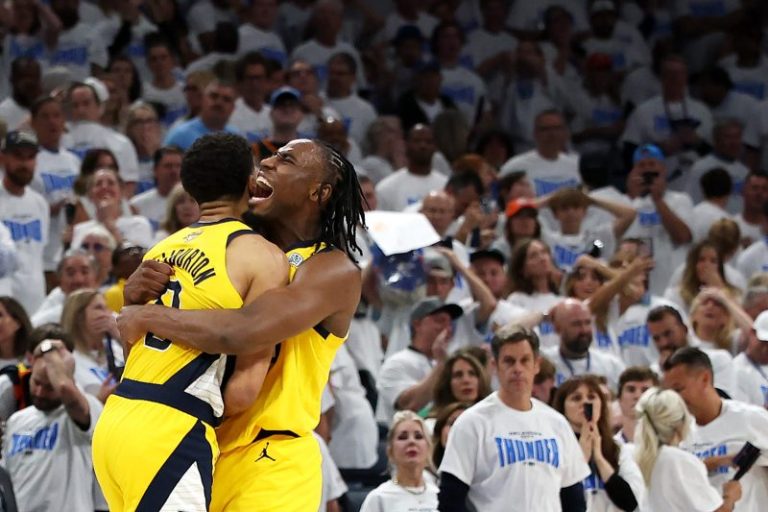
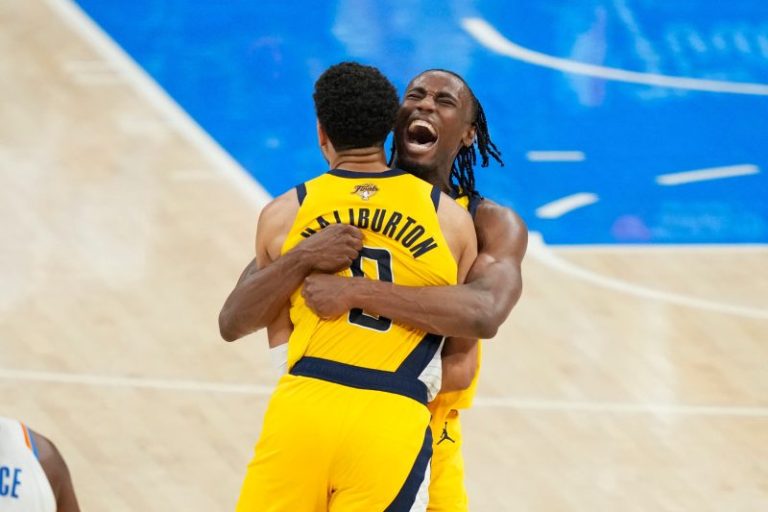
Kept playing until they took their first lead of the game late in the fourth quarter. Kept playing until they stunned the Oklahoma City Thunder with a 111-110 victory in Game 1 on Thursday, June 5.
Indiana’s relentless style for 48 minutes allowed them to overcome 25 turnovers and steal the series opener.
Tyrese Haliburton’s 21-foot jumper with 0.3 seconds left in the fourth quarter gave the Pacers a 111-110 lead – and the victory. It was Indiana’s first lead of the game.
Pascal Siakam had 19 points and 10 rebounds, Obi Toppin had 17 points off the bench, and Haliburton added 14 points, 10 rebounds and six assists for the Pacers who were 18-for-39 on 3-pointers. The Thunder went 0-for-5 from beyond the arc in the fourth, while the Pacers went 6-of-10.
Game 1 was the Pacers’ fifth comeback victory from a deficit of 15 or more points in the 2025 NBA playoffs, the most by a team in a single postseason since 1998.
It was an improbable victory for the Pacers, who had 20 turnovers in the first half and trailed 94-79 with 9:42 left. But the Pacers believe in their system and ability to come back and win.
Thunder star Shai Gilgeous-Alexander, the 2024-25 NBA MVP, scored 38 points. He scored at least 30 points for the 12th time in the playoffs and has reached 30 in eight of his past nine games. Thunder All-Star Jalen Williams had 17 points.
It all added up to a must-see Game 1. USA TODAY Sports provides the highlights, analysis and more. NBA reporter Jeff Zillgitt is in Oklahoma City. Follow along:
NBA Finals Game 1 highlights: Pacers 111, Thunder 110
Final: Pacers 111, Thunder 110
Tyrese Haliburton gave Indiana its first lead of the game on a 2-pointer with 0.3 seconds remaining as the Pacers stunned the Thunder at home in Game 1. This season, Haliburton is 13-of-15 (86.7%) on shots inside the final two minutes (including overtime) to tie or take the lead. He has scored 32 points on those 15 attempts. Three of them have come in the postseason.
Pacers back in it after 12-2 run
The Pacers, true to their form this postseason, aren’t going away quietly.
Indiana ripped off a 12-2 run to close the deficit to just four points with 6 minutes left. The Pacers have done it with 3-point shooting, flushing a trio of shots from beyond the arc in less than a minute.
The Pacers are 16-of-34 (47.2%) from 3-point range, compared to Oklahoma City’s mark of 11-of-28 (39.3%) — giving Indiana a 15-point edge on shots from deep. They started the quarter 4-of-5 from beyond the arc.
Thunder run opens largest lead
It may not be an overwhelming run by the Thunder, but it opened up the largest lead of the game.
Oklahoma City, known for its ability to ignite on massive runs, is on a 9-3 run to start the fourth quarter, opening up a 15-point lead with 9:42 left to play.
Not surprisingly, the run was capped by a Jalen Williams dunk that came on yet another Pacers turnover, their 24th of the game.
What are the most steals in a NBA Finals game?
The Oklahoma City Thunder are closing in on history. The Thunder have 12 steals entering the fourth quarter, six shy of tying the NBA Finals record. The Boston Celtics hold the record after they swiped the ball from the Los Angeles Lakers 18 times during Game 6 of the 2008 NBA Finals. With the win, the Celtics clinched the Larry O’Brien Championship Trophy. The NBA has been tracking that statistic since the 1973-74 season.
What are the most turnovers in a NBA Finals game?
The Pacers are up to 22 turnovers in Game 1 of the 2025 NBA Finals, leading many to wonder what are the most turnovers a team has surrendered in the Finals? That record belongs to Portland, which turned the ball over 34 times in the Trailblazers’ 107-101 loss to the Philadelphia 76ers in Game 1 of the 1977 NBA Finals. Despite dropping the first two games of the championship series, Portland went on to win, 4-2. The NBA has been tracking that statistic since the 1973-74 season.
End Q3: Thunder 85, Pacers 76
The Oklahoma City Thunder are not yielding, but the Pacers are making things interesting.
Each time the Pacers have mounted a small charge in Game 1 of the NBA Finals, Oklahoma City has responded. But, although the Pacers shrunk the deficit to single-digits, the Thunder are one quarter from taking a 1-0 series lead, holding an 85-76 edge through three periods.
The Pacers did a better job of protecting the ball in the third quarter, turning it over just three times in the period after they had given it away 19 times in the first half. Indiana’s shooting slightly cooled in the third, however, as forward Pascal Siakam is finding more of a rhythm. He leads all Indiana players with 16 points on 6-of-13 shooting. Tyrese Haliburton has added 10 points on 4-of-9 shooting, along with eight rebounds and five assists.
Thunder forward Lu Dort, typically known for his defense, came into Thursday shooting just 30.4% from beyond the arc in the playoffs. Through three quarters, he has nailed 5-of-7 (71.4%) from deep. His 15 points are second-best for the Thunder, with Shai Gilgeous-Alexander leading the way with 28 on 12-of-26 shooting.
OKC hangs Western Conference finals banner
The Oklahoma City Thunder wasted little time celebrating its postseason accomplishments, displaying its Western Conference finals banner in the rafters of the Paycom Center before Game 1.
The Thunder won the series 4-1 against the Minnesota Timberwolves, after concluding the series with a 124-94 victory in Game 5 on May 28.
Oklahoma City also has a banner hanging for winning the conference championship during the 2011-12 season. The Thunder fell short in the NBA Finals that season to LeBron James, Dwyane Wade and the Miami Heat.
There’s still a banner to play for this season with the Thunder hosting the first two games of the NBA Finals series against the Indiana Pacers.
Halftime: Thunder 57, Pacers 45
There was a stretch in the second quarter when the Indiana Pacers looked like they might go on a run.
The Thunder, however, continued to swarm, continued to force turnovers and a trio of Lu Dort 3s sparked a 9-0 run that helped Oklahoma City open up a 57-45 lead headed into the half.
The Pacers, for the second consecutive quarter, committed at least nine turnovers, to bring their total in the game to 20. The Thunder, not surprisingly, took 18 more shots in the first half than Indiana.
It’s almost remarkable that the Pacers are down just 12, especially when factoring in Indiana’s pedestrian scoring production from its starting five. Backup point guard T.J. McConnell leads all Pacers with nine points in just 11:15 of game time, while All-Star Tyrese Haliburton, the player whom McConnell spells, has just six on 2-of-5 shooting.
For the Thunder, Shai Gilgeous-Alexander is clearly intent on getting to his spots, putting up 18 shots in the first half. He made eight of those and leads all players with 19.
Oklahoma City shot 20-of-54 (37.0%) from the floor, while the Pacers are 15-of-36 (41.7%).
One area where Indiana does deserve some credit, though, is transition defense; depite losing the turnover battle 20-4, the Pacers have yielded just nine points off those giveaways, compared to Indiana’s four points off of Oklahoma City’s four turnovers.
Fathers of Haliburton, Gilgeous-Alexander link up
The 2025 NBA Finals has offered up an unexpected duo.
John Haliburton and Vaughn Alexander, the fathers of Tyrese Haliburton and Shai Gilgeous-Alexander, respectively, posed for a photo together before their sons faced off in Game 1 of the NBA Finals. Haliburton donned a yellow shirt featuring the Pacers logo with matching socks, while Alexander opted for blue tie-dye pants and a blue hoodie.
Both sons were introduced to basketball by their fathers. John Haliburton served as a basketball referee, while Vaughn Alexander played basketball in high school and went on to serve as his son’s youth coach.
End Q1: Thunder 29, Pacers 20
Though it was not an explosive quarter, the Oklahoma City Thunder have punched first in the NBA Finals.
The Thunder opened a 29-20 lead through one quarter on their swarming, turnover-inducing defense and steady shot making.
Point guard Shai Gilgeous-Alexander, the NBA’s Most Valuable Player, was ultra-aggressive, attempting 11 shots in the first period, draining five. He finished the quarter with 12 points and a pair of rebounds.
Center Isaiah Hartenstein, who came off the bench after starting every Oklahoma City game this postseason, added seven points in just 4:40.
A few things to watch for the Pacers: All-Star point guard Tyrese Haliburton missed his first two shots and finished just 1-of-3 in the period, with three points. Thus far in the postseason, the Pacers have struggled when Haliburton fails to assert himself; in losses, he is averaging just 11.5 points per game. In victories, that figure jumps to 21.3.
The other issue facing Indiana is turnovers. The Pacers entered Thursday averaging just 12 turnovers per game in the playoffs. In the first quarter, the Pacers committed nine.
As a result, Oklahoma City took 10 more shot attempts (27) than Indiana did in the period. The Pacers, however, are actually shooting better — 47.1% — than the Thunder are (40.7%).
Pacers forward Pascal Siakam and backup point guard T.J. McConnell lead Indiana with four points apiece.
Local pastor opens NBA Finals with national anthem
Rob Clay sang the national anthem ahead of Game 1 of the NBA Finals between the Thunder and the Pacers. Clay, a local pastor and singer, is a fan of the Thunder and has sung at OKC home games in the past.
“Honored. Humbled. Ready,” Clay said in a post on Facebook. “Today, I have the incredible privilege of singing the National Anthem for Game 1 of the NBA Finals – a dream years in the making.”
Clay has been viewed as a good luck charm, performing the national anthem for Game 1 of the first-round series (against the Memphis Grizzlies) and the Western Conference semifinals against the Denver Nuggets. He did not perform ahead of Game 1 in the Western Conference Finals against the Minnesota Timberwolves. — James Williams
OKC hangs Western Conference Finals banner
The Oklahoma City Thunder wasted little time celebrating its postseason accomplishments, displaying its Western Conference Finals banner in the rafters of the Paycom Center.
The Thunder won the series 4-1 against the Minnesota Timberwolves, after concluding the series with a 124-94 victory in Game 5 on May 28.
Oklahoma City also has a banner hanging for winning the conference championship during the 2011-12 season. The Thunder fell short in the NBA Finals that season to LeBron James, Dwyane Wade and the Miami Heat.
There’s still a banner to play this season with the Thunder hosting the first two games of the NBA Finals series against the Indiana Pacers. — James Williams
What time is Indiana Pacers vs. Oklahoma City Thunder?
The Oklahoma City Thunder host the Indiana Pacers for Game 1 of the NBA Finals at Paycom Center in Oklahoma City. The game is scheduled for 8:30 p.m. ET.
How to watch Indiana Pacers vs. Oklahoma City Thunder Game 1
- Time: 8:30 p.m. ET
- Location: Paycom Center (Oklahoma City)
- TV: ABC
- Stream: Fubo, Sling TV
Watch the NBA Finals with Fubo
Where is Game 1 between Indiana Pacers and Oklahoma City Thunder?
The Oklahoma City Thunder host the Indiana Pacers at Paycom Center in Oklahoma City for Game 1 of the NBA Finals.
NBA expansion progress remains slow going
OKLAHOMA CITY — With the Finals starting in Oklahoma City (where the Seattle SuperSonics relocated in 2008), NBA expansion is a noteworthy topic, especially with Seattle, Las Vegas and other markets trying to land a team if and when expansion becomes a reality.
NBA commissioner Adam Silver addressed the topic before Game 1.
“The current sense is we should be exploring it,” Silver said. “I don’t think it’s automatic because it depends on your perspective on the future of the league. As I’ve said before, expansion in a way is selling equity in the league. If you believe in the league, you don’t necessarily want to add partners. On the other hand, we recognize there are underserved markets in the United States and elsewhere, I think markets that deserve to have NBA teams. Probably even if we were to expand, more than we can serve.
“We have an owners’ meeting in July in Las Vegas. It will be on the agenda to take the temperature of the room. We have committees that are already talking about it. But my sense is at that meeting, they’re going to give direction to me and my colleagues at the league office that we should continue to explore it.”
Shaq is in the house – and his empire just keeps growing
TV commercials. Licensing deals. Other partnerships. O’Neal, 14 years removed from his Hall of Fame career that included four NBA championship rings and three Finals MVPs, seems to be cashing in everywhere.
On Wednesday, June 4, Netflix premiered a six-episode docuseries called ‘Power Moves with Shaquille O’Neal’ about the 53-year-old taking over as president of Reebok in 2023. (Shaquille O’Neal’s Jersey Legends Productions partnered with Sony Pictures Television on the show.) He is providing commentary during NBA TV’s coverage of Game 1 and Game 2 of the NBA Finals between the Oklahoma City Thunder and Indiana Pacers. He is at Paycom Center.
Perry Rogers and Colin Smeeton, who have both worked closely with O’Neal for about 20 years, help paint a vivid picture of how O’Neal turned his millions in NBA wages into more millions — and became a household name. Read Josh Peter’s story on how O’Neal ‘flipped the script’ here.
Referees for NBA Finals Game 1
- John Goble (Ninth Finals)
- Marc Davis (14th Finals)
- David Guthrie (Eighth Finals)
Thunder starting five for NBA Finals Game 1
The Thunder have made a change to their starting lineup, inserting Cason Wallace and moving Isaiah Hartenstein to the bench. This move gives the Thunder more options when it comes to defending Indiana star Tyrese Haliburton. Expect Wallace to spend time on Haliburton.
- Jalen Williams, F
- Lu Dort, F
- Chet Holmgren, F
- Cason Wallace, G
- Shai Gilgeous-Alexander, G
Pacers starting five for NBA Finals Game 1
- Pascal Siakam, F
- Aaron Nesmith, F
- Myles Turner, C
- Andrew Nembhard, G
- Tyrese Haliburton, G
Jarace Walker injury update for NBA Finals Game 1
The Pacers will be without Jarace Walker to start the NBA Finals. He was ruled out of Game 1 with a right ankle sprain and the injury will likely keep him sidedlined for Game 2. Walker injured his ankle late in the Pacers’ 125-108 series-clinching win over the New York Knicks in Game 6 on May 31. Walker landed awkwardly on his right ankle after attempting to block a shot from the Knicks’ Karl-Anthony Towns in the fourth quarter.
Pacers coach Rick Carlisle shows support for ESPN’s Doris Burke
Indiana Pacers coach Rick Carlisle, an hour-and-a-half before his team was set to face the Oklahoma City Thunder in Game 1 of the NBA Finals, opened his pre-game news conference to offer support for ESPN analyst Doris Burke.
A New York Times report from Wednesday, June 4 indicated that ESPN was evaluating the future of the network’s No. 1 NBA team — namely Burke and fellow analyst Richard Jefferson — after the finals.
“She has changed the game for women in broadcasting,” Carlisle said Thursday, June 5, of Burke. “I have a daughter who just turned 21, who is in her second year at (the University of Virginia). She’s not in the basketball industry, but Doris is a great example of courage and putting herself out there.
“It was just so sad to see these reports leaked, really unnecessarily before such a celebrated event. Doris is a friend. I’ve asked her many times why she doesn’t get into coaching; she has such great knowledge.”
Thunder coach Mark Daigneault jokes he doesn’t have many friends
OKLAHOMA CITY — Asked if he reached out to anyone in the coaching fraternity to discuss coaching in the NBA Finals and handling the spectacle of the series, Thunder coach Mark Daigneault said, “I don’t have a lot of friends. I’m embarrassed. Never been more embarrassed in my life.”
He added: “I haven’t, like, scanned the coaching circles. I don’t have Phil Jackson’s number.”
Daigneault did chat with Billy Donovan. Daigneault was an assistant for Donovan at Florida and with the Thunder.
“I talked to Billy Donovan right after we clinched (the Western Conference),” Daigneault said. “He’s somebody obviously I’ve worked with, that’s played on high-level stages (and) got some insight from him.”
Opinion: Stop worrying about TV ratings. This NBA Finals should be appreciated
OKLAHOMA CITY — The email hit my inbox with the subject line “Will viewers watch Pacers-Thunder?”
The headline in the newsletter from Front Office Sports: “History shows Pacers vs. Thunder may draw record-low ratings.” It’s not the first time and won’t be the last time that TV ratings accompany a discussion of this season’s NBA Finals between Indiana and Oklahoma City.
The small-market matchup has generated this idea that there isn’t or won’t be interest. The NBA biosphere seems to thrive on debate and criticism with an emphasis on how some aspect of the game isn’t good enough and can be better.
The reflexive contempt for teams not from the coasts or bigger markets is odd. It’s not my job to sell this series. That’s on the NBA and its TV partner, Disney’s ABC, which is televising the Finals.
The Pacers and Thunder are on the cutting edge of today’s NBA. They emerged as the two best teams in the league ‒ rosters assembled with a savvy eye on making the parts fit. The matchup should be celebrated and appreciated. Read Jeff Zillgitt’s full column here.
NBA 3-pointer reigns supreme for championship teams
The NBA’s 3-point shot has enemies.
Too many 3s, they say. The shot is ruining the game, they say.
And those critics of the 3-point shot found ammunition in the Eastern Conference semifinals of this season’s playoffs when the Boston Celtics attempted 60 3-pointers and missed 45 against the New York Knicks. The guffawing ignored the fact that Boston’s 3-point shooting was instrumental in its 2023-24 championship season and in its 61-21 record this season.
Regardless of your aesthetic view of how basketball should be played and what it should look like, the 3-point shot has turned divisive but remains vital to winning championships.
USA TODAY’s Jeff Zillgitt takes a deeper look at this controversial shot.
Thunder vs. Pacers: Who has the edge?
The Thunder were the best team in the regular season and have been the best team in the playoffs. The Pacers have been impressive the past two seasons, but this has seemed like Oklahoma City’s year since the first game in October.
Find out who has the edge in various categories with Jeff Zillgitt’s NBA Finals breakdown.
Thunder and Pacers NBA Finals X factors
In the NBA playoffs, the outcome often rests on the underrated.
Certainly, the performances of Shai Gilgeous-Alexander and Tyrese Haliburton will be scrutinized and big games can propel their respective teams to victories. But it’s often the role players, sometimes off the bench, erupting on a scoring streak or clamping down on defense, who can make the difference between winning and losing.
USA TODAY’s Lorenzo Reyes gives three X factors for the Thunder and Pacers in this NBA Finals preview.
NBA Finals matchup: SGA vs Haliburton
The 2025 NBA Finals is, in many ways, a celebration of the point guard.
Shai Gilgeous-Alexander, the NBA’s Most Valuable Player and the Oklahoma City Thunder superstar, and Tyrese Haliburton, the pass-first point guard with a penchant in the clutch, are each franchise’s hope to win the Larry O’Brien Trophy.
Though they likely won’t match up directly all the time, the responsibility of guarding the other likely falling to more specialized defenders, Gilgeous-Alexander and Haliburton are reshaping the image of the point guard in the modern NBA.
USA TODAY’s Jeff Zillgitt and Lorenzo Reyes look at the Pacers and Thunder’s biggest stars.
Opinion: NBA’s new era of parity – and small-market success – what owners wanted
If the impending NBA Finals matchup of the league’s 23rd and 27th-ranked media markets is supposed to spell doom for the league, it is a doom the NBA’s owners intentionally brought on themselves.
While two glitz-free Midwestern cities in the Finals might not have the celebrity pull the NBA has largely enjoyed through its historically successful franchises, it was an inevitable outcome once the league designed a collective bargaining agreement that dismantled its traditional cycle of superteams and dynasties.
Welcome to the new NBA, where championship windows are smaller, the life cycle of a roster is shorter and the number of teams that can win a title in any given year is beyond anything we’ve seen in our lifetimes. — Dan Wolken
Read Wolken’s full column here.
2025 All-NBA team
Oklahoma City Thunder guard and league Most Valuable Player Shai Gilgeous-Alexander and Denver Nuggets center Nikola Jokic were unanimous selections from a panel of 100 global reporters and broadcasters who cover the NBA voted on the squad. View the complete list.
NBA champions by year
Winners over the past 20 years. For a full list of champions, visit NBA.com.
- 2023-24 — Boston Celtics
- 2022-23 — Denver Nuggets
- 2021-22 — Golden State Warriors
- 2020-21 — Milwaukee Bucks
- 2019-20 — Los Angeles Lakers
- 2018-19 — Toronto Raptors
- 2017-18 — Golden State Warriors
- 2016-17 — Golden State Warriors
- 2015-16 — Cleveland Cavaliers
- 2014-15 — Golden State Warriors
- 2013-14 — San Antonio Spurs
- 2012-13 — Miami Heat
- 2011-12 — Miami Heat
- 2010-11 — Dallas Mavericks
- 2009-10 — Los Angeles Lakers
- 2008-09 — Los Angeles Lakers
- 2007-08 — Boston Celtics
- 2006-07 — San Antonio Spurs
- 2005-06 — Miami Heat
- 2004-05 — San Antonio Spurs
Indiana Pacers vs. Oklahoma City Thunder Game 1 odds
The Oklahoma City Thunder are favorites to take a 1-0 lead over the Indiana Pacers in Game 1 of the 2025 NBA Finals, according to BetMGM (odds as of Wednesday, June 4):
- Spread: Thunder (-9.5)
- Moneyline: Thunder (-450); Pacers (+340)
- Over/under: 231.5
Thunder vs. Pacers NBA Finals series odds
The Oklahoma City Thunder enter Game 1 as the favorite to win the 2025 NBA Finals over the Indiana Pacers, according to BetMGM (odds as of Wednesday, June 4)
- Series winner: Thunder (-700); Pacers (+500)
Thunder vs. Pacers NBA Finals picks: USA Today staff predictions
USA TODAY: Every expert picks the Thunder
All of the NBA experts at USA Today Sports picked the Oklahoma City Thunder to beat the Indiana Pacers in the 2025 NBA Finals
- Scooby Axson: Thunder in five
- Cydney Henderson: Thunder in six
- Jordan Mendoza: Thunder in six
- Lorenzo Reyes: Thunder in six
- Heather Tucker: Thunder in five
- James Williams: Thunder in six
- Jeff Zillgitt: Thunder in five
OKC Thunder vs. Indiana Pacers predictions: Expert picks for NBA Finals
ESPN: 14 out of 15 experts pick Thunder
14 out of 15 of ESPN’s NBA experts pick the Oklahoma City Thunder to win the 2025 NBA Finals against the Indiana Pacers.
NBA.com: Every expert picks the Thunder
John Schuhman writes, ‘The Thunder are, simply, the best team in basketball. Their No. 1 defense has been ridiculously good in the playoffs, holding the Grizzlies, Nuggets and Wolves to 19.6, 15.0 and 4.2 fewer points per 100 possessions, respectively, than they scored in the regular season. (Take away the Game 3 blowout and the Wolves’ discrepancy would also be in the double-digits.) The Indiana offense vs. Oklahoma City defense could be the best one-end-of-the-floor matchup that we’ve seen in the Finals in a long time, but the Thunder should have the edge on that end of the floor and the other.’
NBC Sports: Experts pick Thunder
Kurt Helin writes: ‘Here’s Indiana’s problem: Tyrese Haliburton is outstanding, but Shai Gilgeous-Alexander is just better; Indiana’s defense is improved and can force turnovers, but OKC’s is elite and just better; Myles Turner is good, but Chet Holmgren is just better (especially paired with Isiah Hartenstein); the Pacers bench was good enough for the East, but the Thunder bench is just better. And so it goes down the line. Indiana is a quality team that’s about to get overwhelmed.’
What channel is the NBA game tonight? How to watch Thunder vs. Pacers
The Oklahoma City Thunder host the Indiana Pacers at 8:30 p.m. ET with coverage on ABC.
Thunder vs. Pacers NBA Finals schedule
- Game 1, June 5: Pacers 111, Thunder 110
- Game 2, June 8: Pacers at Thunder | ABC, Fubo | 8 p.m.
- Game 3, June 11: Thunder at Pacers | ABC, Fubo | 8:30 p.m.
- Game 4, June 13: Thunder at Pacers | ABC, Fubo | 8:30 p.m.
- Game 5, June 16: Pacers at Thunder | ABC, Fubo | 8:30 p.m.*
- Game 6, June 19: Thunder at Pacers | ABC, Fubo | 8:30 p.m.*
- Game 7, June 22: Pacers at Thunder | ABC, Fubo | 8 p.m.*
All times Eastern; *-if necessary
NBA playoff bracket
Eastern Conference finals
- No. 4 Indiana Pacers def. No. 3 New York Knicks, 4-2
Western Conference finals
- No. 1 Oklahoma City Thunder def. No. 6 Minnesota Timberwolves, 4-1
NBA Finals
- No. 4 Indiana Pacers vs. No. 1 Oklahoma City Thunder
This post appeared first on USA TODAY