Author

admin

Browsing

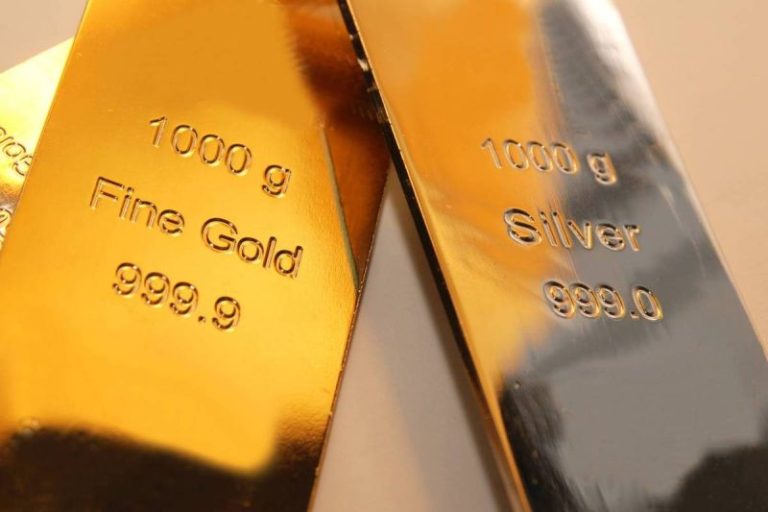
Christopher Aaron, founder of iGoldAdvisor and Elite Private Placements, explains where gold and silver are in the current cycle and what his strategy looks like now.

‘This cycle is going to end in a mania,’ he said. ‘You want to position not when the mania is unfolding, but when it gets quiet, and I think we’re in one of those windows now to be positioning.’

Securities Disclosure: I, Charlotte McLeod, hold no direct investment interest in any company mentioned in this article.

This post appeared first on investingnews.com

Genesis Minerals (ASX:GMD,OTCPL:GSISF) has struck a recommended deal to acquire Magnetic Resources (ASX:MAU) in a transaction that would add more than 2 million ounces of high-grade gold to its Laverton inventory and reshape its production growth outlook in Western Australia.

Under a binding Scheme Implementation Deed announced Tuesday (February 17), Genesis will acquire 100 percent of Magnetic via a court-approved scheme of arrangement. The offer values Magnetic at approximately US$450 million on a fully diluted basis.

At the centre of the deal is Magnetic’s flagship Lady Julie gold project in the Laverton region, which hosts a mineral resource of approximately 2.2 million ounces grading 1.8 grams per tonne (g/t) gold, and ore reserves of around 1 million ounces at 1.7 g/t. The project sits roughly 20 kilometres from Genesis’ operating 3 million tonne per annum Laverton mill.

“This transaction creates substantial value for both groups of shareholders, delivering genuine synergies while combining the right assets with the right people,” Genesis Executive Chair Raleigh Finlayson said.

“Magnetic’s Lady Julie Gold Project will add more than 2Moz at an attractive high grade to Genesis’ Laverton inventory, further bolstering the mine life and production outlook.”

Lady Julie’s northern boundary adjoins ground recently acquired by Genesis through its purchase of Focus Minerals’ (ASX:FML,OTCPL:FCSUF) Laverton gold project, creating the potential to integrate what would otherwise be neighbouring standalone developments into a larger open pit operation.

Genesis said removing tenement boundaries between the assets presents tangible cost and operational synergies. The acquisition would expand its Laverton mineral resources to approximately 8.4 million ounces, representing a 40 percent increase, and lift its pro forma total mineral resources to 21 million ounces.

The company signaled that the deal could support an uplift to its “ASPIRE 500” growth strategy, with an updated multi-year plan expected following completion.

Magnetic Managing Director George Sakalidis said the deal follows a strategic review exploring development pathways for Lady Julie: “Genesis’ offer follows a strategic review which the Board and its advisers have been working on for several years to explore potential options to collaborate with other operators which have the existing skill set or combination synergies to develop Magnetic’s discoveries and unlock value for our shareholders.’

If implemented, Magnetic shareholders would own approximately 2.4 percent of the enlarged Genesis. Major shareholders representing about 19.6 percent of Magnetic’s issued shares have already committed to vote in favour of the scheme, subject to customary conditions.

Securities Disclosure: I, Giann Liguid, hold no direct investment interest in any company mentioned in this article.

This post appeared first on investingnews.com

PHOENIX — Bruce Meyer, the tenacious veteran litigator who has been the Major League Baseball Player Association’s lead negotiator, was voted unanimously Wednesday by the players to be their interim executive director, replacing Tony Clark.

Meyer, who was promoted to be the union’s deputy executive director in 2022, has been MLB’s public enemy since he joined the union in 2018. He frequently has clashed on even small agenda items with MLB, which has accused him of being bad for baseball.

Meyer, 64, is considered the union’s most fierce litigator since the days of Don Fehr and Gene Orza, and once again Wednesday expressed his deep resentment towards MLB’s hopes for a salary cap, believing that a lockout Dec. 1 is inevitable when the collective bargaining agreement expires.

“A lockout is all but guaranteed at the end of the agreement,’’ Meyer said Wednesday afternoon after meeting with the Chicago Cubs, and spending the morning with the Kansas City Royals. “The league has pretty much said that. Their strategy in bargaining has always been to put as much pressure on players as they can to try and create divisions and cracks among our membership.

“It never worked. I don’t think it will ever work.’’

Meyer, who said he will continue to be the lead negotiator, said that he and his staff have a duty to the players to listen to whatever MLB offers, but showed his disdain towards even entertaining a salary cap.

“Our position and the historic position of this union for decades on the salary cap is well known,’’ Meyer said. “It’s the ultimate restriction. It is something that owners in all the sports have wanted more than anything, and in baseball in particular. There’s a reason for that, because it’s good for them and not the players.’’

Meyer, even with the sudden resignation of Clark over an inappropriate relationship with a union employee, insisted Wednesday morning there is no disarray among the union ranks, and its resolve remains strong.

“I think anybody who’s going to assume that and act on that,’’ Meyer said, “is really making a mistake. I’m not going to say (the timing of Clark’s resignation) is a great thing. This is unforeseen. There have been some issues hanging over (him), and in some respects, it’s good to get them out of the way sooner rather than later.’’

Who is Bruce Meyer?

Meyer, while respected for his fierceness, does have his detractors. There was an attempt to remove him from the office two years ago, an effort led by attorney Harry Marino, who organized the efforts to have minor leaguers unionized. It failed when Clark came to Meyer’s defense.

The eight-person executive subcommittee pushed for Meyer to be voted as the executive director in their meeting Tuesday, but after pushback by at least three players on the call, no vote was taken. The larger group of 72 players, including player representatives from all 30 teams, decided to reconvene at 7 p.m. ET Wednesday after polling their own teammates. If Meyer didn’t receive enough support, they likely would have turned to Matt Nussbaum, the union’s general counsel who was promoted to interim deputy executive director, Meyer’s previous title.

Now, Meyer, who previously worked as a senior adviser at the NHL players union and was a partner at the law firm Weil, Gotshal & Manges, will be running the whole show, much to MLB’s fear.

When the 99-day lockout ended in 2022, and the rank-and-file voted to accept MLB’s last proposal, Meyer sympathized with the executive council who wanted to continue negotiations, even if it meant losing games.

“Some players emerged from bargaining disappointed that we did not accomplish more,’’ Meyer said in a letter to players two years ago, “and in particular that we did not miss games to see if more gains could be made. To be clear, I sympathized and still do with these players and this position.’’

Meyer, who becomes the seventh executive director of the union, expects negotiations with MLB to begin in April on the next CBA, and just like the last round, tranquility will not be on anyone’s bingo card.

“I’d say I’m known as a tough litigator who also knows how to make deals when necessary,’’ Meyer said in a Q&A with the MLBPA newsletter. “In the sports area I’ve been involved in just about every type of issue, including labor, antitrust, licensing, collective bargaining and others. But the common thread is I have a passion for player advocacy and defending player rights.’’

Let the negotiations, with plenty of rancor, begin.

Follow Nightengale on X: @Bnightengale

This post appeared first on USA TODAY

  • Mikaela Shiffrin won the Olympic slalom gold medal, finishing 1.50 seconds ahead of the silver medalist.
  • The victory gives Shiffrin her third Olympic gold, tying her for the second-most by a U.S. Winter Olympian.
  • Her four total Olympic medals tie her for the most by a U.S. woman in Alpine skiing.

CORTINA D’AMPEZZO, Italy — Mikaela Shiffrin didn’t need this Olympic gold medal.

Her legacy was secured long ago, between her other two Olympic golds, her World Cup wins record and all the other superlatives she’s achieved. But that’s never been good enough for the peanut gallery, which tunes in every four years and doesn’t understand why Shiffrin can’t just conjure gold medals out of snow.

Ski racing is hard. Really, really hard. Get a couple of inches off your line and you’re toast. Or worse. Get a course or a hill that doesn’t suit your style and it’s just not going to be your day.

But the Winter Olympics is the only measuring stick for some folks and, in their minds, Shiffrin hasn’t measured up.

Maybe now they’ll finally get off her back.

“The irony is I’ve cared so much about wanting everybody to know the reality and to not want to answer those questions and to be so sick and tired of it. And I’ve felt that way since (being) fourth in South Korea in the slalom,” Shiffrin said.

“In order to do this today, I kind of needed to accept the possibility that those questions would keep coming,” she said. “It was like, just don’t resist it. Just live in my own moment.”

And that moment? My God, was it magnificent.

Shiffrin obliterated the field in winning the Olympic slalom on Wednesday, Feb. 18, finishing a whopping 1.50 seconds ahead. Silver medalist Camille Rast was closer to 12th-place finisher Laurence St-Germain than she was Shiffrin.

With three gold medals, Shiffrin is now tied with snowboarder Shaun White and bobsledder Kaillie Humphries for second-most by a U.S. Winter Olympian. (Speedskaters Bonnie Blair and Eric Heiden have five each.) Her four total medals tie her with Julia Mancuso for most medals in Alpine skiing by a U.S. woman. Only Norway’s Kjetil Andre Aamodt and Croatia’s Janica Kostelic have more gold medals, with four.

When Shiffrin crossed the finish line, she looked at the scoreboard for several long seconds — “I never seem to be able to read the scoreboard” — before reality hit. About what she’d done, what it took to get here, and all the people — here and beyond — who’ve played a part in it.

She cried as she hugged her mother Eileen, who is also one of her coaches. She paused to gather herself and then kissed her hand and touched the snow, a tribute to her late father, before climbing onto the medals podium.

“These moments, we do build them up for sure. I think everybody builds it up and I’m building it up for myself, too,” she said. “Like I said, the biggest task today was to simplify and focus on the skiing.”

Shiffrin’s career, at the Olympics and everywhere else, is the kind of dominance that inspires people to hang banners, build statues and name their children and pets after. Yet rather than appreciating what she’s done, she’s always been held to an impossible standard.

You won a gold medal in the giant slalom at the Pyeongchang Games? Great, but what about that fourth-place finish in the slalom? The Beijing Olympics were Bizarro World because of the COVID restrictions and it was the first Games since the unexpected death of your dad, who was so central to you as both a person and a ski racer, but what’s wrong with you that you couldn’t win a single medal?

And when Shiffrin struggled in the slalom portion of the team combined, her 15th-place finish dropping her and Breezy Johnson from first to fourth, it was here we go again.

“I knew after the team combined that there would be some stories out there that would be really frustrating to look at,” Shiffrin said.

The truth is, Shiffrin never had an “Olympic problem.” She had ski races that didn’t go her way. Which is no different than what happens every season.

No different than the Olympic experience of pretty much every other skiing great, by the way. Marcel Hirscher, whose eight overall World Cup titles are the most of any skier? Has three Olympic medals, two of them gold. Same for Ingemar Stenmark, whose World Cup wins record Shiffrin broke.

“The reality of our sport is you lose a lot more than you win,” Shiffrin said. “When you look back on my career, I know statistics and everything, but still I’ve definitely lost a lot more than I’ve won. So that’s the one thing that’s certain is that you’re not going to win everything.”

But most people don’t see, or care, about that. So Shiffrin’s “reality” blew up into something it wasn’t.

“This whole season, every single slalom race, I’m like, ‘Oh God, I am really just digging myself into a hole here,’” Shiffrin said of her success this year in the World Cup, where she’s won seven of the eight slalom races and finished second in the other.

“The one thing that’s certain is that that wave’s going to stop,” she added. “You don’t get to ride that wave forever.”

Shiffrin has ridden it longer, and better, than most, however.

It’s about time she gets the recognition, and appreciation she deserves. She’s more than earned it.

Follow USA TODAY Sports columnist Nancy Armour on social media @nrarmour.

This post appeared first on USA TODAY

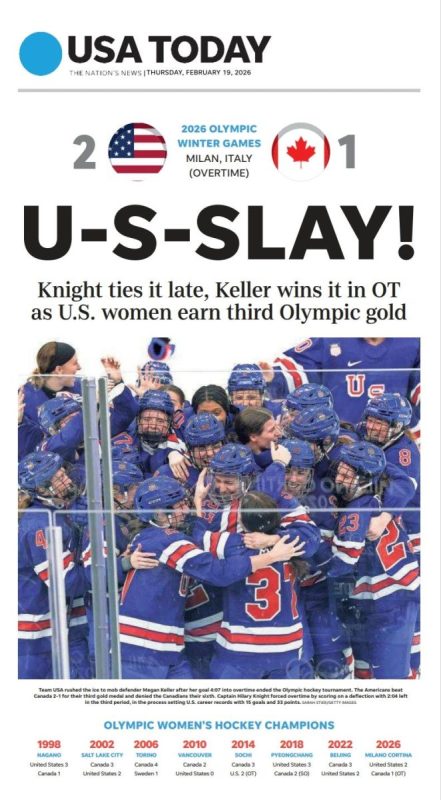
The USA’s 5-0 win against rival Canada in the preliminary round was an anomaly in the history of Olympics women’s hockey.

The USA and Canada will meet on Thursday, Feb. 19, in the gold medal game (1:10 p.m. ET on USA/Peacock) and all of their previous six meetings in championship games have been close. In fact, the last three and four of the six have been 3-2 scores.

Canada’s Marie-Philip Poulin and the USA’s Hilary Knight are likely to play key roles, not surprising considering Poulin is now the leading Olympic goal scorer and Knight has tied the U.S. Olympic record for goals and points.

In 2014, the USA held a 2-0 lead with five minutes left before Brianne Jenner made it 2-1. The Americans hit the post on a shot toward an empty net, then Poulin tied the game in the final minute. Knight was in the penalty box when Poulin scored in overtime.

The USA did the rallying in 2018 in a game in which both Knight and Poulin scored. Monique Lamoureux tied the game in the third period and her sister Jocelyne had the decisive goal to give the Americans a shootout win.

In 2022, Poulin scored twice for a 3-0 lead before Knight scored. Amanda Kessel made it 3-2 with 13 seconds left, but that ended up as the final score.

Canada is 4-2 against the United States in gold-medal games. Here are the previous scores:

USA vs. Canada gold medal game results

1998 gold medal game: 3-1 USA

2002 gold medal game: 3-2 Canada

2010 gold medal game: 2-0 Canada

2014 gold medal game: 3-2 Canada (OT)

2018 gold medal game: 3-2 USA (shootout)

2022 gold medal game: 3-2 Canada

This post appeared first on USA TODAY

The former Steelers safety was a two-time Pro Bowl selection and a member of all four Super Bowl-winning teams during the 1970s. He was a key member of the notorious Steel Curtain defense and a staple of one of the NFL’s greatest dynasties.

Wagner was drafted in the 11th round of the 1971 NFL Draft from Western Illinois. As a rookie, he started in 12 games and recorded two interceptions. Unfortunately, an injury to his neck in 1977 limited him to just three games that season. However, he returned in 1978, starting 14 games and recording two interceptions during the regular season, helping the Steelers win their third Super Bowl.

In 1979, he played in eight games and, although he didn’t play in the Super Bowl due to injuries, earned his fourth ring of the decade with the franchise.

In a statement, Steelers president Art Rooney II emphasized Wagner’s career accomplishments and honors with the Steelers.

‘We are deeply saddened by the passing of Mike Wagner, a tremendous player and an integral part of some of the most successful teams in Pittsburgh Steelers history,’ Rooney II said.

‘Mike played a key role on our championship teams of the 1970s. As a member of four Super Bowl-winning teams, his toughness and consistency were paramount to our secondary. His contributions on the field were significant, but it was also his steady presence and team-first mentality that truly defined him.

‘On behalf of the entire Pittsburgh Steelers organization, we extend our heartfelt condolences to Mike’s family. He will always be remembered as a champion, a great teammate, and a proud member of the Steelers family.’

Wagner finished his career with 36 interceptions, including an NFL-high eight in 1973.

During his 10-year career from 1971 to 1980, Wagner played in 119 games with 116 starts. He recorded 12 fumble recoveries and his 36 interceptions rank sixth all-time in franchise history.

This post appeared first on USA TODAY

MILAN – There were nerves and then, immense relief, the kind that comes with knowing the despair of the alternative.

The USA men’s hockey team remains on a path to the gold medal game, as does top rival Canada, at the 2026 Winter Olympics. The next step comes Friday, Feb. 20 in a semifinal matchup against Slovakia, the same day Canada plays Finland.

Both teams needed to win in overtime on Feb. 18 at Milano Santagiulia Ice Hockey Arena, and in between their victories – USA, 2-1 over Sweden; Canada, 4-3 over Czechia – Finland needed overtime to defeat Switzerland, 3-2.

Overtime ruffles even the best of teams.

‘That’s as nervous as I’ve been ever in a hockey game,’ said Dylan Larkin, who scored in regulation. ‘Just the way 3-on-3 goes, it’s really just being opportunistic. Someone could fall, some puck could bounce, anything could happen, especially with the ice out there.’

Then Quinn Hughes stepped on the ice, Matt Boldy got him the puck, and Hughes created space for himself, put the puck on his forehand and took a shot.

‘That was one of the best feelings I’ve ever had,’ Brady Tkachuk said. ‘Just the relief of scoring that goal, but seeing it was him, I think it just shows why he’s one of the best defensemen in the show.’

The USA’s roster is entirely NHL elite talent, but Sweden’s roster was stellar, too. The USA wasn’t able to take advantage of Sweden having had to play a qualification game the day before. The Americans couldn’t close them out, and so with 91 seconds left, Lucas Raymond made an incredible pass to set up Mika Zibanejad, and the Americans had to collect themselves.

‘I think it just showed exactly what we’ve been talking about this whole time,’ Tkachuk said. ‘It’s just the adversity, the character, just the will to win with our group. Probably something that can deflate you and end your tournament if you don’t just put your mind back in a good spot, and I think it just shows the character of being able to bounce back and get that win.’

Hughes shrugged it off.

‘Got to pick yourself back up,’ he said. ‘I’ve been saying all along, we’ve got guys that have won Cups and gone deep in the playoffs and superstars in the league, so I feel like it’s resilient group. You just pick yourself back up, get ready to go and I feel like we had an attack mindset in overtime.’

It’s one thing to settle NHL games via 3-on-3 overtime in the regular season. But when everything is on the line, it’s a pressure cooker. And unlike NHL teams, where the same three guys tend to rotate together in OT, as much as USA players know one another, it’s different in such a format.

‘We did address overtime at the beginning of at the start of this tournament because we felt at some point it was going to play a role,’ coach Mike Sullivan said. ‘We had a video session on it. It’s hard with the limited practice time that we have and the condensed schedule, the amount of games in a short period of time. It’s hard to maybe have an opportunity to actually give them reps and practice. But we dedicated a meeting on overtime 3-on-3 on both sides of the puck so that we could have some predictability around it.’

The players aced the test, and now get to study up on Slovakia.

This post appeared first on USA TODAY

Sigma Lithium (TSXV:SGML,NASDAQ:SGML) has secured another large-scale sale of high-purity lithium fines and activated a production-backed revolving credit facility as it ramps up operations in Brazil.

The lithium producer announced it has agreed to sell 150,000 metric tons (MT) of high-purity lithium fines containing 1 percent lithium oxide at a net final price of US$140 per MT upon warehouse delivery at the port of Vitória.

The buyer has the option to purchase a further 350,000 MT at market prices.

Sigma, which refers to the high-purity fines as a low-grade product, said the optional volumes provide flexibility to respond to market conditions and customer requirements.

According to the company, the sale of its low-grade product could generate proceeds equivalent to the sale of 70,000 MT of its high-grade lithium oxide concentrate. Sigma attributes the marketability of the fines to the processing technology at its Greentech plant, which uses dense media separation and dry stacking.

According to the São Paulo-based company, clients have achieved up to 60 percent recovery when reprocessing the material, producing lithium concentrate with over 4 percent lithium oxide content.

That higher-grade concentrate is currently priced at about US$1,370 per MT on average by Shanghai Metals Market.

“Our sequential sales of the Low Grade Product show how this material can generate recurring value, demonstrating its marketability,” said Marina Bernardini, Sigma vice president of business development. “Continuous demand for the Low Grade Product has supported the creation of an additional revenue stream for the Company.”

The February 13 agreement follows Sigma’s January sale of 100,000 MT of high-purity lithium fines.

At the time, the company reiterated that mining remobilization was proceeding as planned and pushed back against what it described as inaccurate media reports regarding an administrative process related to waste piles.

Alongside the new sale, Sigma confirmed that the resumption of production of its high-grade lithium oxide concentrate has triggered the start of pre-payments under a US$96 million revolving facility.

The unsecured binding agreement, signed with what the company describes as a leading company in the battery materials supply chain, calls for the delivery of 70,500 MT of high-grade concentrate in 2026.

Under the terms, fixed pre-payments of US$8 million are made 30 days prior to production and delivery to the port of Vitória. The first pre-payment was disbursed on January 13.

Each pre-payment carries interest at SOFR plus 1 percent for 30 days until final sale upon delivery. Pricing for each shipment is tied to prevailing spot market prices for high-grade lithium concentrate, as reflected in major industry indexes.

Securities Disclosure: I, Giann Liguid, hold no direct investment interest in any company mentioned in this article.

This post appeared first on investingnews.com

Global central banks own about 17 percent of all the gold ever mined, with reserves topping 36,520.7 metric tons (MT) at the end of November 2025. They acquired the vast majority after becoming net buyers of the metal in 2010.

Central banks purchase gold for a number of reasons: to mitigate risk, to hedge against inflation and to promote economic stability. Increased concerns over another global financial crisis have as expected led central banks once again to build up their gold reserves.

In a mid-2025 survey, the World Gold Council (WGC) said that 95 percent of the central bankers it polled expect global gold reserves to increase over the next 12 months. The precious metal’s ‘performance during times of crisis’ was cited by 85 percent of respondents as highly or somewhat relevant to their decision, while 80 percent cited its long-term store of value.

Central banks added 863.3 metric tons of gold to their vaults in 2025. While this was lower than the previous three years, which all topped 1,000 MT each, the reserve gains were still well above the 2010 to 2021 annual average of 473 MT.

Yearly central bank gold purchases since 2019.

Chart via the WGC.

A record 95 percent of respondents to the WGC survey stated their belief that central banks will continue to grow their holdings, with 5 percent suggesting they would hold at current levels. For the second year in a row, no respondents expected reserves to decrease.

The Council found that sentiment was consistent across advanced and emerging economies and reflected the strategic role of gold amid dynamic economic and geopolitical uncertainty.

Which central banks hold the most gold?

Read on to find out the 10 top countries by central bank gold holdings, as per data from the WGC, including recent Q4 2024 and full-year 2024 reports.

1. United States

Gold reserves: 8,133.46 metric tons

When it comes to the largest gold depository in the world, the American central bank is number one with 8,133.46 metric tons of gold.

A large percentage of US gold is held in “deep storage” in Denver, Fort Knox and West Point. As the US Treasury explains, deep storage is “that portion of the US Government-owned gold bullion reserve which the Mint secures in sealed vaults that are examined annually by the Treasury Department’s Office of the Inspector General and consists primarily of gold bars.”

The rest of US-owned reserves are held as working stock, which the country’s mint uses as raw material to mint congressionally authorized coins.

2. Germany

Gold reserves: 3,350.3 metric tons

The Bundesbank, Germany’s central bank, currently owns 3,351.53 metric tons of gold. Like many of the central banks on this list, the German national bank stores a significant portion of its gold in foreign central banks.

Today, just over half of Germany’s gold holdings are stored within Frankfurt, while internationally 1,236 MT of gold is stored in the vaults of the New York Federal Reserve, and 12 percent of its holdings are in London.

The Bundesbank’s foreign gold reserves came into question in 2012, when the German Federal Court of Auditors, the Bundesrechnungshof, was openly critical of the Bundesbank’s gold auditing. The German bank issued a public statement defending the security of foreign banks. Privately, the Bundesbank then began the arduous process of repatriating some of its gold stock back to German soil. By 2016, more than 583 MT of gold had been transferred back to Germany.

The economic upheaval and geopolitical volatility brought about by US President Donald Trump’s tariff wars and adversarial posturing toward Europe has led to calls for Germany to consider further repatriating its gold, reported The Guardian in January 2026.

3. Italy

Gold reserves: 2,451.9 metric tons

Banca d’Italia, the national bank of Italy, holds 2,451.84 metric tons of gold. The central bank began amassing its gold in 1893, when three separate financial institutions merged into one. From there, its 78 MT of holdings slowly grew into the large gold reserves it holds today.

Like Germany, Italy stores parts of its reserves offshore. In total, 141.2 MT are located in the UK, 149.3 MT are in Switzerland and 1,061 MT are kept in the US Federal Reserve. Italy houses 1,100 MT of gold domestically.

4. France

Gold reserves: 2,437 metric tons

The Banque de France has 2,437 metric tons of gold reserves, all of which it keeps on hand. The precious metal is stored in the bank’s secure underground vault, dubbed La Souterraine, which is located 27 meters below street level.

La Souterraine’s gold vaults are one of the four designated gold depositories of the International Monetary Fund.

According to Investopedia, the collapse of the Bretton Woods gold standard system was in part due to former French President Charles de Gaulle, who “called the U.S. bluff and began actually trading dollars in for gold from the Fort Knox reserves.” At the time, US President Richard Nixon “was forced to take the U.S. off the gold standard, ending the dollar’s automatic convertibility into gold.”

5. Russia

Gold reserves: 2,326.5 metric tons

The Bank of Russia is the official central bank of the Russian Federation and owns 2,332.74 metric tons of gold. Like France, Russia’s central bank has opted to store all its physical gold domestically. The Bank of Russia stores two-thirds of its gold reserves in a bank building in Moscow, and the remaining one-third in Saint Petersburg.

The majority of the yellow metal is in the form of large, variable-weight standard gold bars weighing between 10 and 14 kilograms. There are also smaller bars on site weighing as much as 1 kilogram each.

Russia, which is the second largest gold producer by country, has been a steady purchaser of the precious metal since roughly 2007, with sales ramping up significantly between 2015 and 2020. However, Russia’s refineries were banned from selling gold bullion into the London market following the country’s invasion of Ukraine. Sanctions by the west also include a freeze on about half of Russia’s gold reserves.

In early 2022, Russia tied its currency, the ruble, to the yellow metal. ‘The plan was to shift the currency away from a pegged value and into the gold standard itself so the ruble would become a credible gold substitute at a fixed rate,’ according to Robert Huish, an Associate Professor in International Development Studies at Dalhousie University.

6. China

Gold reserves: 2,306.3 metric tons

The central bank for Mainland China is the People’s Bank of China (PBoC), located in Beijing. According to the WGC, the national financial institute stores 2,279.56 metric tons of gold, most which has been purchased since 2000. In 2001, the PBoC had 400 MT of gold in reserve, but in just a little more than two decades that total has climbed by 459 percent.

The PBoC issues the Panda gold coin, which was first created in 1982. The Panda coin is now one of the top five bullion coins issued by a central bank. It is among the ranks of the American Eagle, Canadian Maple Leaf, South African Krugerrand and Australian Gold Nugget.

The PBoC was one of the top gold buyers of the world’s central banks for 2024 and 2025, purchasing 44 MT and 27 MT of gold during the years respectively. April 2024 marked the 18th consecutive month of gold buying for China’s central bank, which paused its purchases afterward until picking them up again in November. As of January 2026, it has purchased gold for a further 15 consecutive months.

7. Switzerland

Gold reserves: 1,039.9 metric tons

The Swiss National Bank (SNB) holds the seventh largest central bank gold reserves. Its 1,039.94 metric tons of gold are owned by the state of Switzerland, but the central bank manages and maintains the reserve. The Swiss constitution allows the SNB to buy and sell gold with market trends, but it is not required to report the sales.

After years of opaqueness regarding the country’s golden treasure trove and increased selling in 2011 as prices rose, the Swiss Gold Initiative was launched in 2011.

The initiative called for an amendment to the constitution to add three new points to it. The first was a mandate for all reserve gold to be held physically in Switzerland. The other two dealt with the central bank’s ability to sell its gold reserves, along with a decree that 20 percent of the Swiss bank’s assets be held in gold.

This culminated in a national referendum in 2014 that failed to reach a majority of votes. However, the public conversation did prompt the bank to be more transparent.

According to a 2013 release, the central bank reported that 70 percent of its gold reserve was held domestically, 20 percent was located at the Bank of England and 10 percent was stored with the Bank of Canada.

8. India

Gold reserves: 880.2 metric tons

The Reserve Bank of India is another central bank that has fervently acted to increase its holdings in recent years. It began adding to its gold assets in 2017; however, the majority of its purchases have taken place in the past four years.

Strikingly, after India’s central bank purchased 16 MT of gold in 2023, the institution scooped up another 72 MT of the precious metal in 2024. However, its 2025 purchases totaled just 4 MT, its lowest in eight years.

While more than half of its gold is held overseas in safe custody with the Bank of England and the Bank of International Settlements, about a third of its gold is held domestically. In June 2024, India repatriated 100 MT of gold from the United Kingdom. This was the first time since 1991 that the Reserve Bank of India moved its overseas gold holdings back home.

9. Japan

Gold reserves: 846 metric tons

The Bank of Japan currently holds 846 metric tons of gold. Public information about the Bank of Japan’s gold reserves is hard to come by.

In 2000, the island nation was holding approximately 753 MT of the yellow metal, and by 2004, the Bank of Japan’s gold store had grown to 765.2 MT. Its gold reserves remained at that level until March 2021, when the country purchased 80.76 MT of gold, bringing it to its current total.

10. Turkey

Gold reserves: 613.7 metric tons

The Central Bank of Turkey holds 613.7 metric tons of gold. Turkey has been a consistent gold buyer over the past several years, with its central bank adding 75 MT to its holdings in 2024. While the pace of the country’s buying slowed in 2025, the country accumulated another 27 metric tons through the end of November, making it the year’s fifth-largest gold buyer.

*11. International Monetary Fund

Gold reserves: 2,814 metric tons

The gold reserve held by the International Monetary Fund is the third largest in terms of size at 2,814 metric tons. The large gold reserve was amassed primarily during the founding of the international organization in 1944.

In that inaugural year, it was decided that “25 percent of initial quota subscriptions and subsequent quota increases were to be paid in gold.”

Since 1944, the International Monetary Fund has added gold through the repayment of debts owed by member countries. Nations can also exchange gold for another member country’s currency.

Securities Disclosure: I, Melissa Pistilli, hold no direct investment interest in any company mentioned in this article.

Securities Disclosure: I, Dean Belder, hold no direct investment interest in any company mentioned in this article.

This post appeared first on investingnews.com