
Author

admin

Browsing

Bragason has held senior leadership roles in 650 mW+ of Geothermal Energy Infrastructure Deployment Totalling ~$3.3b, Including the World’s Largest Geothermal Power Plant, Hellisheidi in Iceland.

Syntholene Energy CORP (TSXV: ESAF,OTC:SYNTF) (FSE: 3DD0) (OTCQB: SYNTF) (‘Syntholene’), announces the appointment of Eirikur Bragason as Lead Project Manager for Syntholene’s planned synthetic fuel demonstration facility and future commercial scale-up at its cornerstone production footprint in Iceland. Mr. Bragason will support Syntholene’s infrastructure development strategy, project governance, technical risk management, and expansion efforts.

Mr. Bragason brings more than 25 years of experience in geothermal energy development, large-scale power infrastructure, and complex project execution across Europe, Asia, and the Americas, strengthening the Company’s depth in geothermal energy, power plant construction, and large-scale energy infrastructure delivery.

Mr. Bragason has acted as Chief Project Manager or Senior Technical Lead on some of the world’s most significant geothermal and renewable energy projects. These include the Hellisheidi Geothermal Power Plant in Iceland, a combined 300 megawatt electric and 400 megawatt thermal facility recognized as the largest geothermal power plant on Earth. He also served as the Deputy General Manager of Sinopec Green Energy, overseeing a total of 4.2 gigawatts of thermal energy in operation encompassing a total investment of approximately $6 billion. Mr. Bragarson has further overseen major geothermal project development across Indonesia, the Philippines, Hungary, China, and Central Europe.

‘Syntholene is pursuing a technically rigorous and commercially disciplined approach to synthetic fuel production, differentiated by its unique integration of geothermal energy,’ commented Mr. Bragason. ‘I look forward to supporting the company as it transitions from demonstration facility to commercial scale, showcasing its potential to materially improve the economics of clean fuels.’

‘Eirikur is one of the most experienced geothermal project leaders in the world,’ said Dan Sutton, CEO of Syntholene. ‘His direct experience delivering utility-scale geothermal infrastructure, managing multinational development teams, and executing complex energy projects is aligned with Syntholene’s commercial scale-up strategy. As we advance our thermal hybrid power-to-liquids platform and deploy geothermal-anchored synthetic fuel production, his insight and operational discipline will be invaluable.’

Mr. Bragason is a globally recognized expert in geothermal power plant project management. Most recently, he served as Chief Operating Officer of Arctic Green Energy, where he oversaw international geothermal platform development and operational execution. Prior to that, he was Chief Executive Officer and Chief Project Manager of KS Orka Renewables and Orka Energy in Singapore, leading the development and delivery of geothermal assets across multiple jurisdictions.

About Geothermal Energy in Iceland

Iceland’s unique geological position atop the Mid-Atlantic Ridge provides exceptional access to high-temperature geothermal energy, which today serves as a cornerstone of its 100% renewable electricity grid, as well as providing over 90% of the nation’s district heating. This baseload power is characterized by its high capacity factors, often exceeding 90%, providing a level of grid stability that distinguishes it from intermittent renewables like wind and solar.

According to data from the Low-Carbon Power 2025 Report, Iceland’s geothermal infrastructure currently boasts an installed capacity of approximately 799 megawatts electrical equivalent (e), contributing nearly 28% of the country’s total electricity generation. The existing infrastructure, managed by leaders such as Landsvirkjun and ON Power, includes world-class facilities like the Hellisheidi and Reykjanes plants, which are increasingly integrating carbon capture and storage (CCS) technologies to move toward carbon-negative operations.

The National Energy Authority of Iceland (Orkustofnun) identifies a massive ‘understood potential’ for future development through the Master Plan for Nature Protection and Energy Utilization. Current estimates suggest that Iceland’s total geothermal energy potential for electricity generation is approximately 20 terawatt hours per year of high-enthalpy energy available for industrial scaling.

This stable political and geological environment has positioned Iceland as a hub for long-term industrial expandability, particularly for high-energy users in the eFuel and Digital Infrastructure sectors. Reports from atNorth and Country Reports note that the ‘predictable, low-cost nature of Icelandic geothermal power’ is attracting a new wave of industrial tenants, including eFuel producers and AI-ready data centers, who require scalable, 24/7 renewable energy to meet global ESG mandates.

Iceland continues to leverage its ‘geothermal-first’ policy to foster strategic collaborations between energy producers and prospective industrial customers. This synergy bolsters confidence that industrial users can secure long-term power purchase agreements (PPAs) that are insulated from the volatility of global fossil fuel markets, solidifying Iceland’s role as an energy powerhouse of the North Atlantic.

About Syntholene

Syntholene is actively commercializing its novel Hybrid Thermal Production System for low-cost clean fuel synthesis. The target output is ultrapure synthetic jet fuel, manufactured at 70% lower cost than the nearest competing technology today. The company’s mission is to deliver the world’s first truly high-performance, low-cost, and carbon-neutral synthetic fuel at an industrial scale, unlocking the potential to produce clean synthetic fuel at lower cost than fossil fuels, for the first time.

Syntholene’s power-to-liquid strategy harnesses thermal energy to power proprietary integrations of hydrogen production and fuel synthesis. Syntholene has secured 20MW of dedicated energy to support the Company’s upcoming demonstration facility and commercial scale-up.

Founded by experienced operators across advanced energy infrastructure, nuclear technology, low-emissions steel refining, process engineering, and capital markets, Syntholene aims to be the first team to deliver a scalable modular production platform for cost-competitive synthetic fuel, thus accelerating the commercialization of carbon-neutral eFuels across global markets.

For further information, please contact:
Dan Sutton, CEO
comms@syntholene.com 
www.syntholene.com
+1 608-305-4835

X: @Syntholene
Linkedin: Syntholene Energy
Youtube: Syntholene Energy

Investor Relations
KIN Communications Inc.
604-684-6730
ESAF@kincommunications.com

Neither TSX Venture Exchange nor its Regulation Services Provider (as that term is defined in policies of the TSX Venture Exchange) accepts responsibility for the adequacy or accuracy of this release.

Forward-Looking Statements

This press release contains forward-looking statements within the meaning of applicable securities laws. The use of any of the words ‘expect’, ‘anticipate’, ‘aims’, ‘continue’, ‘estimate’, ‘objective’, ‘may’, ‘will’, ‘project’, ‘should’, ‘believe’, ‘plans’, ‘intends’ and similar expressions are intended to identify forward-looking information or statements. All statements, other than statements of historical fact, including but not limited to statements regarding the completion of the demonstration facility, commencement commercialization efforts, potential to materially improve the economics of clean fuel, the successful implementation of the test facility, commercial scalability, technical and economic viability, anticipated geothermal power availability, anticipated benefit of eFuel, and future commercial opportunities, are forward-looking statements.

The forward-looking statements and information are based on certain key expectations and assumptions made by the Company, including without limitation the assumption that the Company will be able to execute its business plan, that the eFuel will have its expected benefits, that there will be market adoption, and that the Company will be able to access financing as needed to fund its business plan. Although the Company believes that the expectations and assumptions on which such forward-looking statements and information are based are reasonable, undue reliance should not be placed on the forward-looking statements and information because the Company can give no assurance that they will prove to be correct. Since forward-looking statements and information address future events and conditions, by their very nature, they involve inherent risks and uncertainties.

Actual results could differ materially from those currently anticipated due to a number of factors and risks, including, without limitation, Syntholene’s ability to meet production targets, realize projected economic benefits, overcome technical challenges, secure financing, maintain regulatory compliance, manage geopolitical risks, and successfully negotiate definitive terms. Syntholene does not undertake any obligation to update or revise these forward-looking statements, except as required by applicable securities laws.

Readers are advised to exercise caution and not to place undue reliance on these forward-looking statements.

To view the source version of this press release, please visit https://www.newsfilecorp.com/release/284115

News Provided by TMX Newsfile via QuoteMedia
This post appeared first on investingnews.com

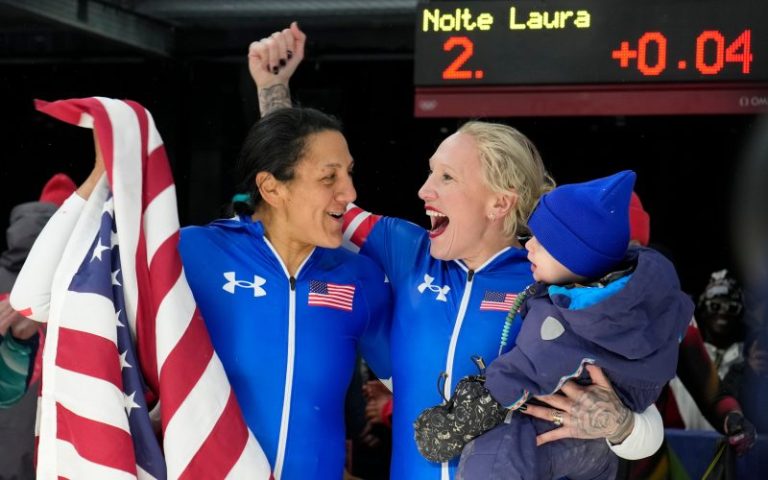
CORTINA D’AMPEZZO, Italy — Elana Meyers Taylor’s boys are too young to realize that mom is an Olympic champion. Kaillie Armbruster Humphries’ son just wanted to play in the snow around the medals podium where his mom had just stood.

But every woman who’s ever tried to juggle motherhood and a career, who’s felt as if she’s giving everything she’s got and more and still coming up short, they’ll know. And Meyers Taylor and Armbruster Humphries hope they’ll see a little of themselves in the two women on that Olympic podium.

“I hope it shows that just because you’re a mom doesn’t mean you have to stop living your dreams,” said Meyers Taylor, who finally got the Olympic gold medal she has so long sought by winning the monobob on Monday, Feb. 16, finishing ahead of Germany’s Laura Nolte and Armbruster Humphries.

The standards for any woman are impossible. Add a family, in whatever fashion it is, and it gets exponentially more difficult. Add getting older, in a society that considers women over the hill before they’re eligible to run for president, and you might as well be scaling the mountain on which the Milano Cortina bobsled track is located.

Meyers Taylor and Armbruster Humphries have felt that. Have felt all that.

Two nights ago was the first time Armbruster Humphries had been apart from her son since he was born and it gutted her. She knew she needed rest – she is competing in the Olympics, after all – and she wouldn’t get it with a toddler who still wakes up in the middle of the night.

That didn’t make it any easier.

“My husband is here, my parents are here, my in-laws are here. So I knew he was in really good hands,” Armbruster Humphries said. “So for me, it’s compartmentalizing probably more than anything. Recognizing that mom guilt is a thing and it existed, but that I needed to do it in order to be my best.”

Meyers Taylor and Armbruster Humphries are the first to acknowledge they are not doing it alone. They both have husbands who are supportive and, as former bobsledders, understand the grind. They have families who pitch in.

The U.S. Olympic and Paralympic Committee provides resources, financial and otherwise, for its athletes who are mothers, which isn’t something a lot of women can say.

But no one else can quiet the voice in her head that every working mother has. No one else can weigh the conflicting choices and decide what sacrifices are acceptable. No one else can tell them it’s OK when priorities change or give them permission to put themselves first.

“This medal is also for all those moms who weren’t necessarily able to live their dreams, but their kids are now their dreams,” Meyers Taylor said. “Because those people keep me grounded. Those people kept me going. And those people are the ones who reached out to me when things got hard and encouraged me to keep going.”

And as they stood atop the medals podium with their little boys watching, Meyers Taylor and Armbruster Humphries hoped they gave other moms that same type of encouragement.

It doesn’t matter if they are chasing Olympic medals or just trying to get through the day. These two badass women understand and empathize with the struggles because they face them, too.

“I hope that it inspires other people to go out and chase their dreams, whatever it may be,” Armbruster Humphries said. “I grew up in the sport when, if you have kids, once you get to 40, it’s all downhill. And Elana and I get to be proof that that’s not true.

“It might look different then when you’re 20, but it doesn’t mean that you can’t stand on top of the podium. It doesn’t mean you can’t go out there and achieve your dreams.”

It’s not easy, this juggling act. But for everyone who does it, those Olympic medals around the necks of Meyers Taylor and Armbruster Humphries are for you, too.

Follow USA TODAY Sports columnist Nancy Armour on social media @nrarmour.

This post appeared first on USA TODAY

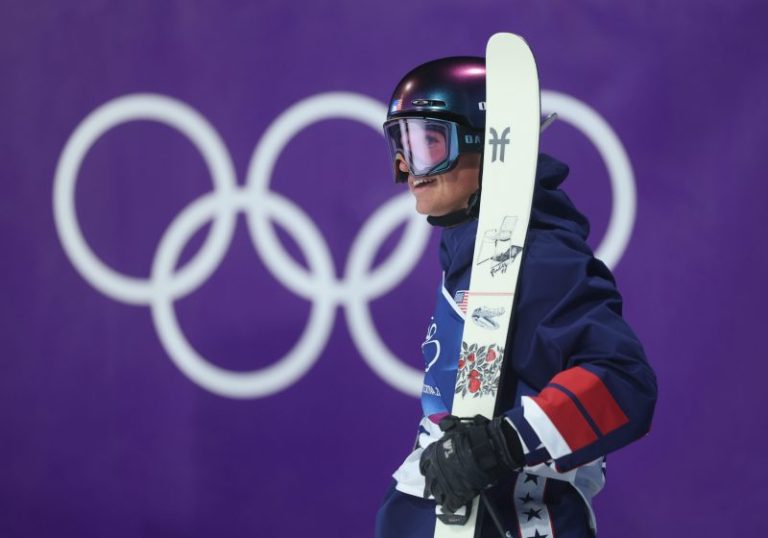
LIVIGNO, Italy — Mac Forehand’s first two jumps were so good that he could take it easy on his third and still win the evening.

Two other Americans – Troy Podmilsak and Konnor Ralph – scored well enough to advance, too, and all three are promising to come out swinging with bigger and better tricks in the final at the 2026 Winter Olympics.

Yeah, Feb. 15 was a good night for Team USA in the men’s freestyle skiing big air qualifying.

“I don’t want to jinx them,” said teammate Alex Hall, “but I think we are going to get at least one or two medals in the big air. They are riding so good. It’s so fun to watch.”

One quarter of freeski big air’s 12-man Olympic final on Feb. 17 will be comprised of Americans who’d already competed in these Games in slopestyle.

Same goes for the men’s slopestyle snowboarding qualifying final on Feb. 18. Three USA riders qualified – also on Feb. 15 – for that final. Ollie Martin, Jake Canter and Red Gerard were in the big air previously in snowboarding.

So what does slopestyle have to do with big air? That seems a popular question.

Qualifying Olympians in snowboarding and freestyle skiing are automatically added – or forced, you might also say – to compete in both slopestyle and big air. There is a systematic connection between these two events despite clear differences. Slopestyle is contested on a longer course with rails and various jumps. Big air is just one jump off an enormous ramp. It’s kind of like traditional ski jumping, except athletes perform acrobatic tricks before landing.

It is entertaining. It’s more dangerous, too.

As such, it’s generally viewed as better to have slopestyle scheduled first in an Olympics, because you aren’t risking injury as much in slopestyle, whereas an injury in big air – if it’s up first – could impact both events.

Freestyle skiing got the benefit of having slopestyle first in these Olympics, while snowboarding did not.

Hall, who won silver in freeski slopestyle earlier in these Olympics, was the lone American not to make it out of the Feb. 15 big air qualifying.

“I just love slopestyle way more, honestly,” Hall said. “… Not that one is more impressive than the other, but this is like going to war. You’ve just got to survive and do the craziest trick you can ever think of, where slopestyle is a lot about finesse and figuring out a run.”

Gerard, a former gold-medalist in snowboarding slopestyle, was critical earlier this Olympics of a format that makes him compete in both events when “I’m not a fan of big air at all,” he said. “… If I wasn’t forced to do (big air), I wouldn’t do it.”

While others haven’t voiced it as strongly, many seem to agree with Gerard and Hall. They’d lean toward a preference for slopestyle, even if they’ve performed well in big air.

“I definitely like slopestyle more,” said snowboarder Martin, who nearly medaled in big air earlier in these Olympics. “It just feels safer. You’re able to have a run going. It’s more creative.”

Canadian snowboarder Mark McMorris, a three-time bronze medalist in slopestyle, was injured during big-air training leading up to these Olympics, causing him to miss that event. He was fortunate to be able to return for slopestyle, and he has qualified for that final.

“The last two Olympics since (big air) has been added,” McMorris said, “it’s been slopestyle into big air (for snowboarding). Big air is pretty dangerous. So I definitely preferred the other way around. …

“Big air can take names. Including myself.”

With the slopestyle already out of the way in freestyle skiing, an American like Forehand said he took advantage of a bit more freedom for risks in big air.

By scoring 93.25 in his first jump and 89.75 in his second, Forehand placed first in qualifying with a 183.00 total. He is a strong contender for a medal in the big air final, and he’s not alone among Team USA.

“I’d prefer, I think, big air second, honestly,” Forehand said. “We did big air first in Beijing. I feel like you can go into big air kind of in a gung-ho attitude, like do whatever you want. You don’t have to worry about getting hurt for slopestyle.”

This post appeared first on USA TODAY

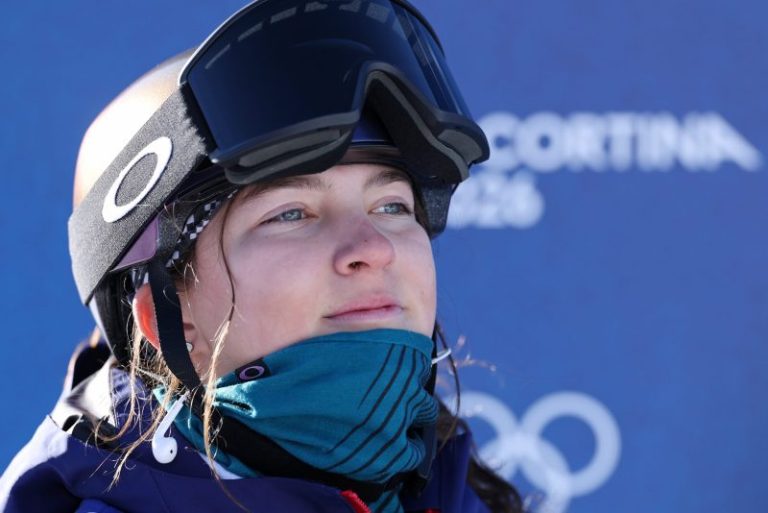
LIVIGNO, Italy — When Team USA snowboarder Jess Perlmutter gets finished chasing medals in Italy, she’ll have homework to do.

A lot of homework.

“I had like 42 assignments missing, like last week,” Perlmutter said with a laugh. “Which is really bad. I’m usually a good student and only have like a few missing.”

Perlmutter and teammate Lily Dhawornvej will compete Feb. 17 in a final at the 2026 Winter Olympics. Each qualified Feb. 15 by finishing the top 12 of the women’s slopestyle qualifying at Livigno Sports Park, which was a heck of an achievement considering this fact:

Both are only 16 years old.

In snowboarding and freestyle skiing, that’s not too young to represent the United States in an Olympics. And particularly these Olympics. Some of brightest rising stars in Livigno have been high school aged kids. On the men’s side, 17-year-old Americans Ollie Martin (big air/slopestyle) and Alessandro Barbieri (halfpipe) have each impressed.

“We’re young,” Perlmutter said, “but it’s a pretty young sport.”

Indeed. Ten of the 30 riders in the women’s slopestyle qualifying, including Perlmutter and Dhawornvej, weren’t born before 2007. Sky Remans, who competed for Belgium, won’t turn 16 until October.

Obvious question: What are these kids doing for high school?

Answer: The majority are taking online classes that offer the flexibility to complete course work on their own timeframes while competing globally.

“My schedule just got pretty busy,” said Dhawornvej, of Colorado. “I wasn’t really home that much. Online is definitely the move. … It’s pretty hard. I’m not going to lie. I’m pretty behind on a lot of my schoolwork. But I do online school, so I can snowboard and just do it online whenever I have time.”

Freestyle skier Avery Krumme, 17, reached the finals of the slopestyle at this Olympics, finishing 11th. She is a native Canadian who chose to compete for the United States, and she does “online school through my local high school,” she said.

“My teachers are really kind,” Krumme said. “They sort of let me go slow, because they understand this takes up a lot of my time and effort, and just everything goes into my skiing and training for it. So they understand. I’ll hopefully graduate this June. We’re working up to that.”

Perlmutter, who’s originally from New Jersey, attends the Killington Mountain School in Vermont, a school geared toward helping winter sports athletes “pursue excellence on the slopes and in the classroom,” reads the school’s website.

“It’s not fully online,” Perlmutter said. “I can go in there whenever I want and do school, just like a normal school. But, yeah, I just do it from remote. … Especially at this level, pretty much everyone, if they are doing school, they are doing online or a special program or something.”

And about those missing assignments?

“Honestly,” Perlmutter said, “I’ll just tell my teachers that I’m at the Olympics.”

This post appeared first on USA TODAY

The playoff picture is coming into view across NCAA women’s hockey as the final week of the season approaches. 

It also means the top programs in the nation are in their final week without Olympians on their rosters. There are only two games left in Milan, Italy, with Team USA and Canada facing off in Thursday’s gold medal game, while Sweden and Switzerland face off for bronze.

This month, with many stars overseas, some players have also stepped forward individually, bolstering their 2026 PWHL Draft status.

This week, Princeton was the biggest faller, while several programs took small steps forward.

Here’s a look at the top 10 NCAA women’s hockey programs this week:

Women’s college hockey power rankings

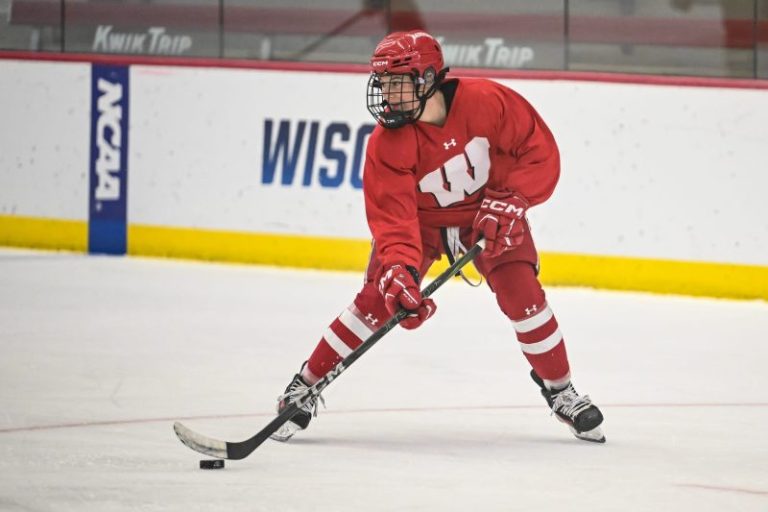
1. Wisconsin (WCHA)

Wisconsin got an unexpected boost this weekend with the return of fifth-year forward Marianne Picard, who came back in time to finish her career with the Badgers from a leg injury that originally looked like it would end her season. She collided with a goal post and missed seven games. Lacey Eden, meanwhile, continued to climb the national scoring charts with a four-point weekend as the Badgers swept Minnesota State. Eden now sits only one point behind Abbey Murphy, who’s at the Olympics.

2. Ohio State (WCHA)

Ohio State had an impressive weekend, beating Minnesota 4-2 and 3-1. Rookie Maxine Cimoroni had two goals and two assists, while captain Jocelyn Amos had another strong weekend for the Buckeyes, helping to power their two-way game. Goaltender Hailey MacLeod has looked better facing more shots in recent weeks, but Ohio State’s crease remains its biggest question mark heading to the playoffs.

3. Minnesota (WCHA)

A pair of hard-fought losses to Ohio State were difficult for the Gophers. The return of Abbey Murphy, Nelli Laitinen, Josefin Bouveng, and Tereza Plosova from the Olympic Games can’t come soon enough for the Gophers, which managed only two goals this past weekend. Chloe Primerano scored her ninth goal and 24th point, tying her for 11th in the NCAA among defenders in scoring.

4. Quinnipiac (ECAC)

Quinnipiac beat Brown 5-2 and Yale 4-3 in overtime. As she has all season, Kahlen Lamarche continued to produce, with three goals and four points combined in those games. She now has 35 goals in 34 games this season, which has her tied for second among the NCAA’s top goal-scorers. With Team Canada looking for an influx of youth, Lamarche has thrust herself into that conversation this season.

5. Penn State (AHA)

Losing 3-2 in overtime to RIT to open its weekend won’t instill confidence in Penn State as a nationally ranked team in anyone. They remain so high because of a weak schedule. This is a significantly different team without Tessa Janecke, Matilde Fantin and Nicole Hall, who all advanced to the Olympic quarterfinals, with Janecke and Hall set to play for a medal.

5. Northeastern (Hockey East)

It was like another Beanpot weekend with Northeastern playing two other Boston schools. They beat Boston University, but were then shut out by Boston College. Northeastern’s youth have had to do a lot of lifting up front recently, and it’s come with some bumps. Defender Jules Constantinople is climbing the PWHL draft charts with her second-half play.

7. Yale (ECAC)

An overtime loss to Quinnipiac and a shutout win over Princeton made this another good weekend for Yale, which is peaking at the right time. They did squander a two-goal lead in the final 1:02 against Quinnipiac, but they carried that lead for most of the match against the Bobcats and also shut down one of the top lines in the nation with Princeton.

8. UConn (Hockey East)

UConn handled Boston University and New Hampshire with ease this weekend. With Tia Chan in net, the Huskies can beat anyone on any given night. While it could be a concern with other programs, UConn doesn’t have one player it relies on offensively. They certainly have players who score more than others and help drive possession, but this team thrives when the attack is spread out.

9. Cornell (ECAC)

Cornell beat St. Lawrence in overtime and Clarkson this past weekend. It was a good test for Cornell, which won a pair of hard-fought one-goal games. Annelies Bergmann continues to be one of the best goaltenders in college hockey, making 64 saves over the weekend. She has a 1.83 goals-against average, .931 save percentage and seven shutouts through 30 games.

10. Princeton (ECAC)

Something didn’t click for Princeton this past weekend. They opened their weekend with a shutout loss to Yale, then had Brown take them to overtime. Issy Wunder is a superstar in NCAA women’s hockey and a top prospect for the 2026 PWHL Draft, but she can’t be Princeton’s only weapon if this team wants to win.

This post appeared first on USA TODAY

CORTINA D’AMPEZZO, Italy — Lindsey Vonn is back in the United States after she suffered a complex tibia fracture at the 2026 Winter Olympics, she announced on social media on Tuesday, Feb. 17.

‘Haven’t stood on my feet in over a week…,’ Vonn wrote in a post on X, formerly known as Twitter. ‘been in a hospital bed immobile since my race. And although I’m not yet able to stand, being back on home soil feels amazing.’

What happened to Lindsey Vonn?

Vonn hooked the fourth gate with her right arm, which sent her spinning and hurtling into the hard, packed snow. She tumbled end over end several times before coming to a stop.

‘Things just happen so quick in this sport,’ U.S. teammate Bella Wright said after the race. ‘It looked like Lindsey had incredible speed out of that turn, and she hooked her arm and it’s just over just like that.’

The three-time Olympic medalist remained prone in the snow, and she could be heard wailing in pain. The gasps and groans from fans faded into shocked silence as medics worked on her. Vonn remained on the course for approximately 13 minutes before being loaded into a helicopter.

What is Lindsey Vonn’s injury?

In an Instagram post on Feb. 9, Vonn shared the devastating news that she suffered a complex tibia fracture that will require multiple surgeries. The 41-year-old updated fans on Feb. 11 after a third surgery in Italy and included some gruseome photos of her progress. On Feb. 14, Vonn posted after her third surgery that she still has more procedures ahead of her, but was finally able to return to the United States.

‘Once I’m back I will give you more updates and info about my injury,’ Vonn wrote.

A tibia fracture is a break in the shin bone that is an emergency needing immediate treatment. ‘Your tibias are some of the strongest bones in your body. It usually takes a lot of force to break one,’ according to the Cleveland Clinic. ‘You probably won’t be able to stand, walk or put weight on your leg if you have a broken shin bone.’

A complex fracture involves multiple breaks in a bone and damaged soft tissue, according Yale Medicine. Symptoms include extreme pain, numbness and, sometimes, a bone that protrudes through the skin. Treatment involves stabilization and surgery.

Lindsey Vonn crash video

NBC broadcasts the Olympics and posted video of Vonn’s crash.

USA TODAY Sports’ Samantha Cardona-Norberg breaks down Linsdey Vonn’s crash just after it happened.

Fans went silent as soon as Vonn crash, reacting with shock, grief and later support as the helicopter lifted her into the sky. USA TODAY Sports talked to some fans after the crash .

Is Lindsey Vonn OK?

Vonn was in obvious pain after the crash, but she was moving her arms, head and neck.

About 18 minutes after the crash, the helicopter slowly began flying toward Cortina. ‘Let’s let Lindsey Vonn hear us!’ the American announcer said as the chopper flew away with her, and the crowd cheered and applauded.

Vonn’s sister Karin Kildow was at the course today for the downhill and spoke to NBC reporters during their live broadcast:

‘I mean that definitely was the last thing we wanted to see and it happened quick and when that happens, you’re just immediately hoping she’s okay. And it was scary because when you start to see the stretchers being put out, it’s not a good sign,’ Kildow said. ‘But she really … She just dared greatly and she put it all out there. So it’s really hard to see, but we just really hope she’s okay.

‘She does have all of her surgeons and her PT staff here and her doctors, so I’m sure they’ll give us a report and we’ll meet her at whatever hospital she’s at.’

Lindsey Vonn torn ACL

It was second time in as many weeks Vonn left a mountaintop on a chopper. She fully ruptured her left ACL, sustaining meniscus damage and bone bruising, in a downhill crash on Jan. 30, in the final World Cup event prior to the start of the Olympics.

Vonn is also skiing with a partial replacement of her right knee. She had dominated the sport before the crash, making the podium in all five downhill races this season and winning two of them.

Despite the latest injury, Vonn was determined to race at her fifth and final Olympics. She said her knee felt stable and strong, and she had spent the last week doing intense rehab, pool workouts, weight lifting and plyometrics. She skied both training runs, posting the third-fastest time in the second run before it was canceled because of fog and snow.

Lindsey Vonn torn ACL

Vonn is 41 and was skiing in her fifth Winter Olympics (2002, 2006, 2010, 2018, 2026). She has won three Olympic medals (1 gold, 2 bronze).

This post appeared first on USA TODAY

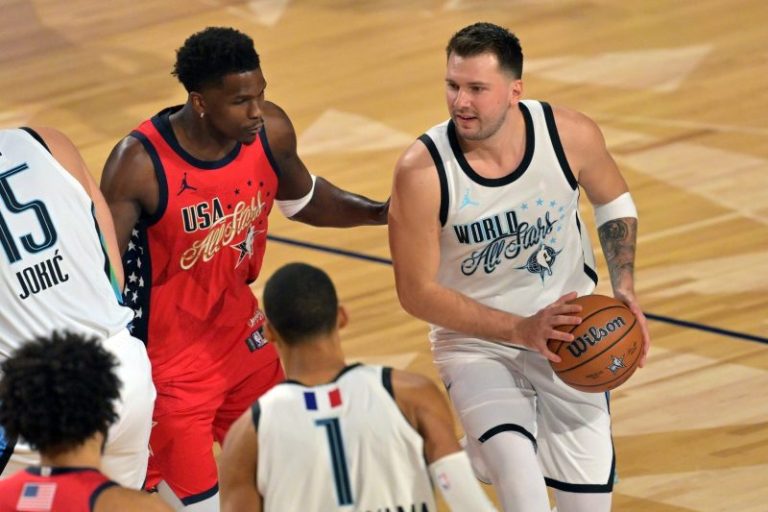
Anthony Edwards furthered his case to be the face of the NBA after securing the All-Star Game MVP at the Intuit Dome in Inglewood, California, on Sunday, Feb. 15.

The Minnesota Timberwolves star joined a list of ASG MVP winners that includes Kobe Bryant, Michael Jordan, Shaquille O’Neal and LeBron James. Each of those players spent time as the face of the league.

Edwards produced 32 points during the three mini games he played in for Team Stars (USA) on Sunday.

The league introduced a new format for the All-Star Game this year with three teams, two consisting of American players and a World team that featured players with international ties, playing each other in a small tournament to determine which two teams would meet in the championship game.

Edwards has acknowledged the potential of being the face of the league, but it isn’t something he’s necessarily chasing.

‘It isn’t something I’m out here shooting for, if it happens, it happens,” Edwards told NBA TV after the game. “I’m not somebody like ‘oh I’m trying to be the face of the league,’ but if it happens, it happens.’

Edwards did not shy away when pointing out that some of the NBA’s best players saw minimal action on Sunday.

‘No shade towards Luka (Doncic) and (Nikola) Jokić, but like they are two of the best players in the league, they’re not trying to play in the All-Star Game,’ Edwards said during an interview on NBA TV.

Nikola Jokić saw limited action, playing just over five minutes during the first game, collecting two defensive rebounds and shooting 0-for-1 from the field. He had not been listed on the Denver Nuggets’ injury report but was diagnosed with a hyperextended left knee injury in December that caused him to miss 16 games.

Luka Doncic also played just over five minutes for Team World, shooting 1-of-3 from the field (0-for-2 from the 3-point line) with two assists. Doncic suffered a left hamstring strain on Feb. 5 and missed four consecutive games for the Los Angeles Lakers.

Milwaukee Bucks forward Giannis Antetokounmpo (right calf strain) and Oklahoma City Thunder guard Shai Gilgeous-Alexander (abdominal strain) did not play for Team World due to injuries.

Anthony Edwards career stats

Anthony Edwards has averaged 24.5 points, 5.3 rebounds and 4.1 assists per game in 427 NBA games played.

This post appeared first on USA TODAY

MILAN — For most of the 21st century, U.S. pairs figure skating has been an afterthought. 

While the men, women and ice dance sent three representatives in their respective disciplines, it became the norm to just send two pairs. Even then, they weren’t really medal favorites. It was never something Team USA boasted. 

But things appear to be changing in the right direction.

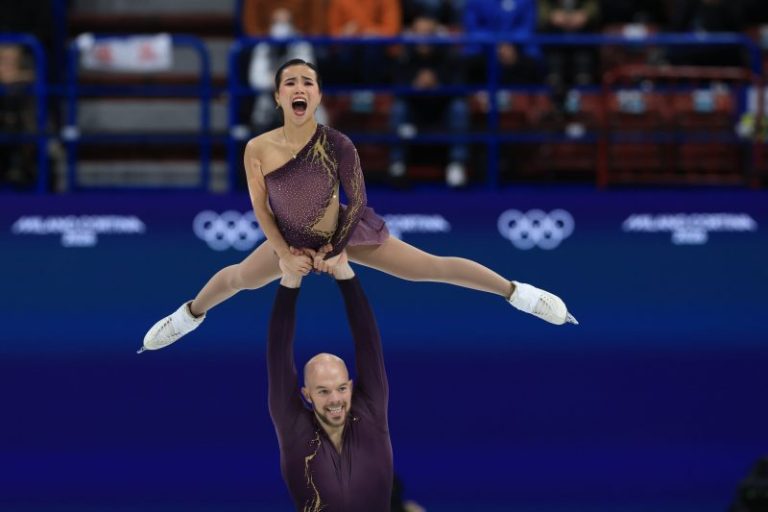
While not quiet podium contenders, the teams of Ellie Kam and Danny O’Shea with Emily Chan and Spencer Akira Howe showed the American pairs division is on the rise, starting the short program on a strong note to set up what could be a milestone finish.

Team USA’s night on Sunday, Feb. 15 began with a team that technically got in thanks to some lucky breaks. National champions Alisa Efimova and Misha Mitrofanov, as well as third-place finishers Katie McBeath and Daniil Parkman, couldn’t qualify for the Olympics due to citizenship issues, opening the door for the fourth-place finishers in Chan and Howe.

It was at the U.S. figure skating championships where the two had a rough short program, riddled with mistakes that almost took them out of Olympic contention immediately. Clearly, a month of preparation helped. 

There was a night-and-day difference in their performance, highlighted by a dazzling triple toe loop. Even better, no mess-ups.

“It was a bit of a sigh of relief and just excitement,” Chan said of her reaction when the program was finished. “We really went out there and we were together, and we experienced that whole entire program together. I just felt on the top of the mountain.”

Chan and Howe earned a score of 70.06, more than 10 points of what they got in the same program one month ago. It earned praise from 2006 ice dance medalist Ben Agosto, telling the crowd inside Milano Ice Skating Arena it was the “best I’ve seen them in a long time.”

“A big goal has always just been getting out there and feeling good, because if you can feel good, then you have your best chances of delivering what you need to do,” Howe said. “I just felt really laser focused out there.”

That set it up for the team event’s unsung heroes. After playing a critical role in the U.S. winning gold, Kam and O’Shea rode the wave from a week ago. However, the short program in the team event was tough since Kam fell on the throw triple loop. 

Since winning gold, they spent time away from the Olympic Village to pull the emotions together, but keep the good vibes going.

This time around, there was no hitting the ice. Kam was able to keep her balance on the throw, proof their plan worked.

“It feels like we were able to keep all the good momentum and the good things that we wanted to take from the team event and leave all the rest that we didn’t need behind,” she said.

Despite some minor self-inflicted mistakes from O’Shea, the pair didn’t just get a better score than the team event. They got a season-best 71.87.

“We definitely had a little more jitters,” O’Shea recalled of their first outing. “Since then, we’ve been able to settle in and really reframe and refocus on having the time of our lives. 

“The performance itself is something we’re really proud of,” he added. “We stayed on our feet, got rid of those bigger mistakes and got a season’s best.”

Improvement in US figure skating pairs

Heading into the free skate, Kam and O’Shea are in seventh place with Chan and Howe in ninth. It may not seem impressive, but it marks quite the accomplishment. With the 2022 Games, the U.S. has now had two pairs in the top 10 of the standings after the short program in back-to-back Olympics for the first time in the 21st century.

O’Shea credited Alexa Knierim and Brandon Frazier, whose sixth place finish in 2022 was Team USA’s best since 2002, for opening the door for improvement in the category, and frankly, the reason he and Kam are now partners.

“We’re only getting better,” she said.

Now, the U.S. can complete it in the free dance by having two top 10 finishers in back-to-back Olympics for the first time this century. It’s nothing to brag about, but it shows there’s an upward trend for a discipline that’s been desperately looking for one for decades.

Will either team snap the skid and be the first American pair to win an Olympic medal since 1988? Not likely, but given how unpredictable figure skating has gone in Milano Cortina, including in the pairs, nothing can be entirely ruled out.

Medal or not, the two teams are proving there’s a resurgence in pairs, and it may be a few Olympics away from finally standing on that podium once again.

“I’m so proud of what the pairs in the US have been doing,” O’Shea said. “We really hope to keep that tradition going.”

This post appeared first on USA TODAY

While the world’s attention is naturally on the Olympics right now, the NCAA men’s hockey season is getting into the stretch run. Oh, and there is one current college player in Milano, as Minnesota-Duluth’s Adam Gajan, the Chicago Blackhawks prospect, is on Team Slovakia. Gajan hasn’t seen any action in the Olympics yet and there’s a very good chance he won’t get between the pipes at all, but just the fact he’s around this atmosphere and practicing with NHLers such as Juraj Slafkovsky and Simon Nemec is great experience for the youngster.

In the meantime, Boston College won the Beanpot earlier this week, defeating their archrivals from Boston University to claim the famed city-wide trophy. With Team USA’s Olympic squad featuring Eagles alum such as Matt Boldy and Noah Hanifin and former Terriers such as Jack Eichel, Brady Tkachuk and Charlie McAvoy, I’m going to assume it came up once or twice in the dressing room this week. Now let’s get to the rankings.

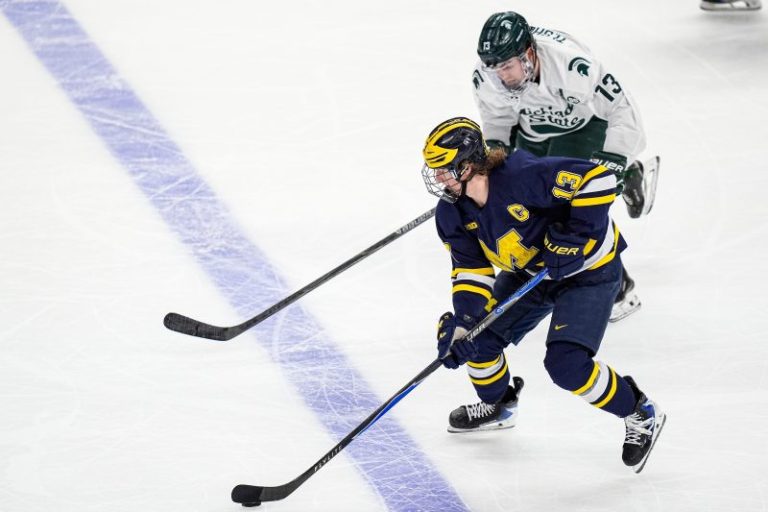
1. Michigan Wolverines (24-5-1)

Taking on a rested Penn State squad, the Wolverines came away with two more wins, though the first contest did go to a shootout. Nonetheless, Michigan continues to dominate the NCAA rankings. Free agent T.J. Hughes is still the top scorer on the team, while goalie Jack Ivankovic (NSH) is finding his range again after returning from injury.

2. Michigan State Spartans (22-6-0)

The Spartans had the weekend off, but remain in second spot based on their overall season. Michigan State’s final games of the regular season are against the three weakest teams in the Big Ten (Ohio State, Notre Dame and Minnesota), so they could run the table. Trey Augustine (DET) remains hot in net with a 1.96 goals-against average.

3. North Dakota Fighting Hawks (23-7-0)

A sweep of Miami means the Hawks continue to roll in a deep, difficult conference. Defenseman Abram Wiebe (CGY) had a beauty overtime winner against the Redhawks, while even defensive blueliner E.J. Emery (NYR) found the scoreboard. Needless to say, NoDak is a team that can beat you from all angles.

4. Western Michigan Broncos (22-8-0)

The Broncos blasted Arizona State over the weekend by a combined score of 13-4. That means they’ve still only lost two games since the calendar flipped over to 2026 and after an uneven start to the campaign, the defending national champions seem to be rounding into form at the right time. Junior Grant Slukynsky leads the offense with 33 points in 30 games.

5. Quinnipiac Bobcats (24-5-3)

While the Bobcats are still paced by scoring machine Ethan Wyttenbach (CGY), they’re not a one-man team by any means. Freshmen Antonin Verreault and Marcus Vidicek, both of whom came from the major junior ranks, have also been solid contributors to a team that is really looking dangerous this season.

6. Denver Pioneers (19-11-3)

Sweeping Omaha has the Pioneers continuing on the ascent and now Denver has just one regular-season series left, against Arizona State. Rieger Lorenz (MIN) has been red-hot with seven points in his past five games, while defenseman Eric Pohlkamp (SJ) still leads the team in overall scoring with 31 points in 33 games.

7. Providence College Friars (19-8-2)

Like Western Michigan, the Friars have lost only two games in 2026 – though one of them was this past weekend against a Northeastern team that has been dangerous. Providence has a decent lead atop Hockey East and with other programs exhibiting a lot of inconsistency, the Friars are in a good spot as the post-season nears.

8. Penn State Nittany Lions (18-9-1)

True, Penn State was swept by Michigan on the weekend – but at least they pushed one of the contests into the shootout. Gavin McKenna (2026 draft) was an obvious target for trolling by the Wolverines’ fans, but he did manage an assist. Reese Laubach (SJ) actually had a great weekend with four points against Michigan.

9. Boston College Eagles (17-10-1)

It feels like the Eagles are on the cusp of something, they just haven’t quite gotten over the hump so far this season. After winning the Beanpot (a big deal), they split with Merrimack this weekend, which is not ideal. On the positive side, freshman Oscar Hemming (2026) got his first NCAA goal and now has eight points in 12 games since joining the team midway through the year.

10. Connecticut Huskies (17-7-4)

The key to UConn’s success lately has been defense. The Huskies have given up just three goals total in their past three games – and they all came in a shootout win over Maine. Netminder Tyler Muszelik (FLA) can take a lot of the credit for that too, as he was the goalie of record in all of those matches.

This post appeared first on USA TODAY