
Author

admin

Browsing

NOT FOR DISTRIBUTION TO UNITED STATES NEWS WIRE SERVICES
OR FOR DISSEMINATION IN THE UNITED STATES

Osisko Metals Incorporated (the ‘ Company ‘ or ‘ Osisko Metals ‘) (TSX: OM,OTC:OMZNF; OTCQX: OMZNF; FRANKFURT: OB51) is pleased to announce that it expects to complete a non-brokered private placement with certain strategic investors for an aggregate of approximately 67,666,666 common shares of the Company (the ‘ Common Shares ‘) at an offering price of $0.48 per Common Share for aggregate gross proceeds to the Company of approximately $32,480,000 (the ‘ Private Placement ‘).

The Private Placement is expected to include subscriptions from certain strategic investors, including:

  • Hudbay Minerals Inc. : 29,166,666 Common Shares for gross proceeds of $14,000,000;
  • Agnico Eagle Mines Limited : has indicated that it intends to subscribe for 26,000,000 Common Shares for gross proceeds of $12,480,000 pursuant to an existing participation right;
  • Franco-Nevada Corporation : 4,166,667 Common Shares for gross proceeds of $2,000,000; and
  • A strategic institutional investor : 8,333,333 Common Shares for gross proceeds of $4,000,000.

The size of the Private Placement will depend on, among other things, certain contractual participation rights granted by the Company to Glencore Canada Corporation (the ‘ Glencore Participation Right ‘).

Osisko Metals CEO Robert Wares commented: We are pleased to welcome Hudbay Minerals as a new significant shareholder of Osisko Metals. We also appreciate the continued participation of Agnico Eagle and two of our existing principal and strategic shareholders. We view the participation in the private placement by these investors as support for the potential of the Gaspé Copper project and we look forward to continued support from these shareholders as we advance our project.

After giving effect to the Private Placement, but before giving effect to any other issuance of Common Shares (including pursuant to the Glencore Participation Right): (i) Hudbay Minerals Inc. (‘ Hudbay ‘) is expected to beneficially own or control 29,166,666 Common Shares, representing approximately 4.3% of the issued and outstanding Common Shares, calculated on a non-diluted basis; and (ii) Agnico Eagle Mines Limited (‘ Agnico ‘) is expected to beneficially own or control 87,815,000 Common Shares, representing an ownership interest in the Company equal to approximately 12.5% (calculated on a partially-diluted basis). As part of the Private Placement, the Company and Hudbay have agreed to enter into an investor rights agreement, pursuant to which Hudbay will be granted certain rights, including top-up rights and the right to participate in future offerings of securities of the Company upon Hudbay’s ownership interest increasing to 9.9% and, subject to certain minimum ownership thresholds and other conditions, the right to board representation.

The net proceeds of the Private Placement are expected to be used to advance the Company’s Gaspé Copper project (including drilling, permitting and technical studies) and for general corporate purposes. The Private Placement is expected to close on or about December 16, 2025, subject to the negotiation and execution of definitive agreements and the satisfaction of certain customary closing conditions therein, including the conditional approval of the Toronto Stock Exchange (the ‘ TSX ‘).

This news release does not constitute an offer to sell or a solicitation of an offer to buy any of the securities in the United States. The securities have not been and will not be registered under the U.S. Securities Act, or any state securities laws and may not be offered or sold within the United States or to or for the account or benefit of a U.S. person (as defined in Regulation S under the U.S. Securities Act) unless registered under the U.S. Securities Act and applicable state securities laws or an exemption from such registration is available.

About Osisko Metals

Osisko Metals Incorporated is a Canadian exploration and development company creating value in the critical metals sector, with a focus on copper and zinc. The Company acquired a 100% interest in its flagship project, the past-producing Gaspé Copper mine, from Glencore Canada Corporation in July 2023. The Gaspé Copper project is located near Murdochville in Québec’s Gaspé Peninsula. The Company is currently focused on resource expansion of the Gaspé Copper system, with current Indicated Mineral Resources of 824 Mt grading 0.34% CuEq and Inferred Mineral Resources of 670 Mt grading 0.38% CuEq (in compliance with NI 43-101). For more information, see Osisko Metals’ November 14, 2024 news release entitled ‘ Osisko Metals Announces Significant Increase in Mineral Resource at Gaspé Copper ‘. Gaspé Copper hosts the largest undeveloped copper resource in eastern North America, strategically located near existing infrastructure in the mining-friendly province of Québec.

In addition to the Gaspé Copper project, the Company is working with Appian Capital Advisory LLP, through the Pine Point Mining Limited joint venture, to advance one of Canada’s largest past-producing zinc mining camps, the Pine Point project, located in the Northwest Territories. The current mineral resource estimate for the Pine Point project consists of Indicated Mineral Resources of 49.5 Mt at 5.52% ZnEq and Inferred Mineral Resources of 8.3 Mt at 5.64% ZnEq (in compliance with NI 43-101). For more information, see Osisko Metals’ June 25, 2024 news release entitled ‘Osisko Metals releases Pine Point mineral resource estimate: 49.5 million tonnes of indicated resources at 5.52% ZnEq’ . The Pine Point project is located on the south shore of Great Slave Lake, Northwest Territories, close to infrastructure, with paved road access, an electrical substation and 100 kilometers of viable haul roads.

For further information on this news release, visit www.osiskometals.com or contact:

Don Njegovan, President
Email: info@osiskometals.com
Phone: (416) 500-4129

Cautionary Statement on Forward-Looking Information

This news release contains ‘forward-looking information’ within the meaning of applicable Canadian securities legislation based on expectations, estimates and projections as at the date of this news release. Any statement that involves predictions, expectations, interpretations, beliefs, plans projections, objectives, assumptions, future events or performance (often, but not always, using phrases such as ‘expects’ or ‘does not expect’, ‘is expected’, ‘interpreted’, ‘management’s view’, ‘anticipates’ or ‘does not anticipate’, ‘plans’, ‘budget’, ‘scheduled’, ‘forecasts’, ‘estimates’, ‘potential’, ‘feasibility’, ‘believes’ or ‘intends’ or variations of such words and phrases or stating that certain actions, events or results ‘may’ or ‘could’, ‘would’, ‘might’ or ‘will’ be taken, occur or be achieved) are not statements of historical fact and may be forward-looking information and are intended to identify forward-looking information. This news release contains forward-looking information pertaining to, among other things: the ability for the Company to complete the Private Placement on the terms contemplated (if at all); the size of the Private Placement; the expected ownership interest of certain participants in the Private Placement; the negotiation and execution of definitive agreements in connection with the Private Placement; the exercise of the participation rights by Agnico and Glencore Canada Corporation; the closing date of the Private Placement; the ability for the Company to obtain the conditional and final approval of the TSX; the anticipated use of proceeds of the Private Placement; the ability for the Company to unlock the full potential of its assets and achieve success; the ability for the Company to create value for its shareholders; the advancement of the Pine Point project; the anticipated resource expansion of the Gaspé Copper system; and Gaspé Copper hosting the largest undeveloped copper resource in eastern North America.

Forward-looking information is not a guarantee of future performance and is based upon a number of estimates and assumptions of management, in light of management’s experience and perception of trends, current conditions and expected developments, as well as other factors that management believes to be relevant and reasonable in the circumstances, including, without limitation, assumptions about: the ability of exploration results, including drilling, to accurately predict mineralization; errors in geological modelling; insufficient data; equity and debt capital markets; future spot prices of copper and zinc; the timing and results of exploration and drilling programs; the accuracy of mineral resource estimates; production costs; political and regulatory stability; the receipt of governmental and third party approvals; licenses and permits being received on favourable terms; sustained labour stability; stability in financial and capital markets; and availability of mining equipment and positive relations with local communities and groups. Forward-looking information involves risks, uncertainties and other factors that could cause actual events, results, performance, prospects and opportunities to differ materially from those expressed or implied by such forward-looking information. Factors that could cause actual results to differ materially from such forward-looking information are set out in the Company’s public disclosure record on SEDAR+ ( www.sedarplus.ca ) under Osisko Metals’ issuer profile. Although the Company believes that the assumptions and factors used in preparing the forward-looking information in this news release are reasonable, undue reliance should not be placed on such information, which only applies as of the date of this news release, and no assurance can be given that such events will occur in the disclosed time frames or at all. The Company disclaims any intention or obligation to update or revise any forward-looking information, whether as a result of new information, future events or otherwise, other than as required by law.

News Provided by GlobeNewswire via QuoteMedia

This post appeared first on investingnews.com

(TheNewswire)

Additional Financing Closes

NOT FOR DISTRIBUTION TO UNITED STATES NEWS WIRE SERVICES OR FOR DISSEMINATION IN THE UNITED STATES

Vancouver, British Columbia TheNewswire – December 3rd, 2025 Prismo Metals Inc. (‘ Prismo ‘ or the ‘ Company ‘) (CSE: PRIZ,OTC:PMOMF) (OTCQB: PMOMF) is pleased to announce it has received assay results for samples recently taken at the Silver King Project from two exploration targets located on the east side of the property, namely the Black Diamond replacement target and the newly named Crown porphyry intrusion target (Fig. 1).

Figure 1 .  Map showing the location of the Black Diamond replacement and Crown porphyry intrusion exploration targets at the Silver King project.  Claim boundaries are shown in yellow.

The assays show high grade copper mineralization present at Black Diamond (Fig 1). The rock chip samples yielded generally high copper assays with several samples analyzing in excess of 1 % Cu and two samples in excess of 5 % Cu (Table 1, Fig. 2).  Gold is generally anomalous for the Black Diamond samples.

Rock chip samples from the Crown porphyry intrusion generally exhibited lead and zinc values with elevated silver and low copper and gold (Table 2).  Importantly, however, two samples of vein material from the stockwork target yielded high gold values of 4 and 5 g/t (Fig. 2). The mineralization in the stockwork veining at Crown provides impetus to complete additional exploration in the area.

Table 1. Assay results for samples from the Black Diamond replacement target.

Sample

Location

Easting

Northing

Width m

Au g/t

Ag g/t

Cu %

Pb %

Zn %

544572

Black Diamond

492601

3687624

1.5

0.007

0.30

0.18

0.009

0.02

544573

Black Diamond

492601

3687625

1.5

0.052

0.34

0.29

0.013

0.03

544574

Black Diamond

492603

3687623

1.5

0.008

0.47

0.12

0.009

0.02

544575

Historic adit 3

492642

3687624

0.5

1.08

0.15

5.56

0.013

0.03

544576

Historic adit 3

492641

3687625

0.5

0.045

1.08

0.44

0.022

0.02

544577

Historic adit 3

492643

3687621

1.0

0.012

0.76

0.07

0.014

0.02

544578

Historic adit 1

492670

3687639

0.8

0.285

12.43

6.02

0.01

544581

Historic adit 1

492672

3687640

1.1

0.125

10.5

1.14

0.011

0.02

544582

Historic adit 1

492667

3687640

1.4

0.285

6.66

2.63

0.006

0.02

544583

Black Diamond

492678

3687626

0.5

0.034

2.18

0.15

0.009

0.02

544584

Historic adit 2

492670

3687625

0.5

0.35

7.99

1.24

0.006

0.01

544585

Historic adit 2

492679

3687628

0.5

0.125

8.87

0.45

0.013

0.02

544586

Historic adit 2

492672

3687638

1.0

0.053

8.97

1.42

0.013

0.02

Table 2 . Assay results for samples from the Crown porphyry intrusive target.

Sample

Location

Easting

Northing

Width m

Au g/t

Ag g/t

Cu %

Pb %

Zn %

544566

Crown

492633

3687859

1.5

0.008

3.7

0.005

0.03

0.04

544567

Crown

492805

3687910

1.3

0.011

1.3

0.006

0.01

544568

Crown

492803

3687910

2.0

0.006

1.28

0.008

0.03

0.03

544569

Crown

492836

3687898

1.0

0.012

0.25

0.008

544570

Crown

492499

3687669

1.0

0.011

2.31

0.035

0.07

0.09

544571

Crown

492534

3687657

0.5

0.016

2.65

0.002

0.09

0.03

544588

Crown

492737

3687901

2.5

0.015

2.76

0.005

0.01

0.01

544589

Crown

492746

3687884

1.0

0.022

4.21

0.010

0.03

0.02

544590

Crown

492763

3687867

0.5

0.07

11.26

0.013

0.05

0.11

544591

Crown

492799

3687851

1.0

5.19

46.44

0.048

0.21

0.06

544592

Crown

492793

3687823

1.0

4.06

13.97

0.021

0.10

0.07

544593

Crown

492701

3687858

1.5

0.027

1.0

0.011

0.03

0.04


Click Image To View Full Size

Figure 2. Copper assays and high gold values for samples mentioned from the Black Diamond
and Crown areas at Silver King.

IP Survey Update

The Company also has received the report for initial phase of its IP survey at Silver King.  The IP survey consisted of a gradient array to test for resistivity and chargeability anomalies at a depth of about 300m below the surface.

The IP survey shows low resistivity lows associated with the Black Diamond replacement body as well as the stratigraphically controlled Cu bearing replacements that extend toward the nearby Magma mine (Fig. 3).  A second nearly east-west trending resistivity low occurs in the central portion of the claim block and coincides with a hypothesized structure that may control the Black Diamond body and also may be important in the formation of the Silver King deposit.  This type of structure is similar to the Magma vein, the main mineralized structure at the high-grade Magma mine, and is a prime exploration target.

The IP survey also shows several chargeability anomalies that are presumably associated with disseminated sulfides, largely pyrite (Fig. 4).  The stockwork intrusion mentioned previously is associated with one of these chargeability anomalies and provides a second important exploration target with characteristics similar to mineralization at high structural levels in porphyry systems.  A second similar chargeability anomaly occurs nearby to the southwest in an area overlain by a mostly barren quartz diorite intrusive and may represent a similar blind porphyry target.

Based on the results of the initial IP survey, a follow-up pole-dipole survey to further define the anomalies from shallow to deeper levels along section lines is planned to be conducted in December.

Figure 3. IP resistivity map showing exploration targets: yellow line-Silver King glory hole,
magenta line-polymetallic vein, green line-copper vein, red outlines-Black Diamond replacement
body and stratigraphically controlled replacement horizons, black outline-stockwork intrusion.

Figure 4. IP chargeability map showing exploration targets: yellow line-Silver King glory hole,
magenta line-polymetallic vein, green line-copper vein, red outlines-Black Diamond replacement
body and stratigraphically controlled replacement horizons, black outline-stockwork intrusion.

Drilling Update

Alain Lambert, CEO of Prismo commented: ‘The results announced today confirm the vast exploration potential at Silver King. While we look forward to drilling these new targets in the future, our plans remain unchanged. Our immediate priority is to undertake our fully funded drill program, as previously announced. This drill campaign will focus primarily on the historic Silver King mine site and will be for a minimum of about 1,000 meters. The objective is to test the upper half of the steeply dipping pipelike Silver King mineralized body as well as potential mineralization adjacent to the dense stockwork that was the focus of historic mining.’

Mr. Lambert added: ‘We are pleased with the steady progress on the permitting front. The collaboration of Forest Service officials demonstrates a clear commitment to supporting mining activities in Arizona.’

Prismo recently announced that the Forest Service, the federal surface land management entity for Silver King, had determined that the Company’s proposed drill plan meets the regulatory requirements for processing, and that such plan is complete, as described in the regulations at 36 CFR 228.4(c).

The Forest Service will now proceed with the environmental analysis pursuant to 36 CFR 228(a)(5) in conformity with the National Environmental Policy Act (NEPA). This analysis will proceed as a Categorical Exclusion, the lowest level of environment reviews applicable to projects that are not expected to have a significant effect on the environment, such as Silver King.

Financing Update

Prismo also announced that further to its news releases dated October 20, 2025 and November 13, 2025, the Company has proceeded with an upsized second closing of its previously announced non-brokered private placement of units of the Company (‘ Units ‘) at an issue price of $0.10 per Unit (the ‘ Private Placement ‘). The second closing of the Private Placement was increased from 1,250,000 Units to the issuance of 1,650,000 Units for gross proceeds of $165,000 (the ‘ Second Tranche ‘). The Company previously announced a first closing of the Private Placement on November 12, 2025 for aggregate gross proceeds of $1,745,000. Due to strong investor demand, the Company has now raised aggregate gross proceeds of $1,910,000.

Each Unit consists of one common share in the capital of the Company (a ‘ Share ‘) and one common share purchase warrant of the Company (a ‘ Warrant ‘). Each Warrant entitles the holder to purchase one Share for a period of thirty-six (36) months from the date of issue at an exercise price of $0.175.

The Company intends to use the net proceeds of the Private Placement primarily for drilling at its Silver King project and for general corporate purposes. The Company expects to accept additional subscriptions of units in the coming days for an approximate amount of $125,000.

The Units issued pursuant to the Second Tranche are subject to a four-month hold period from the closing date of the Second Tranche under applicable Canadian securities laws, in addition to such other restrictions as may apply under applicable securities laws of jurisdictions outside Canada.

In connection with the Second Tranche, the Company issued an aggregate of 68,000 finder’s warrants (the ‘Finder’s Warrants’ ) and paid finder’s commissions of $6,800 to a certain qualified finder. Each Finder’s Warrant is exercisable for a period of twenty-four (24) months from the date of issuance to purchase one Share at a price of $0.10. In addition, the Company paid a cash fee of $2,000 to a financial advisor.

The securities being issued in connection with the Second Tranche have not been and will not be registered under the U.S. Securities Act and may not be offered or sold in the United States, or to, or for the account or benefit of, U.S. persons or persons in the United States, absent registration or an applicable exemption from the registration requirements. This press release shall not constitute an offer to sell or the solicitation of an offer to buy nor shall there be any sale of the securities in any State in which such offer, solicitation or sale would be unlawful.

QA/QC

Samples were analyzed by SGS, an internationally recognized analytical lab, with preparation at the Tempe, Arizona facility and analyses at the Burnaby laboratory.  Prismo inserts controls samples consisting of a standard pulps and a coarse blanks in the sample stream, and the lab also inserts control samples.

Qualified Person

Dr. Craig Gibson, PhD., CPG., a Qualified Person as defined by NI-43-01 regulations and Chief Exploration Officer and a director of the Company, has reviewed and approved the technical disclosures in this news release.

About Prismo Metals Inc.

Prismo (CSE: PRIZ,OTC:PMOMF) is a mining exploration company focused on advancing its Silver King, Ripsey and Hot Breccia projects in Arizona and its Palos Verdes silver project in Mexico.

Please follow @PrismoMetals on Twitter , Facebook , LinkedIn , Instagram , and YouTube

Prismo Metals Inc.

1100 – 1111 Melville St., Vancouver, British Columbia V6E 3V6 Phone: (416) 361-0737

Contact:

Alain Lambert, Chief Executive Officer alain.lambert@prismometals.com

Gordon Aldcorn, President gordon.aldcorn@prismometals.com

Neither the Canadian Securities Exchange nor its Market Regulator (as that term is defined in the policies of the Canadian Securities Exchange) accepts responsibility for the adequacy or accuracy of this release.

Cautionary Note Regarding Forward-Looking Information

This release includes certain statements and information that may constitute forward-looking information within the meaning of applicable Canadian securities laws. Forward-looking statements relate to future events or future performance and reflect the expectations or beliefs of management of the Company regarding future events. Generally, forward-looking statements and information can be identified by the use of forward-looking terminology such as intends’ or anticipates’, or variations of such words and phrases or statements that certain actions, events or results may’, could’, should’, would’ or occur’. This information and these statements, referred to herein as ‘forward-looking statements’, are not historical facts, are made as of the date of this news release and include without limitation, statements regarding discussions of future plans, estimates and forecasts and statements as to management’s expectations and intentions with respect to, among other things: the timing, costs and results of drilling at Silver King; and the intended use of any proceeds raised under the Second Tranche.

These forward-looking statements involve numerous risks and uncertainties, and actual results might differ materially from results suggested in any forward-looking statements. These risks and uncertainties include, among other things: the potential inability of the Company to utilize the anticipated proceeds of the Private Placement as anticipated; and those risks set out in the Company’s public disclosure record on SEDAR+ ( www.sedarplus.com ) under the Company’s issuer profile .

In making the forward-looking statements in this news release, the Company has applied several material assumptions, including without limitation, that the Company will use the proceeds of the Second Tranche as currently anticipated and on the timeline currently expected.

Although management of the Company has attempted to identify important factors that could cause actual results to differ materially from those contained in forward-looking statements or forward- looking information, there may be other factors that cause results not to be as anticipated, estimated or intended. There can be no assurance that such statements will prove to be accurate, as actual results and future events could differ materially from those anticipated in such statements. Accordingly, readers should not place undue reliance on forward-looking statements and forward- looking information. Readers are cautioned that reliance on such information may not be appropriate for other purposes. The Company does not undertake to update any forward-looking statement, forward-looking information or financial outlook that are incorporated by reference herein, except in accordance with applicable securities laws. We seek safe harbor.

Copyright (c) 2025 TheNewswire – All rights reserved.

News Provided by TheNewsWire via QuoteMedia

This post appeared first on investingnews.com

There was the Thanksgiving triple-header loaded with excitement, a Black Friday game that gave the NFC a new No. 1 seed, a massive upset of the NFL’s top team, a surging second-year quarterback taking over as MVP favorite and more interceptions from the league’s co-leaders in the stat.

In the middle of it all, as always, were the quarterbacks. One quarterback’s clutch performance on late downs earned him a bump in this week’s power rankings. Another dropped a bit after throwing as many interceptions in the first quarter of Week 13 as he had in the first 12 weeks of the season combined.

And those quarterbacks were just the ones that played each other (Bryce Young the former, Matthew Stafford the latter).

Here’s how all 32 starting signal-callers stack up in the Week 14 edition of quarterback power rankings:

NFL quarterback power rankings: Week 14

1. Drake Maye, New England Patriots

Maye leads the NFL in completion rate (71.5%), passing yards (3,412) and MVP odds (-120, per BetMGM Sportsbook). He’s led the Patriots to 10 straight wins and the current top spot in the AFC.

2. Matthew Stafford, Los Angeles Rams

Stafford threw two interceptions in Week 13, which matched his season total going into the game against the Panthers. Even with the shocking Rams’ loss, Stafford’s spot near the top of the power rankings remains unaffected as he continues to lead the NFL with 32 touchdown passes.

3. Josh Allen, Buffalo Bills

The reigning MVP and his offense kept things mostly on the ground against the Steelers in Week 13, but his six-touchdown game from two weeks prior still looms large in ranking considerations. Allen is fourth in the league in completion rate (69.4%) and yards per pass attempt (8.1).

4. Patrick Mahomes, Kansas City Chiefs

The Chiefs may continue to find themselves on the wrong end of one-score games, but Mahomes is still Mahomes-ing this season. ESPN analyst Ben Solak pointed out that the Chiefs’ quarterback leads the NFL in expected points added (EPA) on extended dropbacks (four seconds or longer) with 0.14. Every other quarterback is in the negatives on EPA on extended dropbacks, meaning Mahomes is still proving himself to be the best signal-caller in the league when it comes to improvising.

5. Jordan Love, Green Bay Packers

Love led all NFL quarterbacks in ESPN’s QBR efficiency metric and Pro Football Focus’ passing grade in Week 13. That should not be a surprise given his four touchdowns – a couple of them on terrific throws – and ability to avoid turnovers against a strong Lions defense.

6. Dak Prescott, Dallas Cowboys

Prescott is second in the NFL in pass attempts and first in the NFL in completions. It’s no wonder the Cowboys are so willing to lean on Prescott’s arm and their passing game, given the years that receivers George Pickens and CeeDee Lamb are having, along with tight end Jake Ferguson.

7. Justin Herbert, Los Angeles Chargers

It’s unclear whether Herbert will be able to play in Week 14 after undergoing surgery to treat a left-hand fracture. But his 75% completion rate in Week 13’s 31-14 win over the Raiders, despite the broken hand, deserves recognition. The Chargers’ quarterback is sixth in the NFL with his 21 touchdown passes and eighth with 2,842 passing yards.

8. Sam Darnold, Seattle Seahawks

Darnold’s chance at a ‘revenge game’ against the Vikings wasn’t great, featuring season-low marks in completion rate (53.8%) and passing yards (128). But the Seahawks’ new quarterback has led the team to a tie atop the NFC West with five weeks to play. Darnold also has the fifth-best success rate of any passer (51.3%), sixth-best completion rate (68.2%), seventh-most passing yards (2,913) and the most yards per attempt (9.0).

9. Jared Goff, Detroit Lions

Goff is up over 3,000 passing yards for the season and is tied for second in the NFL with 25 passing touchdowns through 13 weeks. The Lions’ struggles are not entirely Goff’s fault. Detroit’s last three losses were all by one score and all ended with the Lions’ opponent holding the ball last and needing a first down (or multiple) to secure the win.

10. Joe Burrow, Cincinnati Bengals

Burrow is the only Week 14 starting quarterback with an undefeated record. Much of that is owing to the Bengals’ quarterback missing Weeks 3-12 with a turf toe injury, but still. Burrow’s return heralded a potential Bengals miracle run to the playoffs, as the Bengals beat the Ravens in Baltimore. Cincinnati will need to run the table and have a lot of other factors swing their way, but the Bengals played like they had more energy in Week 13 with their quarterback back. We’ll see if it lasts.

11. Lamar Jackson, Baltimore Ravens

Jackson led the Ravens to four straight wins after he returned from injury but hit a major speed bump in Week 13’s loss to the Bengals. The Baltimore quarterback threw an interception and fumbled twice, and he’s still clearly playing hurt with all of his recent appearances on the Ravens’ weekly injury reports. Jackson’s league-leading 72.9% completion rate through five starts has not been a continued trend – he’s completed 56% of his pass attempts in the last four weeks.

12. Caleb Williams, Chicago Bears

Williams’ surge up the power rankings for recent performance stops short of the top 10 after a (reasonably) shaky performance on a very windy day in Philadelphia. He threw his first interception since Oct. 26 on Black Friday, but the second year has the Bears owning the NFC’s No. 1 seed as they enter Packers Week.

13. Baker Mayfield, Tampa Bay Buccaneers

After a very strong start to the 2025 season, Mayfield has trended down toward the middle of the pack thanks to injuries to Buccaneers receivers and lead running back Bucky Irving limiting Tampa Bay’s offense. The arrow is pointing back up for Mayfield with Irving and Chris Godwin back in Week 13. Their returns correlated with one of Mayfield’s best passing performances since early in the season.

14. Jalen Hurts, Philadelphia Eagles

Where Mayfield’s arrow is trending up, Hurts’ is trending down. The Eagles’ offense struggled in the middle third of the season. Philadelphia has scored 20+ points just once in the last four weeks, and that was the only game in that span when Hurts had a completion rate over 60%.

15. Daniel Jones, Indianapolis Colts

Jones fractured his fibula in a Week 12 practice, and the Colts have lost back-to-back games since. The former Giants quarterback is still fifth in the league in passing yards (3,041) and has mostly avoided turnovers this season, aside from the two very bad games to start November.

16. Brock Purdy, San Francisco 49ers

In each of the three games since Purdy’s return from an injury, the 49ers quarterback’s completion rate and passing yards total have declined. But San Francisco has won each of those games, so Purdy remains in just about the exact middle of the power rankings as he successfully executes head coach Kyle Shanahan’s offensive game plans.

17. C.J. Stroud, Houston Texans

Stroud returned after a three-game absence stemming from a stint in the NFL’s concussion protocol and had one of his best games en route to a massive divisional win over the Colts.

18. Trevor Lawrence, Jacksonville Jaguars

The Jaguars have won three straight games to take a share of the AFC South division lead in Week 13. Lawrence had a nice day against the Titans on Nov. 30, earning himself a 67.7 QBR and 79.6 PFF passing grade.

19. Bo Nix, Denver Broncos

Nix nearly matched a season-high with 321 passing yards against the Commanders on ‘Sunday Night Football.’ He also had an average depth of target of just five yards (fourth-lowest in Week 13) on his 45 pass attempts (third-highest in Week 13). To his credit, the Broncos’ second-year signal-caller was 5-of-9 with a touchdown and an interception on passes that traveled 10+ yards past the line of scrimmage.

20. Bryce Young, Carolina Panthers

Young played one of the most clutch games of his career in the Panthers’ shocking upset over the Rams in Week 13. The Panthers quarterback threw three touchdowns in the game. Each of them went for more than 30 yards, and each of them came on third or fourth down.

21. Jaxson Dart, New York Giants

Dart made his return from the NFL’s concussion protocol in Week 13, but it didn’t result in the Giants’ third win of the season. He did continue to avoid turnovers but did not avoid taking some big hits on a few rushing plays.

22. Jacoby Brissett, Arizona Cardinals

Brissett ranks highest among all (non-rookie) quarterbacks who started the season as backups. His 243.1 passing yards per game rank eighth in the NFL, and the Cardinals have been a top-10 team in dropback success rate (48.8%) since Week 6, when he took over behind center. It just hasn’t translated to many wins.

23. Tyrod Taylor, New York Jets

From Weeks 1-11, the Jets ranked 27th in dropback EPA (-0.056) and 29th in dropback success rate (43%). In Week 12, Taylor took over the starting role. Over the last two weeks, New York ranks 12th in dropback EPA (0.071) and 13th in dropback success rate (44.9%). In Week 13, Taylor’s 172-yard performance included a touchdown and the Jets’ third win of the season.

24. Tyler Shough, New Orleans Saints

Shough has flown under the radar since taking over as the Saints’ starter in Week 9, but he has played mostly solid football behind center in New Orleans. The second-round rookie’s first shot at a game-winning drive came up a yard short on a fourth-down QB sneak in Miami in Week 13.

25. Marcus Mariota, Washington Commanders

Mariota had his most productive start of the season against the Broncos on ‘Sunday Night Football’ with 294 yards and two touchdowns. His pass on a two-point conversion to complete the upset against Denver was batted down behind the line of scrimmage. It’s so far unclear how much longer Mariota’s starting stint in Washington will continue, with starter Jayden Daniels itching to return this season.

26. Cam Ward, Tennessee Titans

Ward has had some flashes of greatness with poise and excellent ball placement against some tough defenses this year. He’s also had some poor performances against more middling units this year. In other words, he’s been playing like a rookie quarterback amid a chaotic situation in Tennessee.

27. Kirk Cousins, Atlanta Falcons

Cousins’ performance in Week 13 was one of his better outings of the season, but he’s still a veteran backup quarterback, and the Falcons still lost to the Jets.

28. Aaron Rodgers, Pittsburgh Steelers

Rodgers turned 42 years old on Dec. 2. He has played like it this season – shying from contact, missing zip on his throws and unable to improvise in the pocket like he did in the past. Now, he’s playing with a broken wrist, and it’s limiting Pittsburgh’s offense.

29. Shedeur Sanders, Cleveland Browns

Sanders’ second career start was his first NFL appearance (he’s played in three games) without an interception. He also had a career-high 64% completion rate. But Sanders also held onto the ball for too long, lost yards on sacks he could have avoided by throwing the ball away and missed open receivers several times. In other words, he’s playing like a fifth-round rookie quarterback that began the season as the third-string option in Cleveland.

30. J.J. McCarthy, Minnesota Vikings

McCarthy didn’t play in Week 13 while dealing with a concussion, but he has struggled mightily in his de facto rookie season. He has 10 interceptions in six starts, and his 6.3% rate of throwing picks is the highest of all quarterbacks with at least four starts.

31. Tua Tagovailoa, Miami Dolphins

The Dolphins have won three straight games, but it has felt more like they’ve won despite Tagovailoa than because of him. The co-league leader in interceptions (14) got Miami down to New Orleans’ 29-yard line for a first down with about 20 seconds left in the first half in Week 13. Head coach Mike McDaniel had him wait 18 seconds to spike the ball and kick a first-half-ending field goal, rather than taking a shot at the end zone first. It spoke volumes about what the Dolphins think of their starting quarterback.

32. Geno Smith, Las Vegas Raiders

Smith has the second-highest pressure-to-sack ratio of any quarterback (26.6%), per PFF. He has the co-lead in interceptions (14) this season. He has the third-lowest average depth of target of Week 14 projected starters. The Raiders will likely have a top-five pick in the 2026 NFL Draft, and they will have to heavily consider drafting a new quarterback with that pick.

This post appeared first on USA TODAY

  • College Football Playoff structure allows 7-5 Duke to remain in the hunt for a bid, while better teams are out.
  • Conference expansion makes you wonder whether automatic bids should be part of CFP.
  • Committee catches a lot of heat, but it’s not responsible for playoff structure.

Tell me what’s wrong with this picture.

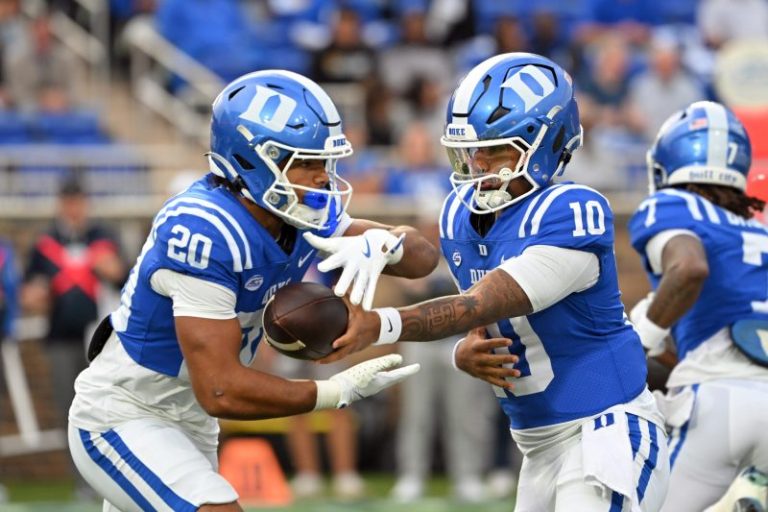
Unranked Duke, at 7-5, remains alive for the College Football Playoff, while 10-2 Vanderbilt is out.

Try explaining that to someone who doesn’t closely follow this sport.

Heck, try explaining that to someone who follows the sport but watched Duke lose to UConn, plus four other teams.

We could be headed toward a truly stupid CFP bracket, and I’m not blaming the committee.

The committee just ranks the teams. The committee didn’t create this system, a system wherein — and I want to reiterate this — a 7-5 Duke team is alive, and 10-2 Vanderbilt is out.

Five-loss Duke can still qualify for playoff. Yes, really.

The committee, by rule, is required to select five conference champions as automatic qualifiers.

If unranked Duke upsets No. 17 Virginia this weekend, it would be eligible for one of those auto bids.

Yes, Duke might need help to secure an auto bid — No. 25 James Madison probably needs to lose in the Sun Belt Championship — but, I repeat once more: Five-loss Duke is alive, and two-loss Vanderbilt is out.

Dumb.

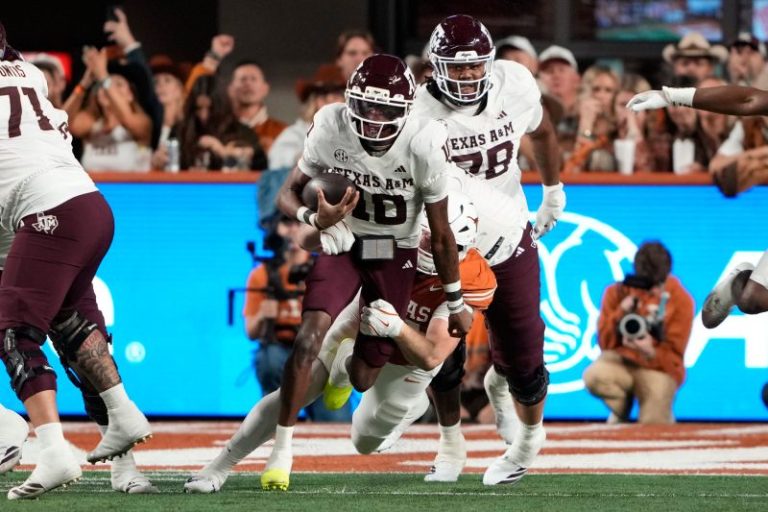
Duke is alive. No. 13 Texas, which just upset previously undefeated Texas A&M, is out.

Dumb.

Duke could win the ACC and qualify with five losses, and the Big 12’s No. 11 Brigham Young probably would miss the playoff if it finishes 11-2, with both losses coming to No. 4 Texas Tech.

Dumb.

The playoff’s size is not the problem. And I could live with the committee’s rankings. The top 12 teams in these latest rankings would create a bang-up bracket. SEC boss Greg Sankey would squabble about Texas and Vanderbilt being omitted, but once the moaning stopped, the bracket would look pretty stout.

Imagine No. 12 Miami at No. 5 Oregon in Round 1. You in for that? I’d be in.

Trouble is, we’re not going to get that, because the ACC’s standings and tiebreaker application has Duke headed to the conference championship game instead of 10-2 Miami.

Duke is one of five teams tied for second in the ACC standings. The Blue Devils own the worst overall record of the tied teams, but the league’s tiebreaker rules have Duke headed to Charlotte.

So, a Duke team that lost to Illinois by 26 points could be playoff bound, while a Miami team that beat Notre Dame is vulnerable of getting sent to an also-ran bowl.

Dumb.

We’re not there yet. Virginia could save some sanity for this bracket by beating and eliminating Duke, winning the ACC, and snatching one of those auto bids.

Are automatic bids the enemy of a top-notch bracket?

I’ve previously shown support for this 12-team playoff model, but this screwy scenario of Duke being alive for the playoff in the first week of December, while undeniably better teams are out of the mix, makes me question whether any automatic bids are worth retaining, as the playoff’s future size and shape go under evaluation.

Or, should all bids just be awarded via at-large selection?

Why should we have auto bids, when conference champions aren’t necessarily even the best team in their own league? They might just happen to be the team that drew the easiest conference schedule, or they caught a good break from the tiebreaker rules.

When conferences were smaller, we could say with a straight face conference championship games generally produced the conference’s best team as champion.

Not anymore.

Conference expansion and the elimination of divisions disrupted the utopia of conferences crowning worthy champs.

The ACC swelled to 17 teams and nixed divisions in favor of a united standings. Duke’s win against California pushed it a step closer to winning the Atlantic Coast Conference.

Think about that for a moment.

Each ACC team played only eight conference games. Put differently, Duke could win a 17-team conference and become eligible for a playoff auto bid after facing less than half the teams in the conference.

That’s dumb.

Perhaps, the playoff would be better served with no more conference championship games. No more automatic bids.

Expand the regular season by one week, giving the committee one additional data point for every team in the first week of December. This wouldn’t lengthen the season. You’d just be swapping in a 13th regular-season game in place of conference championship weekend.

Then, rank the 12-best teams, and congratulate Duke on its bid to the Gator Bowl.

Blake Toppmeyer is the USA TODAY Network’s senior national college football columnist. Email him at BToppmeyer@gannett.com and follow him on X @btoppmeyer.

This post appeared first on USA TODAY

The penultimate College Football Playoff rankings serve as a table setter for Selection Sunday five days later with the majority of teams in at-large consideration not playing in conference championship games.

That means the fifth release of the season Tuesday, Dec. 2, was important in establishing a pecking order – both for seeds and for teams fighting to make the field.

The top of the rankings did not change with Ohio State and Indiana – the lone unbeatens in the Football Bowl Subdivision – leading as the Big Ten schools have since the first release. That will change in the final rankings on Sunday, Dec. 7, with the Buckeyes and Hoosiers set to meet in the conference title game.

Who would follow the top two was the first question for the committee to answer. Last week’s No. 3 Texas A&M lost to Texas, knocking the Aggies out of the SEC title game. How far would A&M fall? The committee slotted it at No. 7, meaning a likely first-round home game with no opportunity to earn a bye to the quarterfinals.

Georgia slides up one place to third with Texas Tech and Oregon making equal improvements to round out the top five. The Bulldogs will face No. 9 Alabama in the SEC title game. Avenging their lone loss should put them in the No. 2 spot in the final rankings. The Red Raiders could also move up further and secure a first-round bye if they defeat No. 11 Brigham Young in the Big 12 title game. The Ducks have completed their regular season.

In addition to where Texas A&M landed, the other question for the committee was where to place Mississippi. The Rebels finished 11-1 with a defeat of Mississippi State in the Egg Bowl. But the departure of coach Lane Kiffin to LSU was needed to be considered as part of the criteria the committee must follow. Ultimately, Ole Miss was placed at No. 6. with Oklahoma, Alabama and Notre Dame rounding out the top 10.

After that group comes BYU, Miami, Texas, Vanderbilt and Utah. Each of these teams is outside the bubble and must hope for losses by teams playing ahead of them and a boost from the committee when the final rankings are revealed.

The fight for the Group of Five’s place in the field got more definition, too. Tulane remains in the rankings at No. 21 and will face No. 24 North Texas in the American title game. The winner looks assured of taking that spot.

But another could go to No. 25 James Madison. Should the Dukes beat Troy for the Sun Belt championship, they could finish ahead of five-loss Duke if the Blue Devils defeat No. 17 Virginia in the ACC title game. Because the playoff rules state the five highest-ranked champions are in the field, it is possible for the ACC to get shut out in this scenario.

This is the final Tuesday ranking of the college football season. The College Football Playoff field is revealed in the final release on Sunday, Dec. 7.

CFP rankings Top 25

  1. Ohio State (12-0)
  2. Indiana (12-0)
  3. Georgia (11-1)
  4. Texas Tech (11-1)
  5. Oregon (11-1)
  6. Mississippi (11-1)
  7. Texas A&M (11-1)
  8. Oklahoma (10-2)
  9. Alabama (10-2)
  10. Notre Dame (10-2)
  11. Brigham Young (11-1)
  12. Miami (10-2)
  13. Texas (9-3)
  14. Vanderbilt (10-2)
  15. Utah (10-2)
  16. Southern California (9-3)
  17. Virginia (10-2)
  18. Arizona (9-3)
  19. Michigan (9-3)
  20. Tulane (10-2)
  21. Houston (9-3)
  22. Georgia Tech (9-3)
  23. Iowa (8-4)
  24. North Texas (11-1)
  25. James Madison (11-1)

How the College Football Playoff would look based on rankings

First round

No. 12 Fifth-rated conference champion at No. 5 Oregon

No. 11 Fourth-rated conference champion at No. 6 Mississippi

No. 10 Notre Dame at No. 7 Texas A&M

No. 9 Alabama at No. 8 Oklahoma

Quarterfinals

No. 4 Texas Tech vs. Oregon-Fifth conference champion winner

No. 3 Georgia vs. Mississippi-Fourth conference champion winner

No. 2 Indiana vs. Notre Dame-Texas A&M winner

No. 1 Ohio State vs. Alabama-Oklahoma winner

What is the College Football Playoff schedule?

The schedule for first-round games taking place on campus sites will see No. 5 hosting No. 12, No. 6 facing No. 11, No. 7 meeting No. 10 and No. 8 squaring off with No. 9.

Winners of those games will advance to the quarterfinals with the Cotton Bowl hosting its matchup on Dec. 31. The other three games of the round will be played Jan. 1 with the Orange Bowl starting the day followed by the Rose Bowl and Sugar Bowl. The Fiesta Bowl and Peach Bowl will host the semifinals on Jan. 8 and Jan. 9, respectively.

The championship game will be played on Jan. 19 in Miami Gardens, Florida, at Hard Rock Stadium.

This post appeared first on USA TODAY

The Toronto Blue Jays are not hesitating to fortify the backbone of their success the past four seasons: Starting pitching.

On the same day they announced the signing of Dylan Cease to a $210 million contract, the club agreed to a three-year, $30 million deal with another right-handed starter, Cody Ponce, a person with direct knowledge of the deal confirmed to USA TODAY Sports. The person spoke on the condition of anonymity because the deal, first reported by The Athletic, is not yet official.

Who is Ponce, you ask?

Well, he’s the latest pitcher who started his career in the major leagues, only to reinvent themselves playing overseas and return a finished product, ready to cash in on a more lucrative deal. Ponce, 31, pitched in 20 games, including five starts, for the Pittsburgh Pirates in the 2020 and ’21 seasons, posting a 5.86 ERA.

Stuck in a perpetual swingman role even in the Pirates’ minor leagues, he ventured to Asia in 2022 and in three seasons in Japan’s top leagues, largely could not shake that inconsistency.

Yet a move to Hanwa of South Korea’s KBO seemed to flip the switch.

He dominated this past season for the Eagles, striking out 252 batters in 189⅔ innings, with a 1.89 ERA and a 17-1 record over 29 starts. He earned MVP honors for his performance. Ponce’s fastball now sits at 95 mph, a couple beats faster than his heater with the Pirates, and like so many major leaguers in recent years has added a split-finger pitch to his repertoire.

That will fit right in on the Blue Jays, whose rotation returnees in 2026 are splitter-happy veteran Kevin Gausman and rookie Trey Yesavage. Combined with Cease, that makes for a potentially dominant starting four, with veteran righty Jose Berrios – who sat out the Blue Jays’ World Series run with an elbow injury – leading a deep contingent of arms who could fill in the No. 5 spot, barring trade.

And it also backfills both current and expected future losses in the rotation. Chris Bassitt’s three-year deal with the club expired after the World Series, as did Max Scherzer’s one-year deal. Gausman’s $115 million pact is up after 2026.

Having taken care of their most significant winter need, the Blue Jays can now focus on retaining infielder Bo Bichette, their most significant free agent from their pennant-winning roster.

This post appeared first on USA TODAY

  • The 2026 World Cup will feature an expanded field of 48 teams.
  • Teams will be sorted into 12 groups of four during the official draw.
  • The World Cup draw is scheduled to take place on December 5 in Washington, D.C.
  • USA TODAY Sports will host a Q&A session on December 4 to discuss the upcoming tournament.

The anticipation is building for the 2026 World Cup and soon we’ll find out which teams are playing in the 12 groups.

Overall, there will be 48 teams in the upcoming World Cup, which equates to four teams in each group. What teams will be in each group?

That’s an answer we’ll get on Dec. 5 in Washington, D.C., when the draw is conducted.

USA TODAY Sports’s Jesse Yomtov is ready to answer your questions about the 2026 World Cup, the upcoming draw and the teams that have qualified thus far on Thursday, December 4 at 12 p.m. ET.

You can send in your questions in advance via the box below and of course come back on Dec. 4 to get your answers.

This post appeared first on USA TODAY

As scrutiny continues to intensify across the battery metals supply chain, the conversation around sustainability has moved far beyond carbon footprints.

At this year’s Benchmark Week, Stefan Debruyne, director of external affairs at Sociedad Quimica y Minera de Chile (SQM) (NYSE:SQM), made that point unmistakably clear: sustainability in lithium is as much about people, process and transparency as it is about emissions — and it must be learned, not imposed.

SQM, one of the world’s largest lithium producers, has long been at the center of debates about extraction in Chile’s Salar de Atacama. But for Debruyne, the company’s vision of leadership goes beyond scale.

“We approach leadership in a holistic way,” he said. “It’s not only about having trust to produce and being able to deliver the quality the market needs, but also doing it in a responsible way — dialogue, working closely with stakeholders and civil society. We work very hard on all components.”

Building social license

Much of Debruyne’s role over the past five years has centered on improving engagement with Indigenous communities, many of which have deep historical grievances tied to land, water and the impact of large-scale resource extraction.

“It’s really about being the best neighbor possible,” he said.

But getting there has required fundamental shifts in mindset and method. One of the clearest examples is what Debruyne called the principle of horizontality — a change born from early missteps.

A decade ago, when communities questioned the mine’s hydrological impacts, SQM responded the way many industrial operators would: it sent engineers to explain the technical data.

“You would think that’s a great thing to do,” Debruyne said. “But we learned that’s not the right way, because community members aren’t hydrologists. There’s a vertical difference.”

Instead, SQM now helps communities secure independent experts of their choosing, ensuring conversations happen “on a horizontal level.” This shift has been crucial to rebuilding trust.

Just as important, Debruyne said, is abandoning the western notion of time.

“Communities have a different concept of time. It’s about giving them the time they need — taking information back, returning, iterating. You may think you’re doing things the right way, but there’s always room for improvement.”

Why social investment reduces risk

For Oxfam policy advisor Andrew Bogrand, these types of changes are not just ethical — they’re also practical.

The expert, who also spoke on the panel, noted that since 2010, more than 800 protests or violent incidents have occurred around mine sites globally, including 300 since 2021 alone.

Each one carries real costs: slowdowns, legal expenses, rising insurance premiums — and, as Bogrand pointed out, the hidden cost of executive time diverted to crisis management.

“There is a win-win solution,” he told the Benchmark Week audience. “It’s engaging communities, making sure everyone’s on the same page. Sometimes the solutions are very simple.”

As an example, he pointed to mining projects where warning messages were sent in English to communities that do not speak the language, or where key safety information was delivered over SMS when what residents needed was a physical noticeboard in their own dialect.

Bogrand described companies that “step over a dollar to pick up a penny” — refusing modest community requests, only to face shutdowns costing tens of millions of dollars.

Transparency: A tool, not a threat

Debruyne described transparency as one of SQM’s most effective tools, even if it initially felt counterintuitive.

A few years ago, the company made all hydrological data from its government reporting publicly accessible online.

“I was bracing myself,” he said, expecting to receive dozens of questions about brine levels. But counter to his fears, transparency defused tension rather than fueling it. “I received complete silence,’ Debruyne noted.

It also created a foundation for future collaboration, including joint environmental monitoring programs with communities that had refused to speak with SQM for years.

Moving slow to move fast

The tension between rapid industry growth and slow, iterative sustainability processes often surfaces in investor discussions. For Bogrand, the answer is simple: “You have to move slow to move fast.”

Rushing early stage engagement almost always backfires, he argued, while early investment in community relationships pays dividends across the life of a mine.

Debruyne echoed this idea, noting that patience, consistency and presence — not promises — win trust. In one case, SQM organized a visit for Atacama Indigenous women leaders to electric vehicle and battery plants in Germany and Poland, allowing them to see firsthand where lithium fits in a finished product.

One participant, surprised that the metal formed only a thin coating on a cathode, admitted she had imagined an “Avatar-like” scenario where mines destroyed massive volumes of land for each battery.

“Because they don’t have visibility on the value chain, they make interpretations, which is human,” Debruyne told listeners. “Dialogue is so important.”

Both Debruyne and Bogrand agree that the lithium supply chain cannot scale without social acceptance, credible transparency and deep engagement with affected communities.

As Debruyne noted, “Ultimately, it’s about people.”

Securities Disclosure: I, Georgia Williams, hold no direct investment interest in any company mentioned in this article.

This post appeared first on investingnews.com

Humanoid robotics is rapidly advancing.

Driven by the convergence of technological innovation, evolving labor market demands and growing investor interest, the humanoid robotics industry is expanding at a rapid rate. A handful of humanoid robotics companies have announced initial public offerings in 2025, such as China’s Unitree and Singapore’s Otsaw, with more predicted in 2026.

Ark Invest CEO Cathie Wood said in October that humanoid robots “will be the biggest of all” artificial intelligence (AI) opportunities, highlighting their potential in transportation, healthcare and productivity enhancement.

Samimi discussed the impact AI integration has had on the robotics industry, challenges such as labor shortages and supply chain disruptions and how the firm evaluates opportunities within this nascent yet promising market.

Key trends in humanoid robotics

According to Samimi, recent trends in robotics include enhanced automation in the industrial and logistics sectors.

“We’re seeing a lot of new trends on foundation models and control stacks within the robotic sector, as well as new sorts of electronic assemblies to put all of these components together,” he explained, pointing to companies like Amazon (NASDAQ:AMZN), BMW (ETR:BMW,OTC Pink:BMWKY) and Mercedes-Benz Group (ETR:MBG,OTC Pink:MBGAF) as current adopters of humanoid robots in factories and warehouses.

Additionally, Samimi highlighted that recent battery advances have improved energy density, enabling longer robot operation for industrial and logistics tasks. Meanwhile, lighter, more efficient actuators enhance precision and energy use, supporting dynamic interaction and human collaboration.

Finally, advances in robotics control systems are powered by cutting-edge AI algorithms. Platforms like RideScan, a Humanoid Global portfolio company, harness continuous, independent AI-driven monitoring, risk scoring and anomaly detection to optimize robot performance. The company recently filed a patent in the UK for its core AI technology

Samimi added that safety and reliability remain critical focal points amid these technological advances.

Advances in algorithms, machine learning and operational intelligence systems are enabling comprehensive, scalable safety and maintenance solutions for robots deployed across different facilities, supported by digital twin technologies and a closed-loop data cycle for continuous improvement.

Addressing labor shortages via robotics

Labor shortages and constrained supply chains are accelerating innovation by prompting industrial sectors to adopt robotics to augment limited labor resources.

The 2025 MHI Annual Industry Report, a document that covers emerging disruptive technologies, confirms robotics is thriving amid labor shortages and rising complexity in logistics and manufacturing.

During the US-Saudi Investment Forum, Tesla (NASDAQ:TSLA) CEO Elon Musk made a bold prediction about the long-term effects of robotics and AI: work will become optional, and money will be obsolete.

“I don’t know what long term is — maybe it’s 10, 20 years or something like that,” Musk said, adding that there is still a lot of work to be done before society gets to that point.

In the meantime, the workforce will likely see more human-robot collaboration. Samimi said he has observed that humanoid robots and collaborative robots (cobots) are increasingly taking over repetitive manual tasks.

“Human labor now shifts to more, higher-value tasks, rather than moving a warehouse box or a palette from A to B. So we’re seeing somewhat of a shift (that’s) helping make labor more scalable and more productive, and really less dependent on that shrinking labor pool,” he said.

Resource-heavy and industrial sectors present strong opportunities for robotics, especially amid a limited labor pool. Areas like agriculture, mining, pharmaceuticals and lumber stand to benefit from automation and upskilling via robotics.

Robotics investment thesis and portfolio evaluation

Humanoid Global views its role not only as an investor, but also as an ecosystem builder, actively fostering collaboration and knowledge sharing across its portfolio companies.

By strategically connecting early stage innovators with mature industry players, Humanoid Global seeks to accelerate the global deployment and scale of humanoid robotics technologies.

The firm emphasizes balancing risk across a portfolio that includes both disruptive technology developers and companies closer to full commercial deployment, allowing for diversified exposure while driving integrated growth.

Companies are evaluated with a strong prioritization for teams with proven execution capabilities and sustainable technological moats, such as proprietary IP or unique data networks. Scalability and clear go-to-market strategies are equally important, as is a strong safety architecture embedded in the technology.

This approach highlights the importance of strategic relationships, market education and risk-managed growth in realizing the transformative potential of humanoid robotics.

Securities Disclosure: I, Meagen Seatter, hold no direct investment interest in any company mentioned in this article.

This post appeared first on investingnews.com

Investors looking for exposure to the silver price and silver-mining companies should consider silver exchange-traded funds (ETFs).

Spurred by moves in the gold market, safe-haven buying as well as increasing demand from industrial sectors, in the fourth quarter of 2025 the price of silver broke through its all-time high of US$49.95, which it set in 1980, and set a new-all time high of US$58.83.

While silver has often been seen as a more approachable precious metal owing to its lower per ounce price, its performance has lagged gains seen in the gold price over the past few years. However, silver has stolen some of the spotlight in 2025 as it sees significant gains on the back of geopolitical tension and economic uncertainty from the US trade and tariff policy.

Like gold investing, investors can invest in silver in several ways that each offer their own pros and cons, along with differing costs and risks. For example, investors can purchase physical silver bars or coins, or trade silver futures.

Another way for investors to diversify their portfolio with silver is to invest in ETFs. These products work similarly to mutual funds in that they pool investor resources into an asset. However, as their name suggests, ETFs are traded on exchanges like stocks, making them more accessible to investors than mutual funds are.

While ETFs aren’t without risk, they can offer a more stable investment compared to individual stocks thanks to their diversification and the fact that they are often managed and rebalanced.

Silver ETFs come in several forms, such as ones that hold physical silver and ones that hold silver mining, royalty and exploration stocks. Investors looking to start trading silver ETFs should be aware of the options available to them to determine which silver ETF will best suit their precious metals investing needs and risk tolerance.

Here’s a brief look at 10 of the top silver ETFs by total assets. The first five ETFs offer exposure to the price of silver, while the last five provide exposure to silver-mining stocks.

Assets and prices for these silver ETFs were collected on December 1, 2025, using data from the funds’ web pages.

5 ETFs for exposure to the silver price

1. iShares Silver Trust (ARCA:SLV)

Total assets: US$26.33 billion
Unit price: US$51.21

The iShares Silver Trust provides investors with access to the silver price performance, using the London Bullion Market Association silver price as its benchmark.

As the iShares Silver Trust’s web page warns, it is not an investment company registered under the Investment Company Act of 1940, or a commodity pool under the Commodity Exchange Act. Because of this, it is not subject to the regulatory requirements that apply to mutual funds or ETFs.

This silver trust holds 508 million ounces of silver bullion.

2. Sprott Physical Silver Trust (ARCA:PSLV,TSX:PSLV)

Total assets: US$11.61 billion
Unit price: US$18.65

The Sprott Physical Silver Trust is an option for investors looking for the security of physical silver without the need to find secure storage.

The ETF is backed by 191.12 million ounces of silver held in trust in fully allocated London Good Delivery silver bars.

Additionally, the ETF is fully convertible into physical silver, should investors decide they want the precious metal on hand. However, the fund states that holders ‘must have enough units to equate to ten 1000 oz silver bars.’

3. Aberdeen Standard Physical Silver Shares ETF (ARCA:SIVR)

Total assets: US$3.71 billion
Unit price: US$53.71

The Aberdeen Standard Physical Silver Shares ETF’s investment objective is for its shares to reflect the performance of the silver price less the expenses of the trust’s operations. It has an expense ratio of 0.3 percent.

This ETF comes with the same warnings as the iShares Silver Trust.

The fund is backed with 45.51 million ounces of silver held with JPMorgan Chase Bank in London in a secured vault.

4. ProShares Ultra Silver ETF (ARCA:AGQ)

Total assets: US$1.33 billion
Unit price: US$107.32

The ProShares Ultra Silver ETF, established in 2008, was designed to offer daily investment results that correspond with twice the daily performance of the Bloomberg Silver Subindex. Because of this, the ETF is aimed at investors who are bullish on silver and able to monitor their investments on a daily basis.

The fund uses derivatives such as futures contracts to invest in silver and has an expense ratio of 0.95 percent.

5. ProShares UltraShort Silver ETF (ARCA:ZSL)

Total assets: US$73.71 million
Unit price: US$9.51

The ProShares UltraShort Silver ETF is designed to provide investors with a hedge against declines in the silver market. ProShares launched it alongside the ProShares Ultra Silver ETF in late 2008. It also has an expense ratio of 0.95 percent.

Because the fund is built around providing results at a negative two times daily performance of the Bloomberg Silver Subindex, it is meant for traders who have a high capacity for risk and who are willing to monitor their positions on a daily basis. The fund should be treated in the same way as the Ultra Silver ETF.

5 ETFs for exposure to silver-mining stocks

1. Global X Silver Miners ETF (ARCA:SIL)

Total assets: US$3.93 billion
Unit price: US$77.66

The Global X Silver Miners ETF gives investors access to a basket of silver-mining and royalty stocks. The ETF benefits from the fact that these companies can climb when the silver price is rising. It also allows investors to avoid the risks associated with individual companies and lets them add geographical diversity to their portfolios.

This ETF has an expense ratio of 0.65 percent, and its top holdings include streaming company Wheaton Precious Metals (TSX:WPM,NYSE:WPM) at a weight of 22.5 percent, Pan American Silver (TSX:PAAS) at a weight of 12.3 percent and Coeur Mining (NYSE:CDE) at 8.1 percent.

2. Amplify Junior Silver Miners ETF (ARCA:SILJ)

Total assets: US$2.97 billion
Unit price: US$26.09

The Amplify Junior Silver Miners ETF bills itself as the ‘first and only ETF to target small cap silver miners.’ The index provides a benchmark for investors to track public small-cap companies in the silver space.

The ETF has an expense ratio of 0.69 percent and its holdings span Canada, the US and the UK, with key silver companies such as Hecla Mining Company (NYSE:HL) at a weight of 11.3 percent, First Majestic Silver (TSX:AG,NYSE:AG) at 10.3 percent and Coeur Mining at 8.7 percent.

3. iShares MSCI Global Silver Miners ETF (BATS:SLVP)

Total assets: US$630 million
Unit price: US$31.59

The iShares MSCI Global Silver Miners ETF tracks an index composed of global equities of companies primarily engaged in silver exploration or metals mining.

The ETF has the lowest expense ratio of the three ETFs focused on silver stocks at 0.39 percent.

The large majority of companies in its holdings, about 69 percent, are traded on Canadian exchanges, and companies on US and Mexican exchanges combine for 27 percent.

The top three holdings for the iShares MSCI Global Silver Miners ETF are Hecla Mining at a weight of 15.5 percent, Industrias Peñoles (BMV:PE&OLES) with a weight of 11.7 percent and Fresnillo (LSE:FRES) at 10 percent.

4. Sprott Silver Miners & Physical Silver ETF (NASDAQ:SLVR)

Total assets: US$453.7 million
Unit price: US$51.31

The Sprott Silver Miners & Physical Silver includes a combination of physical silver holdings as well as equities, setting it apart from the other silver-mining ETFs on the list.

The fund launched in January 2025, making it one of the newest entries to the list. Its management fee is 0.65 percent.

This silver ETF’s second largest holding is its counterpart Sprott Physical Silver Trust, which provides investors exposure to physical silver, at a 14.3 percent weight. Its other top holdings are First Majestic Silver at 27.12 percent and Endeavour Silver (TSX:EDR,NYSE:EXK) at 10.6 percent.

5. Sprott Active Gold and Silver Miners ETF (NASDAQ:GBUG)

Total assets: US$134.42 million
Unit price: US$41.18

Established in February 2025, the Sprott Active Gold and Silver Miners ETF is designed to provide investors broad access to both gold and silver equities. Additionally, as an active fund, it will see more frequent rebalancing to increase the potential of better returns for investors.

The fund’s top holdings consist of OceanaGold (TSX:OGC,OTCQX:OCANF) weighted at 4.32 percent, G Mining Ventures (TSX:GMIN,OTCQX:GMINF) at 4.18 percent and Equinox Gold (TSX:EQX,NYSEAMERICAN:EQX) at 4.16 percent.

Its management fee is 0.89 percent.

Securities Disclosure: I, Dean Belder, hold an investment in Sprott Active Gold and Silver Miners ETF.

This post appeared first on investingnews.com