Astral Resources (AAR:AU) has announced Feysville Land Use Agreement Signed With Marlinyu Ghoorlie
Download the PDF here.
This post appeared first on investingnews.com


Astral Resources (AAR:AU) has announced Feysville Land Use Agreement Signed With Marlinyu Ghoorlie
Download the PDF here.

The NBA asked for this embarrassment.
It was only too happy to jump in bed with legalized gambling, thinking it could take the gaming industry’s money but inoculate itself from its seedy underbelly with a few terse warnings to its players and somber PSAs for fans.
It doesn’t work that way, though. There is always a price to pay for greed and associating with unsavory people, and the NBA’s bill just came due.
Rather than praise for Victor Wembanyama or debates about whether the New York Knicks are the real deal, the NBA woke up Thursday to find itself at the center of a massive betting scandal. Portland Trail Blazers coach Chauncey Billups, Miami Heat guard Terry Rozier and former NBA player Damon Jones all were arrested as part of a yearslong investigation into illegal gambling rings. With ties to the mafia, no less!
Billups was charged in connection with an illegal poker operation while Rozier was accused of manipulating his play during a game to benefit bettors. Jones was charged in both cases.
“We take these allegations with the utmost seriousness,” the NBA said in a statement, “and the integrity of our game remains our top priority.”
Too bad the NBA ceded their right to that high ground long ago.
It is true that the NBA does not have a direct role in this scandal. But the enthusiastic embrace of legalized gambling by the league, as well as the NFL, Major League Baseball and just about every other sports organization, has fostered an environment where there are no guardrails.
When the NBA’s own website has a Fantasy page listing “authorized gaming partners and operators,” why should Rozier think it’s a big deal to take a play or two off to help out some bettors? When the NBA allows DraftKings to offer a “promotion” that includes three free months of NBA League Pass, why should Billups question whether it’s a good idea to partake in a shady poker ring?
When the NBA has no problem with its teams having sports books at their arenas, how can it demand that players and coaches keep the gaming industry at arm’s length? When the NBA is sending such mixed messages — problems from gambling are bad! but profits from gambling are good! — why should anyone respect the league’s moral authority?
The league opened the door to this, all of it, and it cannot be surprised or indignant now that it’s gone sideways.
There was a reason every sports entity in the United States resisted any association with legalized gambling for as long as they did. They knew the troubles it would bring because they saw it playing out in real-time overseas. Corrupt people trying to influence games. Gambling addictions. Players being threatened or harassed by bettors and, worse, organized crime.
Ultimately, though, the money was just too good to pass up. NBA commissioner Adam Silver even wrote an op-ed in the New York Times in 2014 encouraging widespread legalization of sports betting. For the good of humanity, of course. People were already gambling, Silver said, so why not bless it?
“I believe that sports betting should be brought out of the underground and into the sunlight where it can be appropriately monitored and regulated,” Silver wrote then.
What’s a little integrity when there are billions in potential profits to be had, right?
By giving their approval to legalized gambling, the NBA and other leagues might as well have handed an arsonist a match.
There is no daylight between gaming and its toxic byproducts, especially when smartphones make irresponsible gambling and abuse of players so easy. Warnings posted in small print, be they in locker rooms or online, are no match for human frailties, temptations and fears, and the NBA owns today’s shame as much as Billups, Rozier, Jones and everyone else who was arrested.
The NBA was well aware of the dangers that come with sports betting and it didn’t care because it wanted the gaming industry’s money more. There’s no more damning indictment than that.
Follow USA TODAY Sports columnist Nancy Armour on social media @nrarmour.
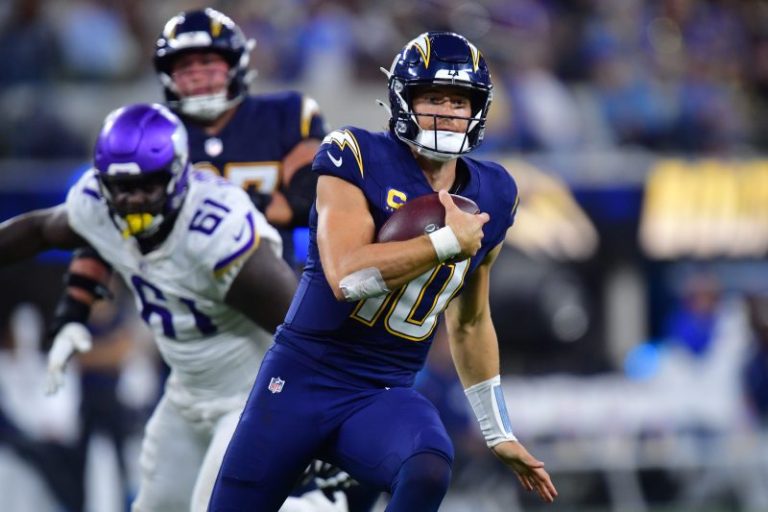
INGLEWOOD, CA — In prime time, and in front of a national audience, the Los Angeles Chargers got back in the winner’s column.
Justin Herbert and the Chargers routed the Minnesota Vikings 37-10 to improve to 5-3.
The Chargers took control of the game early. Herbert led the Chargers on three touchdown drives in the first half as team took a commanding 21-3 lead into the locker room at halftime.
The Vikings couldn’t get anything going offensively in the second half and their defense provided little resistance as the Chargers were able to pad their lead.
Carson Wentz threw an interception with 12:02 remaining in the fourth quarter that prompted fans to head for the exits.
USA TODAY Sports was at SoFi Stadium for Thursday night’s Vikings vs. Chargers contest. Here are the winners and losers from the interconference matchup:
Herbert completed 18-of-25 passes for 227 yards, to go with three touchdowns and one interception. The quarterback was in command and efficient for most of the contest.
Herbert has 2,146 career completions, the most completions ever by a player in his first six seasons.
Herbert entered Week 8 leading the league in passing yards (1,913) and ranked second in completions (183).
Th Chargers rushed for a season-high 207 yards.
Running back Kimani Vidal rushed 23 times for 117 yards and one touchdown.
The Chargers’ season-high output on the ground came without first-round pick RB Omarion Hampton (ankle) who is on injured reserve.
A week after producing 164 receiving yards, the fourth-most ever by a rookie tight end in a game in NFL history, Oronde Gadsden II tallied five catches for 77 yards and a touchdown.
The Chargers found themselves a starting tight end for the present and future in Gadsden.
Slot receiver Ladd McConkey had a team-high six catches for 88 yards and a touchdown.
The Chargers defense held Minnesota to four first downs, 93 yards and three points in the first half. Minnesota’s only touchdown drive came on a short field after a Justin Herbert interception.
The Vikings only gained 164 yards of total offense and went 3-for-11 on third downs.
The Chargers played most of the game without star safety Derwin James who suffered an ankle injury in the first half. No Derwin, no problem: rookie safety RJ Mickens had an interception in the fourth quarter that convinced fans to beat the traffic.
Chargers standout tackle Joe Alt returned to the lineup after injuring his ankle in Week 4. He had an instant impact as he help stabilize the Chargers O-line.
The Chargers wore their modern throwback all navy uniforms for Thursday’s primetime game. After their popular powder blue unis, it’s probably the second-most visually appealing set they have in the closet.
Wentz, who had a brace on his left arm, was under duress for much of the game. He was sacked five times and hit eight. He finished with just 144 yards, one touchdown and one interception.
Wentz was on the injury report with a left shoulder injury leading up to the game. He didn’t look like he was 100%.
Justin Jefferson was a bright spot for the Vikings, as the wide receiver surpassed 8,000 career receiving yards in the matchup. He’s the fastest player to reach 8,000 receiving yards in the Super Bowl era.
Vikings CB Isaiah Rodgers had an interception overturned when he didn’t maintain possession of the football on the Chargers first offensive series. It was a huge missed opportunity that would’ve given Minnesota some much-needed momentum.
The Vikings defense gave up 266 yards and three touchdowns in the first half. Minnesota trailed 21-3 at halftime.
The Chargers compiled 419 yards and a season-high 37 points on Minnesota’s defense.
The Vikings had international games Week 4 in Ireland and Week 5 in London, followed by a cross country trip to Los Angeles in Week 8. The team played jetlagged on Thursday night.
Follow USA TODAY Sports’ Tyler Dragon on X @TheTylerDragon.
“This game is rigged.”
“Can’t believe the script had that team winning.”
“Player X is freezing out Player Y because he’s facing him in fantasy this week.”
Most of us have expressed similar sentiments over the years about the sports we watch. In jest.
But Thursday’s shocking revelation that the FBI indicted more than 30 people allegedly linked to a gambling scandal tied to the NBA served to do exactly what pro sports leagues used to fear about any association with betting: rocking the public’s confidence in the integrity of the sports it consumes.
Should we be all that surprised? Really?
Warning alarms have blared since 2018, when the Supreme Court loosened regulations on sports wagering – opening the industry to states far afield from the formerly singular legal sports betting bastion that is Las Vegas. It wasn’t long after that when pro leagues like the NFL began doing what had previously been unthinkable (and taboo) − partnering with betting sites like FanDuel and DraftKings and even allowing sportsbooks to advertise in conjunction with their most premium content: games.
For years, we’ve been trying to parse authentic news from fake, while elected officials – and apparently even Justice Department lawyers at this point – wantonly lie. Many of us have become increasingly desensitized to it. Others actually embrace it.
How are we supposed to know if a pro player is shaving points? Or trafficking insider injury information? It’s not like players across the pro sports spectrum haven’t incurred suspensions in recent years for myriad violations, including betting on games involving their teams. It happens, the respective commissioner touts his league’s gambling guardrails, and everyone basically moves on.
Now the FBI, at a time when its own credibility is under fire, has stepped in to throw a fragmentary grenade into the NBA’s operation. Yet how much will fans care what Damon Jones or Miami Heat guard Terry Rozier or Portland Trail Blazers coach Chauncey Billups purportedly did a week from now? Or even tomorrow? How long before Adam Silver, if he wanted, could hire Vince McMahon as a creative consultant, and no one would blink? And what does it all matter if there’s a metaverse where the New York Jets are the babyface dynasty while the Kansas City Chiefs are the weekly tomato cans?
Easy as it is to be cynical, let’s not allow our faith in sports to be irreparably fractured just yet. There are too many talented athletes working too hard for championship glory – much less simply putting food on the table – and have too much integrity and honor to believe this is all a systemic ruse. (Not for nothing, there are also far too many incapable of keeping a secret this big for us to begin dismissing the veracity of what we see from the couch, press box, upper deck or sideline.)
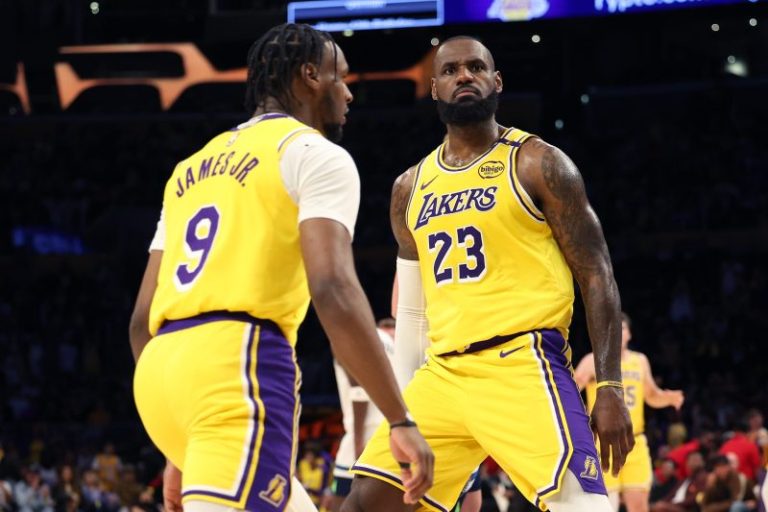
And while LeBron James has somehow exceeded all the hype that’s been heaped on him for more than a quarter-century – even if Jones apparently profited from knowing how healthy he was – leagues that aren’t actually scripted had no room for would-be leading men like Tim Tebow, Johnny Manziel, Markelle Fultz or Darko Miličić, none lasting despite apparently emanating from central casting.
We should feel comforted that Dwayne “The Rock” Johnson was (is?) nearly incomparable as a professional wrestler but not good enough to play in the NFL − and apparently doesn’t have sufficient business acumen beyond making movies and tequila to make the UFL anything more than the fringe football league its forebears have always been.
Sports never have been, nor will be, a pure meritocracy – contracts, public relations, personalities and the like perpetually exert varying influences. Yet so much of the unparalleled excellence and unimaginable tragedy – not to mention the mundane Week 8 NFL game or Tuesday night NBA contest – are too compelling to be authored by some athletic puppet master. Or sullied by shysters. Not when you see what Shohei Ohtani and George Springer just managed in order to create their World Series matchup. Not when you see the New York Giants find a way to lose an 18-point lead in the final six minutes of a game. Not when you see a 7-foot-5, 245-pound player like Victor Wembanyama run the break … unless he decides to pull up and pop a three. Not when Damar Hamlin nearly dies on a football field before he and his career are revived.
Don’t tell me those moments were or could be orchestrated. Our sports aren’t the WWE writ large (not that wrestling’s ardent fans would care).
May they never be.
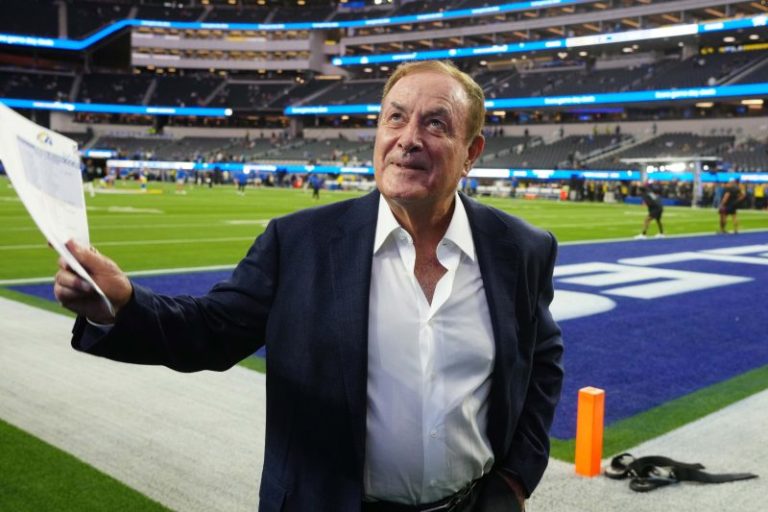
If there was ever a day for Amazon Prime announcer Al Michaels to avoid mentioning sports betting lines for a ‘Thursday Night Football’ game, it would have been Oct. 23.
Hours after the NBA was rocked by a massive sports betting scandal, Michaels was on air discussing the gambling implications of a field goal attempt in the final minutes of the Los Angeles Chargers vs. Minnesota Vikings game.
‘You know, occasionally, a game like this, you think it is over, but it’s not quite over,’ Michaels said, seemingly referencing the game’s over/under line. ‘You know what I mean? I’ll be punished again – what can I tell you? It’s close to being over. I don’t want to call it ‘over’ with three minutes to go.’
The pregame over/under line for the Chargers’ win on Oct. 23 was set at 44.5 points. Michaels started referring to the line in the final three minutes of the game as the Chargers played out their final drive with 44 total points on the board.
‘Sometimes you never know when that half will destroy you,’ Michaels said, referencing the 0.5 points still necessary at that point of the game for an ‘over’ bet to hit.
When Chargers kicker Cameron Dicker lined up for a 45-yard field goal attempt moments later, Michaels returned to referencing the betting line.
‘Meanwhile, you have a 45-yard attempt, which will draw a little interest,’ he said.
Dicker knocked down the 45-yarder, leading to Michaels’ final betting-related comment of the night:
‘And there it is,’ he said as the ball sailed through the uprights. ‘Now you can say it is ‘over.”
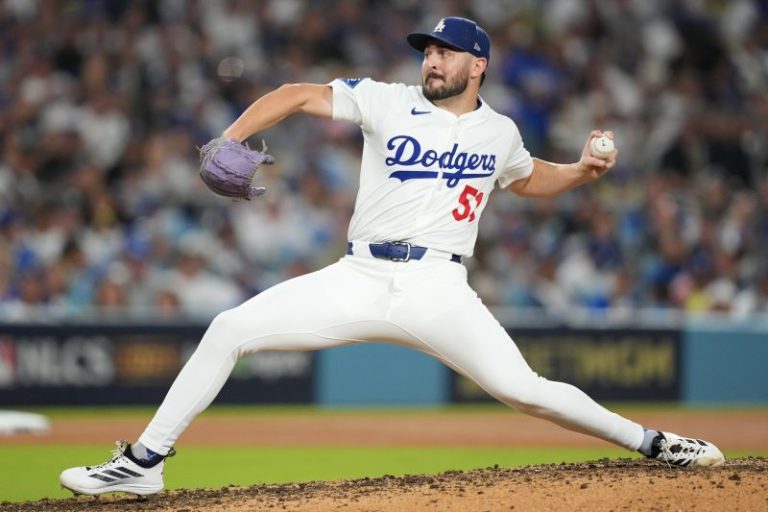
TORONTO — The Los Angeles Dodgers will be without left-handed reliever Alex Vesia for at least the first two games of the World Series after the club announced that he and his wife were dealing with a “deeply personal family matter.’
Vesia and his wife, Kayla, have been expecting their first child.
“The entire Dodgers organization is sending our thoughts to the Vesia family,’ the Dodgers said in a statement, “and we will provide an update at a later date.’
The Dodgers now have the option, according to an MLB official, of placing Vesia on the “family medical emergency list.’ If Vesia is placed on leave, he would be required to stay for a minimum of three days and a maximum of seven days.
Vesia, who has pitched for the Dodgers since 2021, has been one of their valuable left-handed relievers. He pitched in 68 games during the regular season with a 3.02 ERA and five saves, and appeared in seven of the Dodgers’ 11 postseason games, yielding three hits and striking out four in 4 ⅔ innings.
Veteran reliever Tanner Scott could replace Vesia on the roster. Scott, who signed a four-year, $72 million contract last winter, struggled during the season and lost his closer’s job to Roki Sasaki. He did not pitch the first round of the postseason against the Cincinnati Reds and had been left off the postseason roster the last two rounds after undergoing an abscess incision prodecdure on his lower body.
“I think right now, we’re in the mode of trying to understand the process, the rules, a way that we could sort of try to navigate the roster,” Dodgers manager Dave Roberts said. “So I think we have a little bit of time (10 a.m. ET, Friday) to finalize our roster. But, yeah, we’re going through the process of trying to backfill his spot on the roster. …
“Honestly, I think we’re just going day-to-day with really no expectations.’’
Volatility punctuated the global lithium market during the third quarter of 2025, as prices, supply/demand dynamics and geopolitics converged to reshape the landscape.
After slipping to a four year low at the end of June, benchmark lithium carbonate prices rallied through July to reach an 11 month high of US$12,067 per metric ton on August 21. However, the momentum proved unsustainable and prices slipped shortly thereafter, ending the three month session at US$11,185.89.
According to Fastmarkets, the surge was driven by rumors that Australian producers Mineral Resources (ASX:MIN,OTC Pink:MALRF) and Liontown Resources (ASX:LTR,OTC Pink:LINRF) might scale back supply.
Both companies denied the reports, and analysts have suggested that even if such reductions were implemented, they would do little to rebalance the current surplus in the lithium market.
“The nascency of the lithium market means that it is prone to be led by sentiment,” Fastmarket’s Claudia Cook wrote in a July update. “However, with healthy inventory levels and continued ramp-up of production, the reported supply cuts, even if they proved true, may not be enough to dip the market into a deficit.”
US policy uncertainty also weighed on sentiment. The Trump administration’s bill to roll back electric vehicle (EV) tax credits, alongside tariff concerns and a perceived retreat from the Inflation Reduction Act, rattled investors.
The repeal had the potential to spur a short-term rush in EV purchases, although liquidity in North America remains thin, and the medium-term outlook has turned bearish, Cook noted.
Elsewhere China’s fair competition policy — intended to curb market monopolies and prevent below-cost dumping — stirred speculation across the lithium supply chain. Though the directive primarily targets downstream industries, traders are watching closely to see whether it will ripple upstream and influence pricing dynamics.
The largest undercurrent for the lithium market is excessive supply. Since 2020, mined output has climbed 192 percent from 82,000 metric tons to 240,000 metric tons in 2024, as outlined by the US Geological Survey.
As supply grew, demand was unable to keep pace, leading to a mounting glut that has weighed on prices.
“While futures activity can catalyse short-term price movements, beneath the surface demand remains tepid, inventories high and buyers cautious, underscoring a disconnect between price action and market reality,” Paul Lusty, head of battery raw materials at Fastmarkets explained in a September update. “We expect continued price instability in the near term with potential for further corrections unless meaningful supply disruptions materialise.”
The supply increase was anticipated to satiate a growing appetite for EVs that has yet to fully materialize.
The EV boom has fueled strong long-term growth forecasts for lithium, but the market is now facing a sharp imbalance. Global EV sales climbed past 17 million units in 2024 and are projected to top 20 million in 2025, yet a 22 percent surge in mined supply last year has outpaced demand, pushing prices lower and creating a persistent oversupply.
This discrepancy was underscored by industry attendees at Fastmarkets’ Lithium Supply & Battery Raw Materials conference, who warned that the imbalance could persist until at least 2030.
As a result, lithium prices remain under pressure despite strong EV uptake, and a meaningful re-balancing will likely depend on new supply expansions being delayed, mine closures and steeper than anticipated demand growth — potentially in the second half of the decade.
With EV demand expected to accelerate beyond 2030 and new supply projects lagging, Q3 2025 could mark the start of a tighter era. For investors watching battery metals, the key question is whether the market has found a floor — or is merely in the calm before the next supply squeeze.
As mentioned, the market did find support through July and August, thanks in part to Chinese battery giant Contemporary Amperex Technology (CATL) (SZSE:300750,HKEX:3750) suspending operations at its Jianxiawo lepidolite mine. Located in the country’s Jiangxi province, it is one of the world’s largest lithium sources.
The shutdown followed the August 9 expiration of the mine’s operating permit, with CATL confirming it is seeking an extension but providing no timeline for restarting production. The halt was expected to last at least three months, removing about 65,000 metric tons of lithium carbonate equivalent — roughly 6 percent of global supply — from the market and reigniting bullish sentiment in an otherwise oversupplied sector.
The shuttering of the mine propelled lithium prices and mining stocks.
In mid-October China introduced new export restrictions on advanced lithium-ion batteries, key materials and production equipment — a move set to ripple through global supply chains.
Effective November 8, 2025, companies will now need export licenses to ship high-energy batteries, cathodes, synthetic graphite anodes and related machinery abroad. The new policy follows July’s limits on lithium iron phosphate (LFP) technology exports, tightening Beijing’s control over the battery sector.
China produces over 70 percent of global cathode materials and more than 95 percent of synthetic graphite, making its export decisions pivotal. S&P Global notes in an October briefing that the new controls are expected to delay production timelines and complicate sourcing for manufacturers outside China, particularly in the US, which imports roughly two-thirds of its lithium-ion batteries from Chinese suppliers.
“Export control does not mean an outright export ban, but rather a stricter approval process,” said Fastmarkets’ Walter Zhang. “We believe that the primary intent is to counter measures such as the US OBBB (One Big Beautiful Bill) Act, while preventing potential technology transfer demands from European or American governments and avoiding the military or dual-use applications of advanced battery technologies.”
Additionally, the move adds a new front to the US-China trade standoff, with Washington expected to deepen partnerships with Korean and Japanese producers like LG Energy Solution and Panasonic to reduce dependency.
While China’s CATL will likely pivot toward Europe and emerging markets, global battery costs and supply volatility are expected to rise through 2026.
Outside of China, the US invested heavily in the lithium-mining segment in Q3.
On October 1, Washington released the first US$435 million tranche of a landmark US$2.23 billion loan to Lithium Americas (TSX:LAC,NYSE:LAC), marking one of the Trump administration’s most significant steps yet to strengthen domestic control over critical minerals.
The funds, directed through the Department of Energy, will support construction of the Thacker Pass lithium project in Nevada, which is set to become the largest lithium source in the Western Hemisphere.
As part of the deal, the department will receive warrants representing a 5 percent equity stake in Lithium Americas and an equivalent interest in its joint venture with General Motors (NYSE:GM).
The agency also agreed to defer US$182 million in debt service over five years, underscoring Washington’s long-term commitment to building a resilient battery supply chain.
Thacker Pass is central to US efforts to reduce reliance on Chinese lithium refining and rival major producers in Australia and Chile. Once operational, Phase 1 of the project will produce 40,000 metric tons of battery-grade lithium carbonate annually — enough to power roughly 800,000 EVs — and reinforce the administration’s push to secure supply.
Looking at the rest of the year and remainder of the decade sentiment towards lithium is cautiously optimistic, according to Benchmark analysts fresh off the heels of this year’s LME Week in London.
“Market participants noted that strong spodumene appetite continues amid limited lepidolite supply from Jiangxi,” a Benchmark overview states. “Attention turned to CATL’s Jianxiawo mine, with its start‑up – whether as soon as next month or delayed to early Q1 26 – likely to influence short‑term pricing.”
Securities Disclosure: I, Georgia Williams, hold no direct investment interest in any company mentioned in this article.

Apollo Silver is advancing two high-impact silver projects in premier North American jurisdictions—California and Chihuahua—offering investors a unique combination of scale, optionality, and leverage to silver and critical mineral demand.
Apollo Silver (TSXV:APGO,OTCQB:APGOF,FSE: 6ZF0) is a silver-focused company advancing a dual-asset strategy centered on two high-impact projects in North America: the Calico silver project in California, USA and the Cinco de Mayo project in Chihuahua, Mexico. Both are located in mining-friendly jurisdictions with strong infrastructure and significant historical work.
At Calico, Apollo Silver is advancing the Waterloo deposit toward development through geological modeling, barite resource definition, and engineering studies. Calico boasts 125 Moz of silver (measured and indicated) and 58 Moz of silver (inferred), and recent test work has produced a 94.6 percent barite concentrate, supporting the asset’s potential as a US critical minerals supplier.
In Mexico, Cinco de Mayo offers rare optionality with a historical inferred resource of 154 Moz silver equivalent (385 g/t), and a potentially game-changing discovery at the Pegaso Zone. The project is under an option agreement between Apollo Silver and Pan American (previously MAG Silver), wherein Apollo Silver will complete a 20,000-meter drill program to convert the option to an acquisition of the Cinco de Mayo. Apollo Silver’s strategy is underpinned by disciplined capital allocation, high-impact exploration, and a proven ability to acquire and unlock value from high-quality assets—following a model similar to Prime Mining. With no debt, strong institutional backing, and an experienced team, Apollo Silver is well-positioned to deliver scalable, discovery-driven growth in a rising silver and critical minerals market.
The Calico silver project comprises three adjacent properties—Waterloo, Langtry and Mule—located in mining-friendly San Bernardino County, 15 km from Barstow, California. Resources at Calico sit primarily on private land with vested mining rights, simplifying the path to permitting. Infrastructure is excellent: paved roads, power lines within 5 km, and proximity to the expanding Barstow rail terminal.
Using a 47 g/t silver equivalent cut-off grade, the Waterloo Deposit includes 125 M oz of silver in in 55Mt at an average grade of 71 g/t silver in the Measured and Indicated categories, and 0.51 Moz silver in 0.6 Mt at an average of 26 g/t silver in the Inferred category. The Langtry Deposit now contains 57 Moz silver in 24 Mt at an average grade of 73 g/t in the Inferred category, using a 43 g/t silver cut-off grade. The deposits are approximately 2 km apart, shallow, laterally extensive, and exhibit excellent geologic continuity. The mining concept would be a potential open-pit operation, with a minimal environmental footprint and where Waterloo would have a low strip ratio of 0.8:1.
Apollo Silver recently added critical mineral resources for both barite & zinc at the Calico project. Barite has shown recoveries above 94.6 percent in earlier test work. Waterloo includes an Indicated resource estimate of 2.7 Mt of barite and 354M lbs of zinc at an average grade of 7.4 percent barite and 0.45 percent zinc at a cut-off grade of 47 g/t silver equivalent. It also contains Inferred resource estimate of 0.65Mt of barite and 258M lbs of zinc, at an average grade of 3.9 percent barite and 0.71 percent zinc at a cut-off grade of 47 g/t silver equivalent.
The company has recently acquired 2,215 hectares of highly prospective claims contiguous to its Waterloo property at the Calico silver project referred to as the Mule claims comprising 418 lode mining claims. The Mule claims expand the Calico Project land package by over 285 percent, from 1,194 ha to 3,409 ha of contiguous claims.
Having recently announced its mineral resource estimate, ongoing 2025-26 programs are contemplated to include exploration for additional gold mineralization, with a subsequent targeted drill program contingent on positive early results, and metallurgical and geotechnical work program on Waterloo.
Cinco de Mayo is a district-scale carbonate replacement deposit (CRD) system located in Chihuahua, Mexico along the same NW-SE structural trend that hosts some of the country’s largest silver and base metal deposits. The project was historically MAG Silver’s flagship asset, hosting a 2012 historical mineral resource estimate prepared by RPA. At an NSR cut-off of US$100/t, the Inferred resources were estimated to total 12.45 Mt at 132 g/t silver, 0.24 g/t gold, 2.86 percent lead, and 6.47 percent zinc. The total contained metals in the resource were 52.7 Moz of silver, 785 Mlbs of lead, 1,777 Mlbs of zinc, and 96,000 ounces of gold. Notably, a significant mineralized intercept—including 61 meters of massive sulphides—was drilled by MAG Silver in the Pegaso Zone beneath the known resource but never followed up due to social access issues.
The site also includes the Pozo Seco deposit, which hosts an additional historical resource consisting of 29.1 Mt grading 0.147 percent molybdenum and 0.25 g/t gold, containing 94.0 Mlbs of molybdenum and 230,000 oz of gold, in the Indicated resource category. An Inferred Mineral Resources were estimated at 23.4 Mt grading 0.103 percent molybdenum and 0.17 g/t gold, containing 53.2 Mlbs of molybdenum and 129,000 oz of gold. Cut-off grade used in the 2010 technical report was 0.022 percent molybdenum.
Apollo Silver has secured an option to acquire the Cinco de Mayo property from Pan American (previously Mag Silver) and is re-engaging with the local community to secure surface access. A new, development-friendly ejido administration, elected in December 2024, has created an opportunity to negotiate a mutually beneficial agreement for access rights. Once secured, Apollo plans to launch a 20,000-meter drill campaign, with priority targets at Pegaso and expansion zones at Jose Manto.
Under the option agreement with Pan American, Apollo must secure surface access, complete the 20,000 meters of drilling, and issue 19.99 percent of its common shares to finalize the acquisition. The company is also evaluating metallurgical studies and engineering reviews to support a future resource update.
A venture capitalist with over 30 years of operational experience, Andrew Bowering has raised over $500 million in value and capital for companies within the natural resources industry. He is the founder of Millennial Lithium and American Lithium, and he is a director and executive advisor to Prime Mining.
Ross McElroy is a professional geologist with over 38 years of experience in the mining industry, spanning operational and corporate roles with major, mid-tier, and junior companies worldwide. He played a pivotal role in the discoveries of several world-class uranium and gold deposits, many of which have advanced through development into mining operations. Most recently he was the CEO of Fission Uranium Corp, where he oversaw the sale of Fission for more than $1.14B to Paladin Energy.
Chris Cairns is a CPA, CA and brings more than 13 years of experience working in the finance and mining industries. He obtained his designation while at PwC, working with numerous Canadian and US-listed mining and exploration companies operating in North America, South America and Mongolia, before leaving to serve in roles as controller and CFO of two publicly listed mining exploration companies listed in Canada and the United States.
Rona Sellers is an experienced governance professional with more than 13 years of experience in corporate and securities law. Previously, she was VP compliance and corporate secretary at Maple Gold Mines, and previous to that she held corporate secretarial roles at publicly traded companies listed in Canada and the United States.
With over 25 years experience leading resource focused technical programs and teams, Isabelle Lépine brings extensive knowledge in mineral resource management to Apollo. Her significant experience ranges across the advanced stages of the resource development cycle through to mining. Most recently, she was director of mineral resources at Stornoway Diamonds.

Here’s a quick recap of the crypto landscape for Wednesday (October 22) as of 9:00 p.m. UTC.
Get the latest insights on Bitcoin, Ether and altcoins, along with a round-up of key cryptocurrency market news.
Bitcoin (BTC) was priced at US$107,811, a 3.5 percent decrease in 24 hours. Its lowest valuation of the day was US$107,657, and its highest was US$108,936.
Bitcoin price performance, October 22, 2025.
Chart via TradingView.
Bitwise Chief Investment Officer Matt Hougan believes gold’s explosive price performance this year could offer a glimpse of what lies ahead for Bitcoin, arguing that the world’s top cryptocurrency may be preparing for a similar structural breakout once its remaining pool of sellers runs dry.
Gold has surged roughly 57 percent in 2025, powered largely by sustained central bank accumulation. Bitcoin, meanwhile, has traded in a relatively narrow range between US$108,000 and US$112,000. According to Hougan, the comparison between the two assets provides a potential roadmap for their trajectory going into next year.
“Don’t look at gold’s meteoric rise with envy. Look at it with anticipation. It could end up showing us where bitcoin is headed,” Hougan wrote in a client note this week.
In addition, steady accumulation by exchange-traded funds (ETFs) and corporate treasuries has provided a similar source of structural demand. Since the launch of spot Bitcoin ETFs in January 2024, institutions and corporations have purchased roughly 1.39 million BTC, far outpacing new supply generated by the network.
Market data this week supports the idea of renewed accumulation. Following a US$19 billion liquidation event earlier this month, spot Bitcoin ETFs have recorded US$477 million in positive net inflows.
Predictions about a breakdown below US$100,000 have not materialized, though ongoing long liquidations over the past four hours reveal how vulnerable bullish traders remain near current support.
Ether (ETH) was priced at US$3,796.34, a 4.9 percent decrease in 24 hours. Its lowest valuation of the day was US$3,795.42, and its highest was US$3,873.52.
CMC’s Crypto Fear & Greed Index remains locked in a state of anxiety, sitting in “fear” territory (29) for seven consecutive days and marking its longest streak since April. Its stagnation reflects a growing sense of caution among investors, as Bitcoin continues to trade within a narrow band between US$103,000 and US$115,000 for nearly two weeks.
Over the past 30 days, the index has been in greed territory for just seven days — the same period when Bitcoin reached its all-time high of US$126,000 in early October. Since then, investor sentiment has reversed sharply.
CMC Crypto Fear and Greed Index, Bitcoin price and Bitcoin volume.
Chart via CoinMarketCap.
The current fear phase began on October 11, a day after the largest liquidation event in crypto history erased more than US$20 billion in leveraged positions. Historically, similar periods of heightened fear have marked turning points for Bitcoin. The last extended stretch of fear occurred in March and April during the Trump administration’s tariff standoff with China, when Bitcoin bottomed near US$76,000. Market analysts say the prevailing mood underscores uncertainty following the US Federal Reserve’s recent policy pivot and renewed US-China trade negotiations.
Bitcoin derivatives metrics suggest traders are taking a wait-and-see approach.
Liquidations for contracts tracking Bitcoin have totaled approximately US$6.12 million in the last four hours, with the majority being long positions, signaling continued risk aversion. Ether liquidations showed a similar pattern, with long positions making up the majority of US$9.35 million in liquidations.
Futures open interest for Bitcoin was down by 1.09 percent to US$68.51 billion over four hours, with further decreases in the final hour of trading. Ether futures open interest moved by -1.15 percent to US$43.7 billion.
The funding rate remains positive for both crytocurrencies, with Bitcoin at 0.008 and Ether at 0.002, indicating more overall bullish positioning than bearish.
Bitcoin’s relative strength index stood at 44.98, meaning its price momentum is in a neutral to slightly bearish zone.
Senate Democrats have called on Steve Witkoff, US President Donald Trump’s special envoy to the Middle East, to explain why he has not divested from his crypto holdings despite federal ethics requirements.
In a letter led by Senator Adam Schiff, eight lawmakers pressed Witkoff for details on his interests in World Liberty Financial, the Trump-linked crypto firm he co-founded in 2024, and several affiliated entities.
Witkoff’s latest ethics disclosure, dated August 13, shows he still owns stakes in multiple crypto-related businesses, including WC Digital Fi and SC Financial Technologies. Lawmakers allege these investments pose potential conflicts of interest given his diplomatic role and the company’s business ties to the United Arab Emirates.
The scrutiny follows a New York Times report linking Witkoff’s crypto dealings to a US$2 billion Emirati investment in Binance funded through World Liberty Financial’s stablecoin, USD1.
Neither the White House nor World Liberty Financial has commented on the matter.
FalconX announced plans to acquire 21Shares, one of Europe’s leading crypto exchange-traded product issuers.
The deal, confirmed Wednesday, will integrate FalconX’s prime brokerage operations, which serves over 2,000 institutional clients, with 21Shares’ portfolio of 55 listed products across Bitcoin, Ether and other digital assets.
21Shares currently oversees more than US$11 billion in assets and will continue operating independently under CEO Russell Barlow following the deal. While the financial terms remain undisclosed, the transaction marks FalconX’s third major acquisition this year after Arbelos Markets and Monarq Asset Management.
Hong Kong regulators have approved the region’s first spot Solana ETF.
The Securities and Futures Commission granted authorization to China Asset Management Company to launch the Hua Xia Solana ETF on the Hong Kong Stock Exchange on October 27. The product will trade through OSL Exchange, with OSL Digital Securities as sub-custodian and BOCI-Prudential Trustee serving as the primary custodian.
Each unit will consist of 100 shares, with a minimum investment of about US$100.
The fund’s debut makes Solana the third cryptocurrency — after Bitcoin and Ethereum — to receive regulatory approval for a spot ETF in Hong Kong.
Fed Governor Christopher Waller signaled a major policy shift during his opening remarks at the Payments Industry Conference on Tuesday (October 21), welcoming DeFi and crypto innovators into mainstream payments dialogue and proposing a new framework for direct access to Fed payment infrastructure for eligible firms.
In his speech, Waller recognized traditional banks and crypto-native fintechs as core stakeholders and stressed the Fed’s intent to be active in technology-driven payment revolutions like distributed ledger technology, tokenized assets and artificial intelligence (AI). The proposed payment accounts, referred to as skinny master accounts, would offer eligible nonbank entities direct access to the Fed’s payments rails, bypassing third-party banks, but without interest, overdraft protection or discount window access, and potentially with balance caps.
Waller said this tailored access aims to match the needs and risks of payment firms and digital asset companies with a simpler review. He also noted that the Fed is conducting hands-on research into tokenization, smart contracts and AI/payments intersection and will seek industry input on the new account framework.
Andreessen Horowitz’s most recent State of Crypto 2025 report highlights a new era in the cryptocurrency industry that the firm says is defined by real utility and maturing institutional adoption.
The authors point out stablecoins’ explosion as a dominant macroeconomic force, citing nearly US$46 trillion in processed transactions over the past year, a figure that rivals traditional payment systems.
The report also emphasizes infrastructure upgrades across blockchains like Ether and Solana, which have increased transaction speeds while lowering costs, as well as improved regulatory clarity in the US through supportive legislative actions, which have been major catalysts helping revive builder confidence and establish frameworks for digital asset oversight that balance innovation with investor protection.
World, the digital identity project formerly known as Worldcoin, is expanding into prediction markets by integrating Polymarket. The company, which is led by OpenAI CEO Sam Altman, announced on Tuesday that its World app, a mobile app combining a digital wallet with a decentralized identity tool, has integrated the Polymarket app.
The launch of the Polymarket mini app on World enables World app users to place Polymarket bets directly from the World app wallet using Circle’s USDC or World’s token, Worldcoin.
Securities Disclosure: I, Giann Liguid, hold no direct investment interest in any company mentioned in this article.
Securities Disclosure: I, Meagen Seatter, hold no direct investment interest in any company mentioned in this article.
Jindalee Lithium (JLL:AU) has announced Despatch of SPP Offer Documents
Download the PDF here.