- Defensive players rule the 2026 NFL draft midseason rankings, with Caleb Downs, Rueben Bain Jr. and Arvell Reese at the top.
- Fernando Mendoza and Dante Moore are vying for the top QB spot, but LaNorris Sellers and Ty Simpson are in the mix, too.
- Arizona State’s Jordyn Tyson is the top-rated offensive player and receiver.
The 2026 NFL Draft is exactly six months away, leaving plenty of time for the picture to shift in the league’s much-hyped annual ‘Player Selection Meeting.’ But the first half of the college football season has already done much to reset the prevailing wisdom about the upcoming class.
New top quarterbacks have emerged while others have faded in a position group that offers little in the way of certainty. Several top prospects at other positions have entrenched themselves as likely early selections, while a handful of stars have shot to the top of draft boards amid breakout seasons. And yet there’s still bound to be more changes to come in the weeks and months ahead as the action continues and the pre-draft process ramps up.
With that said, here’s our latest look at the top 50 prospects for the 2026 NFL Draft:
2026 NFL draft rankings
1. Caleb Downs, S, Ohio State
If you had to pick a player most likely to become an All-Pro from this class, he’d be your choice. Downs’ stock might hinge on whether teams get stuck on his positional label or can envision him as more of the do-everything defender he’s demonstrated himself to be for a Buckeyes defense allowing just 5.9 points per game. He can clean up almost anything on the back end and be a legitimate force against the run.
2. Rueben Bain Jr., DE, Miami (Fla.)
At 6-3 and 275 pounds, he’s a true terror off the edge. But unlike many pass-rushing prospects his age, that’s not due to pure speed. Instead, Bain makes life miserable for opposing blockers by locking on and uprooting them. When he’s not merely driving through linemen, he’s proven adept at shedding them with active hands. Though his consistent pressure has yielded just two sacks in 2025, his forcefulness in both the pass and run game augurs well for his pro projection.
3. Arvell Reese, LB, Ohio State
The college football world has taken a shine to the Buckeyes’ breakout defender, who leads his team with 42 tackles. But his true admirers are likely waiting at the next level. At 6-4 and 243 pounds, Reese can comfortably spy quarterbacks or handle coverage assignments. His real appeal, however, might be in what he can afford a pass rush, as his impressive closing speed has helped him secure 5 ½ sacks so far this season.
4. Jordyn Tyson, WR, Arizona State
He entered the season as the front-runner to be the first receiver taken in what seemed to be shaping up as a lackluster class at the position. But while his peers have stepped up their game, so too has Tyson. A fluid threat who can separate at all three levels, the 6-2, 200-pound target ranks fifth among Power Four players with 628 receiving yards and second with eight touchdown catches.
5. Fernando Mendoza, QB, Indiana
At 6-5 and 225 pounds, the Cal transfer has long looked the part of a top quarterback pick. Now he’s playing like one, too. Mendoza has been nearly flawless in orchestrating Indiana’s prolific attack, throwing 21 touchdowns with just two interceptions while averaging 9.7 yards per attempt. Precision is no problem for him, as he rhythmically picks apart defenses from the pocket with a 73.5% completion rate. But things can be a little bit for him when he’s forced off his spot, so proving he can extend plays and thrive out of structure would help answer one of the few outstanding questions about his play.
6. Dante Moore, QB, Oregon
The former five-star recruit’s rapid ascension has changed the complexion of a quarterback class that once looked short on first-round options. In his first season at the helm at Oregon after a rocky true freshman debut in 2023 at UCLA, Moore has shown poise beyond his years, tossing 19 touchdowns while exploiting defenses both from the pocket and on the move. Only a redshirt sophomore, he doesn’t have to hop into this year’s draft if things get more difficult down the stretch and his stock takes a hit. If he remains on his current trajectory, though, there might not be much reason to stick around.
7. Jeremiyah Love, RB, Notre Dame
A 228-yard rushing outing against USC drove home how much distance Love has built on the pack for the title of college football’s best back. A springy and elastic runner, the 6-0, 214-pound ball carrier can transform a backfield with his big-play ability. He’s not as complete a player as Ashton Jeanty was last year, however, and matching the former Boise State back’s draft slot looks like a stretch given how some of the teams that used top picks on running backs in April have continued to struggle in the ground game.
8. Peter Woods, DT, Clemson
The full leap into consistent dominance hasn’t yet materialized amid the Tigers’ widespread woes. Still, when Woods is on, there’s no interior presence that’s more disruptive. The high-end flashes and upper-echelon athleticism are enough to keep him squarely in the conversation for a top-five spot in the draft, but he’d help his cause significantly with a strong finish to the season.
9. Francis Mauigoa, OT, Miami (Fla.)
In a deep class for offensive tackles, Mauigoa shapes up as the stoutest option. That’s certainly true from a physique standpoint, as the 6-6, 335-pounder resembles a boulder at right tackle. But he’s also been arguably the most reliable blocker of all the top prospects in this class, with his pass-protection chops catching up to his formidable work paving holes in the run game.
10. Kenyon Sadiq, TE, Oregon
The 6-3, 245-pounder has entered full-scale offensive weapon territory, moving beyond the bounds of typical tight end usage while threatening defenses both down the seam and after the catch. Sadiq, however, is not merely a glorified receiver, as he’s also established himself as a devastating downfield blocker in the run game.
11. Avieon Terrell, CB, Clemson
If Clemson had more players like Terrell, perhaps the school’s season wouldn’t have gone south so quickly. The younger brother of Atlanta Falcons cornerback A.J. Terrell plays far bigger than his 5-11, 180-pound frame, especially when it comes to run support and operating as a blitzer. NFL teams will covet him for how he balances aggression in pursuing the ball in coverage with seldom giving up big plays.
12. Mansoor Delane, CB, LSU
The term shutdown corner is thrown around too liberally, but the label certainly seems warranted in capturing the Virginia Tech transfer’s work this season. Delane has seldom been tested but surrendered essentially nothing – six catches on 23 targets – in the few instances in which teams have looked his way. Smooth and savvy in every phase of coverage, the 6-0, 190-pound corner will be especially appealing to teams that lean heavily on man-to-man matchups.
13. Keldric Faulk, DE, Auburn
At the very least, he should thrive as a run-stopping force, engulfing ball carriers at the line of scrimmage with his 6-6, 285-pound frame. What will really put him over the top, though, is additional development as a pass rusher after he collected seven sacks in 2024. There haven’t been many signs of progress so far this fall, but Faulk’s penchant for shedding blocks underscores untapped upside.
14. Carnell Tate, WR, Ohio State
To some, he might just be the link between rookie sensation Emeka Egbuka and forthcoming phenom Jeremiah Smith in Ohio State’s incredible pipeline of pro receivers. But the Buckeyes’ newest go-to target has made a name for himself by averaging 17.3 yards per catch. The 6-3, 195-pounder is particularly valuable when bailing out his quarterback with his body control along the sidelines and knack for securing contested catches, though he’s also demonstrated a nuanced approach to freeing himself against both man and zone coverages.
15. Makai Lemon, WR, USC
In another era, his modest size (5-11 and 195 pounds) might have relegated him to a spot on Day 2 or beyond. With former USC standout Amon-Ra St. Brown and other undersized receivers thriving as critical weapons for their respective offenses, however, he stands to cash in on a season that has seen him sprint out to the lead in receiving yards among Power Four players with 758. Quick and sure-handed, Lemon figures to remain a high-volume target who will feast in the short-to-intermediate area.
16. T.J. Parker, DE, Clemson
At 6-3 and 260 pounds with a wealth of production (16 ½ sacks, 32 tackles for loss) in his first two seasons, Parker meets several of the standards for a first-round edge rusher. But his junior campaign has seen him take a bit of a step back, particularly in pressuring opposing quarterbacks. With a little more consistency, though, his bully-ball approach should translate well to the next level.
17. David Bailey, OLB, Texas Tech
Hotly pursued in the transfer portal, he’s gone from intriguing edge rusher at Stanford to the Football Bowl Subdivision’s sack leader with 10 ½. The 6-3, 250-pounder’s game is predicated on speed, and with good reason. Bailey is a blur off the line of scrimmage, and he can snake past blockers or beat them with an impressive array of moves. Questions about his strength might lead to his rush stalling out at times and leave him vulnerable in the run game, but defenders with this much juice don’t tend to hang around long.
18. Kadyn Proctor, OT, Alabama
One look at the 6-7, 366-pound blinside protector reveals that he figures to be a unique evaluation. Proctor sparked some concerns with his early struggles, but he’s since settled down. Though his size will leave some unease about his leverage and balance, he’s an outstanding athlete who has the makeup to handle NFL edge rushers.
19. LaNorris Sellers, QB, South Carolina
This is admittedly splitting the difference on a polarizing prospect. Between his superlative arm strength and rare running ability, the 6-3, 240-pound signal-caller possesses more than enough pure talent to merit a top-five selection. But his development as a passer hasn’t quite taken off at the level many had hoped to see from the redshirt sophomore. If and when it does, though, he could shoot to the top of draft boards.
20. Ty Simpson, QB, Alabama
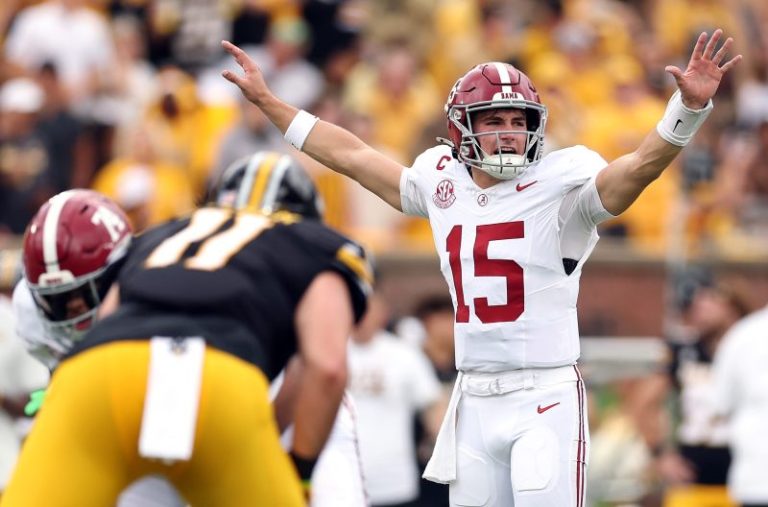
The sample size is small, with only seven starts under his belt. But Simpson is defying all expectations, racing out to the SEC lead in touchdown passes (16) while playing virtually mistake-free football since the season-opening loss to Florida State. QB1 status isn’t out of the question if he keeps going at this pace.
21. Spencer Fano, OT, Utah
An accomplished pass protector who looks tailor-made for a zone-blocking scheme, Fano has a way of exerting a certain degree of control no matter what scenario he faces. But his lean build likely will lead to questions of whether he needs to move inside at the next level, which could drag down his stock a good deal.
22. Jermod McCoy, CB, Tennessee
He’s still yet to make his return this season after suffering a torn anterior cruciate ligament in January, an injury that no doubt will loom over his draft stock. Yet McCoy’s playmaking credentials are not to be questioned after he notched four interceptions and 11 passes defensed last season for the Volunteers after transferring from Oregon State. The next month will be vital in establishing his trajectory.
23. Matayo Uigalelei, DE, Oregon
There’s not much mystery to a player who goes by ‘Young Concrete.’ The 6-5, 272-pounder wins with unmatched tenacity and a comfort in walking blockers backward. Honing his counters and becoming a more reliable presence against the run would elevate his game considerably, but both tasks seem within reach for a player who has shown impressive capacity for growth after also starring at tight end in high school.
24. CJ Allen, LB, Georgia
Wherever the ball is, Allen surely isn’t far behind, as the Bulldogs linebacker sticks to his man in coverage and tracks down opponents in the backfield. The 6-1, 235-pounder will have to continue to find ways to slip past bigger blockers in the pros, but his agility and craftiness help him avoid being engulfed.
25. Denzel Boston, WR, Washington
At 6-4 and 210 pounds, he’s what you would expect from a receiver consistently asked to haul in deep heaves and contested catches. A build not conducive to quick-twitch movements can be problematic in his efforts to beat press coverage and get going in his releases, but he has enough build-up speed to threaten defensive backs once he’s rolling.
26. Chris Brazzell II, WR, Tennessee
The Tulane transfer hasn’t kept up the torrid pace he set in the early season after burning Georgia for three touchdowns, but he’s still announced himself as one of the country’s pre-eminent deep threats. While working downfield will be his calling card early in his career, he’s also shown potential for growth – particularly as an intermediate target – beyond the basic route tree he’s asked to run in Tennessee’s offense.
27. Olaivavega Ioane, G, Penn State
The Nittany Lions’ season has been a downright disaster, but don’t place any of the blame on Ioane. The 6-3, 328-pound blocker continues to dole out punishment in the run game, but the massive progress he’s made as a pass protector has enabled him to become the leading candidate to be the first interior lineman selected next April.
28. Germie Bernard, WR, Alabama
From his previous stints at Michigan State and Washington to working alongside Ryan Williams in 2024, Bernard once seemed destined to max out with a complementary role in college. But amid Williams’ early struggles, the senior has reached a new level in 2025 by showing just how effective he can be as a go-to target. From creating separation to piling up yards after the catch, he has a strong handle on plenty of skills that will make him a central figure to any offense.
29. Colton Hood, CB, Tennessee
After learning behind Travis Hunter at Colorado last season, Hood has gotten his own turn to step into a playmaker role with an SEC-leading seven passes defensed. The 6-0, 195-pounder has the physical makeup and ball skills to hang in man coverage, though he’ll need to affirm that he can match up with the best receivers the conference has to offer.
30. Zion Young, DE, Missouri
With four sacks in his last four games – including two as part of an effort to close out a double-overtime win against Auburn – Young already has developed a strong finishing touch. Comfortable grappling with offensive tackles in the run game, the 6-5, 262-pounder is a well-rounded threat on the edge with a fairly high floor.
31. Caleb Lomu, OT, Utah
He represents the less heralded half of the Utes’ bookend blockers, but Lomu has a strong chance to join Fano as an early pick. Though the matchup against Texas Tech’s prolific pass rushers didn’t go his way, the 6-6, 308-pounder will keep teams captivated with his fleet footwork.
32. Trevor Goosby, OT, Texas
Tools, tools, tools. The 6-7, 312-pound redshirt sophomore has them in abundance despite having just a handful of starts to his name. He’s been one of the few reliable performers for the Longhorns offense, his stock is up and looking set up for a serious surge.
33. Sonny Styles, LB, Ohio State
A 6-5, 243-pound son of a former NFL linebacker with the movement skills of a safety – his previous position – should be an easy sell to any front office. The full extent of Styles’ contributions is no longer a hypothetical, however, as he’s become a reliable presence at the second level in addition to an intriguing movable chess piece.
34. Anthony Hill Jr., LB, Texas
There aren’t many linebackers in this class more dynamic than Hill, a thunderous blitzer who can be deadly once he locks onto ball carriers in the backfield. He still has work to do, though, to become a more complete player when asked to drop in coverage or otherwise operate beyond chase mode.
35. A’Mauri Washington, DT, Oregon
In his first year as a starter, the 6-3, 330-pounder has made a habit of detonating plays at the line of scrimmage. A supreme jumbo-sized athlete, Washington can be a force multiplier along the front even if he never ends up posting massive sack numbers.
36. Caleb Banks, DT, Florida
The 6-6, 330-pounder has missed all but one game with a foot injury that he later reaggravated and underwent surgery on. When healthy, he’s an absolute load for opposing offenses to handle in the middle, with surprising playmaking potential for a defender of his size.
37. Cashius Howell, OLB, Texas A&M
He’s small (6-2, 248 pounds) with a sawed-off build, traits that typically might doom an edge rusher’s stock. But the Bowling Green transfer has seized the SEC lead in sacks (8 1/2) by way of quick-twitch moves and a deep well of knowhow. Howell won’t be a fit for every scheme, but teams willing to look past his atypical traits might be in for quite the reward.
38. Chris Bell, WR, Louisville
The A.J. Brown comparisons come naturally for the 6-2, 220-pound target, who’s equally comfortable hauling in catches with defenders clinging to him as he is racing away from opponents with the ball in his hands. Bell is nowhere near as complete a receiver as the Eagles star is, but his early success – he ranks fourth in the FBS with 638 receiving yards – points toward a player who’s making massive strides in handling the finer points of the position.
39. A.J. Harris, CB, Penn State
Maybe this is a bit high for a player who’s had a bit of a turbulent ride in coverage this season, especially with several other top prospects at the position faring better this fall. But the 6-1, 186-pound Harris frequently dissuades opposing quarterbacks from even looking his way thanks to his ability to stay in receivers’ hip pockets downfield.
40. Jake Golday, LB, Cincinnati
A former transfer from Central Arkansas, Golday has continued his steady ascent this season by collecting 61 tackles and proving to be a hyperactive presence on the Bearcats defense. The former defensive end adds to this class’ wealth of well-built linebackers with surprising straight-line speed.
41. Joshua Josephs, OLB, Tennessee
His 6-3, 240-pound frame might be bordering on disqualifying for some teams that would view him as a designated pass rusher rather than an every-down player. But his size hasn’t stopped him from wreaking havoc in the SEC, where he’s tallied four sacks and three forced fumbles while holding up nicely against the run.
42. Connor Lew, C, Auburn
Rugged and reliable, Lew is the picture of what teams want from a center. He’s more solid than spectacular in most phases and might have some trouble against the most powerful defensive tackles the NFL has to offer, but his combination of intelligence and athleticism should make him a fixture of any front.
43. Quincy Rhodes Jr., DE, Arkansas
There’s no missing a 6-6, 276-pound defensive end with the burst and agility of a much smaller rusher. Rhodes can run hot and cold and too often turns to his (admittedly nifty) spin move, but his arrow is pointed firmly upward.
44. Garrett Nussmeier, QB, LSU
It’s been a strange season for a player who once seemed in the mix to be the top quarterback taken in 2026, with the Tigers’ repeated lackluster outings leaving plenty of questions about Nussmeier’s pro projection. The son of New Orleans Saints offensive coordinator Doug Nussmeier has long leaned on his anticipation and aggressiveness as a passer to compensate for his pedestrian physical tools. His quick processing and savvy approach might give him a higher floor than many of his peers, but it’s unclear how NFL teams will view a signal-caller who relies so heavily on timing given his other deficiencies.
45. John Mateer, QB, Oklahoma
Even in the volatile world of quarterback evaluations, Mateer sizes up as a particularly confounding passer to assess. That stems mostly from a playing style that flies in the face of efficient play at the position, with the Washington State transfer repeatedly embracing high-risk, high-reward throws. It might be impossible to get a daring playmaker to modulate his devil-may-care approach, but teams will still be drawn toward the prospect of harnessing his penchant for threading throws into tight windows and breaking long runs.
46. Isaiah World, OT, Oregon
There’s been a distinct learning curve for the Nevada transfer as he adapts to life in the Big Ten, but things seem to be coming together for World as of late. It’s almost impossible to find 6-8, 318-pound offensive tackles with his ease of movement, so some team will take an early flier in hopes of molding him into the next great left tackle.
47. LT Overton, DE, Alabama
Whether it’s working as an edge rusher or crashing back inside, the former five-star recruit and Texas A&M transfer isn’t afraid to mix it up with opposing linemen. But the next step in his pass-rush development has yet to be unlocked, and he might not collect more than clean-up sacks until he learns to do more than bull rush.
48. Kamari Ramsey, S, USC
There’s a sizable gap between Downs and the second safety in this class, with Toledo’s Emmanuel McNeil-Warren and Oregon’s Dillon Thieneman also having a case. Ramsey, however, might have a leg up on the field thanks to coverage instincts that leave him well-equipped to handle almost any assignment.
49. R Mason Thomas, DE/OLB, Oklahoma
With Bailey, Howell, Josephs and Texas Tech’s Romello Height all making strong impressions this season, the 2026 class has a strong crop of undersized pass rushers who warrant consideration on the first two days of the draft. A rocket off the edge who’s registered 5 1/2 sacks this season, the 6-2, 249-pound Thomas has shown he can be as disruptive as any name among that group.
50. Christen Miller, DT, Georgia
Several run-stuffing defensive tackles could have contended for the final spot, including Iowa State’s Dominique Orange and Ohio State’s Kayden McDonald. Miller, however, gets the nod thanks to explosiveness and lateral agility that indicate room for growth beyond the limited returns he’s provided so far in disrupting the passing game.
This post appeared first on USA TODAY