Brightstar Resources (BTR:AU) has announced Mining Approvals Received for Lord Byron Open Pit Mine
Download the PDF here.
This post appeared first on investingnews.com


Brightstar Resources (BTR:AU) has announced Mining Approvals Received for Lord Byron Open Pit Mine
Download the PDF here.

Zeus Resources Limited (ZEU:AU) has announced Casablanca Antimony Geophysics – Updated JORC Table
Download the PDF here.

The US Federal Reserve lowered its key interest rate for the first time in 2025 this week, while the Bank of Canada resumed cutting after pausing in March, providing a boost to growth-oriented sectors.
Tech stocks, particularly semiconductor and artificial intelligence (AI) companies, responded positively, reflecting investor optimism about a more supportive monetary environment for tech sector growth.
Fed Chair Jerome Powell cautioned that the cut was a risk-management move motivated by concerns over the labor market’s softness and persistent inflation risks, rather than a sign of strong economic confidence. He highlighted that downside risks to employment have increased, and that inflation remains above the Fed’s 2 percent goal.
Likewise, Bank of Canada Governor Tiff Macklem warned that broad-based tariffs and trade tensions pose structural risks to the Canadian economy. He emphasized that, unlike the pandemic bounceback, Canada will not see a quick economic rebound if tariffs persist, as they could permanently lower output and weaken growth across key sectors.
Nasdaq-100 performance, September 12 to 19, 2025.
Chart via Nasdaq.
Against that backdrop, the Nasdaq-100 (INDEXNASDAQ:NDX) put on a strong performance this week, closing at 24,626.25 on Friday (September 19), up 0.7 percent. The index saw momentum build toward the end of the week, supported by growth in technology and semiconductor stocks.
While the Fed’s decision was a key factor for the tech sector this week, a landmark deal stole the spotlight.
A strategic partnership between NVIDIA (NASDAQ:NVDA) and Intel (NASDAQ:INTC) dominated the news cycle on Thursday (September 18), sending shockwaves through the semiconductor industry.
In a historic move, NVIDIA announced a US$5 billion investment in Intel as part of a new partnership. The companies will collaborate on custom data center and PC products, aiming to jointly develop custom CPUs and GPUs by integrating NVIDIA’s AI and accelerated computing technologies with Intel’s x86 platforms for data centers and personal computing.
The deal marks a major realignment in the chip industry focused on AI infrastructure innovation. Shares of both companies finished the week higher, with Intel notching a notable 21 percent increase.
Semiconductor exchange-traded funds (ETFs) also surged in response to the NVIDIA-Intel partnership announcement, with the iShares Semiconductor ETF (NASDAQ:SOXX) gaining 4.17 percent, the Invesco PHLX Semiconductor ETF (NASDAQ:SOXQ) rising 3.93 percent and the VanEck Semiconductor ETF (NASDAQ:SMH) increasing 3.92 percent over the course of the week, reflecting strengthened investor confidence across the sector.
Semiconductor ETF performance, September 16 to 19, 2025.
Chart via Google Finance.
The Intel-NVIDIA collaboration comes after reports this week that China’s regulatory authority has instructed major tech firms like Alibaba (NYSE:BABA) and ByteDance to stop buying and cancel orders of NVIDIA’s AI chip designed for China. The news sent NVIDIA shares down early in the week, but the company ended the period flat.
The collaboration also helped provide a much-needed boost to Intel’s share price. The company has struggled with operational challenges and a difficult turnaround effort in the highly competitive semiconductor market.
In a direct reaction to the Intel-NVIDIA deal, shares of Advanced Micro Devices (NASDAQ:AMD) and Taiwan Semiconductor Manufacturing Company (NYSE:TSM) declined on Thursday.
The latter company recovered some of its losses on Friday.
Advanced Micro Devices and Taiwan Semiconductor Manufacturing Company performance, September 16 to 19, 2025.
Chart via Google Finance.
In other tech news, the US and UK signed a memorandum of understanding on Friday, pledging to boost collaboration in science and tech. Called the Technology Prosperity Deal, the arrangement focuses on civil nuclear power, aiming for independence from Russian fuel by late 2028 and developing new tech like small modular reactors.
The agreement also establishes joint task forces for AI standards and security, as well as quantum computing breakthroughs, and explores civil maritime nuclear applications.
Next week, investors will have an eye on Micron Technology’s (NASDAQ:MU) fiscal Q4 results, scheduled to be released on September 23 after market close. Analysts are estimating revenue of around US$11.15 billion.
Accenture (NYSE:ACN), a professional services company, will also release its fiscal Q4 results next week on September 25, with revenue expected in the US$17 billion range.
Securities Disclosure: I, Meagen Seatter, hold no direct investment interest in any company mentioned in this article.
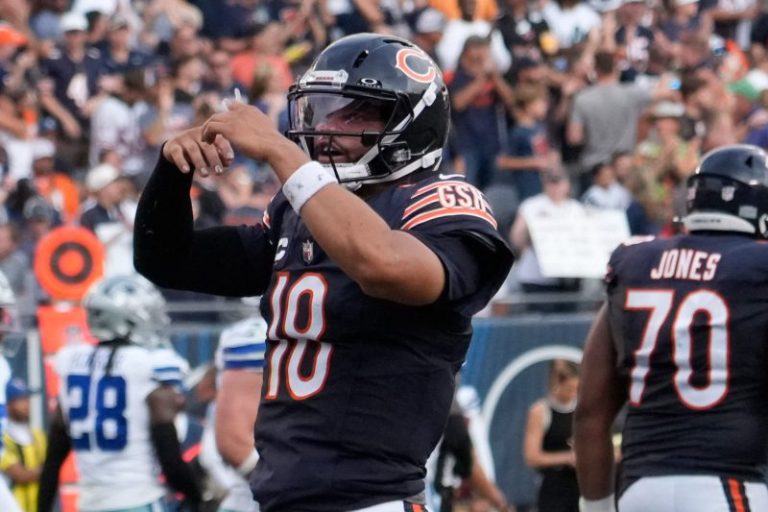
CHICAGO — This game is exactly what the Chicago Bears, and their fans, hoped for when they drafted Caleb Williams and hired Ben Johnson.
An explosive offense. An offense that’s fun to watch. An offense that can grind opposing defenses into submission. A defense that’s opportunistic. A defense that doesn’t beat itself.
Most of all, a team that can win.
“We have so many guys that care,” Williams said after Sunday’s 31-14 thrashing of the Dallas Cowboys.
“We always felt that our hard work, our preparation, the long-drive drill, the two-minutes, the moments, the four-minute, situational third downs — all those things, those are going to come,” Williams said. “I know we started off 0-2, but the belief was still there. The trust was still there. It’s just being able to go out there and do it.”
One game is not enough to revive a franchise or declare Williams the quarterback the Bears have been searching for since before he was born. This was against the Cowboys, after all, a team that has given up a whopping 891 yards — 720 of them in the air — and eight touchdowns in the last two games and doesn’t yet have Jadeveon Clowney.
Still, for a team and a fan base starved for any sign of progress, this was a game they desperately needed.
Williams matched his career high with four touchdowns, earning fans free hot dogs Tuesday from The Wieners Circle, while posting his best QB rating (142.6) yet. He finished a game without a sack for the first time since the Bears made him the overall No. 1 pick in the 2024 draft, and Chicago did not have any turnovers or pre-snap penalties.
While Rome Odunze remains Williams’ favorite target, he threw to eight different receivers. Williams was able to get rid of the ball quickly — that he was able to pull off the flea flicker that resulted in a 65-yard touchdown to Luther Burden III is a miracle — and his footwork looked better. He made better decisions and, unlike previous games, most of his misses were to the right area.
The defense, meanwhile, set the tone on Dallas’ first possession. Javonte Williams had rushed for 22 yards and was trying to get out of bounds when Tyrique Stevenson ripped the ball from his hands.
Tom Brady still causing headaches for the NFL a decade after Deflategate | Opinion
The Bears D finished the game with interceptions on each of Dallas’ last three drives, two by Tremaine Edmunds.
“It builds confidence for us, as a team and an organization, to be able to go out here and win these games and feel confident about who we’ve got on this field,” Williams said.
Chicago fans have been punked by the Bears on a regular basis since 1985. There have been some years when they resembled a real football team — Lovie Smith took the Bears to the Super Bowl in 2006 and had a winning record in five of his nine seasons — but mostly it’s been long stretches of futility.
Particularly lately.
Chicago hasn’t made the playoffs since 2020 and has had a winning record once in the last 12 years. Johnson is the fifth head coach in that time, and Williams is the third QB the Bears have drafted in the first round since 2017.
But Johnson’s success as Detroit’s offensive coordinator, coupled with Williams’ talent and savvy, gave fans optimism that the Bears had finally gotten it right.
Then the season began.
The Bears gagged up an 11-point lead in a loss to the Minnesota Vikings in the season opener, then got flattened by the Detroit Lions last weekend. Things were bad enough for a players’ only meeting before the Cowboys game.
And for The Wieners Circle, a local institution that specializes in hot dogs and sides of snark, to make its bet.
“The first two weeks had not gone the way we wanted to. It’s early, but we’ve got to get the issues fixed and I thought the guys were committed to that here this week,” said Johnson, who was given a game ball for his first win as a head coach.
Again, one game doesn’t make the Bears contenders for the Super Bowl. Or even the division title.
‘We’re behind the eight ball here,’ Johnson cautioned. ‘We’re 1-2 and we’ve got to get back to .500.’
But for one day, at least, the Bears lived up to their promise. After being so bad, for so long, that’s a huge victory.
Follow USA TODAY Sports columnist Nancy Armour on social media @nrarmour.
We’ve heard the declaration repeatedly for so many years: Special teams makes up one-third of the game.
Did you believe it?
Well, given drama across the NFL on Sunday, that axiom came to life as tried and so true.
Or maybe it’s something better explained by Tampa Bay Buccaneers coach Todd Bowles. His squad squandered a 20-point lead and fell behind the New York Jets inside the final two minutes when Will McDonald IV went 50 yards on a scoop-and-score return of his blocked field goal.
Bowles, well, didn’t want to believe it.
“Excuse my language, but you’ve got to be (bleeping) be (bleeping) me,” Bowles said of his real-time reaction to the blocked kick. “Then, after that, you see how much time is on the clock and you calm down and you try to win the game.”
The Bucs (3-0) drove 48 yards to set up Chase McLaughlin’s 36-yard field goal as time expired. On the day, McLaughlin booted five field goals – including two from 50-plus yards – to help Tampa Bay escape another close call. The Bucs are the first team since the 1970 merger to win with a game-winning score in the final minute of regulation in each of their first three games. Whew.
And the tight margin at Tampa was just one reminder of the special teams mantra. Kickers: It’s like you can’t live with them and can’t win without them.
I mean, all of this also happened on Sunday:
➤ The Rams blew a 19-point second-half lead, then had a would-be, 44-yard game-winning field goal blocked by Eagles D-tackle Jordan Davis, who returned it 61 yards for a touchdown on the final play of the 33-26 thriller at the Linc.
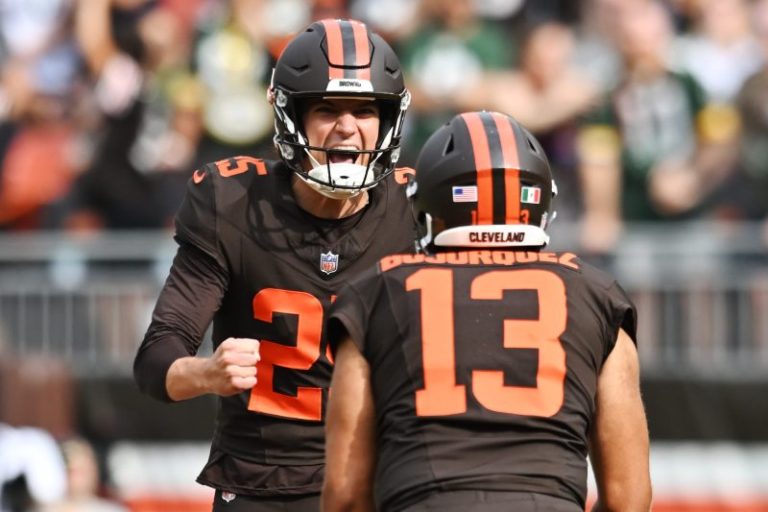
➤ The Browns rallied from a 10-point deficit to spring a 13-10 upset of the Packers – aided by Shelby Harris’ blocked field goal, which set up Andre Szmyt’s 55-yard game-winning field goal as time expired.
➤ The Broncos lost on a field goal as time expired for the second consecutive week as Cameron Dicker’s 32-yard kick kept a perfect record intact for the Chargers with a 23-20 nail-biter. A week earlier, Denver lost after being flagged for leverage on a missed field goal. Moving 15 yards closer for the re-kick, the Colts converted. This time, the Broncos were stung by a division rival. Tough losses.
➤ The 49ers beat a division rival, too, with a 35-yard field goal from Eddy Pineiro – his third of the game – as time expired to topple the Cardinals, 16-15.
Talk about close calls. Or angst among the gamblers.
None of this is automatic, even in an age where 50-yard field goals are increasingly (for some) becoming chip shots. Pineiro, after all, joined the 49ers in Week 2 as the replacement for Jake Moody, who had become too shaky to be trusted.
Szmyt, the Browns’ kicker, redeemed himself on Sunday after his 36-yard field goal attempt in crunch time sailed wide right in Week 1, thwarting the chance to upset the Bengals. He made up for it with the longest walk-off field goal in franchise history. Faith restored.
“He knows who he is,” Browns defensive end Myles Garrett said during his postgame news conference. “One moment doesn’t define you. He was just waiting for this opportunity to come again. We knew he was ready.”
The one-third-of-the-game axiom works both ways in another sense. Harris, Cleveland’s veteran defensive tackle, notched the seventh blocked kick of his 11-year career. That’s not coincidence.
“He always does it,” Browns coach Kevin Stefanski said. “Like, he’s very aware of that football and he’s got great anticipation.”
One third of the game? In crunch time, the kicking game seems to be much larger than merely that. The Rams can vouch for it. Davis’ block of Joshua Karty’s 44-yard kick was Philadelphia’s second as it followed an earlier block of a 36-yard attempt by his fellow defensive tackle, Jalen Carter.
Apparently, both of the defensive tackles took advantage of a particular matchup.
“Yeah, Kevin Dotson was …” Rams coach Sean McVay said, referring to the sixth-year guard. “The reality is, is that we’ve got to execute better and credit to them, they made the plays. I’m not going to make any excuses.”
And he won’t dispute that special teams represents a third of the game – at least.
Contact Jarrett Bell at jbell@usatoday.com or follow on social media: On X: @JarrettBell, on Bluesky: jarrettbell.bsky.social.
Entering the final week of the 2025 Major League Baseball season, playoff berths are still up for grabs with a pair of longtime postseason shoo-ins suddenly in danger of missing out.
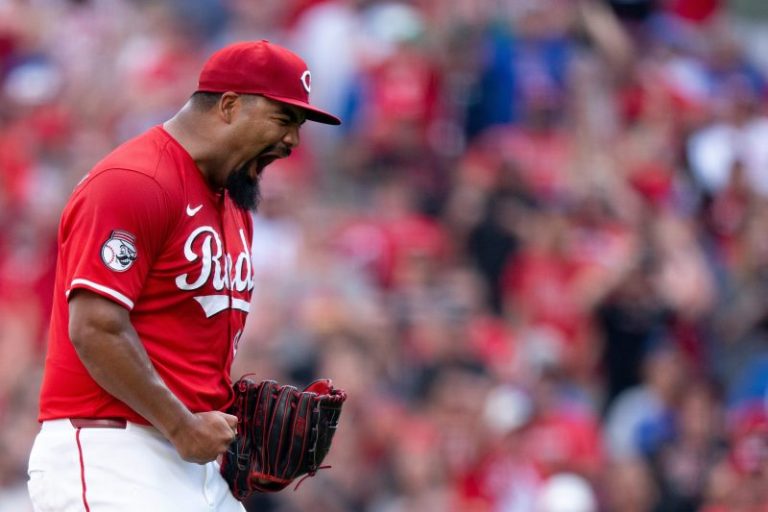
The Cleveland Guardians trailed the Tigers by 11 games in the American League Central on Sept. 4, but reeled off a 10-game winning streak and enter Monday, Sept. 22 just one game back in the division as Detroit has lost nine of its last 10. In the National League, the New York Mets had held a postseason spot since early April, but lost two of three over the weekend against the lowly Washington Nationals, falling behind the Cincinnati Reds for the final wild-card spot.
Cleveland hosts Detroit for a three-game set beginning Tuesday at Progressive Field, with the Tigers needing a sweep to clinch the head-to-head tiebreaker. The Guardians’ ascent also shook up the AL wild-card standings with the Boston Red Sox and Houston Astros needing to fight them off as well.
Here’s a look at the latest standings and playoff picture:
Top three reach playoffs
Top three reach playoffs
The USA TODAY app gets you to the heart of the news — fast. Download for award-winning coverage, crosswords, audio storytelling, the eNewspaper and more.
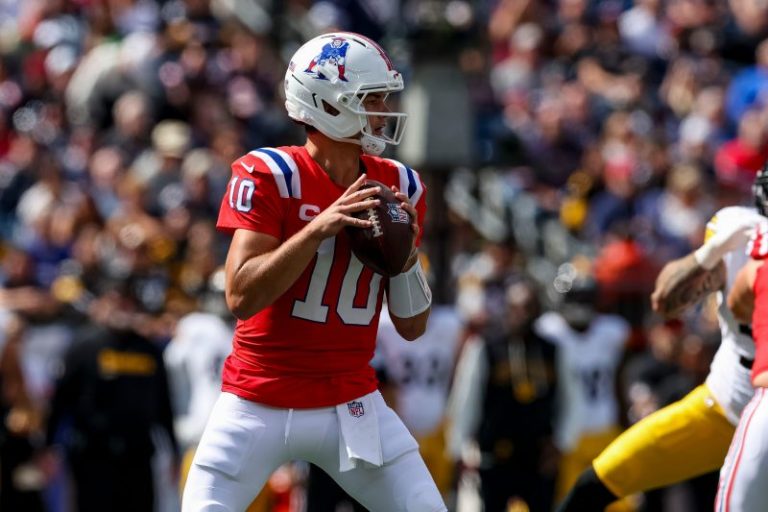
FOXBOROUGH, MA — The goal line, for an offense, typically means scoring chances.
For the New England Patriots’ offense Sunday in a 21-14 loss to the Pittsburgh Steelers, it was the site of calamity – on two separate, equally hurtful occasions. Every time it felt like the Patriots were building momentum, disaster struck.
The Patriots turned the ball over five times – four fumbles by three different players and one interception – compared to the Steelers’ lone turnover (an Aaron Rodgers interception). The game was there for the taking, except New England quite literally coughed it up. Second-year quarterback Drake Maye outplayed Rodgers, however, by completing 28 of 37 passes for (both to tight end Hunter Henry) and a pick.
“I’m not going to state the obvious,” Patriots head coach Mike Vrabel said. “We just have to not give them so many chances with the turnovers, take care of those things. There’s a lot to clean up. A lot of good in there, but unfortunately just not enough to get us to win, to get us to really have any sort of advantage in a football game.”
Worse than the Patriots’ mistakes was their timing. Running back Rhamondre Stevenson’s first error of the game happened three plays into the proceedings and less than two minutes had ticked off the clock. With the Patriots trying to tie the game at 14, he fumbled at the goal line early in the third quarter. Maye’s interception came seven seconds before halftime on a pass intended for Kayshon Boutte that Steelers’ defensive lineman Cam Heyward tipped at the line of scrimmage and fell into the hands of Brandin Echols. The play lingered in Maye’s mind as he headed to halftime.
“It stings just knowing we hurt ourselves,” he said, “and that’s what cost us.”
What Vrabel wants his young quarterback to understand, he said, is that winning can’t be accomplished in one play. Moving on to the next one is sometimes just as important.
“You can’t put the ball in harm’s way at that position,” Vrabel said. “But certainly Drake wasn’t alone.”
Maye’s fumble came in the fourth quarter when Nick Herbig forced the ball out and T.J. Watt recovered it; the Steelers went on their game-winning drive with the ensuing possession. Maye said he saw rookie running back TreVeyon Henderson break open late and he “tried to do something stupid” to get him the ball, thus exposing the pigskin.
But Vrabel said plenty of positives emerged – Maye’s ability to extend plays, scramble and pick up first downs (he rushed seven times for 45 yards) with his legs while delivering the ball consistently within his progression from the pocket.
“There’s a lot of good things in there, just some decision making that we need to have be better for him and for himself,” Vrabel said.
Stevenson, meanwhile, led all running backs last season with seven fumbles. His pair against Pittsburgh confounded his coach. In a 33-27 victory over the Miami Dolphins last week, Stevenson had 54 rushing yards and 88 receiving yards. This week, he cost his team the game. Figuring out how to deal with the yin and yang of his performances is something Vrabel said he can’t decide 20 minutes after the game ended.
“It’s like you sit there, and we were so excited about him and everybody is excited about him, the fans are, and we know what his capabilities are, and we’ve got to get him back,” Vrabel said. “We need him. We absolutely need him. You see what he was able to do for us last week, his ability to make some plays.
“We need him because he helped us win the game last week, and it was a different story today.”
It will be the same tale going forward for the Patriots until the turnover troubles are reversed.
All the NFL news on and off the field. Sign up for USA TODAY’s 4th and Monday newsletter.
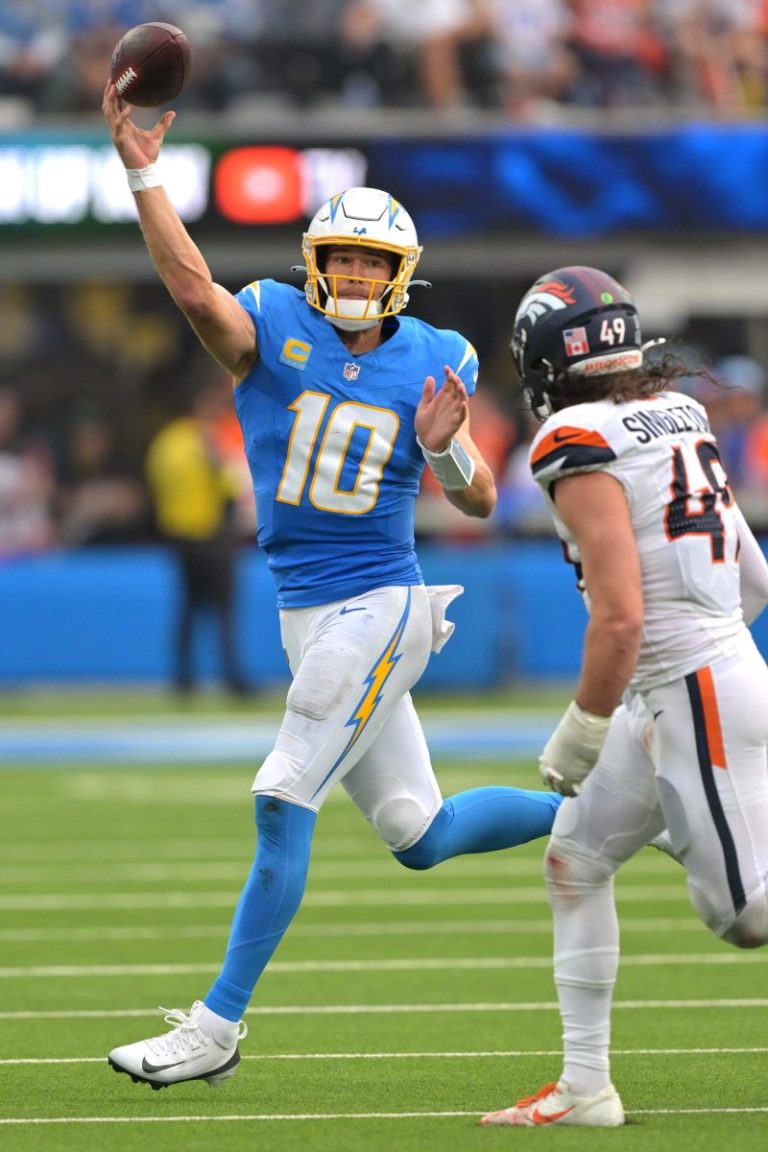
INGLEWOOD, CA – Los Angeles Chargers coach Jim Harbaugh is never short of catchphrases and analogies. But Harbaugh surprisingly didn’t have the words to describe the moment after the Chargers’ 23-20 comeback victory over the Denver Broncos.
“I don’t think I have the vocabulary to really express how great I feel with this win. Just the admiration for our team, for our players and coaches and just everybody,” Harbaugh said postgame. “Three wins in three games. It’s taken everybody.”
It took all three phases for the Chargers to beat Denver on Sunday.
The Broncos scored 17 unanswered points between the second and third quarters. Denver padded its lead to 20-13 advantage into the fourth quarter.
However, Justin Herbert led the Chargers on a game-tying seven-play, 76-yard drive that was capped off by a 20-yard touchdown strike to wideout Keenan Allen. The Chargers’ defense forced the Broncos to a three-and-out on their next possession.
The Chargers offense got the football back with under two minutes remaining. Herbert marched the squad down the field close enough for a game-winning 43-yard field goal by kicker Cameron Dicker that sliced between the uprights as time expired to improve the Chargers to 3-0.
“Not all games are going to be easy. I think we stuck through it and understood the situation of we’re losing at the current moment, but there’s time and downs and opportunity for us to get back out there. The offense took the field, and we knew we had one job. It’s to go move the ball and go score. And that’s exactly what we did,” Herbert said postgame. “Defense got the ball back. They came up with some huge stops all day, and special teams closed it out.”
The Chargers are 3-0 for first time since 2002. Perhaps most importantly, all three wins have come within the AFC West division. The Chargers are the third team since realignment in 2002 to beat division opponents in each of their first three games of a regular season.
Los Angeles sits alone on top of the AFC West.
“It means a lot. That’s like 23 years,” Chargers safety Derwin James said to USA TODAY Sports. “We are trying to become a different team. You can’t turn the worm and become a different team if you don’t take care of the games in front of you. We’re just trying to keep building on it. It’s an amazing team and we’re well coached.”
This year’s Chargers team looks different through three games. The Chargers never trailed against the Kansas City Chiefs. They shut down the Raiders in Las Vegas. In Week 3, they were faced with adversity after they gave up an early 10-point lead and trailed into the fourth quarter. But they were able to rally back in the final quarter and earned a hard-fought win.
When USA TODAY Sports asked James what Harbaugh’s message was to the team following the win. James replied: “the worm has turned.”
It turns out Harbaugh did have an analogy to describe the 3-0 Chargers.
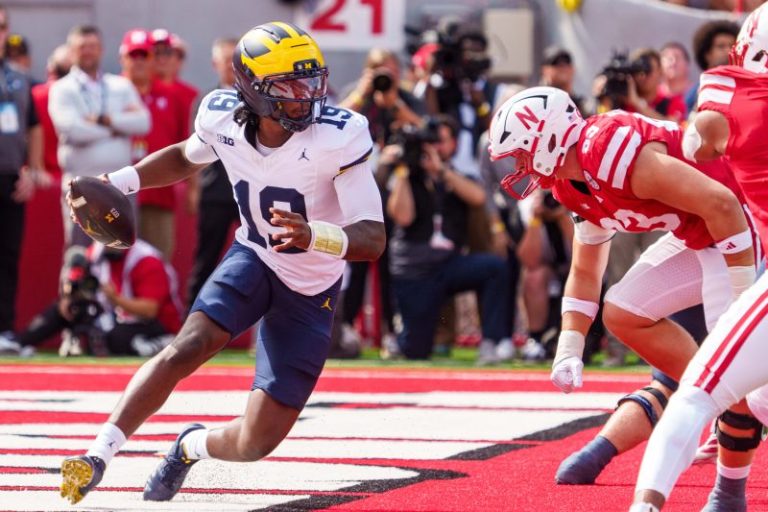
In a matchup of two of the most storied and historically decorated programs in the history of college football — both with large, rabid fan bases and iconic helmets — Michigan came out on top.
Behind a relentless rushing attack and an aggressive pass rush, No. 20 Michigan defeated Nebraska 30-27 on Saturday, Sept. 20 at Memorial Stadium in Lincoln, Nebraska in the Big Ten opener for both teams.
Watch Michigan vs. Nebraska football live with Fubo (free trial)
Wolverines running back Justice Haynes had his way against the Cornhuskers, rumbling for 149 yards on 17 carries, an output highlighted by a 75-yard touchdown run. It was one of two long touchdown scampers for Michigan, with Jordan Marshall’s 54-yard touchdown in the third quarter pushing his team’s lead to 27-17.
The Wolverines’ defensive line feasted on Nebraska quarterback Dylan Raiola, sacking the sophomore standout seven times. When he had time in the pocket, Raiola performed well, completing 30 of 41 passes for 303 yards, three touchdowns and an interception.
Michigan freshman quarterback Bryce Underwood completed 12 of 22 passes for 105 yards while adding 61 rushing yards, many of which came on a 37-yard touchdown run in the first quarter.
It was the first loss of the season for Nebraska, which has lost its past five Big Ten openers. The game was the Wolverines’ final contest under interim head coach Biff Poggi, with head coach Sherrone Moore set to return from his two-game suspension after Saturday’s victory.
USA TODAY Sports brought you live updates, scores and highlights from the game. Follow along.
This section will be updated throughout the game
Michigan recovers the onside kick after the Dylan Raiola touchdown pass and drains the remaining clock to defeat Nebraska 30-27.
Nebraska’s slim hopes of a win against Michigan remain alive. Dylan Raiola ends a 10-play, 75-yard drive with a 3-yard touchdown pass to Heinrich Haarberg to cut the Wolverines’ lead to 30-27 with 1:34 remaining.
As Nebraska drives up the field trying to cut into its deficit, Michigan defensive back Brandyn Hillman is whistled for targeting on a hit on Jacory Barney Jr. on a 21-yard catch that gets the Huskers to the Michigan 3-yard line. Upon video review, though, the penalty is overturned.
It didn’t end with a touchdown, but Michigan plays its latest drive about as well as it could have. The Wolverines go 77 yards in 16 plays while draining 8:46 off the clock, a march that ends with a 21-yard Dominic Zvada field goal to give Michigan a 30-20 lead with 3:54 remaining. Biff Poggi’s team got some big plays along the way, including a 19-yard Justice Haynes run.
It’ll take an unusual series of events for Nebraska to pull off a win.
Dylan Raiola is sacked for the seventh time today by Michigan, this time on a third-and-12 from the Nebraska 27-yard line.
The Huskers punt with 12:53 remaining and the Wolverines will take over at their own 20.
Nebraska will get the ball back with a chance to tie the game after forcing a Michigan punt. The Huskers’ drive will start at their own 29-yard line with 14:05 remaining.
A 12-play, 55-yard Nebraska drive ends with a 38-yard Kyle Cunanan field goal to get the Huskers within seven, 27-20, with 14:56 remaining.
Nebraska very nearly got closer, as it appeared Dylan Raiola found Nyziah Hunter for a 20-yard touchdown on a third-and-14, but officials rule that Hunter stepped out of the back of the end zone before coming back on the field to catch the pass.
Nebraska will open the fourth quarter with a 38-yard field goal attempt that could get it back within a single score of Michigan.
For the second time today, a Wolverines running back takes a handoff to the house for a long touchdown. This time, the heroics come courtesy of Jordan Marshall, who blasts through a huge gap his offensive line created and outruns the Nebraska secondary for a 54-yard touchdown scamper.
Michigan now leads 27-17 with 5:40 remaining in the third quarter.
Nebraska goes three-and-out, with an Archie Wilson punt giving Michigan the ball back at its 38-yard line with 6:21 left in the third quarter. The Huskers have negative-one yards across their two second-half possessions.
The Wolverines break their tie with Nebraska, going 22 yards in eight plays, setting up a Dominic Zvada 56-yard field goal that would have been good from 65 yards, if not 70. The kick ties a career long.
Since the start of the 2023 season, Zvada has made all nine of his field goal attempts from 50 yards or more.
Trapped inside their own 5-yard line, the Huskers aren’t able to do much of anything, going three-and-out and punting. Michigan will take over at its 40-yard line with 10:21 remaining in the third quarter after a 52-yard Archie Wilson punt.
The Wolverines get near midfield on their opening drive of the second half, but Justice Haynes is tackled two yard short of the sticks on a third-and-3, forcing a Michigan punt. Nebraska will take over at its own 3-yard line.
Here are how the Wolverines and Huskers measure up in some of the major statistical categories at halftime:
The game between the Wolverines and Huskers can be streamed on Paramount+, which requires a subscription, and Fubo, which offers a free trial to potential subscribers.
After Dylan Raiola’s Hail Mary touchdown pass, Nebraska and Michigan are tied at 17 at halftime. The Wolverines will get the opening kickoff of the second half.
Nebraska looked destined to head into halftime with a 7-point deficit, with a fourth-and-11 at its own 48-yard line with one second left in the second quarter. Dylan Raiola, however, had other ideas.
The Huskers’ sophomore quarterback rolls to his right and heaves up a Hail Mary, which ended up in the hands of Jacory Barney Jr. for a 52-yard touchdown with no time left on the clock.
Immediately after giving up the lead, Michigan takes it back.
On the first play from scrimmage after the Dylan Raiola touchdown pass, Wolverines running back Justice Haynes bursts through the middle of the Nebraska defense for a 75-yard touchdown run to put his team back on top, 17-10.
It’s the fourth touchdown run of at least 50 yards this season for the Alabama transfer.
We’ve got a tie ballgame in Lincoln. Nebraska’s third-down struggles end in a big way on its latest drive, with Dylan Raiola connecting with Jacory Barney Jr. for a 26-yard touchdown up the middle.
With the extra point, it’s tied at 10 with 2:01 remaining in the first half.
The Wolverines pick up a first down on a Justice Haynes 11-yard run, but they’re not able to get past their own 36-yard line. A 49-yard Hudson Hollenbeck punt is returned 20 yards by Nebraska’s Jacory Barney Jr. to the Huskers’ 37.
The Huskers are able to turn the Bryce Underwood fumble into points. A Dylan Raiola 21-yard completion to Dane Key gets Nebraska down to the Michigan 21-yard line. On a third-and-3 from the Wolverines’ 14, Raiola is sacked for a 7-yard loss. Michigan already has three sacks only 21 minutes into the game.
Nebraska’s able to salvage the drive with some points, though, getting a 39-yard field goal from Kyle Cunanan.
Bryce Underwood is able to scamper for a first down on an 8-yard run on third-and-3, but the Michigan quarterback is stripped of the ball by Elijah Jeudy just before going to the turf. Nebraska falls on it and will take over at its own 48-yard line.
After a false start turned a third-and-3 into a third-and-8, Dylan Raiola is sacked for an 11-yard loss back at the Nebraska 16-yard line, forcing the Huskers to punt. Michigan will take over at its own 37 after a 47-yard punt from Archie Wilson.
The first quarter ends with Nebraska facing a third-and-3 from its own 32-yard line.
Two Wolverines defenders key in on a quick out by Raiola. Jyaire Hill misses a potential pick-6, but linebacker Cole Sullivan makes the diving interception.
One play later, Bryce Underwood takes it 37 yards, untouched, up the gut on the QB keeper to get the first touchdown of the game. Michigan leads 10-0.
Michigan will be kicking itself after two straight missed opportunities at touchdowns in Nebraska territory. The first saw the Wolverines attempt a trick play, with wide receiver Semaj Morgan underthrowing a wide-open Donaven McCulley in the end zone.
Two plays later, Underwood’s deep pass to Channing Goodwin bounces off his hands. The Wolverines instead settle for a 46-yard field goal.
A short punt with a bad bounce for Michigan gives Nebraska the ball at the Wolverines’ 37-yard line.
The Huskers get down to the Michigan 21 before Dylan Raiola is sacked for a 5-yard loss on third-and-7. After that, a Kyle Cunanan 44-yard field goal misses wide right, marking the first time this season he hasn’t connected on an attempt.
Nebraska has twice gotten inside the Michigan 25, but hasn’t come away with any points.
Nebraska comes up empty-handed on a promising opening drive, getting down to the Michigan 6-yard line. From there, coach Matt Rhule opts to go for it on fourth-and-2, but the Wolverines snuff out a shovel pass from Dylan Raiola to Luke Lindenmeyer, with Lindenmeyer stopped a yard short of the sticks.
Michigan will take over at its own 5.
The Huskers will be going with their traditional home look against Michigan — white pants, red jerseys and white helmets.
Michigan will be wearing navy blue pants, white jerseys and the Wolverines’ famed winged helmets Saturday against Nebraska.
The Wolverines’ freshman phenom quarterback gets ready on the field at Memorial Stadium before his team’s game against Nebraska. It’s Underwood’s Big Ten debut.
Less than an hour before one of the biggest games of his college career, Nebraska sophomore quarterback Dylan Raiola leads his team out on to the field at Memorial Stadium in Lincoln.
Three games into his college career, Underwood, the No. 1 overall recruit in the 2025 class, has completed 57.5% of his passes for 628 yards, two touchdowns and an interception. Underwood has added 108 rushing yards and two touchdowns on 14 carries.
According to the latest Big Ten’s football availability report, here’s the injury outlook for Michigan and Nebraska:
During the picks segment on ESPN’s ‘College GameDay,’ four of the show’s five panelists went with Michigan to top Nebraska. Here’s a look at how they voted:
Here’s a look at Michigan football’s 2025 results and remaining schedule:
* Denotes Big Ten game
Here’s a look at Nebraska football’s 2025 results and remaining schedule:
* Denotes Big Ten game
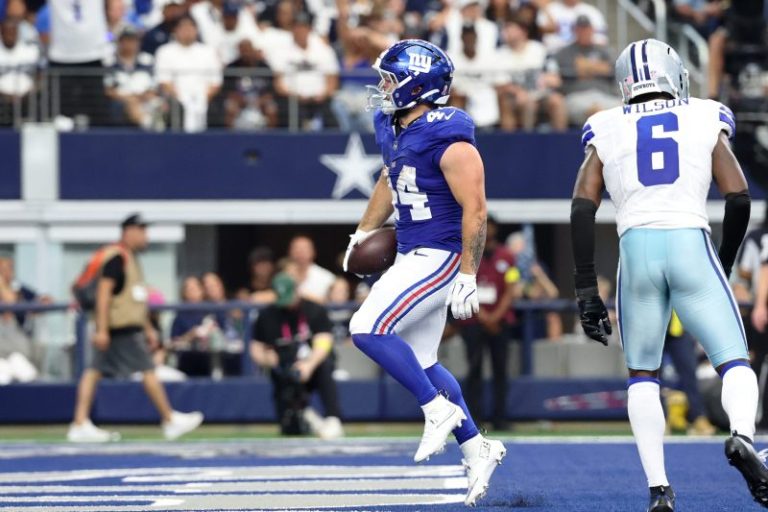
To assist with your most difficult lineup decisions, you’ll find my Week 3 fantasy football rankings below (scroll to the bottom for complete rankings). Toggle between standard, half PPR (point per reception), and full PPR to see where players rank in your league’s format.
Our team at the USA TODAY Sports Network also has you covered for all your fantasy football needs. Looking for up-to-date player news? We’ve got it. Need to know who the best starts and sits of the week are? We have an article for that. We also have fantasy defense rankings, kicker rankings and a trade value chart to help with all your trade decisions.
Given the volatility of this league and fantasy football in particular, these rankings will be updated up to a half hour before the Sunday afternoon games kick off. Let’s get to it.