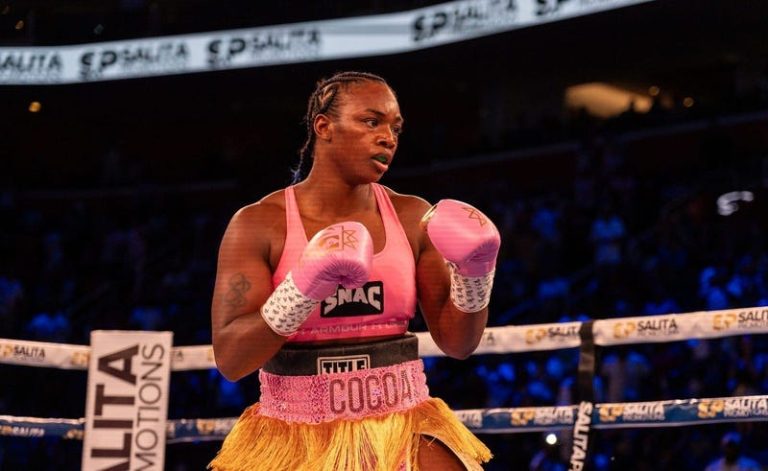
You can run from Claressa Shields, but you cannot hide. You can try to trade punches with her, but that’s not going to work, either.
Yet the latest example: Shields dominated Lani Daniels in a victory by unanimous decision Saturday night, July 26 at Little Caesars Arena in Detroit.
The judges scored the 10-round bout 100-90, 99-91, 99-91.
With the victory, Shields defended her undisputed heavyweight title and improved her record to 17-0.
Daniels stayed on the move in the opening rounds with the clear strategy to stay out of danger. Shields, who looked frustrated, chased after her opponent and to the delight of the sellout crowd landed punches.
But the track meet evolved into an actual boxing match with some electricity.
Daniels, the 37-year-old from New Zealand, opened up in the final rounds. She took a pounding but landed some shots before the final bell rang.
“I mean, she was just very, very tough and she was tricky toward the end,’’ Shields said. “But I know I won every round.’’
In chasing after Daniels early, Shields said she lost her “gas tank.’’ She kept punching even if that tank was on empty. Although in the later rounds she grew more stationary as the fight took place in close quarters.
“I thought she wanted to fight but she didn’t fight until the last three rounds,’’ Shields said. “And even then she was doing a whole bunch of head movement. She even headbutted me twice.
“But Lani is strong. She’s tough. And she got a big head.’’
Daniels’ record dropped to 11-3-2 with the loss.
The fight was Shields’ first since testing positive for marijuana after her victory over Danielle Perkins by unanimous decision, Feb. 2 in Flint, Michigan. Shields was suspended for five weeks before Michigan officials said evidence showed that a procedural error occurred during the drug test and Shields would face no disciplinary action.
Though a possible fight between Shields, 30, and Laila Ali, 47, has generated interested, a stronger candidate to be Shields’ next opponent is WBC and WBA super middleweight champion Franchon Crews-Dezurn (10-2).
Shadasia Green, the WBO and IBF super middleweight champion, beat Savannah Marshall by unanimous decision in a victory that fueled speculation of a possible fight between Green and Shields. But asked earlier this week about fighting Green, Shields responded, “Shadasia didn’t really sound too confident when my name came up.’’
USA TODAY Sports provided updates, analysis and highlights from the Claressa Shields vs Lani Daniels card:
Claressa Shields vs. Lani Daniels: Round-by-round analysis
Undisputed heavyweight title fight, 10 rounds
Lani Daniels came out alone. Claressa’s leading an army of dozens, including Rick Ross.
Round 1
Lani Daniels (a.k.a. “The Smiling Assassin’) comes out beaming despite being a massive underdog against Claressa Shields. Shields was beaming too. So who will be smiling when it all ends? The fight begins. Daniels bouncing around while Shields shadows her and measures her opponent. They trade jabs. Shields moves forward and aims for the body. Daniels backpedals. Shields showboating a little as she chases Daniels, who’s trying to bait Shields. Doesn’t work as Shields lands a right as the bell sounds. Shields 10, Daniels 9
Round 2
Daniels spent the first round running away and frustrating Shields. Now what? More movement from Daniels. Shields stalking her like prey. Shields misses with some big punches. Shields flicking the jab as Daniels stays on the move. Crowd boos. Shields throwing haymakers that mostly miss. Now she fires jabs at the body. Shields lands some big shots. Pounds away as the bell rings. Shields 20, Daniels 18
Round 3
Daniels comes out and is immediately circling the ring. She grabs Shields, then lets go. Shields connects with a body shot. Shields lands a left. She moves in behind three fast jabs but misses with the big punch. Shields uncorking big punches. Daniels lands a left. Shields smothering Daniels and chasing after her as the bell sounds. Shields 30, Daniels 27
Round 4
Daniels fires a jab early, then finds herself under siege with body shots. Shields jabs to the body. Now it’s back to head hunting. Daniels lands a shot, and Shields fights right back. Shields attacking as Daniels is on the ropes. Shields on the ropes and Daniels lands a couple of shots before Shields erupts and the bell rings. Shields 40, Daniels 36
Round 5
Daniels slugs and Shields slugs back. Daniels lands a hard right. Shields misses with two big shots. Shields lands a couple jabs. Daniels heating up. Has Shields on the ropes and she’s busy, but Shields is firing. Shields winding up. Shields pounds Daniels’ body and then aims for the head. Shields 50, Daniels 45
Round 6
Shields out behind the jab. Maybe catching her breath. But wow, those jabs she’s throwing are FAST. Daniels has slowed down. Shields lands a couple of head shots, but Daniels is moving in and throwing punches. Not nearly with the same force as Shields, who’s working Daniels’ body. Digging into the body some more. Shields 60, Daniels 54
Round 7
The two fighters meet at the center of the ring and mix it up. Shields landing the big punches, but Daniels stands her ground and pokes away. Shields swinging with gusto and Daniels poking away. Shields lands a huge right, attacking the body and head. Shields unloading. Daniels uncorks a shot late in the round. Shields 70, Daniels 63
Round 8
Daniels no longer running. Advancing forward now. Shields waits behind that jab. Shields cornered. Unleashes punches and pushes Daniels back. Connects with a left. And a big uppercut. Yet Daniels is coming forward and doing her best to throw leather. Daniels showing aggression but Shields still dominating the action, although Daniels got in some shots. Shields 80, Daniels 72
Round 9
There’s no running in Daniels now. She’s almost dictating the fight, and Shields is allowing Daniels to come forward. Once again, she’s in the corner and fighting off Daniels. Shields digs in with body shots. Credit Daniels for her toughness, but, wow, Shields still firing. Shields lands a big left and keeps the fists flying. Daniel responds but nothing that appears to hurt Shields. Shields 90, Daniels 81
Round 10
Daniels advances as the round begins. Shields against the ropes, and apparently content. Fires punches and fights her way off only to get back on the ropes again. Daniels throwing punches but looks spent. Daniels connects with a hard left and she’s not done yet. Shields unloads, but it’s not enough to drop Daniels. Shields 99, Daniels 91
Claressa Shields vs. Lani Daniels fight card results
- Claressa Shields def. Lani Daniels by unanimous decision, heavyweight title fight
- Tony Harrison def. Edward Diaz by unanimous decision, middleweight
- Pryce Taylor def. Robert Simms by unanimous decision, heavyweight
- Samantha Worthington def. Victoire Piteau by majority decision, for the WBA super lightweight interim title
- Caroline Veyre def. Licia Boudersa by unanimous decision, featherweight
- Da’Velle Smith def. Martez McGregor, super middleweight
- Cameran Pankey def. Dominique Griffin by unanimous decision, featherweight
- Jaquan McElroy def. Joshua Flores by unanimous decision, middleweight
- Kahmel Makled def. Devario Hauser by stoppage, light heavyweight
- Sardius Simmons def. Demetrius Banks by unanimous decision, heavyweight
Claressa Shields vs Lani Daniels: Time, PPV, streaming for fight
Claressa Shields will face Lani Daniels on Saturday, July 26 at the Little Caesars Arena in Detroit.
- Date: Saturday, July 26
- Time: 6 p.m. ET
- Claressa Shields vs. Lani Daniels main event ringwalks: 10 p.m. ET
- Stream: DAZN
Watch Shields v Daniels with DAZN PPV
Tony Harrison def. Edward Diaz by unanimous decision
Harrison, the former world middleweight champion, returned to the ring after a two-year layoff and got a scare in the 10-round bout.
After controlling most of the fight, he got knocked down by Diaz at the end of the ninth round. A slugfest ensued in a wild 10th that electrified the crowd as Harrison prevailed.
The knockdown looked precarious, especially since his last fight – against Tim Tszyu in 2023 – ended with his getting knocked out in the ninth round. But this time Harrison got back on his feet and showed resolve.
The judges scored it 96-93, 98-91, 97-92 in favor of Harrison, a 34-year-old from Detroit who improved to 30-4-1.
Diaz, a 34-year-old from the Dominican Republic, fell to 15-7.
Tony Harrison vs. Edward Diaz: Round-by-round analysis
Middleweight bout, 10 rounds
Round 1
Tony Harrison, a former WBC super welterweight champion, is about to begin his first fight since his 9th-round TKO loss to Tim Tszyu more than two years ago. Edward Diaz is getting a chance to test him as the fight gets underway. Diaz out first with jabs. Nothing lands. Harrison delivers a couple of body shots and Diaz responds with solid punches. Diaz countering nicely. Diaz lands a hard overhand right. Harrison responds with a flurry. Harrison 10, Diaz 9
Round 2
Two big misses by both boxers. Harrison ends up on the ropes – probably not where he needs to be. Diaz showing some aggression. Harrison leaning on the jab, and it’s fast. Diaz missing on a couple of big shots while Harrison makes effective use of the jab. Nice exchanges as the round ends, and Harrison delivers the last shot – an uppercut. Harrison 20, Diaz 18
Round 3
Diaz showing aggression and lands a nice right. Harrison answers with jabs and is backpedaling as Diaz swings and misses with an overhand right. Harrison connects with a combo, which energizes Diaz. Harrison delivers a left to Diaz’s midsection. Is Harrison growing? His height advantage looks more significant. Harrison lands a straight right that catches Diaz’s attention. Harrison 30, Diaz 27
Round 4
Harrison grows passive, and Diaz revs up. Diaz fails to capitalize. Diaz has Harrison on the ropes but does little damage. Harrison getting more active and connects with the left. Nasty jab from Harrison. Harrison digs in with a nice body shot. Harrison throwing punches with more snap while fighting in close quarters. Harrison 40, Diaz 36
Round 5
Diaz comes out stalking and Harrison seems comfortable backpedaling. Diaz revs things up but Harrison looks solid and lands a solid combination. Harrison looks strong as he throws the jab and the occasional right. Diaz wakes up and fires punches, but soon enough Harrison is back in control. Harrison 50, Diaz 45
Round 6
Diaz emerges the aggressor and attacks Harrison on the ropes. Harrison stabilizes things by firing his jab and exploiting his reach advantage. Harrison digs in with a body shot and a jab before Diaz pushes forward and lands a couple of nice shots. Diaz has absorbed plenty of punches but looks no worse for the wear. Harrison using that length again. Harrison 60, Diaz 54
Round 7
Harrison nearly does the splits after unleashing a hard right. The referee gets a towel and dries up the canvas. Harrison drills Diaz with a jab and a few more. Diaz swings and whiffs with an overhand right. Harrison showing some nice defense. Harrison popping Diaz with that jab again. Diaz opens up and fires away. Harrison stands his ground and digs into the body. Harrison 70, Diaz 63
Round 8
Diaz still swinging hard. Can he connect? Connect in a big way? Harrison grows more passive and leans on that jab. That jab is sweet. Or, if you’re on the wrong side of it, sour. Harrison delivering with authority. Harrison 80, Diaz 72
Round 9
Harrison firing that jab. To Diaz’s chagrin. Making it hard for Diaz to close the gap. But Diaz is moving forward. Just not able to do much, if any, damage. Diaz chasing Harrison … on a road to nowhere? Harrison slips away before Diaz can inflict much pain. Harrison goes down! Just as he nails Diaz, Diaz drops Harrison with a hard right. Harrison is up on his feet as the round ends. Harrison 88, Diaz 82
Round 10
Diaz charges after Harrison, clearly looking for the knockout. Harrison is stationary and taking heavy blows. Harrison now fires back. Harrison looks alive and now is digging in before he takes a hard right from Diaz. Heavy exchange of blows. Both men fighting bravely – and hard. Harrison snaps back Diaz’s head with an uppercut. Diaz is swinging super hard while taking heavy punches. These guys are slugging it out. What a finish! Harrison 98, Diaz 91
Pryce Taylor def. Robert Simms by unanimous decision
The crowd booed when Taylor was declared the winner of the eight-round heavyweight bout against Simms.
The outcome was indisputable, but the crowd’s response was understandable.
Taylor spent a significant portion of the fight showboating rather than trying to take out Simms, an ample target at 5-foot-11 and 258 pounds. But despite the crowd’s disdain, Taylor overpowered Simms during the occasional stretches when he turned serious.
The judges scored it 80-72, 80-72, 80-72 for Taylor, a 28-year-old from Brooklyn who improved to 9-0.
Simms, a 41-year-old from Saginaw, Michigan, fell to 12-5-1.
Pryce Taylor vs. Robert Simms: Round-by-round analysis
Heavyweight bout, 8 rounds
Round 1
At 6-foot-4 and 278 pounds, Pryce Taylor has a noticeable size advantage over the 5-foot-11, 258-pound Robert Simms. Simms lets fly with the left. Taylor staying patient rather than rushing into a potential windmill. Simms whirling away with the left, and Taylor responds with some powerful shots. Simms against the ropes and getting pounded. Taylor shimmies in the ring and draws laughter. Simms, who has taken a pounding, is not laughing. Taylor 10, Simms 9
Round 2
Simms throwing reasonably good punches. But Taylor is undeterred and attacks Simms’ body. Simms fights back, as Taylor swings big and misses big. Taylor 20, Simms 18
Round 3
Taylor exposing his body and all but getting Simms to hit him. Then he unloads with some big punches. Taylor controlling this fight, but not dominating it as it appears he could. Simms occasionally landing significant punches. Crowd boos as Taylor showboats before he resumes punching. Taylor 30, Simms 27
Round 4
Taylor appears to be toying with Simms. But Simms maintains a puncher’s chance given the decent power he can generate. Taylor takes three straight rights to the face, then responds with body work. Taylor 40, Simms 36
Round 5
Taylor stalking, but without much urgency. Still looks to be playing around. Shimmies again and the dancing and showboating continue. This is turning embarrassing, as Taylor coasts and showboats. The crowd boos. Understandably. Taylor finishes the round with hard rights. Taylor 50, Simms 45
Round 6
More foolishness from Taylor, who looks into the crowd and nods. This is devolving into farce. Up go chants: “Knock him out. Knock him out.’’ Now Taylor unloads, with a smile. Simms still on his feet, comfortably. Taylor 60, Simms 54
Round 7
Taylor comes out with some more seriousness. More no-look punches from Taylor. Simms throws a hard right and Taylor responds with force. Taylor may simply have grown frustrated that he can’t take out Simms. Taylor 70, Simms 63
Round 8
Probably a moral victory for Simms to finish this fight on his feet. But no victory for the crowd, although Taylor is unloading with a minute left in the fight. Simms wobbles, but rather than fall down he unloads a couple of punches as the bell sounds and the crowd boos. Taylor 80, Simms 72
Samantha Worthington def. Victoire Piteau by majority decision
Claressa Shields came out to watch Worthington, who was seeking her eighth knockout and to maintain her unbeaten record.
Worthington had to settle for something less decisive, beating Piteau by majority decision in their 10-round bout to win the WBA super lightweight interim title.
Worthington dominated the first half of the fight and did just enough to prevail after Piteau mounted a comeback.
The judges scored it 99-91, 95-95, 96-94 for Worthington, a 29-year-old from Lexington, Kentucky, who improved to 12-0.
Piteau, a 26-year-old from France, fell to 14-3.
Samantha Worthington vs Victoire Piteau: Round-by-round analysis
For the WBA super lightweight interim title, 10 rounds
Round 1
With the WBA super lightweight interim title up for grabs, here come Samantha Worthington and Victoire Piteau. And make note that Worthington has 7 KO’s while winning all 11 of her fights. Worthington the aggressor and landing big shots early. Now attacking the body with her right hand. Piteau unleashes a flurry, but without Worthington’s power. Worthington 10, Piteau 9
Round 2
Worthington comes out charging hard. The two exchange sharp blows, and Piteau is not backing down. But Worthington is almost relentless and more powerful than Piteau. Worthington 20, Piteau 18
Round 3
Claressa Shields is three rows behind Worthington’s corner watching the fight, according to DAZN. Piteau throwing a flurry and Worthington responds with a sledgehammer of a right. Worthington 30, Piteau 27
Round 4
Piteau bravely staying within range of Worthington’s punches. She’s eating punches in exchange for chances to land them too. Now Worthington makes her pay. The gutsy Piteau lands a combination and deserves the round. Worthington 39, Piteau 37
Round 5
Piteau still standing her ground and eats a big left. Worthington now attacking Piteau’s body. Piteau just keeps swinging, with less authority than frequency. Worthington walking through the punches, some hard ones, too. Worthington 49, Piteau 46
Round 6
Piteau firing away with her pistols as Worthington tries to load up with the howitzer. Worthington shoves a left into Piteau’s face. But she responds with a right. Lands a hard right, too, as the round ends. Worthington 58, Piteau 56
Round 7
Worthington digs in with body shots. Piteau has weathered the storm and now she’s the one who looks relentless. Worthington 67, Piteau 66
Round 8
Worthington charges out and lands punches, but Piteau fires back. Worthington is landing the big shots again, despite the peppering coming her way from Piteau. Now Worthington appears to be tiring. Piteau lands some late counterpunches, but it’s Worthington’s round. Worthington 77, Piteau 75
Round 9
Piteau’s tank doesn’t look to be close to empty as she keeps firing away. Worthington has lost her snap and eats a big right. Piteau lands a combination and Worthington is unable to dominate as she did early in this fight. Worthington 86, Piteau 85
Round 10
Worthington comes out swinging, and Piteau is swinging back. Worthington connects with a solid right. And another. But Piteau fights back and lands a solid right of her own. Sensational exchange as the round comes to a close. Worthington 96, Piteau 94
Caroline Veyre def. Licia Boudersa by unanimous decision
Veyre smothered Boudersa, landing 158 punches to only 60 punches for Boudersa in their 10-round featherweight fight. It ended with Boudersa bleeding badly – largely because of an accidental headbutt – and the outcome in no doubt.
The judges scored it 99-91, 98-92, 99-91 for Veyre, a 36-year-old from Canada who improved to 10-1.
Boudersa, a 32-year-old from France, fell to 24-4-2.
Caroline Veyre vs. Licia Boudersa: Round-by-round analysis
Featherweight bout, 10 rounds
Round 1
Caroline Veyre bounced back from her first loss with two victories. Licia Boudersa needs a win to boost her stock after going 2-2 in her last four fights. And here they come as the bell rings. Boudersa comes out firing jabs. Veyre mostly on the defensive. Boudersa looks substantially bigger too as she uncorks her right hand. Impressive opening for Boudersa. Boudersa 10, Veyre 9
Round 2
Boudersa throwing effective jabs. Fighters got tangled up and that appears to be Veyre’s strategy, get inside and neutralize the jabs. Veyre lands a couple of hard lefts. Bounce-back round for Veyre. Boudersa 19, Veyre 19
Round 3
Early exchange won by Veyre. She’s showing considerable aggression and lands a shot to the body. With Boudersa against the ropes, Veyre lands a flurry of shots. Veyre showing terrific footwork too while landing more punches. Veyre 29, Boudersa 28
Round 4
Boudersa warned by the referee for holding. Boudersa was not warned for the two lefts Veyre landed on her. Another solid round for Veyre. Veyre 39, Boudersa 37
Round 5
Veyre lands a head-snapping jab. Boudersa exerting plenty of effort but struggling to get to Veyre, who remains active and is putting together combinations. Boudersa responds with a big right. Veyre 49, Boudersa 46
Round 6
Veyre comes out aggressively again and lands combinations. Boudersa winds up and throws the right. Swing and a miss. Twice. Veyre throwing with less velocity but with precision. And now Boudersa is bleeding badly from the nose. Veyre lands two solid lefts and is going in for the kill. Quick on her feet, too. Veyre 59, Boudersa 55
Round 7
Boudersa shows some fight, but this is about more skill than fight. Boudersa eats another right and Boudersa is warned for the second time about shoving down Veyre. Veyre lands a combination and Boudersa collapses on Veyre after pushing her down. Cheap move. Veyre 69, Boudersa 64
Round 8
Looks like more target practice for Veyre, landing an assortment of punches. Stiff jab to Boudersa’s face. And another. Veyre’s quickness paying off big time. Veyre 79, Bourdesa 73
Round 9
Boudersa throws a couple of big overhand rights. At least one of those landed. Ref now warns Veyre for holding. Inside fighting ensues. Boudersa bleeding badly from the left eye resulting from a headbutt. Veyre attacking now. Blood coating both boxers. What a mess. Veyre 89, Boudersa 82
Round 10
Bell rings but Boudersa remains on her stool. Now she’s up and ready to go. Credit Boudersa. Showing no sign of quit. And, well, no sign of winning. Boudersa lands a terrific straight right. Veyre looks unfazed. A nice left from Boudersa as the fight comes to a close. Veyre 98, Boudersa 92
Claressa Shields vs. Lani Daniels fight card
Main card
- Claressa Shields vs Lani Daniels; Heavyweight, for the undisputed title
- Tony Harrison vs Edward Diaz; Middleweight
- Pryce Taylor vs Robert Simms; Heavyweight
- Samantha Worthington vs Victoire Piteau; Super lightweight, for the WBA interim title
- Caroline Veyre vs Licia Boudersa; Featherweight
Claressa Shields vs. Lani Daniels fight card odds
Fight card, according to DAZN and odds according to BetMGM on Saturday.
- Claressa Shields (-2500) vs Lani Daniels (+1000); Heavyweight, for the undisputed title
- Tony Harrison (-1400) vs Edward Diaz (+800); Middleweight
- Pryce Taylor vs Robert Simms; Heavyweight (odds not listed as of writing)
- Samantha Worthington (-600) vs Victoire Piteau (+450); Super lightweight, for the WBA interim title
- Caroline Veyre (-900) vs Licia Boudersa (+600); Featherweight
Claressa Shields vs. Lani Daniels Predictions
Bleacher Report: Shields via fifth-round knockout
Staff writes: ‘Perkins comes into the bout looking to play spoiler. The 42-year-old will be the biggest opponent that Shields has seen in the ring, but is still considered to be a massive underdog.’
Sports Illustrated: Claressa Shields
Apratim Banerjee writes: ‘Claressa Shields is certainly the more decorated athlete heading into the contest and she is the favorite for a reason. However, Shields is making a jump to heavyweight. That said, Danielle Perkins is naturally a heavyweight and could have the strength and weight advantage over Shields, making her chances interesting. However, Shields is too experienced and crafty and should be able to manage a decision win against Perkins. A finish looks unlikely to take place.’
Sportskeeda: Claressa Shields via unanimous decision
Staff writes: ‘Shields is the more polished boxer and will control the pace of the fight. She will force Daniels on her back foot right from the opening bell. Her accurate jabs will prevent her opponent from gaining any kind of momentum. Shields will also target Daniels’ body to limit her movement inside the ring.’
Claressa Shields post-retirement scenario
Claressa Shields said she’s unsure if Laila Ali will come out of retirement at 47 and fight Shields for $15 million. That’s how much Shields said her team is prepared to guarantee Ali.
“I know I can be 60 and if one of these young girls come calling me out when they got $15 million, I’m stepping out,’’ Shields said. “I’m stepping up and I’m going to get the money. Especially if I’m in good shape and I’m helping and I believe that I can still fight. I’m definitely going to do it.’’
Claressa Shields expects sellout crowd
Claressa Shields is expected to fight in front of a sellout crowd of 19,000 at Little Caesars Arena, according to the fight card’s promoter, Dmitriy Salita.
“Yeah, we’re definitely going to have a packed out arena,’’ Shields told USA TODAY Sports earlier this week. “We’re doing really great at ticket sales. I don’t know if I can announce how much the ticket sales is yet, what our gate was, but it’s highest gate that I’ve done so far and we have worked so hard on this.’’
Claressa Shields drug test drama
This fight was Claressa Shields’ first since testing positive for marijuana after her victory over Danielle Perkins by unanimous decision Feb. 2 in Flint, Michigan. Shields was suspended for five weeks before Michigan officials said evidence showed that a procedural error occurred during the drug test and Shields would face no disciplinary action.
Claressa Shields to clash with Jake Paul company?
Claressa Shields, the star of Salita Promotions, addressed whether Salita Promotions might one day be rivals with Most Valuable Promotions (MVP), co-founded by Jake Paul. MVP partnered with Netflix on an all-women card held in front of a sellout crowd of 19,729 on July 11 at Madison Square Garden.
“Hey, they got all those good girls on the roster,’’ Shields said of MVP, “but they don’t have the greatest and that’s a problem for them.’’
Of course, Shields was referring to herself, the self-described G.W.O.A.T. (Greatest Woman Of All-Time).
“I wish them well, but at the end of the day, I’ve always been a one-woman army and looks like I’m winning the war so far.’’
Claressa Shields sizes up Lani Daniels
Yet another Claressa Shields fight, yet another victim? She sized up her next opponent, Lani Daniels, during an interview with USA TODAY Sports.
“She’s not as big as Danielle Perkins,’’ Shields said, referring to her last opponent, “but she’s very elusive. She’s fast, she’s aggressive, she’s very awkward and I look forward to figuring it out and fighting her on Saturday.
“I am very great at being very strategic and figuring out how about putting my opponent through the most pain and beat ’em up in here. And that’s my own goal is just to beat her up. I want to beat Lani Daniels up. I want to put her on an entertaining fight. I want to collect some more belts and I want to continue to let everybody know I’m the greatest woman of all time because the things that I do these other girls can’t do.’’
Claressa Shields’ new tattoo
Shields’ newest tattoo, apparent when she shifted the top of her swimsuit at the weigh-in, is “Papoose.’’ Papoose, born Shamele Mackie, is a rapper and Shields’ boyfriend.
Papoose relationship history with Remy Ma
Papoose, a New York rapper born Shamele Mackie who is Claressa Shields’ boyfriend, is embroiled in a messy divorce from Remy Ma, also a rapper from New York. On May 22, Papoose posted on Instagram what he said was confirmation that a complaint or divorce had been filed.
“The only reason I haven’t filed previously Is for the sake of my daughter,’’ he wrote on Instagram, suggesting the drama has turned the situation “into a circus.’’
Shields and Papoose acknowledged their relationship at the end of last year after Papoose and Remy Ma were estranged.
Papoose net worth
The net worth of Papoose (47), Claressa Shields’ boyfriend, is $500,000, according to Celebrity Net Worth. Shields (30) has a net worth of between $5 million and $10 million, according to Finance Monthly.
Who is Remy Ma?
Remy Ma, the estranged wife of Papoose, in December posted text messages she said showed Papoose and Claressa Shields were having an affair before the boxer and rapper had publicly acknowledged the romance. Papoose fired back on Instagram, writing that Remy Ma chose “to cheat repeatedly.’’
Remy Ma is a four-time Grammy-nominated rapper from the Bronx who also has appeared on reality shows such as ‘Love & Hip Hop.”
Claressa Shields is candid about camera
On X, Shields wrote, “Everyone want they face in the camera. Sit down it ain’t bout you today.’’
Surely Shields means the camera is for her.
Claressa Shields and Laila Ali feud continues
Claressa Shields is putting her undisputed heavyweight title on the line against Lani Daniels Saturday, July 26, but a piece of her mind is occupied by someone else.
Laila Ali.
Shields and her team have said they put $15 million in escrow for Ali — provided she agrees to fight Shields. Four days since they made the offer, Ali has yet to respond, according to Shields.
“Do you want to entertain a fight or do you not?’’ Shields said, referring to Muhammad Ali’s daughter. “And I think that she should let me and the public know because the public is very, very interested. …
Read more on what Claressa Shields had to say about rival Laila Ali.
Claressa Shields eyes motherhood ahead of fight
World champion Claressa Shields joined The Pivot Podcast ahead of her highly anticipated fight against Lani Daniels in Michigan on Saturday, July 26, where she discussed her future outside of boxing.
The Pivot Podcast, hosted by former NFL players Ryan Clark, Channing Crowder, and Fred Taylor, featured a discussion with boxing star Shields. During the episode, she announced her plans to start a family with her partner, rapper Papoose, next year. She explained that one of the main reasons for this decision is her desire to be present for her children rather than waiting until later in her career to start a family. Although she plans to take time off to have a child, she intends to return to the ring to continue her boxing career at some point. — Elizabeth Flores
Claressa Shields’ gift beyond boxing
“Attention has always just kind of came to me,’’ Shields told USA TODAY Sports. ” I can go and hide in the corner and people would still find a way to (approach her). People gravitate toward me and it’s been that way my entire life.’’
On Saturday, July 29, Shields is expected to fight in front of a sellout crowd of 19,000 at Little Caesars Arena in Detroit, according to Dmitriy Salita, promoter of the 11-fight card with Shields putting her undisputed heavyweight title against Lani Daniels in the main event.
Josh Peter has more on Shields and her gift beyond boxing.
Claressa Shields wows at weigh-in
The undisputed women’s heavyweight champion wore high heels, a fur coat, an eye-catching swimsuit and a G.W.O.A.T. chain.
Before Shields stepped on the scale, someone brushed her long blond hair and she flexed her biceps. Her official weight: 174.6 pounds.
Claressa Shields vs. Lani Daniels main card, ring walk start times
- Main card start time: 6 p.m. ET
- Main event ring walks: 10 p.m. ET (approximate)
Claressa Shields parents
Claressa Shields’ father, Clarence, signed her up for boxing, according to Shields. “…even though, he did not want me to actually fight!’’ she wrote on Instagram. “My dad believed in my dreams and me at very young age! I thank God for him! He’s who I get my loud laugh, Gift of gab and quick jab from: I can really write paragraphs about my dad!’’
Of her mother, Marcella Adams, Shields wrote on Instagram, “My mama is my biggest supporter and supports everything I do. She has a hard job because I ain’t the average woman. And wasn’t the average kid. Imagine a little skinny girl coming home with a busted lip or a black eye from boxing the boys.’’
Claressa Shields vs. Lani Daniels live stream, price
Claressa Shields will face Lani Daniels on Saturday, July 26, and the event will be streamed on DAZN. In the U.S., fans can purchase the event for $29.99.
‘The Fire Inside’ movie
“The Fire Inside,’’ a movie about Claressa Shields’ life and boxing career, was released in December. Ryan Destiny, the actress whose work includes roles in the FOX TV musical “Star,’’ played Shields.
On Rotten Tomatoes, the movie scored impressively – 93 percent based on 120 reviews and 94 percent based on more than 500 verified ratings. But the movie has generated $8.1 million at the box office, about $4 million less than its budget.
Claressa Shields vs. Lani Daniels: Tale of the tape
This post appeared first on USA TODAY