
Author

admin

Browsing

As the global economy shifts toward electrification and clean energy, lithium has emerged as a cornerstone of the energy transition, and the US is racing to secure its place in the supply chain.

Lithium-ion batteries are no longer just critical to electric vehicles (EVs); they’re becoming vital across sectors to stabilize power systems, particularly amid growing reliance on intermittent renewables.

According to Fastmarkets, demand for battery energy storage systems (BESS) is accelerating, driven by data centers, which have seen electricity consumption grow 12 percent annually since 2017.

In the US, where data infrastructure is heavily clustered, BESS demand from data centers alone could make up a third of the market by 2030, with a projected compound annual growth rate of 35 percent.

As the US works to expand domestic production and reduce import dependence, policy uncertainty, including potential rollbacks of EV tax credits and clean energy incentives, clouds the investment outlook.

1. Sociedad Química y Minera (NYSE:SQM)

Year-to-date gain: 10.43 percent
Market cap: US$10.82 billion
Share price: US$40.64

SQM is a major global lithium producer, with operations centered in Chile’s Salar de Atacama. The company extracts lithium from brine and produces lithium carbonate and hydroxide for use in batteries.

SQM is expanding production and holds interests in projects in Australia and China.

Shares of SQM reached a year-to-date high of US$45.61 on March 17, 2025. The spike occurred a few weeks after the company released its 2024 earnings report, which highlighted record sales volumes in the lithium and iodine segments. However, low lithium prices weighed on revenue from the segment, and the company’s reported net profit was pulled down significantly due to a large accounting adjustment related to income tax.

In late April, Chile’s competition watchdog approved the partnership agreement between SQM and state-owned copper giant Codelco aimed at boosting output at the Atacama salt flat. The deal, first announced in 2024, reached another milestone when it secured approval for an additional lithium quota from Chile’s nuclear energy regulator CChEN.

Weak lithium prices continued to weigh on profits, with the company reporting a 4 percent year-over-year decrease in total revenues for Q1 2025.

2. Lithium Americas (NYSE:LAC)

Year-to-date gain: 9.67 percent
Market cap: US$719.1 million
Share price: US$3.29

Lithium Americas is developing its flagship Thacker Pass project in Northern Nevada, US. The project is a joint venture between Lithium Americas at 62 percent and General Motors (NYSE:GM) at 38 percent.

According to the firm, Thacker Pass is the “largest known measured lithium resource and reserve in the world.”

Early in the year, Lithium Americas saw its share rally to a year-to-date high of US$3.49 on January 16, coinciding with a brief rally in lithium carbonate prices.

In March, Lithium Americas secured US$250 million from Orion Resource Partners to advance Phase 1 construction of Thacker Pass. The funding is expected to fully cover development costs through the construction phase. On April 1, the joint venture partners made a final investment decision for the project, with completion targeted for late 2027.

Other notable announcements this year included a new at-the-market equity program, allowing the company to sell up to US$100 million in common shares.

3. Lithium Argentina (NYSE:LAR)

Year-to-date gain: 8.46 percent
Market cap: US$467.28 million
Share price: US$2.90

Lithium Argentina produces lithium carbonate from its Caucharí-Olaroz brine project in Argentina, developed with Ganfeng Lithium (OTC Pink:GNENF,HKEX:1772).

The company is also advancing additional regional lithium assets to support EV and battery demand.

Previously named Lithium Americas (Argentina), the company was spun out from Lithium Americas in October 2023.

While shares of Lithium Argentina spiked in early January to a year-to-date high of US$3.10, the share price has been trending higher since June 19 to its current US$2.90 value.

Notable news from the company this year includes its name and ticker change and corporate migration to Switzerland in late January and the release of the full-year 2024 results in March.

In mid-April, Lithium Argentina executed a letter of intent with Ganfeng Lithium to jointly advance development across the Pozuelos-Pastos Grandes basins in Argentina. The plan includes a project fully owned by Ganfeng as well as two jointly held assets majority-owned by Lithium Argentina.

The company released its Q1 results on May 15, reporting a 15 percent quarter-over-quarter production reduction, which it attributed to planned shutdowns aimed at increasing recoveries and reducing costs.

Overall, the production guidance for 2025 is forecasted at 30,000 to 35,000 metric tons of lithium carbonate, reflecting higher expected production volumes in the second half of the year.

Securities Disclosure: I, Georgia Williams, currently hold no direct investment interest in any company mentioned in this article.


This post appeared first on investingnews.com

Self had two stents inserted during a heart procedure that “went very well,” and he is expected to make a full recovery.

“He is in good spirits and expects to be released from the hospital soon.”

The university did not disclose any information regarding a timetable for Self’s recovery or whether he will miss the upcoming basketball season.

Self previously underwent a heart procedure and had two stents placed to treat blocked arteries in 2023. The veteran coach had experienced chest tightness and had concerns about his balance after watching shooting as his team was preparing for a Big 12 tournament quarterfinal game that year.

He recovered and was present at NCAA Tournament practices, but did not fully return to coaching on the sideline for games until the following season.

Who is Bill Self?

Bill Self has spent the past 22 seasons as Kansas’ head basketball coach, winning the national championship in 2008 and 2022.

The Jayhawks have qualified for the NCAA Tournament 21 times during Self’s tenure, only missing the 2020 season when the tournament was canceled due to the COVID-19 pandemic.

He has compiled a 624-156 overall record during his time at Kansas.

When does Kansas open the 2025-26 season?

Kansas has exhibition games scheduled against Louisville (Oct. 24) and Fort Hays State (Oct. 28) before opening the season against Green Bay on Nov. 3 and North Carolina on Nov. 7.

This post appeared first on USA TODAY

The NHL said the five players acquitted of sexual assault in the Hockey Canada case aren’t eligible to play in the league while it conducts a review of the case.

“The allegations made in this case, even if not determined to have been criminal, were very disturbing and the behavior at issue was unacceptable,” the league said in a statement on Thursday, July 24, according to The Athletic. “We will be reviewing and considering the judge’s findings. While we conduct that analysis and determine next steps, the players charged in this case are ineligible to play in the league.”

Michael McLeod, Carter Hart, Dillon Dubé, Cal Foote and Alex Formenton were found not guilty of sexual assault by a judge on Thursday and McLeod was acquitted of a secondary charge of being a party to the offense.

All five were in London, Ontario, in June 2018 for a Hockey Canada gala celebrating their gold medal in the world junior hockey championship. Police charged them with sexually assaulting a woman in a hotel room, but Justice Maria Carroccia ruled that she didn’t find the complainant’s evidence ‘credible or reliable.’

All but Formenton were with NHL teams at the time they were charged in February 2024. The other four took leaves of absence and were cut loose when their teams didn’t give them qualifying offers that June. All five are unrestricted free agents.

The NHL Players’ Association disagreed with the league’s action, noting that the players had been acquitted of all charges.

‘After missing more than a full season of their respective NHL careers, they should now have the opportunity to return to work,’ the NHLPA said in a statement. ‘The NHL’s declaration that the Players are ‘ineligible’ to play pending its further analysis of the Court’s findings is inconsistent with the discipline procedures set forth in the CBA. We are addressing this dispute with the League and will have no further comment at this time.​’

This post appeared first on USA TODAY

We have our first significant deal a week before Major League Baseball’s July 31 trade deadline, with the Arizona Diamondbacks sending first baseman Josh Naylor to the Seattle Mariners, the teams announced Thursday night.

The Diamondbacks are receiving rookie lefty Brandyn Garcia and pitching prospect Ashton Izzi in the deal.

Naylor is slashing .292/.360/.447 this season, with 11 home runs, 59 RBIs and 11 stolen bases. The Diamondbacks had acquired Naylor in an offseason trade with the Guardians, with the slugger coming off a 31-homer, 108-RBI campaign in Cleveland. Naylor, 28, is a free agent at the end of the season, making him a rental for Seattle.

Here’s a breakdown of the deal:

Josh Naylor trade grades

Seattle Mariners: A-

The Mariners were in desperate need of a corner bat and Naylor should immediately become the starting first baseman, pushing Luke Raley back to the outfield. Seattle’s first basemen have combined to hit just .233 this season and Naylor slots nicely into the lineup, giving some legitimate protection to Julio Rodriguez, Cal Raleigh and Randy Arozarena.

If things go well over the next few months, perhaps Seattle considers signing Naylor to a multi-year deal come free agency.

Arizona Diamondbacks: B

The Diamondbacks landed two of the top 20 players in Seattle’s farm system in Garcia (No. 13) and Izzi (No. 16). Garcia is a big-league ready arm who has pitched in relief this year, and the Diamondbacks will have to decide whether they see him as a starter or reliever in the long term.

Josh Naylor trade details

Seattle Mariners receive

  • 1B Josh Naylor

Arizona Diamondbacks receive

  • LHP Brayden Garcia
  • RHP Ashton Izzi

Josh Naylor contract

Josh Naylor is making $10.9 million in 2025 and is a free agent at the end of the season.

This post appeared first on USA TODAY

The New York Jets survived a scare on Thursday after Justin Fields went down with an injury, prompting him to be carted off the field.

Later revealed to be a toe injury, the signal caller was given a rude introduction to life as the team’s quarterback on just the second day of training camp.

While the team likely avoided the worst-case scenario, it still led to some uneasy moments for Fields, the Jets and their fans.

The attention has since shifted to Fields’ upcoming time on the sidelines as he recovers from the injury.

Here’s a look at how long the Jets can expect to be without their starting quarterback.

How long is Justin Fields out?

While the exact timetable for how long Fields will be sidelined is uncertain, the team announced he is listed as day-to-day.

The hope is that the quarterback will be ready for Week 1, when the Jets begin their season at home against the Pittsburgh Steelers.

The most important thing for Fields and the Jets is that the injury is not considered serious, meaning the worst-case scenario has been avoided.

Justin Fields injury update

Fields suffered a dislocated non-big toe after being stepped on in practice on Thursday, reports say.

He was carted off the field after being checked out by trainers, prompting the concern. Fields was sent for tests after initial reports indicated there was no fracture.

Even though reports have indicated the issue isn’t severe, Fields is still set to be sidelined for an undetermined amount of time.

The quarterback will work to get ready for the season, but it does leave the Jets a player short in the room.

Jets QB depth chart

The Jets have three quarterbacks on the roster outside of Fields. Here’s how the depth chart looks without him:

  • Tyrod Taylor
  • Adrian Martinez
  • Brady Cook

Outside of Fields, Taylor is the only quarterback with any legitimate NFL experience – starting 58 games in 14 seasons.

Martinez was an undrafted free agent that played in the UFL in 2024 and spent the NFL season on the Jets’ practice squad.

Cook just wrapped up his college career at Missouri, signing with the team as an undrafted free agent following the 2025 NFL Draft in April.

All the NFL news on and off the field. Sign up for USA TODAY’s 4th and Monday newsletter.

This post appeared first on USA TODAY

Venus Williams made her return to the tennis court this week after a 16-month absence.

The 45-year-old earned a victory in straight sets against 23-year-old opponent, Peyton Stearns, at the Citi DC Open on Tuesday night in Washington D.C.

The seven-time Grand Slam champion became the oldest player to win a tour-level singles match since 47-year-old Martina Navratilova defeated Catalina Castano at Wimbledon in 2004.

Williams could not overcome 27-year-old Magdalena Frech, 6-2, 6-2, in the second round of the tournament on Thursday, July 24. Williams has not won back-to-back matches since 2019.

Did Venus Williams compete in DC Open doubles?

Venus Williams and Hailey Baptiste won their first-round match in doubles play on Monday, but the duo fell short of reaching the third round.

Williams and Baptiste lost to second-seeded Taylor Townsend and Zhang Shuai, 6-4, 3-6, 10-6, in a champion’s tiebreaker on Wednesday, July 23.

Why did Venus Williams take time away from tennis?

Williams had taken time away from tennis as she recovered from surgery for uterine fibroids.

Williams also confirmed after her win on Tuesday that she’s engaged to actor Andrea Preti.

“My fiancé is here, and he really encouraged me to keep playing,” Williams told Rennae Stubbs after the match.

It was the first time Preti had seen her play.

This post appeared first on USA TODAY

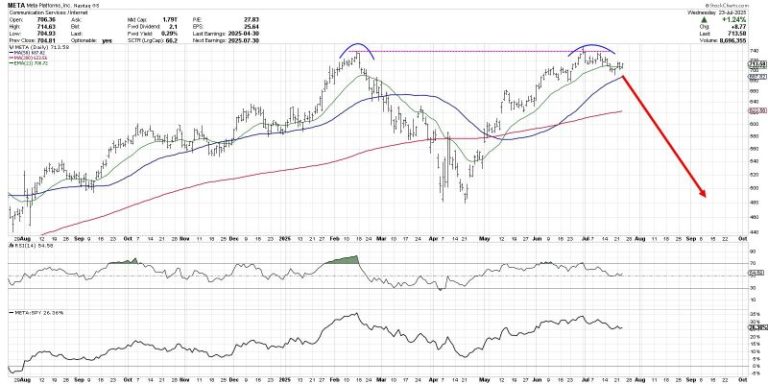
The chart of Meta Platforms, Inc. (META) has completed a roundtrip from the February high around $740 to the April low at $480 and all the way back again.  Over the last couple weeks, META has now pulled back from its retest of all-time highs, leaving investors to wonder what may come next.

Is this the beginning of a new downtrend phase for META?  Or just a brief pullback before a new uptrend phase propels META to new all-time highs?

Today we’ll look at two potential scenarios, including the double top pattern and the cup and handle pattern, and share which technical indicators and approaches could help us determine which path plays out into August.

The double top scenario basically means that the late July retest of the previous all-time high was the end of the recent uptrend phase.  The double top pattern is literally when a major resistance level is set and then retested.  The implication is that a lack of willing buyers means the uptrend is exhausted, and there is nowhere to go but down.

While the 21-day exponential moving average is currently in play for META, I would say that a break below the 50-day moving average could confirm this as the correct scenario.  If that smoothing mechanism does not hold, then the price action would imply less of a pullback and more like the beginning of a real distribution phase.

What is META pulls back but then resumes an uptrend phase, leading META to another new all-time high?  That would result in a confirmed cup and handle pattern, created by a large rounded bottoming pattern followed by a brief pullback.  The key to this pattern is the “rim” of the cup, which sits right at $740 for META.

Given the pullback META has demonstrated so far in July, I would say that a break above the $740 level would basically confirm a bullish cup and handle pattern.  That would suggest much more upside potential for META, as the stock would literally go into previously uncharted territory.

So how can we determine which scenario is more likely to play out?  This is where we need to incorporate more technical indicators into the discussion, as a way to further validate and confirm our investment thesis.

Just to review, I think a break above $740 would confirm a bullish cup and handle pattern.  I would also say that a break below the $680 level, which would represent a move below the 50-day moving average as well as the June swing lows, would basically confirm a bearish double top pattern.

We can also use the Relative Strength Index (RSI) to help determine whether META remains in a bullish trend phase.  During bull phases, the RSI rarely gets below 40, because buyers usually step in to “buy the dips” and keep the momentum fairly constructive.  So if the price would break down, and the RSI would not hold that crucial 40 level, that could mean a bearish outlook is warranted.

Finally, we can use volume-based indicators to assess whether moves in the price are supported by stronger volume readings.  Here I’ve included the Accumulation/Distribution Line, which tracks the trend in daily volume readings over time.  We can see that the high in July resulted in a divergence, as the A/D line was trending lower.  If the A/D line would break below its June and July lows, marked by a dashed red line, that would represent a bearish volume reading for META.

Technical analysis is less about predicting the future, and more about determining the most probable scenarios based on our analysis of trend, momentum, and volume.  I hope this discussion shows how the outlook for META can be easily determined and tracked using the best practices of technical analysis!

RR#6,

Dave

PS- Ready to upgrade your investment process?  Check out my free behavioral investing course!

David Keller, CMT

President and Chief Strategist

Sierra Alpha Research LLC

marketmisbehavior.com

https://www.youtube.com/c/MarketMisbehavior

Disclaimer: This blog is for educational purposes only and should not be construed as financial advice.  The ideas and strategies should never be used without first assessing your own personal and financial situation, or without consulting a financial professional.  

The author does not have a position in mentioned securities at the time of publication.    Any opinions expressed herein are solely those of the author and do not in any way represent the views or opinions of any other person or entity.

Markets don’t usually hit record highs, risk falling into bearish territory, and spring back to new highs within six months. But that’s what happened in 2025.

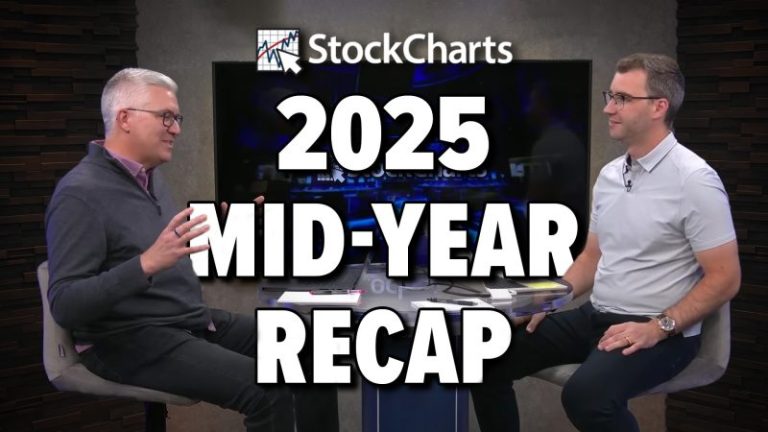
In this special mid-year recap, Grayson Roze sits down with David Keller, CMT, to show how disciplined routines, price-based signals, and a calm process helped them ride the whipsaw instead of getting tossed by it. You’ll see what really happened under the surface, how investor psychology drove the swings, and the exact StockCharts tools they leaned on to stay objective. 

If you’re focused on protecting capital, generating income, and sleeping well at night while still capturing the upside, this is a must-watch. Discover which charts deserve your attention now, what to ignore, and how to prep for the back half of 2025. 

This video premiered on July 23, 2025. Click on the above image to watch on our dedicated Grayson Roze page on StockCharts TV.

You can view previously recorded videos from Grayson at this link.

Here’s a quick recap of the crypto landscape for Wednesday (July 23) as of 9:00 p.m. UTC.

Get the latest insights on Bitcoin, Ethereum and altcoins, along with a round-up of key cryptocurrency market news.

Bitcoin and Ethereum price update

Bitcoin (BTC) was priced at US$118,148, down by 0.7 percent over the last 24 hours. Its highest valuation on Wednesday was US$118,462, while its lowest valuation was US$117,583.

Bitcoin price performance, July 23, 2025.

Chart via TradingView.

Bitcoin traded lower over the past 24 hours, hovering between $117,000 and $120,000 amid several market pressures.

A major whale moved over US$1.2 billion in dormant BTC, sparking speculation of potential selling.

After a rotation into altcoins, investors took profits following recent highs, while outflows from spot exchange-traded funds (ETFs) signaled weaker institutional demand.

Ethereum (ETH) was priced at US$3,592.65, down by 1.9 percent over the past 24 hours. Its lowest valuation as of Wednesday was US$3,568.86, and its highest was US$3,657.02.

Altcoin price update

  • Solana (SOL) was priced at US$188.86, down by 5.5 percent over 24 hours. Its lowest valuation on Wednesday was US$186.95, and its highest was US$192.58.
  • XRP was trading for US$3.25, down 8.9 percent in the past 24 hours. Its lowest valuation of the day was US$3.18, and its highest valuation was US$3.36.
  • Sui (SUI) is trading at US$3.70, down 5.5 percent over the past 24 hours. Its lowest valuation of the day was US$3.67, and its highest was US$3.84.
  • Cardano (ADA) was trading at US$0.8152, down by 6.9 percent over 24 hours. Its lowest valuation on Wednesday was US$0.8058, and its highest was US$0.8370.

Today’s crypto news to know

PNC Bank and Coinbase partner to advance digital asset solutions

PNC Bank and Coinbase Global (NASDAQ:COIN) have announced a strategic partnership to broaden access to digital asset solutions for PNC’s clients and institutional investors.

The collaboration will leverage Coinbase’s crypto-as-a-service platform, enabling PNC to offer secure and scalable cryptocurrency access. PNC clients will be able to buy, hold and sell cryptocurrencies directly through PNC’s platform.

PNC will also provide essential banking services to Coinbase, signifying a mutual commitment to strengthening the digital financial system. Both companies emphasize that this partnership will meet the increasing demand for secure and streamlined digital asset access.

Goldman Sachs and BNY to launch tokenized money market funds

Goldman Sachs (NYSE:GS) and BNY (NYSE:BK) are preparing to offer institutional investors access to tokenized money market funds, aiming to enhance capital markets with real-time settlement, 24/7 access and increased efficiencies.

BNY clients will soon be able to invest in money market funds with ownership recorded on Goldman Sachs’ private blockchain, as per a Wednesday news release.

“As the financial system transitions toward a more digital, real-time architecture, BNY is committed to enabling scalable and secure solutions that shape the future of finance,” said Laide Majiyagbe, global head of liquidity, financing and collateral at BNY, adding that mirrored tokenization of money market funds is the first step.

This initiative involves major players such as BlackRock (NYSE:BLK), Fidelity Investments, Federated Hermes and the asset management divisions of Goldman and BNY.

Tokenized money market funds offer a contrast to interest-bearing stablecoins, which are specifically prohibited under the GENIUS Act, which was signed into law last week. They provide yield, which makes them a low-volatility tool for hedge funds, pensions and corporations.

SEC halts Bitwise crypto index ETF conversion for review

On Tuesday (July 22), the US Securities and Exchange Commission’s (SEC) Division of Trading and Markets approved the Bitwise 10 Crypto Index to convert to an ETF, only to immediately pause it for review.

In a letter issued later that day, SEC Assistant Secretary Sherry Haywood said that the order will remain “stayed until the Commission orders otherwise.” Bloomberg ETF analyst Eric Balchunas has suggested that the SEC might be delaying its approval until it establishes a listing standard for crypto ETFs.

Bitwise had applied for this conversion in November for its fund, which offers exposure to a range of cryptocurrencies.

Nate Geraci, president of NovaDius Wealth Management, described the situation as “bizarre,” drawing parallels to the Grayscale Digital Large Cap ETF conversion, which experienced a similar approval and subsequent pause on July 1.

Bitcoin millionaires surge by 16,000 in 2025, according to report

Nearly 16,000 new Bitcoin wallets have crossed the million-dollar threshold since Donald Trump assumed the presidency in January 2025, according to a Finbold report. The number of Bitcoin millionaires is up from 132,842 in November 2024 to 192,205 as of July 20, marking a 45 percent increase in just eight months.

Large holders with over US$10 million in BTC also saw gains exceeding 16 percent in the same period.

The surge has been linked to renewed investor optimism following Trump’s re-election, along with clear signals of regulatory support and clarity for digital assets.

A significant boost came this week when the US House passed the Genius Act. The legislation, expected to streamline compliance for institutions, is widely seen as the most comprehensive federal crypto framework to date.

The rapidly changing policy environment has encouraged capital inflows and bolstered confidence in US-based crypto markets, with the resulting daily average tallying to 88 new Bitcoin millionaires in 2025 alone.

South Korea warns fund managers to reduce exposure to crypto stocks

South Korea’s Financial Supervisory Service (FSS) has issued informal warnings to asset managers over their exposure to crypto-related stocks and ETFs. According to the Korea Herald, firms with significant holdings in US-listed crypto companies such as Coinbase and Strategy (NASDAQ:MSTR) were reportedly told to scale back.

The directive follows the FSS’s longstanding 2017 stance prohibiting direct investment in virtual assets by financial institutions, despite recent global shifts in crypto regulation. While the agency has been reviewing possible easing of crypto rules, officials reportedly said that licensed entities must continue observing current guidelines.

The FSS has not yet issued a formal statement regarding the report.

PayPal unveils cross-border wallet platform

PayPal (NASDAQ:PYPL) has launched PayPal World, a cross-border payments network that integrates several of the world’s largest digital wallets, aiming to simplify international commerce for billions.

The platform’s initial partners include India’s UPI (via NPCI International), China’s Weixin Pay (via Tenpay Global) and PayPal’s own services including Venmo.

A memorandum of understanding has also been signed with Mercado Pago in Latin America.

According to PayPal CEO Alex Chriss, the initiative allows users to pay with their native wallets regardless of location. Chriss called it a potential “game changer” for frictionless payments in travel and e-commerce.

“The challenge of moving money across borders is incredibly complex, and yet this platform will make it so simple for nearly two billion consumers and businesses,’ Chriss said a recent press release.

Securities Disclosure: I, Giann Liguid, hold no direct investment interest in any company mentioned in this article.

Securities Disclosure: I, Meagen Seatter, hold no direct investment interest in any company mentioned in this article.

This post appeared first on investingnews.com

Oil prices fell sharply during the second quarter, after reaching year-to-date highs early in the year.

Between January and the end of June, Brent shed 18.26 percent from US$81.69 to US$66.77. West Texas Intermediate made a similar decline falling 16.94 percent from US$78.86 to US$65.50, over the same time period.

The contraction was largely attributed to OPEC+ easing production cuts and increasing output.

Global supply was further bolstered by China’s strong import volumes and rising domestic output, giving refiners room to delay purchases and adding to a mild US inventory build, both of which added downward pressure.

Conversely, seasonal demand from the US summer driving season and solid Q2 GDP growth in China offered some support.

Despite that backdrop, the five top-performing oil and gas stocks on the TSX and TSXV have seen share price growth over Q2 2025. All year-to-date performance and share price data was obtained on July 16, 2025, using TradingView’s stock screener, and oil and gas companies with market caps above C$10 million at that time were considered.

1. Falcon Oil & Gas (TSXV:FO)

Year-to-date gain: 43.75 percent
Market cap: C$127.55 million
Share price: C$0.115

Headquartered in Dublin, Ireland, Falcon Oil & Gas is an international oil and gas company incorporated in BC, Canada. The company specializes in the exploration and development of unconventional oil and gas assets, with interests in assets in Australia, South Africa and Hungary.

On January 24, Falcon issued its first corporate update of 2025, announcing the launch of a well stimulation campaign for two wells for the Shenandoah South pilot project in the Beetaloo Sub-Basin, located in Australia’s Northern Territory.

The company has a 22.5 interest in the Beetaloo joint venture, with Tamboran Resources (NYSE:TBN,ASX:TBN) owning the remaining 77.5 percent.

Falcon’s share price spiked several times in June, reaching a year-to-date high of C$0.14 on June 17, which it maintained through late June. The stock movement coincided with Beetaloo updates, including “stellar” flow test results on June 17.

“The IP30 flow rate results announced today of 7.2 million cubic feet per day (MMcf/d), are truly stellar and marks another major data point in the Beetaloo Sub-basin again demonstrating that it compares to the best shale wells in the United States,” CEO Philip O’Quigley wrote in the press release.

2. Imperial Oil (TSX:IMO)

Year-to-date gain: 25.67 percent
Market cap: C$57.37 billion
Share price: C$112.70

Calgary-based Imperial Oil is a prominent Canadian energy company involved in the exploration, production, refining and marketing of petroleum products. With a history spanning over 140 years, Imperial operates diverse assets across Canada, including oil sands, conventional crude oil and natural gas assets.

On January 31, Imperial released its Q4 2024 results, reporting an estimated net income of C$1.23 billion in Q4 2024, slightly down from C$1.24 billion in Q3. The decline was attributed to lower price realizations, partly offset by higher production and improved refinery utilization in the Downstream segment.

On May 2, the company announced a Q2 2025 dividend of C$0.72 payable on July 1.

Imperial shares reached a year-to-date high of C$113.05 on July 13. The rally occurred after Scotiabank raised its share price target for Imperial from C$100 to C$110 on July 11, citing stronger refining margins and earnings outlook.

3. MEG Energy (TSX:MEG)

Year-to-date gain: 10.07 percent
Market cap: C$6.7 billion
Share price: C$26.35

MEG is an energy company solely focused on in-situ thermal oil production in the southern Athabasca oil region of Alberta, Canada. Utilizing innovative enhanced oil recovery projects, including steam-assisted gravity drainage extraction methods, the company aims to increase oil recovery responsibly while reducing carbon emissions.

In mid-May, Strathcona Resources (TSX:SCR) made an unsolicited C$4.1 billion offer for MEG, a move company executives quickly denounced.

In a subsequent press release on June 16, MEG called the offer “inadequate, opportunistic, and NOT in the best interests of MEG or its shareholders.”

Chairman of the Board James McFarland stated in the release, ‘A combination with Strathcona would expose shareholders to inferior assets and significant capital markets risks, including a C$6 billion overhang resulting from Waterous Energy Fund’s 51 percent ownership in the combined company.”

MEG has launched a strategic review and welcomed alternative bids from other companies.

Shares of MEG rose to a year-to-date high of C$26.14 on June 20, on the heels of the statement and alongside news that operations at the company’s Christina Lake operations in Alberta would resume at full capacity following wildfire interruptions.

4. Headwater Exploration (TSX:HWX)

Year-to-date gain: 3.75 percent
Market cap: C$1.65 billion
Share price: C$6.92

Headwater Exploration is a Canadian oil and gas company focused on developing high-quality assets in Alberta’s Clearwater play and low-decline natural gas in New Brunswick’s McCully Field.

In March, Headwater reported strong 2024 results, with annual production up 13 percent year-over-year to 20,310 barrels of oil equivalent per day (boe/d) and net income rising 20 percent to C$188 million.

Headwater released its Q1 2025 results and a company update in May, highlighting the receipt of TSX approval for a normal course issuer bid, allowing it to repurchase up to 10 percent of its public float over the next year.

Additionally the company reported record production of 22,066 boe/d during Q1 and adjusted funds flow of C$92.4 million. Net income for the period came in at C$50 million. The company declared a quarterly dividend of C$0.11 per share during Q1 and ended the quarter with no debt and C$63.6 million in adjusted working capital.

Company shares spiked to a year-to-date high of C$7.43 on January 9, and reached a Q2 high of C$7.22 on June 19, which coincided with a broader surge in the oil market.

5. Athabasca Oil (TSX:ATH)

Year-to-date gain: 3.72 percent
Market cap: C$2.84 billion
Share price: C$5.57

Athabasca Oil is focused on developing thermal and light oil assets within Alberta’s Western Canadian Sedimentary Basin. The company has established a substantial land base with high-quality resources. Its light oil operations are managed through its private subsidiary, Duvernay Energy, in which the company holds a 70 percent equity interest.

On March 5, Athabasca Oil released its 2024 year end results, highlighting strong production and significant cash flow increases. The company averaged 36,815 boe/d during 2024, marking a 7 percent year-over-year increase.

Its Q1 2025 results released on May 7 reported further production growth, with average petroleum and natural gas production of 37,714 boe/d and average thermal oil output of 34,742 barrels per day.

Athabasca Oil generated C$130 million in adjusted funds flow and C$71 million in free cash flow. The company returns capital to shareholders through annual share buybacks, and at the time of the release, it had completed C$94 million in buybacks since the start of 2025.

Broad market positivity in mid-June pushed shares of Athabasca Oil to a year-to-date high of C$6.16 on June 20.

Securities Disclosure: I, Georgia Williams, hold no direct investment interest in any company mentioned in this article.

This post appeared first on investingnews.com