
Author

admin

Browsing

(TheNewswire)


Drill Hole LBX25-101 — Highlights

  • 1.50 m @ 0.88 g/t Au, 13.60 g/t Ag, 0.24% Cu, 5.61% Zn (159.20 m to 160.70 m) 

    • Including 0.50 m @ 2.06 g/t Au, 31.10 g/t Ag, 0.53% Cu, 12.35% Zn (159.70 m to 160.20 m) 

  • 1.60 m @ 1.16 g/t Au, 10.21 g/t Ag, 0.30% Cu, 4.39% Zn (187.70 m to 189.30 m) 

  • 3.00 m @ 0.97 g/t Au, 4.04 g/t Ag, 0.14% Cu, 2.21% Zn (190.50 m to 193.50 m) 


Drill Hole LBX25-102 — Highlights

  • 0.50 m @ 3.89 g/t Au, 38.70 g/t Ag, 0.42% Cu, 5.37% Zn (45.00 m to 45.50 m) 

  • 1.00 m @ 2.04 g/t Au, 0.80 g/t Ag, 0.01% Cu, 0.02% Zn (108.50 m to 109.50 m) 

  • 2.04 m @ 2.63 g/t Au, 2.38 g/t Ag, 0.02% Cu, 0.17% Zn 205.96 m to 208.00 m) 

    • Including 1.00 m @ 5.14 g/t Au, 4.60 g/t Ag, 0.04% Cu, 0.30% Zn (207.00 m to 208.00 m) 

  • 0.50 m @ 2.60 g/t Au, 13.60 g/t Ag, 0.10% Cu, 6.75% Zn (230.30 m to 230.80 m) 


Toronto, Ontario – February 11, 2026 TheNewswire – Laurion Mineral Exploration Inc. (TSX-V: LME | OTCQB: LMEFF | FSE: 5YD) (‘LAURION’ or the ‘Company’) reports assay results from drill holes LBX25-101 and LBX25-102 from the Company’s recent Fall diamond drilling program totalling 1,821 metres completed in 8 drill holes at the A-Zone/McLeod/CRK Zone at the Ishkōday Project, located in the Beardmore–Geraldton Greenstone Belt of north-western Ontario, approximately 220 kilometres northeast of Thunder Bay.

Drill holes LBX25-101 and LBX25-102 were planned as part of LAURION’s model-guided A-Zone program to test interpreted mineralized horizons and strengthen continuity across the northeastern portion of the zone. (See Image DDH Cross Section.) The drill holes were positioned to validate structural interpretations and increase confidence in zones where both historical drilling and more recent Company-led drill programs have identified broad anomalous gold mineralization with localized higher-grade intervals. The assay results provide additional technical data that will support the refinement of future targeting and improve predictability for the Company’s subsequent drill campaigns. (See Image of Drill Locations of Fall Diamond Drilling.)


‘We are advancing the A-Zone through disciplined, high-confidence drill targeting designed to create measurable project value,’ said Cynthia Le Sueur-Aquin, President and CEO of LAURION. ‘Our objective is to complete drilling that answers specific geological questions, strengthens continuity, and improves predictability — because better technical clarity today supports stronger outcomes tomorrow for our shareholders.’


Geological Context


Drill hole LBX25-101 is situated approximately 265 m southwest of LBX25-100, with LBX25-102 positioned an additional 335 m southwest, extending drill coverage along the interpreted A-Zone mineralized corridor into a sparsely drilled area. LBX25-101 was established as a step-back collar to test projected mineralized horizons and structural continuity beyond the denser drill grid. Targeting incorporated projected intercept positions from holes LBX22-055, LBX22-056, LBX22-056A, LBX22-057, and historic hole K56 to improve geological and structural constraint across this portion of the zone.


Drill hole LBX25-102 was collared adjacent to the access road approximately 1.0 km south of the River Road, located north of the McLeod Zone and southwest of drill hole LBX21-041, to support continued drill coverage along this portion of the interpreted mineralized trend. This collar location enabled efficient drill access while extending geological coverage into a less densely tested portion of the corridor.


Hole ID

From

(m)

To

(m)

Core Length (m)

Au (g/t)

Ag (g/t)

Cu (%)

Zn (%)

LBX25-101

7.90

11.80

3.90

0.200

2.88

0.03

0.65

including

7.90

8.60

0.70

0.146

9.80

0.06

2.94

LBX25-101

120.2

120.80

0.60

0.224

4.80

0.12

1.54

LBX25-101

159.20

196.50

37.30

0.209

2.06

0.05

0.87

including

159.20

160.70

1.50

0.883

13.60

0.24

5.61

including

159.70

160.20

0.50

2.060

31.10

0.53

12.35

including

187.70

189.30

1.60

1.159

10.21

0.30

4.39

including

188.20

193.50

5.30

0.872

5.11

0.16

2.53

including

190.50

193.50

3.00

0.971

4.04

0.14

2.21

LBX25-102

45.00

45.50

0.50

3.890

38.70

0.42

5.37

LBX25-102

52.80

53.30

0.50

0.617

3.90

0.03

3.25

LBX25-102

82.90

83.70

0.80

0.511

0.50

0.01

LBX25-102

108.50

109.50

1.00

2.040

0.80

0.01

0.02

LBX25-102

205.96

208.00

2.04

2.630

2.38

0.02

0.17

Including

207.00

208.00

1.00

5.140

4.60

0.04

0.30

LBX25-102

212.00

213.00

1.00

0.339

0.25

0.04

LBX25-102

222.80

223.30

1.20

0.292

9.58

0.02

1.10

including

222.80

223.30

0.50

0.457

20.60

0.03

2.55

LBX25-102

226.00

245.00

19.00

0.355

2.63

0.03

0.58

including

230.30

233.60

3.30

1.114

6.35

0.07

1.78

including

230.30

230.80

0.50

2.600

13.60

0.10

6.75

NOTE: Intervals represent core length. The interval widths reported are down-hole widths. The true widths of the mineralized zones are not known at this time as there is insufficient information to determine the orientation of the mineralization.


Name

Elevation

(m)

Azimuth

Dip

Easting

Northing

Depth

(m)

LBX25-101

321

127

-50

446328

5513024

276

LBX25-102

323

115

-50

446200

5512713

300

Total


576


Sampling and QA/QC Protocols


All drill core is transported and stored inside the core facility located at the Ishkōday Project in Greenstone, Ontario. LAURION employs an industry standard system of external standards, blanks and duplicates for all of its sampling, in addition to the QA/QC protocol employed by the laboratory. After logging, core samples were identified and then cut in half along core axis in the same building and then zip tied individually in plastic sample bags with a bar code. Approximately five or six of these individual bags were then stacked into a ‘rice’ white material bag and stored on a skid for final shipment to the laboratory. All core samples were shipped to the ALS facility in Thunder Bay, Ontario, which were then prepared by ALS Global Geochemistry in Thunder Bay and analyzed by ALS Global Analytical Lab in North Vancouver, British Columbia. Samples are processed by 4-acid digestion and analyzed by fire assay on 50 g pulps and ICP-AES (Inductively Coupled Plasma – Atomic Emission Spectroscopy). Over limit analyses are reprocessed with gravimetric finish. A total of 5% blanks and 5% standard are inserted randomly within all samples. 5% of the best assay result pulps were sent for re-assays. All QA/QC were verified, and no contamination or bias have been observed. The remaining half of the core, as well as the unsampled core, is stored in temporary core racks at the core logging facility in Beardmore and moved to the core storage facility at the Ishkōday Project. Note: QA/QC review of standards and duplicates indicates analytical results are reliable. One zinc standard adjacent to a high-grade zinc interval returned elevated values consistent with expected analytical behaviour following high-grade samples.


Qualified Person


The technical contents of this release were reviewed and approved by Pierre-Jean-Lafleur P. Eng, a consultant to LAURION and a Qualified Person as defined by National Instrument 43-101 – Standards of Disclosure for Mineral Projects.


About LAURION Mineral Exploration Inc.


Laurion Mineral Exploration Inc. is a mid-stage junior mineral exploration company listed on the TSX Venture Exchange under the symbol LME and on the OTC Pink market under the symbol LMEFF. The Company currently has 278,716,413 common shares outstanding, with approximately 73.6% held by insiders and long-term ‘Friends and Family’ investors, reflecting strong alignment between management, the Board, and shareholders.


LAURION’s primary focus is the 100%-owned, district-scale Ishkōday Project, a 57 km² land package hosting gold-rich polymetallic mineralization. The Company is advancing Ishkōday through a disciplined, milestone-driven exploration strategy focused on strengthening geological confidence, defining structural continuity.


LAURION’s strategy is centered on deliberate value creation. The Company is prioritizing systematic technical advancement, integrated geological and structural modeling, and the evaluation of optional, non-dilutive pathways, including historical surface stockpile processing, that may support flexibility in LAURION’s exploration plans without diverting the Company’s focus from its core exploration objectives.


The Company’s overarching objective is to build project value before monetization, ensuring that any future strategic outcomes are supported by technical clarity, reduced execution risk, and demonstrated scale. While the Board remains attentive to strategic interest that may arise, LAURION is not driven by transaction timing. Instead, the Company is focused on advancing the Ishkōday Project in a manner that strengthens long-term shareholder value.


LAURION will continue to communicate updates through timely disclosure and will issue press releases in accordance with applicable securities laws should any material information arise.


FOR FURTHER INFORMATION, CONTACT:

Laurion Mineral Exploration Inc.

Cynthia Le Sueur-Aquin – President and CEO

Tel: 1-705-788-9186 Fax: 1-705-805-9256


Douglas Vass – Investor Relations Consultant

Email: info@laurion.ca

Website: http://www.LAURION.ca

Follow us on: X (@LAURION_LME), Instagram (laurionmineral) and LinkedIn ()


Caution Regarding Forward-Looking Information


This press release contains forward-looking statements, which reflect the Company’s current expectations regarding future events including with respect to LAURION’s business, operations and condition, management’s objectives, strategies, beliefs and intentions, the Company’s ability to advance the Ishkōday Project, the nature, focus, timing and potential results of the Company’s exploration, drilling and prospecting activities, including the Company’s diamond drill program referenced in this press release and the Company’s other planned activities for the Ishkōday Project for the remainder of 2026, and the statements regarding the Company’s exploration or consideration of any possible strategic alternatives and transactional opportunities, as well as the potential outcome(s) of this process, the possible impact of any potential transactions referenced herein on the Company or any of its stakeholders, and the ability of the Company to identify and complete any potential acquisitions, mergers, financings or other transactions referenced herein, and the timing of any such transactions. The forward-looking statements involve risks and uncertainties. Actual events and future results, performance or achievements expressed or implied by such forward-looking statements could differ materially from those projected herein including as a result of a change in the trading price of the common shares of LAURION, the TSX Venture Exchange or any other applicable regulator not providing its approval for any strategic alternatives or transactional opportunities, the interpretation and actual results of current exploration activities, changes in project parameters as plans continue to be refined, future prices of gold and/or other metals, possible variations in grade or recovery rates, failure of equipment or processes to operate as anticipated, the failure of contracted parties to perform, labor disputes and other risks of the mining industry, delays in obtaining governmental approvals or financing or in the completion of exploration, as well as those factors disclosed in the Company’s publicly filed documents. Investors should consult the Company’s ongoing quarterly and annual filings, as well as any other additional documentation comprising the Company’s public disclosure record, for additional information on risks and uncertainties relating to these forward-looking statements. The reader is cautioned not to rely on these forward-looking statements. Subject to applicable law, the Company disclaims any obligation to update these forward-looking statements. All sample values are from grab samples and channel samples, which by their nature, are not necessarily representative of overall grades of mineralized areas. Readers are cautioned to not place undue reliance on the assay values reported in this press release.


NEITHER THE TSX VENTURE EXCHANGE NOR ITS REGULATION SERVICE PROVIDER (AS THAT TERM IS DEFINED IN THE POLICIES OF THE TSX VENTURE EXCHANGE) ACCEPTS RESPONSIBILITY FOR THE ADEQUACY OR ACCURACY OF THE CONTENT OF THIS NEWS RELEASE.


Copyright (c) 2026 TheNewswire – All rights reserved.

News Provided by TheNewsWire via QuoteMedia

This post appeared first on investingnews.com

Rising geopolitical tensions, intensifying competition for critical minerals and the accelerating breakdown of the postwar global order were some of the key themes at the Vancouver Resource Investment Conference (VRIC) in late January, as investors grappled with what a volatile world means for capital, commodities and security of supply.

In a wide-ranging panel moderated by Jesse Day, legendary mining financier Frank Giustra joined retired US Army Colonel Douglas Macgregor and geopolitical analyst Dr. Pascal Lottaz to examine flashpoints from Iran to Greenland, and why resource investors can no longer separate geopolitics from the metals that underpin modern economies.

Giustra, president and CEO of Fiore Group and co-chair of the International Crisis Group, opened the discussion by warning that tensions with Iran are approaching a critical threshold, driven by competing US and Israeli objectives.

“Israel would like to see Iran taken out as a major regional power,” Giustra said. “The US would like to see a different Iran — one it could do business with and that has stable relations with its neighbours. Those objectives are not the same.”

He added that the presence of a US carrier strike group in the region underscores the risk of escalation, but questioned whether military action would achieve Washington’s goals. “Iran is simply too large for a strike to have the intended effect,” he said, pointing to the absence of a coherent long-term policy.

Colonel Macgregor was more blunt, warning the US is “on the precipice of war” with Iran and arguing that Washington’s strategic thinking mirrors failed efforts elsewhere.

“This is the same mindset that committed us to war in Ukraine,” Macgregor said. “Destroy the country, divide it, dominate it, and take its resources. It failed there, and it will fail in Iran.”

Dr. Lottaz, an adjunct researcher at Waseda University in Tokyo and host of the ‘Neutrality Studies’ channel, said unpredictability has become the defining feature of US foreign policy.

“What Israel does is done in conjunction with the US — they are effectively one team,” Lottaz said. “Carrier groups sitting offshore are not just deterrence. They are also sitting ducks. Ships can sink.”

Greenland, minerals and power politics

The panel then turned to Greenland, a region increasingly viewed through the lens of critical minerals and Arctic security.

Giustra dismissed claims that Greenland poses an immediate security risk from Russia or China, arguing instead that resource competition is the real driver. “Greenland has always been open for business,” he said.

“The idea that the US needs to own it to access minerals is simply false.”

Instead, Giustra described Washington’s posture as coercive. “It’s essentially putting a gun to Greenland’s head and saying, ‘We want to buy you.’”

For mining investors, Greenland represents both opportunity and risk.

The island hosts significant deposits of rare earth elements, graphite and other strategic metals essential to clean energy technologies, defence systems and advanced manufacturing. But political uncertainty, including pressure from major powers, complicates development timelines and capital allocation.

Macgregor argued that US ambitions in Greenland and Venezuela reflect more optics than strategy. “This administration loves big gestures,” he said. “But unless you control what happens on the ground, nothing really changes.”

Europe’s energy crisis and deindustrialization

Lottaz traced Europe’s economic strain, particularly Germany’s deindustrialization, back to energy policy decisions, including the shutdown of nuclear power and the loss of Russian gas supplies.

“Political leadership in Europe is increasingly detached from national interests,” he said. “What matters more is positioning within EU and transatlantic institutions.”

That disconnect has direct consequences for resource markets, particularly energy-intensive industries such as metals refining, steel production and battery manufacturing, which depend on stable, affordable power.

Macgregor added that many global institutions, including NATO and the European Union, are approaching “block obsolescence,” forcing investors to rethink long-held assumptions about stability.

Critical minerals and the risk of conflict

As the discussion widened, Giustra pointed to critical minerals as one of the most dangerous fault lines in the emerging world order.

“The intense competition between China and the West over critical minerals is a major factor,” he said. “These are not just economic assets — they’re strategic weapons.”

China currently dominates processing of rare earth elements, lithium chemicals and battery-grade materials, giving it leverage over Western supply chains. Efforts by the US, Europe and allies to secure alternative sources — from Greenland to Africa to South America — are reshaping investment flows across the mining sector.

Giustra warned that history shows transitions between declining and rising powers are rarely peaceful. “The danger of conflict during a shift in world order is extremely high,” he said. “We may already be setting the stage for something far worse.”

Is there room for optimism?

Despite the grim outlook, Lottaz offered cautious optimism, arguing that even strained international systems retain some restraining influence.

“Everyone still claims to operate under the UN Charter, even when they violate it,” he said. “That tells us the idea of international law still matters.”

He also pointed to restraint in conflicts such as Ukraine, noting that NATO has avoided direct war with Russia. “There is still rationality at work. No one wants Armageddon.”

Macgregor closed with a stark reminder for investors and policymakers alike. “Rules only exist if someone enforces them,” he said. “As American power recedes, we’re entering a far more competitive and uncertain world.”

For the resource sector, that uncertainty translates into higher geopolitical risk, but also strategic opportunity. As governments scramble to secure supply chains for energy transition metals, defence materials and critical infrastructure, mining projects once considered peripheral are moving to the centre of global power politics.

Securities Disclosure: I, Georgia Williams, hold no direct investment interest in any company mentioned in this article.

This post appeared first on investingnews.com

MILAN — Ilia Malinin wagged his tongue in joy halfway through his short program in the men’s competition Tuesday night at the 2026 Winter Olympics. He had just completed his three industrial strength jumping passes without a hitch, including two majestic quadruple jumps. Now he was flying past center ice, and his emotions got the better of him, and he was singing along with his music in the icy arena air. He was back, and he knew it.

The 21-year-old self-proclaimed “Quad God” had already lived a lifetime at these Olympic Games. He had experienced the interesting combination of being both tested and, now, rested. The Olympic team figure skating competition had challenged him in ways he hadn’t expected. But he had passed that test, leading the Americans to the gold medal by doing double duty in both the short and long programs when he hadn’t originally planned to. 

“I definitely felt like I was in a better zone this time,” Malinin said after he won the short program, setting himself up beautifully to win a second gold medal here on Friday. “It was, I think I want to call it, Olympic pressure, going out there the first time, hitting that Olympic ice and feeling the atmosphere, it was like, I didn’t expect it to be so much. 

“I mentioned earlier in the week that it took me a little while to understand what really happened, but now that I understand it, I took a different approach today. Really, just take things nice and calm, nice and slow, just relax. Then really just push the autopilot button and just let it cruise.”

An Olympic rookie, he is so much better off having gone through the team experience, which left him with “an incredible feeling,” he said Sunday night.

Now it was 48 hours later, and Malinin was on his own in the individual men’s event. On his own and back to his old self, the skater who has won four consecutive U.S. championships and the last two world titles.

His score? 108.16 points, a healthy five points ahead of Japan’s Yuma Kagiyama, who had 103.07. With a long program likely packed with his record-breaking seven quads, Malinin is back to being the strong favorite to win the gold medal Friday night. How things have changed for him since his shaky short program in the team event over the weekend. 

“I definitely feel like I’ve reached where I want to be for the individual event, and just take a refresh and just nice and slow and calm for that free skate program. … and just let everything happen naturally.”

He now has more free time than he has had all week, with three days off between the short program and the long program (free skate). Asked how he is resting in his spare time, Malinin delightfully subtracted a couple years off his age.

“What would any teenager really do?” he replied with a smile. “I’m not really a teenager, but I feel like one a lot of the time, you know, just watching funny videos or funny fails, like video games and, you know, enjoying the Olympic Village. It’s such a cool place. They have their own gaming room as well. So I go there.”

This is the Malinin the skating world has come to know, a funny, laid back young man who loves to chat, almost always smiles and has the confidence to know how he’ll handle what’s next. For example, after the team competition ended Sunday, he predicted that nail-biter “really set me up for the individual event.” 

Turns out he knew exactly what he was talking about.

Get our Chasing Gold Olympics newsletter in your inbox for coverage of your favorite Team USA athletes

This post appeared first on USA TODAY

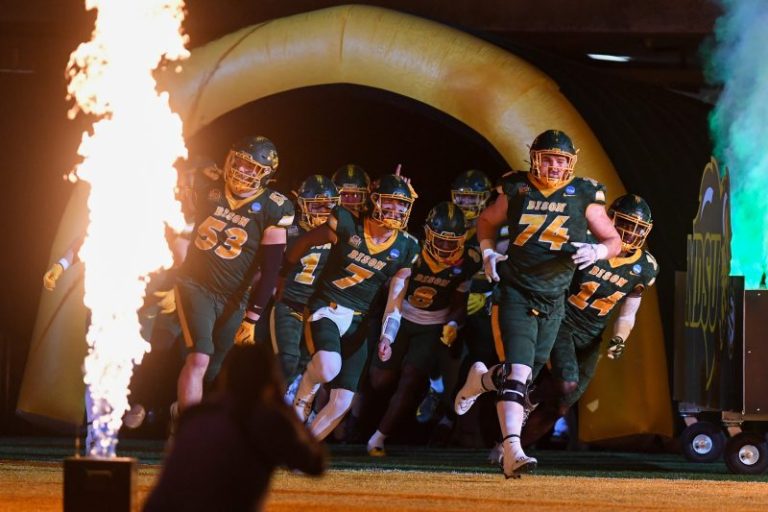
Let me see if I’ve got this straight, because I’m a little fuzzy on the particulars. 

The most successful FCS program in the modern era, and the third-largest oil producing state in the country have joined FBS football. 

To this I say: What took so long? 

North Dakota State has joined the Mountain West Conference in football beginning this fall, and if you’re looking for some quick analysis, here it is: only Texas and New Mexico produce more oil than North Dakota, the black gold that can change everything in college sports.

Hello, private NIL. 

If there’s one thing we’ve learned in this upside-down world of get yours, it’s money talks and tradition walks. 

Indiana just won a national title. I still can’t believe it, so I’m going to write it again: Indiana, lovable loser of Division I football for decades upon decades, found the perfect coach and won the whole thing.

And is now set up to take over the sport with an elite coach (Curt Cignetti), a billionaire booster (Mark Cuban) and the largest alumni base in college sports (800,000-strong).

Texas Tech, which never before won an outright major conference championship, won the Big 12 in 2025 with a school-record 12 wins. Only a quarterback playing with a broken leg kept the billionaire-fueled ― and black gold-infused ― Red Raiders from doing more damage in the College Football Playoff. 

Duke, my god, Duke, won the ACC with a $4 million-a-year quarterback. And Steve Spurrier wasn’t the coach. 

Why in God’s green earth would North Dakota State not attempt to move up to FBS? 

The Bison — that’s pronounced Bizon, everyone — aren’t competing against the Power conference heavyweights, they’re competing against the rest of the Group of 6 for the one CFP charity spot. 

That immediately changes the calculus of it all. 

You’re not banging heads with established programs, you’re playing — ready for this? — Air Force, Hawaii, Nevada, New Mexico, Northern Illinois, San Jose State, UNLV, UTEP and Wyoming. 

I mean, really? 

None of those nine teams would’ve won 10 of 15 FCS titles from 2011-2025. And more than likely, not more than one ― if that.

Four coaches (Craig Bohl, Chris Klieman, Matt Entz, Tim Polasek) won national titles at NDSU in that 15-year span, a line of succession that’s almost unthinkable in this era of quick-change college football. The plan to win hasn’t changed much from when Bohl built the beast, and Klieman perfected it. 

They recruit players to fit their culture and system, and then develop them to reach their ceiling. Since 2020, eight NDSU players have been selected in the NFL draft. 

The 2025 national champion (that would be Indiana, everyone) had six. Six! 

Vanderbilt had three, Duke had seven, and if you want me to continue this exercise in Power conference draft futility, we’ll be here all damn day. Suffice to say, NDSU knows how to develop players. 

Yet that point brings us to the intriguing intersection of culture and cash, the very thing that could dismantle what NDSU has worked so hard to build. Or make it even more dangerous. 

Because if Polasek — an assistant for 10 years with the Bison before getting the job in 2024 and winning 26 of 29 games — can mold the valuable NDSU culture with a handful of impact starters from the transfer portal, this thing could get big. Quickly. 

Again, you’re not reinventing the wheel, you’re giving the hard-driving 18-wheeler a little more horsepower and a refined suspension with a handful of talented transfers. How do you get those transfers?

Oil money. 

If Texas Tech can do it, NDSU sure can. Lubbock is in the middle of nowhere; at least Fargo is across the river from Minnesota.

Also, the middle of nowhere, but you get the point.

Money changes everything. It breathes life into recruiting efforts, and extends the arm of possibility. It can turn a wildly underrated college town into a hotbed of FBS college football. 

Just like it did in Lubbock. Just like it will do in Fargo. 

It was only a matter of time before this inevitable happened. There was too much good going on at NDSU, and not enough challenge. 

There’s only so many times you can beat the brakes off everyone else, and still be satisfied to do it again the following season. Before the advent of NIL and free player movement, the climb to FBS made no sense for the team no one wanted to see on the nonconference body bag circuit.

NDSU has a 9-5 all-time record vs. FBS schools since beginning Division I play in 2004, including wins over Minnesota, Kansas State, Iowa and Iowa State. But think about this all-telling reality: the Bison have been playing FCS football for 21 years, and have been asked to play only 14 FBS guarantee games.    

There was nothing to gain, and more than likely everything to lose for anyone playing NDSU. Now the FBS has to play them — at least, in the Mountain West. 

If things progress how NDSU has envisioned, the Power conferences will have to deal with Bison cash in the transfer portal, and in a perfect, oil-driven private NIL world, on the biggest stage of all in the CFP.

The most successful FCS program of our time, and the third-largest oil production state in the country teaming up in the new private NIL world of college football. 

What took so long?

This post appeared first on USA TODAY

  • Bea Kim is a 19-year-old newcomer on the U.S. women’s halfpipe team for the 2026 Winter Olympics.
  • Inspired by teammate Chloe Kim, she is also a passionate climate advocate with Protect Our Winters.
  • Kim is set to attend Columbia University to study environmental science.

LIVIGNO, Italy – The 19-year-old grabbed the microphone without hesitation, before looking to her right and her left at her older, more experienced teammates.

Assuredness is not something Bea Kim lacks, even if she is the newcomer on the United States’ women’s halfpipe team, which includes Chloe Kim – the event’s back-to-back Olympic champion – three-time Olympian Maddie Mastro and 31-year-old Maddy Schaffrick.

At the group’s news conference in the Italian Alps ahead of their qualifying round at these 2026 Milano Cortina Winter Olympics, the last question revolved around President Donald Trump’s criticism of men’s free skier Hunter Hess over Hess’ pre-Games comments about representing the United States (Trump did not properly reflect what Hess said). It’s a hot-button topic, one that can ignite social media and reach the halls of the West Wing. Shying away would have been a normal response.

Bea Kim didn’t.

‘I think there are a lot of different opinions in the U.S. right now. Obviously, we’re very divided,’ she said. ‘I personally am very proud to represent the United States. That being said, I think diversity is what makes us a very strong country and what makes us so special.

‘I think the four of us sitting here (Monday) are an example of that. We all came from very different backgrounds.’

If that’s not an example of the field Kim is playing, then perhaps it’s her passion for the environment and involvement in Protect Our Winters (POW), an organization that has led her to address the United Nations and speak at the White House regarding climate change. Or that she is bound for Columbia University in the fall. Or maybe it’s the fact that she could be the breakout star of a U.S. women’s halfpipe team that already features one of the biggest names in the entire delegation, who happens to have the same surname as her.

Bea Kim and Chloe Kim, along with Mastro, actually all grew up going to Mammoth Mountain in California and refer to it as their home mountain. Mastro and Chloe Kim have been her role models for a while, Bea Kim said.

“To be able to be on the same team as them, go to the Olympics together and kind of call them my friends has been just so special,” she told USA TODAY Sports in January through her sponsor, Delta Airlines.

The two Kims are not related, though, even if Bea Kim understands why it might be easy for snowboarding casuals to make the assumption. She actually gets a kick that two of her teammates have the same first name – different spellings, though – and that she and Chloe share a last name.

Bea Kim, who is Korean-Japanese-American, attended the 2018 Winter Olympics in South Korea − where Chloe Kim won her first of two halfpipe gold medals − with her parents, younger brother and grandparents. They spent time in Seoul, South Korea, and also visited Japan for the first time. It’s a special family memory.

“That was, I think, a pretty pivotal moment in my own career of seeing someone who looked like me just do something super incredible and be able to inspire me to kind of go after this career path,” Bea Kim said.

Chloe Kim was 17 at that time, with Bea Kim six years her junior.

“I mean, honestly, when I was that young, I don’t think I realized how incredible what she was (doing),” Bea Kim said. “I knew what she was doing was amazing, but I didn’t realize how young she was to be able to do something like that. And then now that I’m closer to that age, it’s definitely like, ‘Wow, that was insane.’”

In fourth grade, Bea Kim penned a poem shortly after she joined the Mammoth snowboarding team.

‘I am the gold medalist at the 2022 Winter Olympics,’ she wrote in the piece shared with USA TODAY Sports. ‘I cry tears of joy when the gold medal is placed around my neck.’

Bea Kim may have been a little premature in the premonition. But who says she can’t live up to the final stanza?

‘I dream of being,’ it reads, ‘the best snowboarder in the world.’

Bea Kim’s passion for outdoors, sport fuels academic ambition

Bea Kim’s passion for the outdoors and career in snowboarding is as full-circle as it gets, she said. Everything her family did – whether it was camping, hiking, snowboarding or surfing – took place in nature.

The family memories built are unforgettable and eventually led to competitive snowboarding, which led to dropping out of school and starting online school so that she could travel with the U.S. snowboarding team.

Those global treks have shown her the world, but competitive snow sports follow a similar travel schedule year over year, and athletes often wind up in the same places at the same time of year.  

“It’s really easy to kind of see how climate’s affecting all of everything,” Kim said.

From glaciers receding to fluctuating snow levels, it is impossible to ignore. She eventually made contact with the non-profit POW.

“They’ve really opened me up to a lot of new experiences where I’ve gotten to kind of share my story and just talk about climate and the snow sports industry and life as an athlete on the road,” Kim said. “So that’s kind of led me to Columbia where I’m going to study that hopefully.”

Kim’s sport is dependent on the weather – not just snow, either. If the winds are howling, it’s harder for her to do her job. If it’s dumping snow, it’s harder than a “bluebird day” when riders can actually tell the difference between the sky and the wall of a halfpipe.

“And those bluebird days are kind of a little bit further and far between now,” said Kim.

Two summers ago, Kim was scheduled to be in Australia for three weeks for a training camp. But it was the warmest season they had on record in years. She spoke to locals, they had never seen it that warm before. “Crazy weather” prevented the training group from even going up to the mountain, and Kim ended up leaving the camp early because the conditions made it unrideable.

The Olympic halfpipe site in Livigno was supposed to host a test event prior to the Games, but the lack of snow in the Alps nixed the dry run.

“It’s wild,” she said.

Bea Kim’s most crucial opponent? Herself

Bea Kim’s first competition in more than 11 months came at Copper Mountain in December 2025. On Christmas Eve the prior year, she underwent shoulder surgery after a series of subluxations destabilized her arm. The goal, she said, was to tighten the joints and muscles before the Olympic year.

Kim described her week at Copper as “actually a crazy little week.”

It was the first Olympic qualifier. The practice days leading into the qualifying round were tough. She was not feeling like herself at all.

“But once I dropped into the competition, I kind of was just reminding myself, ‘You know how to do this, your body knows how to do this.’ It’s all muscle memory,” she said.  

Kim is the type of competitor who believes the pressure of the competition makes her a better performer.

“It’s always kind of a testament to willpower, I think,” she said.

Kim finished third at Copper, which went a long way to securing her spot on the Olympic roster. To be on the podium in Italy, Kim will have to beat out her own teammates, an impressive international contingent with competitors from Australia to Japan to Switzerland and another opponent she’s quite familiar with.

Herself.

“I often say that my biggest competitor is myself, my own brain,” she said. “I think to make it on the podium, I need to really push myself to my limits and do things that scare me.”

All she knows is that she’ll leave everything in the pipe and won’t finish with any regrets.

“Hopefully that ends up standing on the box with a medal,” Kim said. “So, we’ll see. (I’ll) get back to you.”

This post appeared first on USA TODAY

STORRS, CT − The No. 1-ranked UConn women’s basketball team played Saturday’s game without top scorer Sarah Strong, who took the game off to rest.

‘We just want to make sure any tightness she might feel doesn’t become anything,’ UConn coach Geno Auriemma said. ‘She could have played.

‘It’s the college version of load management.’

Strong is expected to return on Wednesday, Feb. 11 against Creighton at Gampel Pavilion. Strong is averaging 19.2 points and 8.0 rebounds a game for the Huskies. UConn (25-0, 14-0 Big East) is looking to extend a 40-game win streak.

Ava Zediker, who scored 25 in a victory over Marquette on Sunday, is averaging 13.8 points for the Bluejays (12-12, 8-7 Big East).

UConn beat Creighton, 95-54, in Omaha on Jan. 11.

What time is UConn vs. Creighton?

The UConn Huskies plays host to the Creighton Bluejays at 7 p.m. ET on Wednesday, Feb. 11 at Gampel Pavilion in Storrs, Connecticut.

UConn vs. Creighton: Streaming

  • Date: Wednesday, Feb. 11
  • Time: 7 p.m. ET (4 p.m. PT)
  • Location: Gampel Pavilion (Storrs, Connecticut)
  • Stream: Peacock

STREAM: UConn vs. Creighton

This post appeared first on USA TODAY

The Seattle Seahawks are celebrating the franchise’s second Super Bowl win with their fans, notoriously known as ‘The 12s,’ in a hometown parade on Wednesday.

USA TODAY Sports is providing live coverage of the parade beginning around 1 p.m. ET. You can watch the festivities live via the embedded video at the top of this page or on the USA TODAY Sports YouTube Channel.

The Seahawks beat the Patriots 29-13 in Super Bowl 60 on Sunday at Levi’s Stadium in Santa Clara, California. It marks the franchise’s first Super Bowl win since the 2013 season, when Seattle defeated the Denver Broncos 43-8 in Super Bowl 48.

Buy Seahawks championship pages, gear

What time does the Seahawks Super Bowl parade start?

According to the Seahawks, the parade is scheduled to begin with a trophy celebration at Lumen Field at 1 p.m. ET (10 a.m. local time), followed by the main parade at 2 p.m. ET (11 a.m. local time).

Seattle Seahawks Super Bowl parade route

The Seahawks’ Super Bowl parade route will run along 4th Avenue in downtown Seattle. It will begin at 2 p.m. ET at 4th Avenue and Washington Street, travel northbound on 4th Avenue and end at 4th Avenue and Cedar Street.

The 2026 version of the route is notably different from the 2014 route: it begins at the stadium instead of ending there. The parade route is just over two miles long through downtown Seattle and is expected to take two hours.

The city of Seattle expects between 750,000 and 1 million fans to attend the parade.

For information on road closures, click here.

This post appeared first on USA TODAY

Dr. Adam Trexler, founder and president of Valaurum, shares his thoughts on gold, identifying a key issue he sees developing in the physical market.

‘There’s a crisis in the physical gold market,’ he said, explaining that sector participants need to figure out how to serve investors who want to own gold, but can’t afford current bar and coin prices.

Securities Disclosure: I, Charlotte McLeod, hold no direct investment interest in any company mentioned in this article.

This post appeared first on investingnews.com

Clear Commodity Network CEO and Mining Stock Daily host Trevor Hall opened his talk at the Vancouver Resource Investment Conference (VRIC) with a strong message: It is still possible to go broke in a bull market.

“I want to start with the simple but uncomfortable truth: most investors don’t lose money in bear markets,” he said.

“They lose it in bull markets. Bear markets are honest. Liquidity disappears; prices fall. Risk is obvious, and fear keeps people cautious. Bull markets, on the other hand, are deceptive.”

According to Hall, bull markets feed the idea that everything is working well.

Charts and spreadsheet data convince investors and business owners that it is the perfect time to make big decisions, making this the phase of the cycle where moves are based on impulse.

“Rising prices get confused with good business, compelling stores get confused with durable assets. Bull markets don’t expose bad ideas immediately; they carry, and that’s why the damage is so severe when cycles turn.”

For short, people get too excited, focusing on the potential weight of what they can earn soon without realizing how much they could lose in the long run.

Supercycle review

Ultimately, what is needed is a shift in mindset. Hall specified that the first point that has to be recognised is that bull markets do not mean that everyone is making money.

“High prices produce a false sense of security. They made marginal assets look competitive,” he said. “They mask permitting challenges, metallurgy issues, infrastructure gaps in management, weaknesses and too much capital changed too many projects simply because the spreadsheet said it works. Investors have need to learn from that in today’s market.”

Momentum is not directly proportional to skill, and government involvement does not eliminate risk.

He cited 2011 as the last super cycle that created enormous opportunities, but also created enormous mistakes.

At the time, companies jumped into spending on huge projects and capital expenditure blowout, not accounting for returns.

Some companies also lost control and went all in on mergers and acquisitions, while developers “pursued production growth for the sake of growth.”

The sector focused on volume, therefore burning investors. The market funded every project that screams as economic at high spot prices.

This lack of discipline led to over a decade’s worth of rebuilding mining credibility.

Now, the sector has changed. This time, companies that generate durable margins, stick to realistic timelines, manage risk and focus on humility will be rewarded.

It’s all in discipline.

Advice for companies

Hall specified certain aspects he believes investors who have learned from the super cycle are now looking for. We summarised them into five points:
  • Concrete de-risk plans with achievable milestones
  • Strict capital discipline, especially on operating and construction costs
  • Management teams with experience in leadership, permitting, engineering and community relations
  • Productive offtakes

“Capital is no longer betting solely on geology. It’s betting on execution,” the CEO stated. “Investors want to see alignment with users, so institutional investors are screening for policy alignment projects that strengthen domestic supply chains, support energy security and fit federal or state strategic priorities.”

Above all, across all this is transparency. Hall said that it is a must and called it “the new currency of trust in this sector.”

Advice for investors

“Many deposits look promising, far fewer have teams capable of construction and operations,” Hall said, adding that while high metal prices do help the sector, they also encourage a wave of marginal projects that do not deserve capital.

Maintaining high standards amidst high prices is vital. He advised investors to ask the following questions before making decisions:

  • Does the project work within conservative price limits or not? Does it have structural advantages?
  • Does it have grade, jurisdiction, scale and production cost?
  • Does the project matter? Does it solve a supply deficit?
  • Does it serve a strategic need, or is it simply additive but unnecessary?
  • Can management actually build it?

Making the right moves

Hall likened his industry recommendations to that of a chess game: make decisive moves and manage risks. It’s not just about what’s in front of you; it’s how you can win.

The industry is entering a new era where the investment cycle is not only driven by numbers and market forces, but by strategic necessity.

It is also the first time in decades that government capital, institutional capital and private capital are moving in the same direction, posing bigger opportunities.

Companies must learn to listen and execute to remain in the game for the next decade of resource development, and investors should come into the space with clear expectations.

“I think the ultimate word is check your discipline, because your discipline and your expectations need to be in line and more in tune than ever before,” Hall told companies.

“And for investors out there listening, you have to remember this: bull markets don’t make people rich by default; they reveal who already have the discipline.”

Securities Disclosure: I, Gabrielle de la Cruz, hold no direct investment interest in any company mentioned in this article.

This post appeared first on investingnews.com

Gold often dominates conversations at the annual Vancouver Resource Investment Conference (VRIC), but silver’s price surge, which began in 2025 and continued into January, placed the metal firmly in the spotlight.

At this year’s silver forecast panel, Commodity Culture host and producer Jesse Day sat down with Maria Smirnova, senior portfolio manager and senior investment officer Sprott (TSX:SII,NYSE:SII); GoldSeek President and CEO Peter Spina; Peter Krauth, editor of Silver Stock Investor and Silver Advisor; and Silver Tiger Metals (TSXV:SLVR,OTCQX:SLVTF) President and CEO Glenn Jessome to discuss silver’s meteoric performance and where it could be headed next.

Significant tailwinds supporting silver

Over the past five years, the silver price has largely stagnated, trading between US$20 and US$25 per ounce until mid-2024 when the white metal crossed the US$30 mark. Even then, the price mostly held steady until 2025, when it crossed the US$35 mark in June, then passed US$40 in September and US$50 in October.

However, the most significant rise came at the start of December, when momentum took over, sending silver on a historic run that pushed it to a record high of US$116 by the end of January.

Behind these meteoric gains was a highly volatile silver market, which, despite strong fundamentals, became highly speculative and attractive to investors seeking an alternative to gold, which is also trading at all-time highs.

“You buy gold to prevent losing money, and you buy silver to make money, to buy more gold,” Spina said.

Silver is in the midst of a six-year structural supply deficit, with the expectation that it will continue through 2026.

A key driver of this deficit is silver’s growing role in industrial applications. Although its biggest gains have come from its use in solar panel production, it’s also important to several other sectors, including automotive and defense.

“We wouldn’t have a modern civilization without silver. It’s used in a myriad of different places, and what is interesting now is that silver is very critical to the national defense of the US, of China, of big superpowers. So it’s becoming weaponized,” Spina explained. He noted that the US designated silver a critical mineral in 2025, placing it alongside copper for strategic purposes, and suggested that stockpiling is likely underway.

In addition to demand driving the silver price, Spina also noted that investors who had been absent from the market for many years moved into net-buying positions last year, which has helped to accelerate the market.

“Its more serious than the gold market, because silver is so essential in our daily lives,” Spina said.

While demand increases, a serious situation is developing on the supply side. The majority of silver produced today comes as a byproduct from mining other metals like copper and zinc.

Jessome outlined how perilous the supply side is, noting that in 2025 there were just 52 primary silver mines worldwide; by the end of 2026, that number is expected to fall to 46, and in 2027 to 39.

With so few mines and high prices, the expectation is that there would be new production set to come online, and although there are some in the pipeline, including Jessome’s Silver Tiger, the reality is that starting a new mine is fraught with challenges. He noted that, from the first drill hole to production, the average time is 17 years.

“From that first drill hole to a commercial mine, it’s one in 1,000. So if you think that we’re going to solve this 39 in the next year, it’s not easy, it’s hard,” Jessome told the VRIC audience.

He continued to explain that, regardless of what happens with the price, people don’t realize there’s not enough silver.

Bull markets, retractions and getting ahead

Even though silver’s fundamentals support high prices, the questions on many lips throughout VRIC were: ‘Is it too much too soon?’ and ‘Is it a bull market or is it a bubble?’

The consensus was that the metal remains in a bull market, but is exhibiting some bubble-like characteristics; investors can expect corrections, but silver will likely maintain momentum.

“We’re multiple percent above the 200 day moving average. This is not something that’s sustainable. If we continue at this pace, it would suck all the money from the markets into this one asset. It’s not likely to continue,” Krauth said just days prior to a significant correction that took the silver price back below US$70.

He pointed to the 2001 to 2011 bull market: silver rose from US$4 to nearly US$50, but along the way, there were corrections. “There were five corrections of 15 percent or more. The average correction was 30 percent. That would take us to US$75, US$80 right now,” Krauth emphasized to the audience at VRIC.

While the expert explained that a silver correction of that magnitude wouldn’t be shocking, he also pointed out that miners would still be pretty happy at those prices.

Given the market volatility, Spina echoed much of Krauth’s belief that there is reason for investors to be excited but also urged caution, commenting, “I would be very, very cautious in trying to trade this, especially with leverage or anything like that, but I do think that we’re in the revaluation phase. Silver could go a lot higher, but along the way, we can get some very vicious pullbacks, and so one has to be ready for those events.’

Smirnova urged calm, and that she was hopeful for a correction, agreeing with Krauth that the parabolic trajectory of silver wasn’t sustainable, and saying she sees gold market as more steady.

She also suggested that, rather than chasing opportunities, investors should be patient and wait for them to come to them, rather than being fearful in such a volatile market.

“I would urge people to think, sit back, and think about the reasons why silver ran in the first place, and whether those reasons are continuing right now, and they will. I think the fundamentals haven’t changed for silver, using corrections as opportunities to reload, to enter, to buy things that you know you like as an investor,” Smirnova said.

Investor takeaway

Overall, the panel was in agreement that the main factors fueling a strong silver market, supply and demand, investment, and a bifurcated market, aren’t going anywhere anytime soon.

Demand for silver goes beyond investment and is set to play a crucial role in the energy transition, AI and technology, and national defense. However, they also agreed that it’s probably run up to fast, and needs a correction, which started to happen on January 29, but none expected the bull market to come to an end.

Smirnova did an excellent job of putting the changing silver market into perspective for investors.

“We mine and produce, between scrap and mining supply, 1 billion ounces a year at US$30. That was a US$30 billion market. At US$100 it’s a US$100 billion market. It’s nothing. We have companies trading at trillion-dollar valuations in the market. The whole silver market is $100 billion a year, so it really does not take a lot of money to move the price, and that’s why I think it’s gone from US$30 to US$100 in no time at all,” she said.

While these price shifts don’t require significant capital inflows, they make a significant difference across the sector. Krauth noted that the price of silver hasn’t really been factored in for silver developers or producers because their projections are currently based on prices that are two-thirds lower.

“Almost nobody ever uses spot prices. They’re arguably two-thirds below spot price,’ he said.

‘So when the next few quarters come in and the market starts to realize what kind of cash these projects are generating, I think that’s when the reality will start to set in,” Krauth added.

The panel was largely optimistic that opportunities will continue to arise in the silver market. They noted that physical silver prices tend to be more volatile, but there are safer options for investors who don’t want to miss out.

Securities Disclosure: I, Dean Belder, hold no direct investment interest in any company mentioned in this article.

This post appeared first on investingnews.com