
Author

admin

Browsing

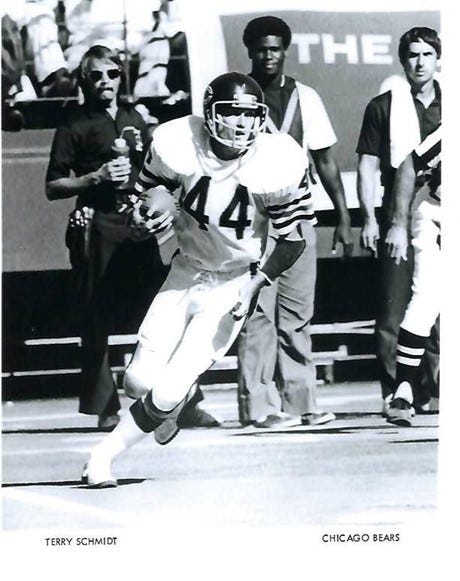
Being a professional football player was never Terry Schmidt’s goal. He wanted to be a dentist.

But there Schmidt was, on the field in Houston, staring at Earl Campbell, who was churning toward him.

‘He broke free,’ says Schmidt, a former NFL defensive back in the 1970s and 1980s, ‘and it was me and the end zone or Earl.’

Schmidt recalls hitting the future Hall of Fame running back on the 10-yard line, and getting him to the ground at the 2.

‘I think, even with that, I was having fun,’ Schmidt recalls today. He lets loose a hearty laugh, which reappeared several times during our conversation.

Schmidt lasted 11 years, retiring after 143 games in the league, and playing his final season for the 1984 Bears. That’s right, he missed winning a Super Bowl on one of the best – if not the best – NFL teams of all time.

He doesn’t regret the decision for a moment. His response as to why winds you through a brutal training camp with a future Hall of Fame coach but happier days at Chicago’s Soldier Field, and to the Amazon and Africa.

Schmidt laid out his life in football, and his one as a father to two kids.

‘My son was playing Little League baseball and he loved baseball, but they selected an all-star team, (and) the guy that coached, his son was a catcher, too, and my son never played,’ Schmidt told USA TODAY Sports. ‘We were driving home from a game and he said, ‘Dad why doesn’t that guy like me?’ And I didn’t have an answer for that and then he quit playing baseball. He just gave it up and it was a shame because he was a really good baseball player.’

We spoke with Schmidt, 73, about how his insight through a lifetime of experience can help you and your young athlete:

(Questions and responses are edited for length and clarity.)

‘I can really do this’: When we’re supported in sports, we’re full of confidence

Terry grew up in Columbus, Indiana, about 40 minutes south of Indianapolis. He loved open-wheel racing, and played high school basketball games in some of the old arenas you see in the movie ‘Hoosiers.’

‘My dad never really said, ‘Let’s go play catch,’ ” he says. “But when I was at school, I’d see kids playing baseball and stuff and I got interested and just started playing. And he helped coach but it wasn’t like one of these things like, ‘Well you need to do this, you need to do that.’ It was just, ‘If you want to play, ‘Fine.’ ”

Schmidt became a three-sport athlete in high school (football, basketball, track) and played football at Ball State. He never dreamed how far he would go from there.

USA TODAY: How did you come to be a professional football player?

Terry Schmidt: I was recruited as a wide receiver. After my freshman year, the head coach was changed (to Dave McClain). I was pretty fast, I guess, and he said, “We’re really deep at wide receiver.’ So, I started at safety spring ball of my freshman year and played all four years as a safety, and played in the East West Shrine game. He said, “You could probably play professional football.” I said, ‘Coach, ‘I don’t know. I’m gonna be a dentist.’ I was drafted by New Orleans, Hawaii (World Football League) and Winnipeg (Canadian Football League).

I thought what the heck, I’m gonna just give this a shot. One of the first strikes ever in the NFL was 1974, and so they brought in a bunch of rookies, free agents, whatever, whoever wandered to cross the picket line. And so, the veterans didn’t come in until after third preseason game. I had a really, really good training camp, and I ended up starting as a rookie for the Saints at corner.

It just kind of happened. I would watch guys on TV, and I’d go, “I’m not that.” But then when I got to training camp and realized, I said, “Yeah, I can do this. I really can do this.’

An egomaniac coach holds a team back, even if you’re Hank Stram

During his third NFL training camp, Schmidt found himself playing for Hank Stram, a future Hall of Fame coach who had led the Chiefs to an AFL championship and and a Super Bowl title.

“I think he was probably a great coach back when they won the Super Bowl, but as the players evolved, he didn’t evolve with them,’ Schmidt says.

After a wild training camp, the Saints traded Schmidt to Chicago before the 1976 season.

USAT: It’s a brutal game, right? I mean, every year was probably really tough to get through.

TS: In the NFL we did two-a-days and Stram, when he came in, we did three-a-days. The evening practice, it was 7-on-7; the linemen didn’t really do anything. So we were running all day long. By the time I got to the Bears, my legs were shot, they really were. Back in the day,  players were conformist. When Stram first came to the Saints, that’s when they couldn’t stop you.

Stram was a good coach, but he was a egotist. We’d be on the bus, and once he got on the bus, everybody left. If you weren’t on the bus when Stram got on the bus, you got left behind. (If) the bus you were on tried to pass the bus Stram was on, he’d tell them to slow down. He had to be in the lead bus.

There was an article that came out in the (New Orleans) Times-Picayune that (owner) John Mecom said something about Stram spending too much money. The very next day, Mecom shows up at training camp and says, “I don’t know what you boys read, but I just wanted you to know that Hank’s my man and whatever Hank wants, Hank gets.” I was walking out after the meeting and I happened to be behind Mecom. I was gonna ask him something about (Indy) racing. I heard him turn to Stram and say, “Is that what you wanted me to say?”

Other tough coaches, like Mike Ditka, learn to compromise

Jim Finks, the Bears general manager, apparently had seen Schmidt play and liked him.

As an athlete, you never know who is watching you when you play, or whom you might run into down the road.

USAT: What happened with your career in Chicago?

TS: Allan Ellis, a great defensive back, got hurt right before the first game (of) the ’78 season. And I started playing at corner and never, ever turned back. We were playing a Thanksgiving game one time and by this time Stram had been fired (after going 7-21 over two seasons with the Saints) and I think he was doing radio for CBS. I happened to walk by Hank in this hallway, so I said, “Trading me was the best thing you ever did in my career.” And his response was, “Well, you know, Terry, we make mistakes from time to time.”

USAT: What were your experiences like with Ditka?

TS: In 1981, it was apparent (head coach) Neill Armstrong was going to be fired at the end of the season.  We had made great strides as a defense under Buddy Ryan and as a defensive squad we collectively felt it would be best if the defensive staff remained.  So we defensive players wrote a letter to (owner) George Halas, requesting he keep the defensive staff.  About a week (later) he came to practice.  Normally the whole team would gather around him.  But today when the offensive players and coaches, including Neill, came to the group, Halas basically told them to “Beat it.”

He said the letter was beautiful and that to his knowledge no other group of players had ever written to attempt to save a coach’s job.  Him being one of the founders of the NFL, that was most likely true.  He told us not to worry, that Buddy and the staff would be retained.

So Mike had to keep Buddy, and his defensive system, when he was hired in 1982. Mike did always support the players, but sometimes I think it is difficult for great players to coach some players. Not all players had his play-through-anything (attitude) – pain, injury, etc.  I heard he played with a very bad ankle sprain that was so intense it altered his running style, which led to hip problems (and) he eventually had it replaced.  Some players did not share that same attitude.

Ditka (was a) complex individual, good coach, good man, very sarcastic at times. Interestingly, despite their differences, Mike came to Buddy’s funeral.

There’s always someone better than you, but you can always grow from an athletic experience

Schmidt would go in and talk to Ryan after the season. By 1984, he says, he was playing the game more mentally than physically.

“What do you think?” he asked Ryan.

“I think it’s time to plan your retirement party,” the coach said.

Schmidt had always planned on dental school, and he says the Bears had set aside money to pay for it over his last three contracts.

USAT: You just missed out on the ‘85 team. What was that like?

TS: You just never know. We made the playoffs in ’77 and ’79. And we got beat in the wild card. And then in ’84, we made it to the NFC Championship. So I figured, what’s the odds of them making it next year?

George Halas really embraced his boys – that they planned for the future, you don’t know how long you’re gonna play, or they’re always looking for somebody to replace you. So, when I asked for money for dental school, they had no qualms at all. The only restriction was that I had to go; they set aside about 50 grand and they just said you have to go to get it and that was fine with me.

And as I look back on my dental career in school, I don’t think I was mature enough for the rigors of dental school when I was 22 and 23. When I went to school, I was 34, and I had a lot of classmates who were just right out of undergrad. They were 22, 23, 24, and they just didn’t concentrate on school. I wanted to be the best dentist I could be. I was ready for the rigors of dental school. Because it’s like a job.

What we miss out on sometimes leads to a bigger opportunity

Schmidt became a dentist for the Department of Veterans Affairs. He worked in Chicago but also in Tampa, Florida, Asheville, North Carolina, and Johnson City, Tennessee, and continues his missionary work in retirement.

“One of the coolest trips we did was a boat trip on the Amazon River (that) stopped at five different villages,” he says. “Once you get up in the jungle where we were, you have a village that’s just carved out. You’ve got anywhere between 30 to maybe 80 homes, and everybody’s got a boat. Every house is up on stilts. And one house has a satellite dish and a generator so if Brazil’s in the World Cup, they get a chance to watch it. They call it football, but every village has got a soccer field and has got soccer balls.”

His kids, Jake and Jennifer, who are now adults, kept loving sports, too. They excelled at volleyball, and his daughter had speed and ran track, like her dad.

Jennifer’s son, Derek, plays rugby at Spring Hill College in Mobile, Alabama.

“It’s a brutal game,” his grandfather says. “They don’t wear any pads.”

USAT: Do you have any advice for families that are trying to go through all this with sports?

TS: I coached one year, and the parents … Why are you taking my kid out? What do you mean? We had a meeting with the parents and said, ‘Look, this is not professional baseball. These kids aren’t doing this for a living. We want to get everybody a chance to play.’

The one thing I didn’t like about volleyball is that one year Jennifer got involved in club volleyball, and that was a nightmare. They go all over the place and I just kept telling my kids, ‘You just can’t concentrate on one sport. If you want to, OK, but I’m just telling you, based on my history.’

Don’t push anything on your kids and have a piece of tape over your mouth. You don’t need to be yelling at the umpires, don’t be yelling at the coaches. Go there and enjoy your son or your daughter playing. And just just let ‘em play.

When I would get beat up, I was still having fun out there. If the first thought that goes through your head when Earl Campbell breaks free is, “I’m gonna get hurt,” you need to quit.

 Borelli, aka Coach Steve, has been an editor and writer with USA TODAY since 1999. He spent 10 years coaching his two sons’ baseball and basketball teams. He and his wife, Colleen, are now sports parents for two high schoolers. His Coach Steve column is posted weekly. For his past columns, click here.

This post appeared first on USA TODAY

SAN JOSE, CA — When it comes to special teams in the NFL, nearly every team talks the talk – even if it’s merely lip service – regarding their often-crucial importance. But the NFC champion Seattle Seahawks walk the walk.

“We have such a good group of core guys – everybody’s bought in. I think that’s shown when we flipped some games,” Seattle kicker Jason Myers, who led the league with 171 points scored this season, told USA TODAY Sports.

“Everyone always says it’s one-third of the game, but not a lot of places where that’s true. Obviously, we do (believe it).”

Myers was quick to cite the investment from Seahawks general manager John Schneider, who signed him in free agency coming off a Pro Bowl season with the New York Jets in 2018 and added a four-year extension in 2023.

Schneider spent a fifth-round draft pick in 2018 − rare currency for a punter − on Michael Dickson, a second-team All-Pro who’s now on his third contract with the team. Then there was the midseason acquisition of wideout Rashid Shaheed, who’s had a massive special teams impact for the Seahawks – including three TD returns, highlighted by a 95-yarder to open (and effectively end?) the game in Seattle’s 41-6 divisional-round playoff rout of the San Francisco 49ers.

That was among many examples where a special teams play – particularly late in the season – proved pivotal for the Seahawks on their way to the NFC’s top playoff seed and, ultimately, their berth in Super Bowl 60:

In an 18-16 win over the Indianapolis Colts in Week 15, Shaheed had 137 return yards while Myers accounted for all the scoring (6-for-6 on field goals) on a day when Seattle’s offense couldn’t find the end zone.

In their riveting 38-37 defeat of the Los Angeles Rams in Week 16, a victory that put the Seahawks in control of the conference’s No. 1 seed, Shaheed’s 58-yard punt return for a TD midway through the third quarter sparked their comeback from a 30-14 deficit.

Dickson’s towering third-quarter punt in windy conditions during the NFC championship game proved too much for the Rams’ Xavier Smith to handle, Seattle’s Dareke Young recovering the muff and setting up a TD pass from quarterback Sam Darnold on the next play (LA never led in the game from that point forward).

“They’re talented players,” Seahawks special teams coach Jay Harbaugh told USA TODAY Sports.

“We just have guys that are so about the team, from the weekly preparation to how they operate on game day. When a group of people has that mindset, it’s crazy how good you can get over time. I’m really thankful to be able to coach them. It’s been a blast.”

Jay Harbaugh, ‘underrated hero’

One of Seattle head coach Mike Macdonald’s first orders of business when the team hired him in 2024 was to recruit Harbaugh, with whom Macdonald had overlapped while with the Baltimore Ravens and University of Michigan.

“He’s kind of like an underrated hero behind this whole operation,” Macdonald said of Harbaugh amidst the Seahawks’ preparations to face the New England Patriots on Sunday.

“Great eye for talent, the way he got buy-in, and the way that he creatively coached these awesome fundamentals. … It was, like, a very, very easy decision to beg him to come to Seattle – and he’s done a tremendous job from Day One.

“Jay’s awesome.”

Harbaugh – the son of Los Angeles Chargers coach Jim Harbaugh, who will be in attendance Sunday with the rare opportunity to see one of his son’s games in person, and nephew of New York Giants coach John Harbaugh, his boss for three years in Baltimore – reciprocates his praise for Macdonald.

“Mike makes it really important,” Jay Harbaugh told USA TODAY Sports regarding Seattle’s investment in special teams, including the support of fellow coordinators Klint Kubiak (offense) and Aden Durde (defense).

“You’re never battling any of that, which happens in a lot of places. So, getting the staff support and buy-in is a great thing. And then the players making it their own and taking ownership and being able to provide their input and ideas – them being committed to the success of each unit and not chasing their own stats.”

Harbaugh specifically name-checked fullback Brady Russell as a player who could probably attain special teams stardom, such as it is, but willingly plays within the confines of the system for the betterment of the group. An undrafted free agent in 2023, Russell has played nearly 1,000 special teams snaps during his time in Seattle compared to 107 on offense. He has 24 tackles over the past two seasons.

But big tackles – just like big kicks and returns – can change the tide of a game, especially when teams are evenly matched, as they theoretically are in a Super Bowl.

“It goes both ways. It really can spark your team and the stadium,” said Harbaugh. “We’ve had a couple of instances where we’ve been on the wrong end of that – you feel that the other way, too. One thing Mike talks about is just the complementary football – which is cliché, but like most clichés, they’re that way because they’re true. … When you have a great play on special teams, and then the offense goes and punches it in after a long return, or the kickoff team gets a really violent tackle at the 25-yard line – you just kind of build that momentum.

“The team feeds off each other, it’s like a family in that sense.”

Brenden Schooler, an All-Pro special teams player who succeeded the great Matthew Slater in New England, has admired Harbaugh and the Seahawks from afar.

“I mean, (Seattle) literally flips a game in one play. You just feel the energy shift,” Schooler told USA TODAY Sports. “Being on the short end of that stick is not fun.’

He added Harbaugh and the Seahawks are “ahead of the curve” while scheming blocks on kickoff returns.

“I’ve watched them all year long,” said Schooler, “it’s been a lot of fun to watch those guys go to work.”

New England special teams coach Jeremy Springer told USA TODAY Sports: “They’ve got the right pieces in the right places – Jay’s done an unbelievable job for them.”

Patriots also thrive on special teams

In addition to Schooler, the Pats also have an All-Pro player in the third phase, return ace Marcus Jones – one of the team’s captains who also doubles as a slot cornerback.

“It’s like having a really good quarterback – you always have the opportunity to score,” Springer said of the impact of a dangerous return man. “When you have a really good returner back there, guys just block harder. Because they know, they don’t want to be the block that doesn’t spring the guy to a touchdown – so your guys play harder for him.

“He just elevates the team.”

While Springer lauded Shaheed’s speed and acceleration, he believes the gift possessed by Jones, who has three punt return TDs in four NFL seasons, is setting up his blocks.

New England is less experienced in the kicking game, long snapper Julian Ashby and kicker Andy Borregales both rookies – though Springer says both are “even keel” and not effectively rookies at this stage of the season.

“We’ve got some good players, too, and at the end of the day, it’s gonna be an identity war,” said Springer, “their identity on special teams and our identity.”

Will opportunity knock in the Super Bowl?

It’s been nearly three decades since Green Bay Packers returner Desmond Howard was named the MVP of Super Bowl 31, the only special teamer who’s ever garnered that honor. If someone is to replicate it Sunday, the key is being prepared to maximize a chance.

“As a specialist, returner – you can’t really force the game,” said Myers. “So you’ve just got to be ready for your opportunity.”

Newly elected Hall of Fame kicker Adam Vinatieri was a frequent Super Bowl hero for the Patriots. Ten players have returned a kickoff all the way, but none since Seattle’s Percy Harvin 12 years ago.

No one has ever returned a punt for a TD in the Super Bowl. Springer also notes that teams are generally at the point of the season when it’s harder to get quality special teams repetitions in practice.

“It’s pretty likely that if you’re on offense or defense, there’s something that you’re dying to call – that you’ve worked on and you’ve schemed up, (and) you’re probably gonna get to call it,” said Harbaugh, explaining that executing a specific special teams play requires so many conditions to be in proper alignment.

“You’ve got be ready to take advantage of the moment when it comes. That’s part of the nature of the beast for us.”

Unlike Candlestick Park, the 49ers’ previous home, Levi’s Stadium – the Super Bowl 60 venue, far removed from the windier bay – isn’t known for erratic conditions that can play havoc with the kicking game. Frankly, it’s much warmer and calmer than Seattle or New England at this time of year.

Maybe what’s expected to be ideal weather can foster a big play from the unsung guys often viewed as having suboptimal NFL jobs.

“I think you’ve got to be a little crazy to do this, running full speed into somebody. At the end of the day, man, it’s doing whatever you can to help the team – whether that’s me running down as a gunner, me covering kicks, blocking for Marcus,” said Schooler.

“It’s whatever you can do to help the team.”

This post appeared first on USA TODAY

CORTINA D’AMPEZZO, Italy — Cortina has a special place in Lindsey Vonn’s heart. And on her résumé.

‘Cortina has always been a place that’s been so special to me,’ Vonn said. ‘I just have a lot of amazing memories, so it wasn’t really a leap for me to say I want to come back and compete in these Olympics.’

Vonn’s 12 wins in Cortina are her second-most at one site, behind her 18 victories at Lake Louise in Alberta, Canada. The Olimpia delle Tofane is a course she’s always understood, Vonn said, and it helped her learn how to be successful in downhill at the World Cup level.

‘I just have a good connection with the mountain. I know what it needs. I know what it takes to win there,’ Vonn said.

‘I’ve always felt really at home (there). It’s such a beautiful place, it’s hard not to stand on the top of that mountain and not really realize why you love the sport,’ she added. ‘So I’m excited to go back there and see the sunrise, the top of the Tofanaschuss, one more time.’

Here are all the times Lindsey Vonn has raced in Cortina, site of the women’s Alpine races at the 2026 Winter Olympics:

2025

  • Jan. 19: World Cup, super-G. DNF
  • Jan. 18: World Cup, downhill. 20th.

2019

  • Jan. 20: World Cup, super-G. DNF
  • Jan. 19: World Cup, downhill. 9th.
  • Jan. 18: World Cup, downhill. 15th.

2018

  • Jan. 21: World Cup, super-G. 6th.
  • Jan. 20: World Cup, downhill. WIN.
  • Jan. 19: World Cup, downhill, 2nd.

2017

  • Jan. 29: World Cup, super-G. 12th.
  • Jan. 28: World Cup, downhill. DNF.

2016

  • Jan. 24: World Cup, super-G. WIN
  • Jan. 23: World Cup, downhill. WIN

2015

  • Jan. 19: World Cup, super-G. WIN
  • Jan. 18: World Cup, downhill. WIN
  • Jan. 16: World Cup, downhill. 10th.

2013

  • Jan. 20: World Cup, super-G. 7th.
  • Jan. 19: World Cup, downhill. WIN.

2012

  • Jan. 15: World Cup, super-G. WIN.
  • Jan. 14: World Cup, downhill. 2nd.

2011

  • Jan. 23: World Cup, super-G. WIN.
  • Jan. 22: World Cup, downhill. 3rd.
  • Jan. 21: World Cup, super-G. WIN.

2010

  • Jan. 24: World Cup, giant slalom. 19th.
  • Jan. 23: World Cup, downhill. WIN.
  • Jan. 22: World Cup, super-G. WIN.

2009

  • Jan. 26: World Cup, super-G. 8th.
  • Jan. 25: World Cup, giant slalom. 10th.
  • Jan. 24: World Cup, downhill. 2nd.

2008

  • Jan. 21: World Cup, super-G. 4th.
  • Jan. 20: World Cup, super-G. 5th.
  • Jan. 19: World Cup, downhill. WIN.

2007

  • Jan. 20: World Cup, downhill, DNF.
  • Jan. 19: World Cup, super-G. 4th.

2006

  • Jan. 29: World Cup, giant slalom. DNF.
  • Jan. 28: World Cup, downhill. 9th.
  • Jan. 27: World Cup, super-G. 3rd.

2005

  • Jan. 16: World Cup, downhill. 18th.
  • Jan. 15: World Cup, downhill. 3rd.
  • Jan. 14: World Cup, super-G. 2nd.
  • Jan. 12: World Cup, super-G. 4th.

2004

  • Jan. 18: World Cup, downhill. 3rd.
  • Jan. 17: World Cup, downhill. 5th.
  • Jan. 16: World Cup, super-G. 43rd.
  • Jan. 14: World Cup, super-G. 53rd.

2002

  • Jan. 25: World Cup, super-G. DNF.

The USA TODAY app gets you to the heart of the news — fastDownload for award-winning coverage, crosswords, audio storytelling, the eNewspaper and more.

This post appeared first on USA TODAY

Here’s a quick recap of the crypto landscape for Friday (February 6) as of 9:00 p.m. UTC.

Get the latest insights on Bitcoin, Ether and altcoins, along with a round-up of key cryptocurrency market news.

Bitcoin (BTC) was priced at US$70,178.66, up by 11.3 percent over 24 hours.

Bitcoin price performance, February 6, 2026.

Chart via TradingView.

Bitcoin has stopped behaving as an alternative safe-haven asset and has re-aligned with the risk-asset cycle. Its high correlation with traditional financial markets, including a broad sell-off in technology stocks, precious metals, and equities, suggests a scenario of systemic stress and scarce liquidity.

Downward pressure intensified after breaking key technical levels, causing nearly US$770 million in leveraged long positions to be liquidated in 24 hours, suggesting the market’s ‘cleansing phase’ is ongoing. The decline was exacerbated by a strong dollar and rising bond yields, which reduced the appeal of non-yielding assets like cryptocurrencies, prompting a rotation into defensive assets.

In the short term, price action will be limited and vulnerable to renewed selling pressure as long as restrictive financial conditions and a defensive tone prevail in global markets. Stabilization requires an improvement in global financial conditions and Bitcoin’s ability to rebuild solid technical support.

Ether (ETH) was priced at US$2,052.03, up by 10 percent over the last 24 hours.

Altcoin price update

  • XRP (XRP) was priced at US$1.46, up by 25.2 over 24 hours.
  • Solana (SOL) was trading at US$87.37, up by 10.4 percent over 24 hours.

Securities Disclosure: I, Meagen Seatter, hold no direct investment interest in any company mentioned in this article.

This post appeared first on investingnews.com

We also break down next week’s catalysts to watch to help you prepare for the week ahead.

In this article:

    This week’s tech sector performance

    Tech stocks extended their selloff into their second week, with the Nasdaq Composite (INDEXNASDAQ:.IXIC) posting its steepest two‑day decline since last April.

    Monday (February 2) saw an early rotation out of tech ahead of Palantir Technologies (NASDAQ:PLTR) earnings report. NVIDIA (NASDAQ:NVDA) slipped on news that its proposed OpenAI‑backed investment hit a snag, dragging AI‑chip names like Advanced Micro Devices (NASDAQ:AMD), Broadcom (NASDAQ:AVGO) and other semiconductor leaders.

    Palantir’s earnings, which beat expectations and included an aggressive revenue growth guide, lifted shares in an early surge on Tuesday (February 3); however, Nvidia’s OpenAI‑investment‑snag news, plus general AI‑disruption worries and positioning, weighed on the broader tech stack, sparking a tech‑growth selloff that impacted NVIDIA, Microsoft (NASDAQ:MSFT) and other software‑heavy names.

    The Nasdaq fell deeper on Wednesday (February 4) as influential tech names such as AMD and other chip and software stocks reversed post‑earnings gains. AMD saw a sharp intraday plunge following its after‑hours earnings print on Tuesday. Its losses dragged the broader index lower.

    Tech selloffs extended into Thursday (February 5), with the Nasdaq closing down 1.6 percent as major tech stocks saw profit‑taking and forward‑looking capex‑related concerns, later crystallized by Alphabet (NASDAQ:GOOGL) and Amazon (NASDAQ:AMZN) aggressive 2026 spending plans.

    The Nasdaq made an impressive recovery on Friday (February 6) as a rally in chip stocks helped pare earlier week losses, despite ongoing volatility in the mega‑caps.

    3 tech stocks moving markets this week

    1.Teradyne (NASDAQ:TER)

    After reporting Q4 2025 earnings results and strong AI-driven guidance on Monday, the stock rose sharply. The semiconductor‑test and robotics‑automation company makes equipment used to test chips, including AI‑related compute and memory and industrial robots.

    2. Skyworks (NASDAQ:SWKS)

    The analog and RF‑semiconductor company, which designs and manufactures components used in smartphones, 5G infrastructure, automotive and IoT devices, reported Q1 fiscal 2026 results on Tuesday, beating expectations and guiding up, which helped it outperform the broader tech selloff.

    3. Apple (NASDAQ:AAPL)

    Apple’s strong performance this week was driven by a wave of analyst upgrades and bullish notes that reinforced the positive narrative from last week’s record‑breaking Q1 print, especially around iPhone demand and China‑market strength.

    Skyworks Solutions, Teradyne and Apple performance, February 2 to 6, 2025.

    Chart via Google Finance.

    Top tech news of the week

      • Canada led an AI delegation to the 2026 World Governments Summit (WGS) in Dubai this week, led by SCALE AI.
        • Alphabet Q4 numbers were driven by search revenue growth, which accelerated by nearly 17 percent, and Google Cloud revenue that jumped 48 percent YoY, helping ease fears that AI chatbots would eat into search. Despite the strong print, the stock dipped as the company said it plans to increase capital expenditures to between US$175 billion and US$185 billion, more than its 2025 cash generation.
        • Palantir’s earnings triggered a pop on Tuesday as it beat revenue expectations and laid out an aggressive 2026 growth guide. The company reported Q4 2025 revenue of US$1.41 billion, up 70 percentYoY, with US commercial revenue surging 137 percent and government revenue rising 66 percent, while guiding full‑year 2026 revenue to about US$7.2 billion
        • Amazon also posted a solid quarter, but said it will spend roughly US$200 billion this year on capital expenditures, a 56 percent jump from 2025, to fund AI‑related infrastructure, data centers and custom chips for AWS. Revenue rose approximately 14 percent to US$213.4 billion, driven by AWS reaccelerating to 24 percent growth and advertising increasing by 22 percent, despite free cash flow collapsing due to a capex surge.

          Tech ETF performance

          Tech exchange-traded funds (ETFs) track baskets of major tech stocks, meaning their performance helps investors gauge the overall performance of the niches they cover.

          This week, the iShares Semiconductor ETF (NASDAQ:SOXX) advanced by 1.89 percent, while the Invesco PHLX Semiconductor ETF (NASDAQ:SOXQ) advanced by 1.66 percent.

          The VanEck Semiconductor ETF (NASDAQ:SMH) also increased by 0.75 percent.

          Tech news to watch next week

          Next week is another earnings‑heavy, tech‑adjacent stretch, with a mix of big‑name reports and key macro data that will like keep markets sensitive to AI capex and earnings.

          Coinbase (NASDAQ:COIN) and Robinhood Markets (NASDAQ:HOOD) will be among the most‑watched names tied to crypto and retail trading. Cisco (NASDAQ:CSCO) also reports midweek.

          In addition to US wholesale inventories, Employment Cost Index and CPI reports, the FOMC minutes will be released on February 11, so rate policy and inflation will stay front‑of‑mind.

          Securities Disclosure: I, Meagen Seatter, hold no direct investment interest in any company mentioned in this article.

          This post appeared first on investingnews.com

          Statistics Canada released January’s jobs report on Friday (February 6). The data showed that the Canadian workforce shrank by 25,000, or 0.1 percent.

          Manufacturing experienced the largest decline, losing 28,000 workers, followed by education with 24,000, and the public sector, which decreased by 10,000. These declines were balanced by increases of 17,000 across information, culture, and recreation; 14,000 in business, building and support services; and 11,000 in agriculture.

          Despite the declines, the unemployment rate fell 0.3 percentage points to 6.5 percent. While the rate was the lowest since September 2024, the agency notes that the decrease was driven by fewer people looking for work through the month, and coincided with a 0.4 percent drop in the labor force participation rate, which came in at 65 percent.

          The release came just a day after the US Bureau of Labor Statistics (BLS) released its job opening report on Thursday (February 5) that showed that labor demand had decreased to its lowest level since September 2020, as December’s figures fell by 386,000 openings.

          The report differs from the employment situation summary, which is typically released on the first Friday of each month. The report has been delayed due to the extended US government shutdown in late 2025 and will be released next Wednesday, February 11.

          Employment data is an important metric for assessing the overall health of the Canadian and US economies and plays a significant role in helping central banks set interest rate policy.

          For more on what’s moving markets this week, check out our top market news round-up.

          Markets and commodities react

          Canadian equity markets were mixed this week.

          The S&P/TSX Composite Index (INDEXTSI:OSPTX) gained 1 percent over the week to close Friday at 32,470.98, while the S&P/TSX Venture Composite Index (INDEXTSI:JX) shed 5.38 percent to 1,015.34. The CSE Composite Index (CSE:CSECOMP) dropped 1.22 percent to 167.56.

          The gold price gained 4.84 percent to close at US$4,951.69 per ounce on Friday at 4:00 p.m. EST. The silver price didn’t fare as well, closing the week down 1.78 percent at US$77.32 on Friday.

          In base metals, the Comex copper price recorded a 0.85 percent rise this week to US$5.93.

          On the other hand, the S&P Goldman Sachs Commodities Index (INDEXSP:SPGSCI) was down 3.7 percent to end Friday at 587.55.

          Top Canadian mining stocks this week

          How did mining stocks perform against this backdrop?

          Take a look at this week’s five best-performing Canadian mining stocks below.

          Stocks data for this article was retrieved at 4:00 p.m. EST on Friday using TradingView’s stock screener. Only companies trading on the TSX, TSXV and CSE with market caps greater than C$10 million are included. Mineral companies within the non-energy minerals, energy minerals, process industry and producer manufacturing sectors were considered.

          1. Giant Mining (CSE:BFG)

          Weekly gain: 69.57 percent
          Market cap: C$27.51 million
          Share price: C$0.39

          Giant Mining is an exploration company working to advance its Majuba Hill District copper, silver and gold project north of Reno in Nevada, US.

          The site consists of 403 federal lode mining claims and four private property parcels that cover an area of 3,919 hectares. Mining at the property took place between 1900 and 1950, resulting in the production of 2.8 million pounds of copper, 184,000 ounces of silver and 5,800 ounces of gold.

          Extensive exploration work has been carried out at Majuba Hill, with 89,930 feet being drilled since 2007.

          The most recent news from Giant came on January 30, when it reported that it planned to drill up to 10,000 feet in a multi-phase drill program at Majuba Hill, targeting three breccia zones.

          Following the first phase of 5,000 feet of drilling, the program will include underground and surface sampling to support follow-up drill targeting for the remaining holes.

          2. CGX Energy (TSXV:OYL)

          Weekly gain: 64.71 percent
          Market cap: C$66.02 million
          Share price: C$0.28

          CGX Energy is an oil and gas exploration company with 27.48 percent ownership of a portfolio of wells in the Corentyne block off the coast of Guyana. Frontera Energy (TSX:FEC) is the company’s joint venture partner in the Corentyne block and also holds 76.05 percent interest in CGX.

          The Kawa-1 exploration well was drilled in 2021 and 2022 and encountered an active hydrocarbon system extending to a depth of 6,000 feet, mirroring trends in the Guyana-Suriname Basin. CGX’s Wei-1 well was drilled in late 2022 and is located on-trend between the Kawa-1 well and Exxon’s (NYSE:XOM) Pluma discovery.

          CGX and Frontera are currently in a legal dispute with the government of Guyana, which believes the petroleum prospecting license for Corentyne expired in 2024, a stance the joint venture disagrees with. The most recent update on the matter mentioned plans to meet and discuss the situation, with potential dates in November or December of last year.

          Shares in CGX posted gains this week, but the company has not released news since November 13, when it announced its third-quarter financial statements. However, Frontera announced on January 30 that it divested its producing Colombian assets while retaining its interests in Guyana, news that may signal that the Corentyne block permitting situation could still be resolved.

          3. Saba Energy (TSXV:SABA)

          Weekly gain: 61.11 percent
          Market cap: C$12.07 million
          Share price: C$0.29

          Saba Energy is an oil and gas exploration company with operations in British Columbia, Canada, as well as the Philippines.

          The company’s primary Canadian operations consist of the producing Boundary Lake and Laprise oil and gas fields, which have a net present value of C$43 million as of its September quarterly report.

          The most recent news from Saba came on January 27, when it announced a heads-of-agreement with Nido Petroleum for a farm-in arrangement on a pair of offshore assets in the Philippines.

          Saba will earn 60 percent of Service Contract 54 (SC54). SC54 covers an area of 550 square kilometers to depths of 50 to 110 meters and hosts three discovery wells and one production well, which previously produced 270,000 barrels at 19,000 barrels per day before it was closed due to water encroachment.

          The company will also earn a 52.73 percent share in the DPPSC Cadlao, which covers an area of 914 square kilometers to depths of 93 meters. The site has 6.8 million barrels in reserves and produced 11.1 million barrels between 1982 and 1992.

          If the transaction is completed, Saba will become the operator of both assets. The company plans to open a US$7.5 million convertible debenture private placement to achieve the requirement of raising US$7 million by mid-April.

          4. Copper Giant Resources (TSXV:CGNT)

          Weekly gain: 60.66 percent
          Market cap: C$157.77 million
          Share price: C$0.98

          Copper Giant Resources is an exploration company advancing its Mocoa copper-molybdenum project in Southern Colombia. It changed its name from Libero Copper and Gold last year.

          The property covers 1,324 square kilometers and hosts a copper porphyry system originally discovered in 1973.

          A November 2025 mineral resource estimate significantly increased its resource. Mocoa now holds an inferred resource of 7.6 billion pounds of copper and 1 billion pounds of molybdenum, at 0.31 percent copper and 0.039 percent molybdenum, from 1.12 billion metric tons of ore. The upgrade made the project South America’s largest undeveloped molybdenum deposit.

          The most recent news from Copper Giant came on January 29, when it reported results from the first drill hole at the La Estrella target. While assays returned low-grade mineralization, the company noted that the significance was geological, as it confirmed continuity of the porphyry system beyond the established deposit.

          The release also reported results from a second hole at the southern edge of the Mocoa footprint, which the company said were stronger than previously interpreted at the southern margin of the deposits. Grades in the hole were 0.13 percent copper and 0.01 percent molybdenum over 804 meters starting from surface, which included an intersection of 0.44 percent copper and 0.05 percent molybdenum over 33 meters.

          5. Benz Mining (TSXV:BZ)

          Weekly gain: 50.46 percent
          Market cap: C$749.9 million
          Share price: C$3.25

          Benz Mining is a gold exploration company that is focused on advancing projects in Québec, Canada, as well as Western Australia.

          Its Eastmain project consists of an 8,000 hectare property located in Central Québec within the Upper Eastmain Greenstone belt. The most recent resource estimate from May 2023 reported an indicated resource of 384,000 ounces of gold from 1.3 metric tons of ore grading 9 g/t gold, and an inferred resource of 621,000 ounces of gold from 3.8 metric tons grading 5.1 g/t.

          In 2025, Benz acquired the Glenburgh and Mount Egerton gold projects in Western Australia from Spartan Resources (ASX:SPR). It spent much of 2025 exploring Glenburgh, which covers an area of 786 square kilometers and features 50 kilometers of strike. The site hosts six priority extension targets and 5 kilometers of exploration trend with over 100 parts per billion gold.

          A November 2024 resource estimate for Glenburgh showed an indicated and inferred resource of 510,000 ounces of gold from 16.3 million metric tons of ore with an average grade of 1 g/t gold.

          On January 28, the company announced a shallow, high-grade discovery at the Glenburgh project’s Icon trend. Assays returned grades including 29 g/t gold over 13 meters starting at a depth of 60 meters. Additionally, results showed wide mineralization as well, including 200 meters grading 1 g/t gold starting at 76 meters.

          The most recent news from Benz came the next day, when it announced it received firm commitments for a AU$75 million bought deal placement, which it said was led by strong demand from two global institutional fund. The company said the investment increases its pro forma cash position to AU$94 million, which will be allocated across its portfolio, particularly focused on the Glenburgh project.

          FAQs for Canadian mining stocks

          What is the difference between the TSX and TSXV?

          The TSX, or Toronto Stock Exchange, is used by senior companies with larger market caps, and the TSXV, or TSX Venture Exchange, is used by smaller-cap companies. Companies listed on the TSXV can graduate to the senior exchange.

          How many mining companies are listed on the TSX and TSXV?

          As of December 2025, 898 mining companies and 71 oil and gas companies are listed on the TSXV, combining for more than 60 percent of the 1,531 total companies listed on the exchange.

          As for the TSX, it is home to 175 mining companies and 51 oil and gas companies. The exchange has 2,089 companies listed on it in total.

          Together, the TSX and TSXV host around 40 percent of the world’s public mining companies.

          How much does it cost to list on the TSXV?

          There are a variety of different fees that companies must pay to list on the TSXV, and according to the exchange, they can vary based on the transaction’s nature and complexity. The listing fee alone will most likely cost between C$10,000 to C$70,000. Accounting and auditing fees could rack up between C$25,000 and C$100,000, while legal fees are expected to be over C$75,000 and an underwriters’ commission may hit up to 12 percent.

          The exchange lists a handful of other fees and expenses companies can expect, including but not limited to security commission and transfer agency fees, investor relations costs and director and officer liability insurance.

          These are all just for the initial listing, of course. There are ongoing expenses once companies are trading, such as sustaining fees and additional listing fees, plus the costs associated with filing regular reports.

          How do you trade on the TSXV?

          Investors can trade on the TSXV the way they would trade stocks on any exchange. This means they can use a stock broker or an individual investment account to buy and sell shares of TSXV-listed companies during the exchange’s trading hours.

          Article by Dean Belder; FAQs by Lauren Kelly.

          Securities Disclosure: I, Dean Belder, hold no direct investment interest in any company mentioned in this article.

          Securities Disclosure: I, Lauren Kelly, hold no direct investment interest in any company mentioned in this article.

          This post appeared first on investingnews.com

          It’s been a wild couple of weeks for gold and silver.

          After surging to record highs at the end of January, prices for both precious metals saw significant corrections, creating turmoil for market participants.

          This week brought some relief, with gold bouncing back from its low point and even trading above US$5,000 per ounce for a brief period of time.

          Silver, which is known for outperforming gold on both the upside and the downside, was more volatile, but seems to have found support around the US$70 per ounce level.

          Why did gold and silver drop, and more importantly, what’s next? As always, there are a variety of different factors at play, but I’ll give you a rundown of what I’ve been hearing.

          Starting with the pullback, I spoke with Joe Cavatoni of the World Gold Council, who pointed to speculative players as a key reason for gold’s price decline. Here’s how he explained it:

          ‘At the end of this, you’re looking at a lot of people who were pushing the price higher — speculative in nature — pulling back and taking money off the table. That’s why I think we’re seeing a correction in the price. I don’t think that we have an issue with, fundamentally, what’s going on in the gold market.’

          Gary Savage of the Smart Money Tracker newsletter made a similar comment, saying that there are times when sentiment gets so bullish that eventually there’s no one left to buy.

          However, on the silver side he saw signs of market manipulation as well:

          ‘Some of it is just (that) we got way too bullish, ran out of buyers. We were due for some kind of correction anyway, and I think the banks took advantage of that and coordinated a huge overnight attack that dropped silver … I think it was almost 30 percent, or maybe it was 30 percent, almost overnight. That allowed them to get out of their shorts, because a lot of those contracts were going to stand for delivery, and they were going to have to buy physical silver at US$120 an ounce to to deliver.’

          Adding more nuance to the silver story this week was the news that billionaire Chinese trader Bian Ximing has reportedly established the largest net short position on the Shanghai Futures Exchange, with his bet against the white metal clocking in at US$300 million.

          Bloomberg analysis of exchange data shows he started ‘ramping up silver shorts’ in the last week of January, although he initially began shifting from a long silver stance this past November.

          Aside from silver, Bian is known for his moves in gold and copper.

          There’s also been commentary suggesting that the nomination of Kevin Warsh for the US Federal Reserve chair position has weighed on gold and silver prices.

          President Donald Trump announced his choice on January 30, with market watchers quickly pointing to Warsh’s hawkish reputation and questioning whether he will fall in line with Trump’s calls for lower interest rates. Rates have been a sticking point between Trump and current Fed Chair Jerome Powell.

          However, in the days since the news broke, the tone has shifted, with Trump himself saying that Warsh wouldn’t have gotten the job if he said he wanted to raise rates.

          Taking a step back from what’s happening now, I want to emphasize that the majority of the experts I’ve been speaking with recently don’t believe gold and silver are topping.

          In a January 25 interview, Adrian Day of Adrian Day Asset Management said exactly that, pointing to previous bull markets where both metals moved steeply down before continuing up. This quote is from before last week’s correction, but I think you’ll see why it’s still relevant:

          ‘A pullback is always in the cards. And people forget, everybody talks about … 1974 to 1975, when gold dropped almost 50 percent. But people forget, the same thing happened in 2006. Halfway through the bull market, you had a 30 percent correction in gold, which of course means a much bigger correction for gold stocks.

          ‘So a pullback at some point is always not just a possibility, but it’s almost a certainty. But if we rephrase the question to, ‘Is this a top?’ You know, absolutely not. In my view, we are absolutely nowhere near a top.’

          With that said, a point that’s come up repeatedly in my interviews lately is personalization — while it’s valuable to listen to other people’s views, what’s really important is to form your own opinions and understand why you own the assets in your portfolio. If you can do that, you’ll be better equipped to weather any storms, and to buy and sell when it’s time.

          Securities Disclosure: I, Charlotte McLeod, hold no direct investment interest in any company mentioned in this article.

          This post appeared first on investingnews.com

          For years, blockchain had promise in the finance industry, but lacked the liquidity and connectivity to scale.

          Yuval Rooz, CEO and co-founder of Canton Network, believes that era is now ending.

          The problem: Legacy friction

          Traditional banking still depends on millions of costly, slow and error-prone messages as institutions attempt to reconcile fragmented records across systems.

          Repurchase agreement (repo) trades highlight the problem. Moving cash and collateral typically requires multiple intermediaries, manual checks and settlement delays that can stretch for days.

          Public blockchains such as Ethereum offer speed, but their full transparency creates a different obstacle, exposing sensitive transaction data that banks cannot legally or competitively disclose.

          At the heart of the issue is a structural trade off. Banks need shared networks to scale efficiency, yet legacy infrastructure and open ledgers force a choice between operating in isolation or revealing too much information. The result has been a patchwork of private systems that protect data sovereignty, but sacrifice interoperability and efficiency.

          Explaining how Canton’s technology removes that trade off, Rooz said:

          “Banks built walled gardens because there was no way to share infrastructure without giving up control or privacy. What we’re seeing now is a gradual shift away from isolated systems toward shared rails where institutions retain sovereignty over their data, while still achieving interoperability.

          ‘That doesn’t mean internal systems disappear overnight, but it does mean the center of gravity shifts toward networks where counterparties can transact in real time.”

          Canton’s solution: Privacy-enabled synchronization

          Canton has created a shared ledger where institutions maintain private blockchains, yet synchronize seamlessly.

          “I think critics misunderstand what financial institutions actually need,” Rooz explained. “Banks don’t want a system where everything is hidden, and they don’t want one where everything is public. They need a way to work together on shared processes, while keeping sensitive details private. That’s what Canton was designed for.”

          In practice, JPMorgan keeps its ledger sovereign, while plugging into LSEG for atomic delivery-versus-payment (DvP) settlements, all without revealing private data. Sub-transaction privacy ensures only trade participants see details; to others, it’s invisible. This network of networks lets banks achieve interoperability without sacrificing control.

          “(This) gives institutions a shared record they can trust, with configurable privacy at the protocol level to divulge transactional information only with involved parties. And because it’s built to connect different applications, firms can link markets and workflows together without sacrificing confidentiality,’ said Rooz.

          “This combination is something traditional systems cannot offer and is why you’re seeing institutions move from pilots into production onchain,’ the expert added.

          Live momentum: JPM Coin and tokenized repos

          JPM Coin’s native integration is a strong signal that the market is maturing.

          JPMorgan’s blockchain rail, with over US$1 trillion in processed volume, has fueled settlements across Canton’s ecosystem. Paired with LSEG’s tokenized deposits, which power live repo activity, there are now synchronized markets where DvP happens in seconds, not days.

          Rooz highlighted the deeper impact, commenting, “Everyone notices the speed, but the collateral mobility is the substance beyond the headline. In legacy markets, collateral spends most of its life idle because moving it safely across systems requires messaging, reconciliation and time. Atomic settlement collapses those steps into a single transaction.’

          He added, ‘When repos settle in seconds, collateral stops being static and becomes reusable. That improves liquidity, balance sheet efficiency and risk management.”

          2026 outlook

          JPM Coin and LSEG repos demonstrate Canton’s shift from pilots to production.

          “We measure success by utilization,” said Rooz, adding, “Having Canton be the network where real transactions are taking place, and regulated assets are moving.’

          He envisions steady expansion powering this transformation. Indeed, similar efforts are already live elsewhere, such as BlackRock’s BUIDL fund, which has tokenized US$1.7 billion in treasuries for 24/7 yields, and DRW Cumberland’s weekend repos, which use tokenized collateral with instant DvP settlements.

          “I’d like to see more asset classes brought on to Canton, and the corresponding transaction volume we’re already seeing will continue to grow in the year ahead,’ said Rooz.

          He sees this convergence accelerating across markets.

          “Our ‘North Star’ is to drive the convergence of TradFi and DeFi onchain to create a new AllFi reality,’ he said.

          Securities Disclosure: I, Meagen Seatter, hold no direct investment interest in any company mentioned in this article.

          This post appeared first on investingnews.com

          MILAN — NHL players are scheduled to land in Milan early in the morning Saturday and start practicing within hours.

          It’s the logistical aspect of getting around 150 players from the U.S. to the 2026 Winter Games, where for the next two weeks they’ll try to reach the gold medal game Feb. 22. The players and other NHL personnel are traveling on chartered planes.

          While NHL owners may grumble about the possibility of injuries, it’s a win for the sport to have the game’s best players back at the Olympics for the first time since 2014. (The 2018 Olympics in South Korea were a no-go for insurance and travel reasons, and the NHL pulled out of the 2022 Olympics in Beijing because of the pandemic.)

          Here’s what to know.

          When and where does Olympic men’s hockey get underway

          The first practices run all day Sunday, with Latvia holding the first slot at 10 a.m. in Milan (4 a.m. ET). The U.S. has a slot from 6-7:30 p.m., and Canada from 7:45 to 9:15 p.m. There are practices through Feb. 10. They’re vital to getting everybody on the same page as quickly as possible, and to turbo-charge team bonding. As far as arenas, Santa Giulia Arena is the primary one, while Rho Ice Hockey Arena is a temporary venue.

          When do the games begin

          Games begin Feb. 11, with the marquee team in action that day being Sweden against Italy. In preliminaries, the U.S. plays Latvia Feb. 12, Denmark Feb. 14, and Germany Feb. 15.

          How many teams are there

          The participating national teams are Canada, Czechia, Denmark, Finland, France, Germany, Italy, Latvia, Slovakia, Sweden, Switzerland, and the U.S. Host Italy is the only team without an NHL player on its roster. The teams are divided into fields of four. Group A has Canada, Czechia, France and Switzerland. Group B is Finland, Italy, Slovakia and Sweden. Group C has Denmark, Germany, Latvia and the U.S.

          All 12 teams play three preliminary games in their respective groups, then move on to a single-elimination playoff that will conclude with the gold medal game Feb. 22.

          Who is there from the NHL

          All 32 NHL teams have a player going, but some teams have quite a few more than others. Take the Florida Panthers (10, representing five teams) and the Vegas Golden Knights (Nine, representing seven countries).The Boston Bruins, Colorado Avalanche, Minnesota Wild and Tampa Bay Lightning each have eight players going.

          Here’s the full list.

          Anaheim Ducks

          Lukas Dostal (CZE)Mikael Granlund (FIN)Radko Gudas (CZE)Jackson LaCombe (USA)

          Boston Bruins

          Henri Jokiharju (FIN)Joonas Korpisalo (FIN)Elias Lindholm (SWE)Hampus Lindholm (SWE)Charlie McAvoy (USA)David Pastrnak (CZE)Jeremy Swayman (USA)Pavel Zacha (CZE)

          Buffalo Sabres

          Rasmus Dahlin (SWE)Tage Thompson (USA)

          Calgary Flames

          Martin Pospisil (SVK)

          Carolina Hurricanes

          Sebastian Aho (FIN)Frederik Andersen (DEN)Nikolaj Ehlers (DEN)Seth Jarvis (CAN)Jaccob Slavin (USA)

          Chicago Blackhawks

          Teuvo Teravainen (FIN)

          Colorado Avalanche

          Joel Kiviranta (FIN)Gabriel Landeskog (SWE)Artturi Lehkonen (FIN)Nathan MacKinnon (CAN)Cale Makar (CAN)Martin Necas (CZE)Brock Nelson (USA)Devon Toews (CAN)

          Columbus Blue Jackets

          Elvis Merzlikins (LAT)Zach Werenski (USA) 

          Dallas Stars

          Radek Faksa (CZE)Thomas Harley (CAN)Miro Heiskanen (FIN)Roope Hintz (FIN)Esa Lindell (FIN)Jake Oettinger (USA)Mikko Rantanen (FIN)

          Detroit Red Wings

          Dylan Larkin (USA)Lucas Raymond (SWE)Moritz Seider (GER)

          Edmonton Oilers

          Leon Draisaitl (GER)Connor McDavid (CAN)Josh Samanski (GER)

          Florida Panthers

          Uvis Balinskis (LAT)Sam Bennett (CAN)Gustav Forsling (SWE)Anton Lundell (FIN)Eetu Luostarinen (FIN)Niko Mikkola (FIN)Brad Marchand (CAN)Sam Reinhart (CAN)Matthew Tkachuk (USA)Sandis Vilmanis (LAT) 

          Los Angeles Kings

          Joel Armia (FIN)Drew Doughty (CAN)Kevin Fiala (SUI)Adrian Kempe (SWE)Darcy Kuemper (CAN)

          Minnesota Wild

          Matt Boldy (USA)Joel Eriksson Ek (SWE)Brock Faber (USA)Filip Gustavsson (SWE)Quinn Hughes (USA)Marcus Johansson (SWE)Nico Sturm (GER)Jesper Wallstedt (SWE)

          Montreal Canadiens

          Oliver Kapanen (FIN)Juraj Slafkovsky (SVK)Nick Suzuki (CAN)Alexandre Texier (FRA)

          Nashville Predators

          Filip Forsberg(SWE)Erik Haula (FIN)Roman Josi (SUI)Juuse Saros (FIN)

          New Jersey Devils

          Jesper Bratt (SWE)Nico Hischier (SUI)Jack Hughes (USA)Jacob Markstrom (SWE)Timo Meier(SUI)Simon Nemec (SVK)Jonas Siegenthaler (SUI)

          New York Islanders

          Bo Horvat (CAN)Ondrej Palat (CZE)

          New York Rangers

          J.T. Miller (USA)Vincent Trocheck (USA)Mika Zibanejad (SWE)

          Ottawa Senators

          Lars Eller (DEN)Nikolas Matinpalo (FIN)Jake Sanderson (USA)Mads Søgaard (DEN)Tim Stutzle (GER)Brady Tkachuk (USA)

          Philadelphia Flyers

          Rasmus Ristolainen (FIN)Travis Sanheim (CAN)Dan Vladar (CZE) 

          Pittsburgh Penguins

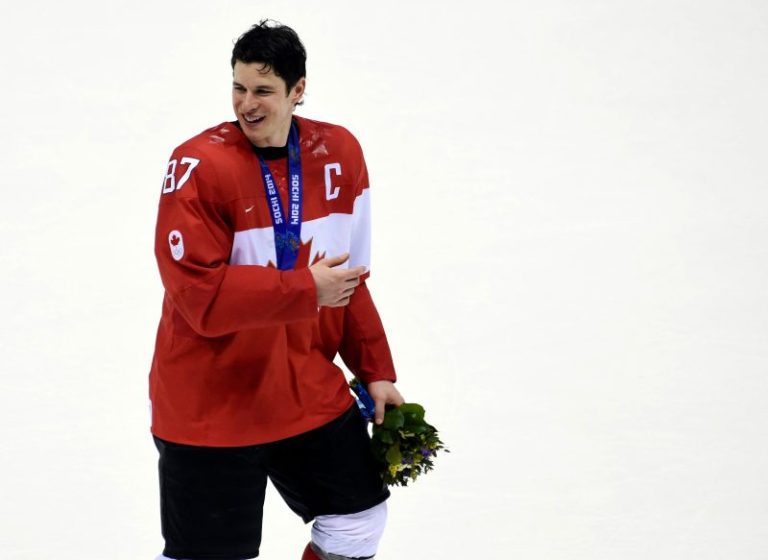
          Sidney Crosby (CAN)Erik Karlsson (SWE)Rickard Rakell (SWE)Arturs Silovs (LAT)

          San Jose Sharks

          Macklin Celebrini (CAN)Philipp Kurashev (SUI)Pavol Regenda (SVK)Alexander Wennberg (SWE)

          Seattle Kraken

          Oscar Fisker Molgaard (DEN)Philipp Grubauer (GER)Kaapo Kakko (FIN)Eeli Tolvanen (FIN)

          St. Louis Blues

          Jordan Binnington (CAN)Philip Broberg (SWE)Dalibor Dvorsky (SVK)Colton Parayko (CAN)Pius Suter (SUI)

          Tampa Bay Lightning

          Oliver Bjorkstrand (DEN)Erik Cernak (SVK)Zemgus Girgensons (LAT)Jake Guentzel (USA)Brandon Hagel (CAN)Victor Hedman (SWE)Pontus Holmberg (SWE)J.J. Moser (SUI) 

          Toronto Maple Leafs

          Oliver Ekman-Larsson (SWE)William Nylander (SWE)Auston Matthews (USA)

          Utah Mammoth

          Clayton Keller (USA)Olli Maatta (FIN)JJ Peterka (GER)Karel Vejmelka (CZE)

          Vancouver Canucks

          Teddy Blueger (LAT)Filip Hronek (CZE)David Kampf (CZE)Kevin Lankinen (FIN)Elias Pettersson (SWE)

          Vegas Golden Knights

          Rasmus Andersson (SWE)Jack Eichel (USA)Noah Hanifin (USA)Tomas Hertl (CZE)Mitch Marner (CAN)Jonas Rondbjerg (DEN)Akira Schmid (SUI)Mark Stone (CAN)Shea Theodore (CAN)

          Washington Capitals

          Martin Fehervary (SVK)Logan Thompson (CAN)Tom Wilson (CAN)

          Winnipeg Jets

          Kyle Connor (USA)Connor Hellebuyck (USA)Josh Morrissey (CAN)Nino Niederreiter (SUI)

          This post appeared first on USA TODAY

          • The 2026 Milano Cortina Winter Olympics opening ceremony was broadcast from three separate locations across northern Italy.
          • NBC’s broadcast featured Mary Carillo, Terry Gannon, and former snowboarder Shaun White as hosts.
          • NBC’s coverage was noted for being an improvement over the 2024 Paris broadcast, despite logistical challenges.

          LIVIGNO, Italy — Nothing will quite top the spectacle that was the opening ceremony of the 2024 Summer Olympics in Paris, where not even a significant rainstorm withered the parade down the Seine River.

          The 2026 Milano Cortina Winter Olympics have a much different reality to confront. With three separate clusters and six total competition sites across northern Italy, from the Alps to the Dolomites to Milan, these Games are the most spread out ever, which NBC made clear at the top of the broadcast, and made the show, naturally, difficult to conjoin.

          The network was looking to bounce back after Peyton Manning and Kelly Clarkson stepped all over the Paris opening ceremony broadcast and made a mess of it, clouding what was a special scene. This time, there were no celebrity guest hosts, as the network had to look at its talent bench with most of its sports broadcasting group, including Olympic host Mike Tirico, in Northern California for NBC’s Super Bowl 60 production Sunday.

          Savannah Guthrie was scheduled to co-host alongside Terry Gannon but had to step aside as she and her family deal with the disappearance and suspected kidnapping of her 84-year-old mother, Nancy.

          Mary Carillo filled in admirably on short notice. She and Gannon adequately addressed Guthrie’s absence during the 20 minutes between NBC going on air and the ceremony starting.

          ‘We are certainly without a loved member of our team,’ Gannon said.

          Joining Gannon and Carillo was three-time Olympic gold-medalist Shaun White, who represented the U.S. at five Winter Games as a snowboarder. He was in the booth for a brief introduction at the start of the show and bowed out until the Parade of Nations, when air time needed to be filled, a wise move by NBC executives. Certainly qualified, White had his moments and provided insight into the snowboarding athletes because he knows them. Every country that walked though became a chance to tell a personal story, though.

          We get it, Shaun. You’ve traveled the world twice over. Whoever got in his ear at the start of his set to encourage him to lay off the number of times he said ‘amazing’ was keen.

          White, for his faults, is natural on television and his inclusion is sensical, unlike Manning and Clarkson were in Paris. He excelled in adding a former athlete’s perspective, complete with an amusing anecdote about not being told to walk during the opening ceremony because of his competition schedule, only to return to the athlete’s village in the wee hours of the morning. He left plenty to be desired when he transitioned into sportwashing on behalf of Saudi Arabia. His promotion of the Snow League, White’s winter sports circuit in its first year (which of course has a deal with NBC), was mildly irritating.

          Carillo at least tried to keep the trains on the track by talking about Lindsey Vonn. She asked questions that advanced the conversation. There was a lightness to her interjections that matched the event. She tried to supply humor. At times, Carillo sounded like she was analyzing an actual sporting event, and it kind of worked.

          Gannon mentioned protests in Iran and the Carillo followed up by pointing out the third act of the ceremony is about peace. They fawned over the Ukrainian athletes. Yet there was no mention of Israel receiving boos inside San Siro Stadium.  

          The Parade of Nations lacked luster because athletes marched in separate places – inside San Siro, around Cortina and at the snow park in Livigno. The graphics department should have been busier and informed viewers which cluster they were watching as the broadcast canvassed each one. Having a camera in U.S. flagbearer Erin Jacskon’s family’s home in Ocala, Florida, created a heartwarming moment.

          NBC threw it to special correspondent Snoop Dogg early but only returned to him for the Jamaican bobsledders and an interview with U.S. flagbearer Frank Del Duca. After his talent became an epic success for NBC in Paris, it was interesting to see the network not give him a bigger role throughout the show. Perhaps there’s an element of not wanting to shoot all of the Snoop bullets at once, but how many people at home would complain about more Double-G?

          What has made Snoop indispensable beyond his entertainment value and camera presence is that it appears he actually does his homework and conveys a legitimate investment in the athletes. NBC deserves kudos for maintaining the partnership.

          It’s not like NBC didn’t lean into the celebrity angle. Twelve minutes into the broadcast, Taylor Swift appeared and gave her props to the athletes representing America. It felt random until learning she dropped a music video for ‘Opalite’ on Friday.

          Another lowlight for NBC was its interview with Chloe Kim, as reporter Tina Smith left plenty of meat on the bone when it came to asking about her injured shoulder and instead acted more like a fan.

          The ceremony began with a montage of what we the world loves about Italy, and what Italy has given the world: opera, music, literature, Renaissance art, espressos, vino, natural beauty and architecture.

          The ceremony’s theme, in Italian, was ‘armonia,’ which translates to harmony. There was a self-aware paparazzi skit that morphed into somewhat creepy mascot-heads of famous Italian composers Rossini, Verdi and Puccini.

          Gannon was solid with the narration, complete with a Jim Valvano – his former basketball coach at North Carolina State – shoutout that would have made the late paisan proud. Carillo was never heavy-handed with additions.

          Mariah Carey sang, in Italian, Domenico Modugno’s ‘Nel Blu, dipinto di Blu,’ followed by one of her most iconic songs, ‘Nothing Is Impossible’ (in English). She hit the falsetto notes – no lip-syncing controversies this time.

          The introduction of Italian president Sergio Mattarella was tasteful. NBC didn’t overdo it by lingering on U.S. vice president JD Vance’s presence two spots from IOC president Kirsty Coventry, and only briefly lingered on him and wife Usha with a mention from Gannon during the Americans’ parade entrance.

          Much of what ailed the NBC coverage was beyond its control. Tragic, in one sense. The network deserves credit for realizing its error two years ago, being nimble given Guthrie’s situation and juggling another massive sporting event. It wasn’t perfect, but much like these Games portend, it was perfectly disjointed.

          This post appeared first on USA TODAY