The Blue Jays’ series winning streak ended on Sunday.
But even more meaningful baseball awaits as Toronto wrestles for positioning with over half of the American League, writes Arden Zwelling.


The Blue Jays’ series winning streak ended on Sunday.
But even more meaningful baseball awaits as Toronto wrestles for positioning with over half of the American League, writes Arden Zwelling.

Bitcoin’s sudden jump wasn’t just about Bitcoin, it started in the U.S. bond market. The U.S. Treasury announced that it would buy back more long-term government bonds, increasing the size of its buyback operations from around $2 billion to at least $4 billion. This pushed long-term bond yields lower. When government bond yields fall, assets like Bitcoin can become more attractive because investors are getting a lower return from relatively safe government debt. That massive move then triggered a short squeeze with traders who had bet that Bitcoin would fall were suddenly losing money, and their positions were automatically closed. That forced them to buy Bitcoin, which pushed the price even higher. Around $1.59 billion worth of crypto positions were liquidated over 24 hours, including roughly $746 million in Bitcoin shorts during the huge move. One important point: this wasn’t QE or the Fed printing money. The Treasury was simply buying back existing government debt to help improve liquidity in the bond market. The key takeaway is that the bond market moved first, Bitcoin followed, and the wave of short liquidations then amplified the move.
From a technical perspective, Bitcoin has strengthened sharply after breaking above the 100-day SMA near $66,140, with price now trading around $77,430 and firmly above both moving averages. The breakout has pushed price well beyond the upper Bollinger Band, highlighting strong bullish momentum but also stretched conditions. The Stochastic oscillator is
deeply overbought, with both lines above 80, increasing the risk of a short-term pullback or consolidation. The $72,500 – 73,000 area now becomes the first important support zone, while a sustained break above $77,500 could open the way toward the $80,000 psychological level. Overall, the technical outlook remains strongly bullish, but the sharpness of the recent rally makes a near-term correction increasingly likely.

With estimates showing that there are up to 16,000 travel agencies and companies selling some form of organized travel operating in the United Kingdom, some will withstand the current market while a large number will struggle.
Rising labor and operational costs, the ease with which people can now book their own travel online and lower consumer spending sentiment amid an uncertain economy all contribute to a situation in which dozens of small and mid-size travel agencies across the country have entered administration or shut down entirely since the start of 2026.
Some recent names include Trav Expert, Groupia, Salamander Voyages, Travel Bespoke, Regen Central, Set Sail Cruises, Yourtravelshop.com, Ski Yodel and TS Travels Group among others.
The most recent name to join the list is Golf Villa Rentals, a company based out of East Sussex southeast of London that sold golf tour packages to countries such as Portugal, Greece, Spain and the United States to Brits.
As first reported by a local outlet, the travel agency deleted its Facebook and Instagram accounts and formally shut down all operations on August 18. Dozens of holiday packages including tickets, accommodation and golfing arrangements into the rest of the 2026 have also been canceled.
Related: Two low-cost airlines shutting down in 2027
As a former member of the ABTA (a shortened form for the Association of British Travel Agents), Golf Villa Rentals was protected through the business failure insurance that the organization uses to cover its members.
Shutterstock
The protection is done through the agency’s insurance provider rather than the travel company itself, which has not been reachable since news of its collapse was reported.
More Travel News:
“If you booked a package holiday through Golf Villa Rentals Ltd, financial protection for those holidays was provided by financial failure insurance,” ABTA said in a statement on the travel agency’s closure. “Customers with bookings should visit the Evolution Insurance Company Ltd website for further information and advice on how to make a claim.”
Related: Travel company shuts down and strands hundreds in suspected scam

Vladimir Guerrero Jr. cleared all testing required under MLB’s concussion protocol to return to service with the Blue Jays against the Yankees on Saturday. Guerrero’s return reads better than it felt @Arden Zwelling writes.

Zcash cryptocurrency can be expected to correct down once it reaches next resistance level 637.00 – with the target of the downward correction standing at formed high at 637.00.
Zcash cryptocurrency has been rising sharply inside the active minor impulse wave 3 – which earlier broke above the key resistance level 637.00 (which stopped wave B at the start of July, as can be seen from the daily Zcash chart below). The active impulse wave 3 belongs to the intermediate impulse wave (3) from the middle of June. The price is currently approaching the major resistance level 683.00, which stopped the sharp uptrend in May – which can attract some profit taking from this level.
Given the strength of the resistance level 683.00, partially weakening bullish sentiment that can be seen across the crypto markets today and the overbought daily Stochastic reading, Zcash cryptocurrency can be expected to correct down once it reaches next resistance level 637.00 – with the target of the downward correction standing at formed high at 637.00.
The subject matter and the content of this article are solely the views of the author. FinanceFeeds does not bear any legal responsibility for the content of this article and they do not reflect the viewpoint of FinanceFeeds or its editorial staff.
The information does not constitute advice or a recommendation on any course of action and does not take into account your personal circumstances, financial situation, or individual needs. We strongly recommend you seek independent professional advice or conduct your own independent research before acting upon any information contained in this article.
If there’s a habit I’ve picked up from watching markets, it’s that when everyone is looking at the loudest trade, I start wondering what’s happening in the quiet corners.
The biggest clues aren’t always found in a soaring stock that’s already overvalued or a famous analyst calling for a breakout. Sometimes they’re buried somewhere else that investors never bother to open. I’d put this one in the last category.
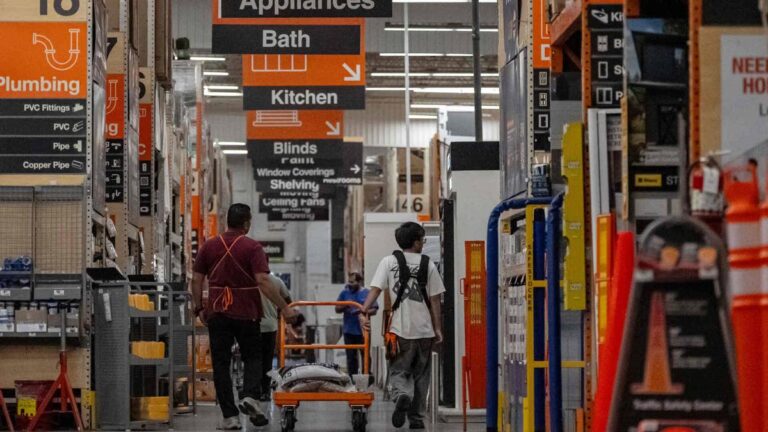
The latest 13F filing from the Bill & Melinda Gates Foundation Trust shows a new $352.7 million position in The Home Depot (HD). At the same time, the trust cut its stake in Berkshire Hathaway by about $818 million.
That’s not pocket change, and it’s certainly not the kind of portfolio move I’d scroll past without asking why.
Why? This is big money moving from one of the market’s most iconic investments into a home-improvement giant. There must be a story hiding underneath the numbers. The trust just bought the shares while everyone else seems to be waiting for the housing market to come back to life.
The trust now holds 1 million shares of The Home Depot. That’s a meaningful opening position for a portfolio with $34.42 billion in managed 13F securities, according to WhaleWisdom.
And it arrives at a moment when The Home Depot just delivered its strongest comparable sales growth since 2022, despite what its own CFO describes as “frozen housing market conditions.”
Also Read: The Home Depot over the years: A complete history of America’s biggest hardware store
The Gates Foundation Trust’s portfolio is concentrated and deliberate. Its top five holdings include Berkshire Hathaway Class B (BRK.B), Caterpillar (CAT), Canadian National Railway (CNI), Waste Management (WM), and Deere & Company (DE), according to GuruFocus data.
These are long-duration bets on essential infrastructure, industrials, and American economic activity.
The Home Depot fits that same framework anyway. It’s the world’s largest home improvement retailer, tied directly to the American housing stock, The Home Depot reports.
More Retail:
The trust also opened a new position in FedEx Freight Holding Company (FDXF) worth approximately $180 million in the same quarter, according to the 13F filing. That’s another infrastructure-adjacent business that I’ll most likely cover next.
My understanding is that the trust is rotating toward companies that benefit from domestic economic activity and physical asset maintenance rather than purely financial holdings. Call me crazy, but that sounds like a pretty interesting investment thesis.
The Home Depot reported Q2 fiscal 2026 results on Aug. 18 that beat expectations across the board.
CFO Richard McPhail was candid about the environment in a CNBC interview.
“We continue to operate in what I call frozen housing market conditions,” he said. “But we also know that we’re taking share and that we’re serving our customers better every day.”
That phrase — taking share in a frozen market — is the crux of the investment case. The Home Depot’s comparable sales growth isn’t being driven by a housing recovery. It’s being driven by smaller, non-discretionary repair and maintenance projects that homeowners undertake regardless of whether they’re buying or selling.
Related: Home Depot is making a big bet on cautious consumers
When a roof leaks or a water heater fails, it gets replaced. Like it or not, The Home Depot captures that spending whether mortgage rates are at 3% or 7%.
The company also received $730 million in tariff refunds during Q2, using $685 million to reduce cost of goods sold, according to McPhail’s comments on the earnings call.
That pass-through to customers mirrors Walmart’s own approach to tariff refunds, as I noted in my previous coverage, highlighting a broader pattern among major retailers navigating the current trade environment.
Bank of America analyst Christopher Nardone reiterated a Buy rating on The Home Depot and adjusted his price target to $407 from $412, according to a note shared with my colleague at TheStreet.
The modest target reduction reflects the cautious guidance The Home Depot reaffirmed rather than raised. But the Buy rating holds.
The Home Depot’s reaffirmed fiscal 2026 guidance calls for total sales growth of 2.5% to 4.5% and comparable sales growth of flat to 2.0%, according to The Home Depot. Gross margin is projected at approximately 33.1%, with operating margin between 12.4% and 12.6%.
McPhail described the customer as “a healthy cohort” who has “the means to spend” but remains hesitant as projects get larger, citing inflation, fuel costs, and general uncertainty, according to his CNBC interview.
That hesitancy is real, but it’s also temporary. The deferred maintenance and renovation spending building up in the U.S. housing stock doesn’t disappear. It accumulates.
HD shares were trading at $334.49 as of Aug. 20, down 1.41% year-to-date and 14.53% over the past year, according to Yahoo Finance. That’s roughly $18 down from where Gates opened their buy position.
My read is that the Gates Foundation is buying The Home Depot at a point of maximum pessimism about housing.
Bank of America’s $407 target implies roughly 22% upside from current levels. The Gates Foundation, apparently, agrees with the direction.
Related: Home Depot faces uphill battle amid a growing customer problem

Nikita Kucherov couldn’t have picked a more perfect time to deliver a dominant season and collect his second Hart Trophy. Michael Amato explains why in this edition of the Friday Four.

Ethereum cryptocurrency can be expected to rise further to the next resistance level 2400.00 – previous monthly high from April and May.
Ethereum cryptocurrency recently broke the resistance zone lying at the intersection of the round resistance level 2000.00 (which stopped wave A at the end of July, as can be seen from the daily Ethereum chart below) and the 50% Fibonacci correction of the previous sharp downward impulse wave from the start of May. The breakout of this resistance area accelerated the active short-term impulse wave C – which then broke the daily up channel from the end of June.
Given the strength of the active impulse wave C and the strongly bullish sentiment that can be seen across the crypto markets today, Ethereum cryptocurrency can be expected to rise further to the next resistance level 2400.00 – previous monthly high from April and May.
The subject matter and the content of this article are solely the views of the author. FinanceFeeds does not bear any legal responsibility for the content of this article and they do not reflect the viewpoint of FinanceFeeds or its editorial staff.
The information does not constitute advice or a recommendation on any course of action and does not take into account your personal circumstances, financial situation, or individual needs. We strongly recommend you seek independent professional advice or conduct your own independent research before acting upon any information contained in this article.
Most technology gets cheaper the longer it stays on sale. That is the bargain buyers have come to expect. Wait a generation or two, and the gadget that cost a fortune at launch turns up at half the price with twice the storage.
Folding phones never honored that bargain.
Seven years after the first one reached store shelves, a folding handset still costs roughly double what a conventional flagship costs. The hinge is still the part owners worry about. The crease is still visible on most models. The category still accounts for a sliver of global shipments rather than the replacement wave the industry kept promising.
Buyers noticed. Survey after survey has found that most people do not want a phone that folds, mostly because they cannot see what the second screen buys them for the extra thousand dollars.
So a research note arguing that folding phones are about to turn into a real growth engine would usually be easy to skip.
This one is harder to skip, because of whose folding phone it involves.
Apple (AAPL) has stayed out of the category longer than any of its rivals, and a firm that had been sitting on the sidelines of the stock just decided that silence is worth paying up for.
The first mass-market folding phone arrived in 2019 from Samsung, and the pitch has barely changed since. You get a tablet-sized screen that fits in a pocket, and you pay a premium of roughly $1,000 over a standard flagship for the privilege.
Seven generations later, the mechanical problems have mostly been solved and the demand problem has not. Rivals including Google, Huawei, and Motorola all sell folding models. None of them has turned the form factor into a mainstream upgrade.
The volume numbers explain why. Samsung’s flagship folding model sells roughly three million units a year, a figure Jefferies flagged when it questioned the size of the market for a $2,000 phone, TheStreet reported on Oct. 3, 2025.
Set that against the 257 million conventional iPhones Rothschild uses in its own fiscal 2027 model, and the gap between a niche product and a mainstream one gets easy to see.
Related: Apple’s first foldable could reshape its entire iPhone launch
The resistance shows up in the survey data. A 2023 CNET survey found that 64% of consumers did not want a foldable handset, though a more recent Forbes survey found that 61% would gain immediate confidence in the category if one specific company entered it, according to Investing.com.
That second number is the entire bull case in one line.
The argument is not that folding phones are good. The argument is that the category has been waiting on a validator, and the case for a $2,000 foldable has always depended on who ships it rather than what it does.
Rothschild & Co Redburn analyst Timm Schulze-Melander upgraded Apple to buy from neutral and raised his price target to $400 from $260 on Aug. 17, implying 31% upside from the prior Aug. 14’s close, according to CNBC.
The strength of the product roadmap and the move into folding handsets “appears underappreciated by the market,” he wrote to clients.
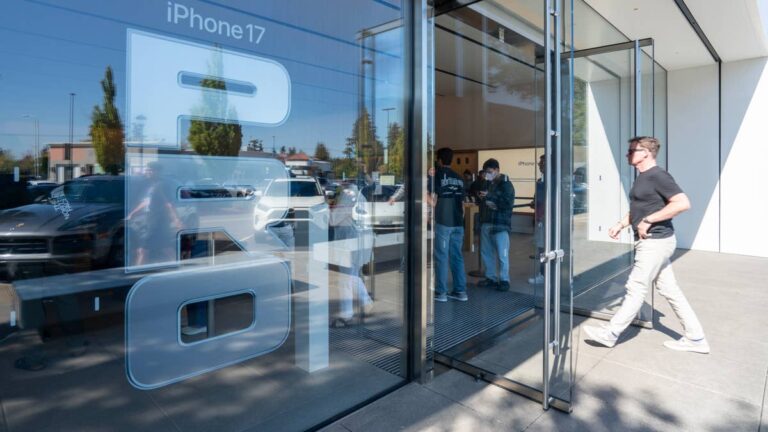
Apple has never confirmed a folding phone. The note assumes one lands next month, alongside the rest of the fall lineup, and that it carries a name most of the supply chain has already settled on: iPhone Ultra.
Here is what the forecast actually contains:
I ran the top-line math on those units, and the scale is smaller than the headline number suggests. Fourteen million units at $2,199 works out to roughly $31 billion in revenue spread across a fiscal year, against the $54.25 billion the iPhone line generated in a single recent quarter.
The foldable is not the story on volume. It is the story on price.
Redburn expects the device to lift average selling prices across the whole iPhone lineup by 11% by June 2027, according to CNBC, and that is the line that moves earnings.
The assumption I keep circling back to is the cannibalization figure. Four million out of 257 million works out to a 2% hit, which means Redburn is modeling a foldable that adds buyers instead of shuffling them.
Apple has pulled that off before with AirPods and Apple Watch. It has also never asked anyone to pay $2,199 for a phone.
The second half of the upgrade has nothing to do with hardware. Apple Intelligence, the company’s artificial intelligence (AI) platform, has disappointed since launch, and some of its marquee features run on a customized version of Google’s Gemini model.
Apple pays Google roughly $1 billion a year for that access while collecting about $27.5 billion a year from Google for search placement across its devices, according to Investing.com.
Redburn’s view is that Apple could cut its dependence by moving to open-source models, possibly with Nvidia (NVDA), an approach the analysts labeled “Fast Follower 2.0.”
More Apple News:
Those two figures are worth sitting with. The company is paying about one dollar for every 27 it collects from the same partner, which is a comfortable position to occupy right up until the search payments come under legal or competitive pressure.
That framing matters because it reprices the AI discount. Apple has spent two years being marked down for showing up late to AI, which is roughly the same criticism it absorbed for showing up late to folding phones, large-screen phones, and streaming.
Late has historically been where the company makes its money.
The risk list is not short. The device could slip, and Nikkei Asia reported engineering setbacks earlier this year before Bloomberg reported that the September timeline still held. Memory and component costs are rising. And a $2,199 phone has never been tested at scale.
The rest of Wall Street is nowhere near this target. The average analyst price target on Apple sits at $338.99, according to TipRanks, which puts Redburn about 18% above the crowd.
Shares closed at $305.59 on Aug. 17, up roughly 13% year to date and down about 8% over the past month, according to CNBC. The stock is cheap relative to the bull case and expensive relative to a company whose next growth engine is still unannounced.
For anyone holding Apple into September, the number to watch is not the price target. It is the mix.
If the folding model sells 14 million units and pulls buyers up the price ladder rather than sideways, the earnings math works and the stock follows. If it sells 14 million units to people who would have bought a Pro Max anyway, Apple gets a very expensive halo product and a flat quarter.
There is a version of this where the skeptics are right and a folding iPhone turns into a $2,199 status object that a few million people buy once. There is another version where it does what the Apple Watch did, which is create a category that did not commercially exist and then own most of it.
The event is next month. The answer starts arriving in the December quarter.

Daz Cameron hit his first home run as a Blue Jay, helping Toronto to a 5-1 victory over the Rays to win their seventh consecutive series. Shi Davidi has the story.
